
Sentinel-2 imagery, atmospheric transport, combustion chemistry, public-health risks, and the limits of official air-quality monitoring
Vladislav Balinsky — chemist, biologist, and editor-in-chief of the online environmental outlet Zelenyi Lyst
Why This Analysis Matters
We are not examining this incident because the fire itself is inherently compelling.
During the night of 18 July 2026, drones struck two facilities in the Moscow region: the Wildberries logistics centre in Elektrostal and an oil depot in Noginsk. According to RT, 24 people were injured in Elektrostal; one of them later died in hospital.
When we examined Sentinel-2 imagery acquired on 19 July, we saw that the smoke did not disperse over empty countryside. It moved across a densely populated area and, in the near-source zone, remained close to the ground. This raises the obvious environmental-health questions: what was in that air, and what were local residents told?
Key finding. The satellite image matters here not as a photograph of a fire, but as a snapshot of the spatial structure of atmospheric transport of combustion products.
The official response came quickly. On 18 July, the same day as the strikes, RIA Novosti, citing the Moscow Region Ministry of Ecology and Natural Resources, reported that no exceedances of ambient-air quality standards had been identified in Elektrostal or the Bogorodsky district. Rossiyskaya Gazeta relayed the same wording, but added a detail that should not be overlooked: no exceedances had been recorded, yet a smell of burning was reported at several locations.
A smell of burning is not a metaphor. It is the human sensory detection of combustion products in air. In other words, substances were present at concentrations high enough to be smelled, while the instruments reportedly registered nothing of concern. How is that possible? The answer lies in what was actually measured.
RT, also citing the ministry, stated that 20 fixed monitoring stations sample between five and eight parameters. Kommersant added that a mobile laboratory operated by Mosoblekomonitoring was working at the site and could measure 32 parameters.
Now consider what was burning: approximately 250,000 square metres of marketplace goods, including PVC packaging, synthetic textiles, polyurethane, consumer electronics, and lithium-ion batteries. Such a fire may generate hydrogen cyanide, phosgene, hydrogen chloride, hydrogen fluoride, dioxins, furans, and polycyclic aromatic hydrocarbons.
Standard urban air-monitoring stations do not normally measure most of these compounds. They measure the pollutants for which they were designed: carbon monoxide, nitrogen and sulphur oxides, and particulate matter. Dioxins cannot be detected by rapid field methods at all; they require chromatographic mass-spectrometric analysis and laboratory processing that may take weeks.
One qualification is essential. The ministry did not specify which five to eight parameters were measured, so our assessment is based on the general operating practice of such stations. If cyanides, phosgene, and organochlorine compounds were in fact analysed, that can be demonstrated easily: publish the measurement protocols. The question could be settled within a day.
What “No Exceedances Were Recorded” Actually Means
The ministry’s statement concerns air — more precisely, the samples collected by instruments on 18 July. That information is useful. But a fire of this type raises four distinct questions, and the statement addresses only one of them.
Air while the fire is burning. Concentrations are highest during active combustion, and this is when monitoring matters most. Yet an instrument can report only what it is designed to detect. If cyanides, phosgene, and organochlorine compounds are not on the analytical list, they will not appear in the report — even if they are present. In this context, “no exceedances” means only “no exceedances among the substances that were tested.”
Air after the flames have been knocked down. Monitoring reportedly continued until the fires were fully contained, which is logical from a narrow air-quality perspective: once combustion stops, the emission source diminishes. But containment does not mean the event is over. Debris removal and water application continued for several days, while oxygen-deficient smouldering can generate substantial concentrations of incomplete-combustion products. People working or living nearby may therefore remain exposed after routine measurements have ceased.
People. This is no longer an air-sampling question. Phosgene may produce delayed effects: a person can inhale it during the fire, feel relatively well the next day, and develop pulmonary oedema 24 to 48 hours later. By that point, measuring the air may be meaningless — the air may be cleaner while the person is not. Medical observation for at least 72 hours is required in suspected exposure scenarios. No public reports indicated that such monitoring had been organised in Elektrostal or Noginsk.
Soil and what grows on it. Dioxins are not captured by rapid field methods. They deposit onto soil and water and can subsequently enter vegetables, milk, and fish. Detecting them requires laboratory analysis of environmental samples after the fire has been extinguished, followed by monitoring over months. No such programme was publicly reported.
Of the four questions, the official response therefore addresses only one — and even that only partially.
Debris That Falls by Itself
Now consider not the figures, but the language. In this case, words perform almost as much work as instruments.
The governor of the Moscow region stated that a fire broke out when one of the drones fell. Grammatically, the drone did not strike; it fell. The fire was not caused by an impact; it simply occurred. The sentence contains no acting subject, no strike, and not even a clearly identified object that was hit. There is only a naturalised sequence: something fell, and something caught fire.
This is not an isolated communications failure. It is a stable construction familiar from Russian official reporting in recent years: not “a strike on an oil depot,” but “falling UAV debris”; not “an impact,” but “a fire caused by falling debris.” In this linguistic world, the debris exists independently. It is no longer part of something that was flying towards and struck a target.
The air-quality statement is built on the same principle. Note the wording: not “the air is clean” or “there is no danger,” but “no exceedances of standards were recorded.” Formally, this is not a statement about the condition of the air. It is a statement about the act of recording. It is difficult to refute because it makes no direct claim about the environment; it says only that the instruments did not register an exceedance.
And in the same communication, several locations were reported to have a smell of burning.
This is where the language reveals its function. “Smell” is an everyday word: scorched food, a neighbour’s bonfire. It does not belong to the vocabulary of hazard. Yet a smell of burning is precisely the sensory detection of airborne pollutants by people in places where the instruments supposedly recorded nothing.
Three elements form a single communications structure. There is no actor who struck the target — only debris that fell. There is no pollution — only exceedances that were not recorded. There are no toxicants — only a smell of burning.
This formula can be named in different ways, but its function is clear: to reduce public alarm without making a directly falsifiable statement. Each individual phrase is defensible. The danger lies in their combination.
There is another important circumstance. This is not a remote province where information takes weeks to circulate. It is the Moscow region: densely populated, adjacent to the capital, equipped with an extensive monitoring network, and covered by dozens of newsrooms. There is no shortage of instruments, journalists, or opportunities to ask questions. The wording is therefore less plausibly explained by a lack of data than by a deliberate choice.
The speed of reassurance is also revealing. The calming conclusion was published on 18 July — the same day as the incident and before the fire had been contained.
A Comparison: Tuapse, Three Months Earlier
To understand how far this response departs from an established pattern, consider a case we analysed in the spring.
After strikes on the Tuapse oil terminal on 16 and 20 April 2026, Rospotrebnadzor recorded concentrations of benzene, xylene, and soot at two to three times the maximum permissible levels. The Krasnodar regional emergency headquarters advised residents to remain indoors unless necessary and to keep windows closed.
The same state apparatus, the same country, three months apart. In Elektrostal, where a far more heterogeneous and potentially more toxic mixture was burning than crude oil alone, the public message was that nothing had been detected.
There are two possible explanations. Either the air in Elektrostal was genuinely cleaner than in Tuapse, which is physically difficult to reconcile with the nature of the fuel load, or the difference lay in what was measured and what authorities chose to disclose.
It is important to stress that all the reporting cited above comes from RIA Novosti, Rossiyskaya Gazeta, RT, Kommersant, and official statements by the relevant Russian ministry. No Ukrainian source is required for this comparison. We have simply placed those reports alongside one another and compared them with what is visible in the satellite imagery.
We begin with that imagery.
1. What the Satellite Revealed
The Sentinel-2 image was acquired on 19 July, approximately 30 hours after the strike. It therefore does not show the peak burning phase, but a later stage characterised by residual combustion, smouldering, and intensive water application.
Two distinct source areas are clearly visible: a compact, dense plume near Elektrostal and a broader, more diffuse smoke veil over Noginsk, extending eastward along the M-7 motorway. Importantly, we identified this two-source structure in the image before cross-checking it against media reporting. The reports subsequently confirmed two affected facilities: the Wildberries logistics centre, covering approximately 250,000 square metres, and an oil-depot fire in Noginsk.
The light-grey colour of the plume is consistent with a late fire phase in which smouldering and heavy water application predominate. This does not imply that the incident was minor. At the time of acquisition, the source areas remained active; the main fire was reportedly contained only during the second half of 19 July.
For this analysis, the image is not merely a photograph of a fire. It is a snapshot of the spatial structure of atmospheric transport of combustion products.
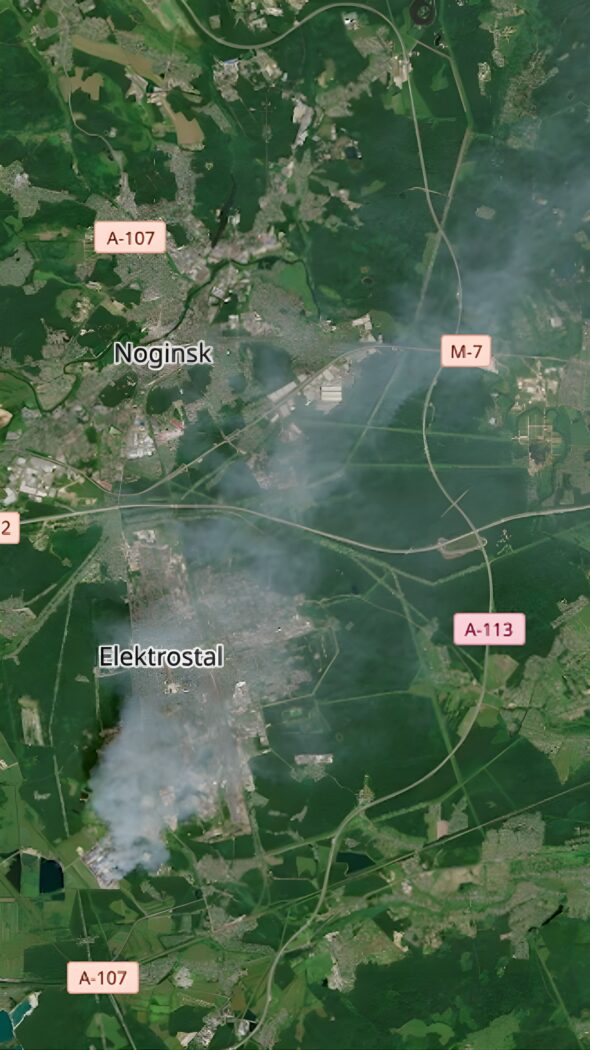
Figure 1. Sentinel-2 image acquired approximately 30 hours after the strike. Two smoke sources are visible: the logistics complex in Elektrostal and the oil depot in Noginsk.
2. More Than Oil Was Burning — and That Complicates the Forecast
The two fire sources involved fundamentally different combustion chemistry. This is not a secondary detail; it is the foundation of the risk assessment.
An oil-depot fire produces a comparatively predictable emissions profile: carbon and sulphur oxides, soot, polycyclic aromatic hydrocarbons, and volatile organic compounds. We examined this profile in detail in our earlier analysis of Russian oil refineries.
A 250,000-square-metre logistics complex is a different type of source. Its potential fuel load includes plastics, PVC packaging, synthetic textiles, polyurethane, cardboard, consumer electronics, and lithium-ion batteries. Where substantial quantities of PVC undergo thermal decomposition, chlorine-containing combustion products are expected, creating conditions under which dioxins and furans may form. Lithium-ion batteries may contribute hydrogen fluoride and metal oxides; synthetic materials may generate cyanide compounds.
In other words, this incident activates a specific rule in our model: chlorine-containing materials can sharply alter the hazard profile and require long-term environmental response, not merely fire suppression.
3. Four Different Risks, Not One
The practical implication of this chemical profile is that there is no single hazard. There are at least four, separated in time and requiring different response protocols.
The first minutes. Synthetic materials and polyurethane can release hydrogen cyanide during combustion. It inhibits cellular respiration and can act within minutes. Carbon monoxide, acrolein, hydrogen chloride from PVC, and hydrogen fluoride from batteries may add to the acute hazard. At this stage, the decisive factor is the speed of evacuation; medical intervention may come too late for those with severe exposure.
One to three days. This is the most deceptive interval. In cooler combustion zones, phosgene may form under appropriate conditions in the presence of chlorine-containing compounds. Toxic pulmonary oedema can then develop after a delay, when the exposed person is already at home and feels relatively well. Hospitalisation during the first night is therefore not a guarantee of safety; observation should continue for at least 72 hours.
Several days for those working at the site. Debris removal and prolonged water application entail repeated work in a smouldering zone, where concentrations of incomplete-combustion products may remain high. Ordinary filtering respirators are not sufficient against carbon monoxide, hydrogen cyanide, or phosgene. Positive-pressure self-contained breathing apparatus is required.
Years. Dioxins, furans, and metals released from electronics create a different risk horizon involving soil, food chains, and long-term medical surveillance. This is the fourth layer of response — and the one for which no public programme was reported.
4. Who Is Affected — and Who Will Not Appear in the Reports
We can now apply this temporal framework to what is known about the people involved.
Official reports referred to 24 injured people in Elektrostal and two in Noginsk. One of the injured later died in hospital, meaning that even the initial casualty figures changed.
These figures represent acute trauma: burns, blast fragments, and poisoning during the first hours. By definition, they do not capture three other groups.
People beneath the plume. When populated areas are exposed to combustion products, increases in presentations for hypertensive crises, arrhythmias, asthma attacks, and exacerbations of chronic obstructive pulmonary disease are statistically expected, especially among older people and those with chronic illness. This is not a claim about specific undocumented cases; it is a well-established pattern in smoke-affected populations. The absence of public data does not prove that no effect occurred. It may simply mean that no one counted it.
Emergency responders. This is probably the most heavily exposed group and one of the least discussed. Many effects may be delayed, which is precisely why responders require structured medical observation rather than ceremonial praise in a press release.
People whose clinical window had not yet closed. At the time of publication, approximately three days had passed since the night of 18 July — exactly the interval in which delayed pulmonary oedema may become apparent. People who initially felt well and did not seek help could therefore have been entering the most critical phase. This was not a future forecast; it was the risk window open at the time the article was published.
5. Where the Plume Went
The remaining question is geographical: how far were the combustion products transported?
In the near-source zone, the plume moved towards the north-east and then turned northward. Its geometry does not show an abrupt shift in direction or pronounced fragmentation, suggesting relatively stable air-mass transport during a substantial part of the fire.
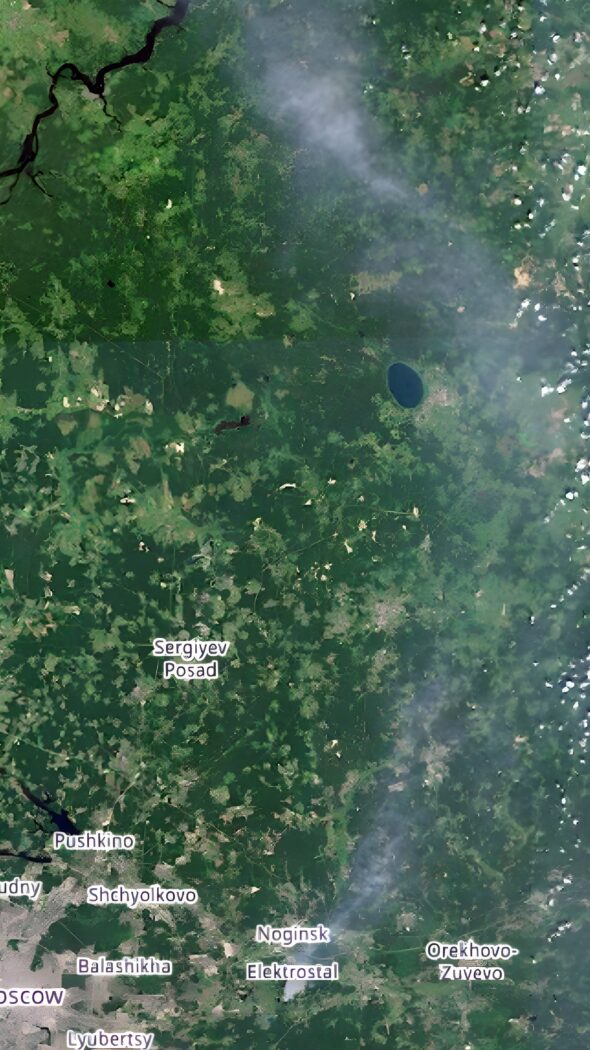
Figure 2. Sentinel-2, 19 July 2026. The visible smoke-plume axis extends northward from Elektrostal and Noginsk, passing east of Sergiyev Posad. Source: Sentinel-2, European Space Agency.
The optically dense portion of the plume can be followed with confidence for approximately 300 kilometres: through the Orekhovo-Zuyevo area, east of Sergiyev Posad, and towards the Rybinsk Reservoir. This trajectory crosses parts of the Moscow and Yaroslavl regions and may have affected the western edge of the Vladimir region.
The 300-kilometre estimate applies only to the part of the plume visible in the imagery. Fine particles and gaseous combustion products may have travelled farther; beyond a certain distance, they are simply no longer distinguishable in the optical image.
One further observation is important for understanding the transport mechanism. Near the source, the smoke remained low and close to the surface. Farther away, it became elevated and diffuse within the atmospheric boundary layer. This is a typical transition from near-source ground-level pollution to regional transport, and it helps explain why different zones require different response protocols.
During this particular meteorological window, the principal atmospheric burden remained over Russian territory. No transport towards Ukraine was observed. Under different meteorological conditions, the spatial pattern would have been different.
6. A Brief Note on the Legal Framework
Because this analysis concerns the consequences of a strike, the status of the targeted facility cannot be ignored.
A logistics hub of this scale may serve both civilian and military supply chains. Dual use is not necessarily a property of a building itself; it is a property of the logistical flows passing through it. Ukrainian sources have stated that such hubs were used to supply sanctioned components for drones and navigation equipment. Russian military bloggers also publicly asked where drones and fibre-optic cable would now be procured.
There is currently no direct open-source confirmation of the contents of this particular warehouse, and that limitation must be acknowledged. At the same time, Articles 57 and 58 of Additional Protocol I to the Geneva Conventions require parties controlling territory to take precautions and, to the extent feasible, separate military objectives from civilian populations and civilian objects. Where military logistics are routed through civilian infrastructure, risks to civilians arise in large part from that organisational choice.
7. Conclusions
This case is not maritime. It involves a different mode of transport, different chemical profiles, and a different legal framework. Yet the model operates in the same way.
Atmospheric transport determined the spatial structure of risk. Combustion chemistry determined its temporal dynamics. The configuration of the logistics hub informed the legal character of the object.
Our spatial-dynamic model makes it possible to:
identify primary impact zones;
separate risks by time scale — minutes, days, weeks, and years;
determine who requires immediate evacuation, who needs 72-hour medical observation, and where soil monitoring may be the appropriate response;
assess the legal character of an object through the function of logistical flows rather than the nominal status of a building.
This brings us back to the starting point.
Strikes on oil depots and logistics centres have more than an economic dimension. They also have environmental and public-health consequences for people living nearby. That principle applies regardless of the side involved or the territory affected.
Residents of Noginsk and Elektrostal were not told what symptoms might emerge a day later. They were not told who should seek medical attention. Responders were not publicly warned that a filtering respirator is not adequate protection in a smouldering zone.
At this point, the conclusion must be stated plainly. The problem was not an absence of capacity. The Moscow region operates 20 fixed stations and a mobile laboratory covering 32 parameters. Three months earlier in Tuapse, the same state system publicly reported concentrations two to three times above permissible limits and advised residents to keep their windows closed. The instruments exist. The specialists exist. The experience exists.
The selection of analytical parameters therefore cannot be dismissed simply as ignorance. Compiling a panel that excludes the compounds most relevant to this particular fire requires an understanding of which compounds are relevant. It is competence applied in the opposite direction.
This leads to a broader conclusion.
What is concealed is usually something whose consequences are understood. Silence of this quality is rarely the product of mere negligence; it is the product of work. That implies that actors within the system understand both the scale of what occurred and the circumstances in which it began — not with debris falling in isolation, but with the war launched and continued by the Russian state, for whose environmental consequences it will bear responsibility alongside the rest.
That responsibility does not disappear because it was not documented domestically.
One final point concerns Ukraine.
Ukraine remains under continual attack. Part of its territory is occupied. Its own ecosystems are being destroyed: the destruction of the Kakhovka Dam, pollution of the Black Sea, and millions of hectares of mined, burned, and degraded land. Yet Ukrainian civil-society organisations continue to document the environmental consequences of the war not only in Ukraine, but also within the territory of the aggressor state.
This is not because Ukraine lacks other priorities. It is because the environmental consequences of this war will eventually have to be assessed in full — on both sides of the front line, using a consistent methodology and without exceptions. We have an interest in making that accounting accurate. Those who remain silent about fires on their own territory do not share that interest in precision — and that, too, is evidence.
Postscript
This article continues Zelenyi Lyst’s series on the environmental consequences of strikes on infrastructure. Earlier case studies examined Tuapse in April 2026 and the Kerch Strait in June 2026. The model remains unchanged from case to case; only the specific transport parameters, chemical profiles, and legal frameworks vary. In our view, that consistency is what distinguishes a working analytical model from a collection of unrelated incident descriptions.
Sources
Event and air-monitoring data: RIA Novosti, Rossiyskaya Gazeta, RT, and Kommersant, 18 July 2026, citing the Moscow Region Ministry of Ecology and Natural Resources. Satellite data: Sentinel-2, European Space Agency, 19 July 2026.