

“Deep-Water Outlet” — a Corrupt Legacy of the Yanukovych Era
On 29 December 2023, the Prymorskyi District Court of Odesa, sitting as a panel, fully acquitted seven participants in the “Tarpan scheme” connected with the Deep-Water Outlet project , just before New Year, so to speak (case No. 522/10665/19, which Green Leaf has already covered). And what an acquittal it was — with honours! The reasoning cites numerous procedural violations by the prosecution, and purely formally this alone would have been entirely sufficient for Odesa’s judiciary to acquit all the defendants on all charges. But the court went further and, in a separate ruling effectively acted as a PR agent for the Deep-Water Outlet project. This is so unusual that I would like to quote it:
“No expert examination of the value of the facility was carried out in the criminal proceedings. During consideration of the criminal proceedings it was established that the tender value of the construction project was UAH 585,000,044.00, while the company undertook to perform all works envisaged by the project for a lower amount — UAH 575,450,910.00. The cost of similar projects implemented by foreign companies is: in Korea — USD 1.1 billion, in the United Kingdom — GBP 100 million, in Spain — EUR 110 million.
The court also established that the Deep-Water Outlet facility is in proper condition, is functioning, is being used for its intended purpose and performs its safe and environmental function. Thus, after the Russian Federation’s full-scale invasion of Ukraine, pursuant to an order of the Odesa Regional Military Administration, all wastewater (sewage) from Odesa has been discharged through the Deep-Water Outlet into the Black Sea from March 2022 to the present day.”

But a question arises: did the court engage international experts? If not, what does the cost of something in Korea have to do with how the budget was spent in Odesa? The court stated that the Deep-Water Outlet is in proper condition and performs its safe and environmental function. Were environmental, sanitary-epidemiological and hydrological expert assessments also carried out? It turns out our judges are now experts, underwater engineers, environmental specialists and PR people all at once.
The Deep-Water Outlet case has entered the annals of corruption. Yet even 14 years after implementation began, it continues to attract ever more corruption schemes and scandals. Moreover, as can be seen from the text of this same extraordinary ruling, the deep-water outlet has already been operating at full capacity since the beginning of the full-scale war, which is additionally confirmed by a corresponding memorandum from Infox LLC!

The Deep-Water Outlet is an ordinary money-siphoning scheme that by definition could not solve either Odesa’s social or environmental problems. The project does not solve the problem of wastewater treatment in the Peresypskyi and Central districts. Discharging water with a high nutrient content into Odesa Bay during the summer will inevitably worsen the environmental and sanitary-epidemiological situation on Odesa’s coast and contribute to the shallowing of the Khadzhibey Estuary. Odesa’s need for technical water will only grow because of climate change, and the city will soon return to implementing a water-reuse project. Using the Deep-Water Outlet for emergency drainage is far too expensive. This is a waste of public funds. I will try to demonstrate to you the futility of this project.
Working well? Dad, I’m trying! (C)
The approvals and cost estimate for the Deep-Water Outlet project were endorsed at the highest level: Order of the Cabinet of Ministers of Ukraine of 15 December 2010 No. 2255-r “On approval of the project ‘Priority construction works for a wastewater disposal system from the Pivnichna biological treatment station in Odesa at the Deep-Water Outlet facility’.”

It is likely that the arrangements concerning this project also included an informal component (a certain percentage as a kickback, for example). In any event, Yanukovych kept the Deep-Water Outlet project under his personal control. And after it was established that the cost of materials and works had been inflated from UAH 402 million to UAH 575 million, project financing was not halted. Details of the first audit by the State Financial Inspectorate, exposing the “Tarpan affair” in figures and actions, are well described in Tetiana Chornovol’s blog on Ukrainska Pravda of 28 July 2014. I will quote one passage from that article:
“Incidentally, the materials of the above-mentioned audit were transferred to the Main Directorate for Combating Corruption and Organised Crime of the Security Service of Ukraine on 27 March 2012, No. 15-06-36-17/3154. At the time the audit was carried out, the state’s funds could have been fully preserved, because final settlement with Tarpan’s structures had not yet been made.
However, Azarov’s Cabinet of Ministers decided otherwise. During the Maidan, on 25 December 2013 (oh, that was the very day they were trying to kill me), a resolution was adopted N928 ‘On the redistribution of certain state-budget expenditures allocated to the Ministry of Finance for 2013 and amendments to certain acts of the Cabinet of Ministers of Ukraine’. Pursuant to this resolution, UAH 197 million was allocated to the sewer-construction contractor.”
I hope no one will argue with me that under the time of “Professor” Yanukovych, just as now, conducting an environmental expert assessment was a formality, especially when projects involving the country’s top officials were concerned? Let me remind you that the “Dry Port”, or Euroterminal LLC, belongs to old criminal associates of Odesa mayor Hennadii Trukhanov (read: an international criminal group) and officially occupies 42 hectares of filtration fields. During implementation of the Deep-Water Outlet project in 2011, Yanukovych, by his instruction, transferred cargo flows in southern Ukraine to the private enterprise Euroterminal. The Southern Customs post was moved here from Odesa Sea Port.

From then on, all imports entering through Odesa were cleared through customs only at the privately owned Euroterminal. My point is that Yanukovych was “investing” public money in the development of an enterprise that was supposed to generate income, including for his own pocket. And like a true “business manager”, he of course understood that modernising the Pivnichna biological treatment station required serious investment, additional infrastructure and, most importantly, land. Development of the Dry Port also required land, and this is where Tarpan and his Deep-Water Outlet project came in handy.
UAH 575 million in public funds with a kickback, minimum space and time required — as they say, the choice was obvious. In other words, no one heard or listened to environmentalists at the time. A public environmental expert assessment, supported at the time by 28 NGOs and scientists, received no response. Many were persuaded by arguments about the technological risk of failure of the Khadzhibey Estuary dam. Some hid behind the claim that it was supposedly much safer to discharge wastewater year-round and four kilometres from the shore than only in winter at a distance of 350 metres, as had been done in previous decades. Yet no one except the public was interested in whether four kilometres was enough in the shallow conditions of Odesa Bay to prevent wastewater from being driven back to shore by the wind; how these discharges would affect the environment under climate change; and where the city would obtain water for economic needs and to replenish the Khadzhibey and Kuialnyk estuaries.
Be that as it may, back in 2009 the environmental and epidemiological assessments were approved without public hearings or media publicity. The environmental conclusion “Environmental Impact Assessment” was prepared by Bild-Pro LLC (licence AB No. 369577), a company belonging to Odesa Regional Council deputy Vadym Teplytskyi. It was approved with the wording: “The final impact on the natural environment during the construction period and during operation is assessed as acceptable and is accepted.” The conclusion of the sanitary-epidemiological expert assessment concerning construction of the deep-water discharge of wastewater and sewage from Odesa’s Pivnichna biological treatment station, was also prepared by Bild-Pro LLC (the deputy turned out to be a professional in every field; he has now been acquitted too, so one can turn to him again) and was approved by the chief state sanitary doctor of Odesa Oblast, L. H. Zasypko. Conclusion No. 275 of 2 April 2009.
A pipe into the sea and development of the irrigation fields instead of modernising Odesa’s treatment facilities
Let me remind you that the essence of the Deep-Water Outlet project was to take treated sewage effluent from the Pivnichna biological treatment station to what was considered a safe distance from the shore.

And this is where the contradictions begin. To speak about the safety and environmental soundness of this project, a number of indicators and values need to be considered. First, the approach itself. Does no one question the fact that we are talking about discharging 146 million cubic metres of sewage and stormwater into the natural environment each year while not discussing treatment methods and quality, or the total amount of pollutants in that volume? We do not discuss how these pollutants will spread within the relatively confined space of Odesa Bay, affect aquatic organisms, affect the marine environment’s ability to self-purify, affect the epidemiological situation, or affect the city’s recreational potential.
Let us examine it. The concept for this project was developed as far back as 1986. Older people still remember the ugly Soviet principle, “Nature is not a temple but a workshop, and man is a worker in it” (I. S. Turgenev). In those days of the absurd so-called socialist realism, no consideration was given to the value of water resources, future climate change or the catastrophic decline in the water levels of major rivers. Wastewater quality, however, was monitored quite strictly. Land resources were also ignored. In Soviet times, the irrigation fields attracted no development interest, and until the mid-1990s the biological treatment station operated at full capacity.
It could be seen visually that at least until the 2000s most of the settling ponds on the irrigation fields were filled. In the photo below they are on the right and extend up to the container yard of Euroterminal LLC. At present — in 2020 and for many years before it — the settling ponds have been dry.
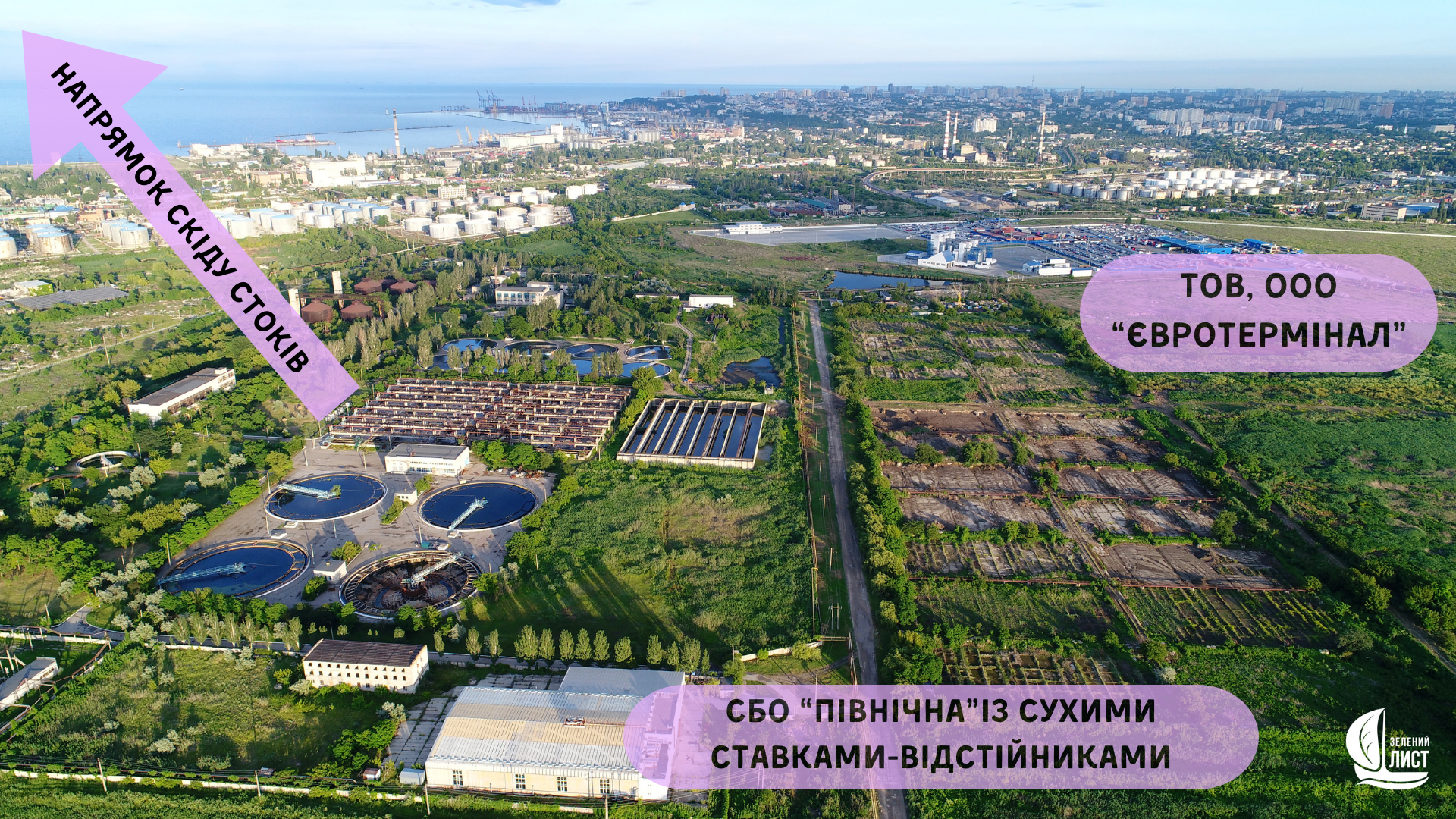
Pivnichna biological treatment station with dry settling ponds. Photo: 06.2020, Vladyslav Balinskyi
That is, even when the technological process was disrupted (insufficient aeration, failure to remove activated sludge on time, and so on), water could previously be purified naturally because of the large active surface area of the ponds. Then, in 2005, the so-called Dry Port appeared, and the irrigation fields began to be drained and filled with construction waste.
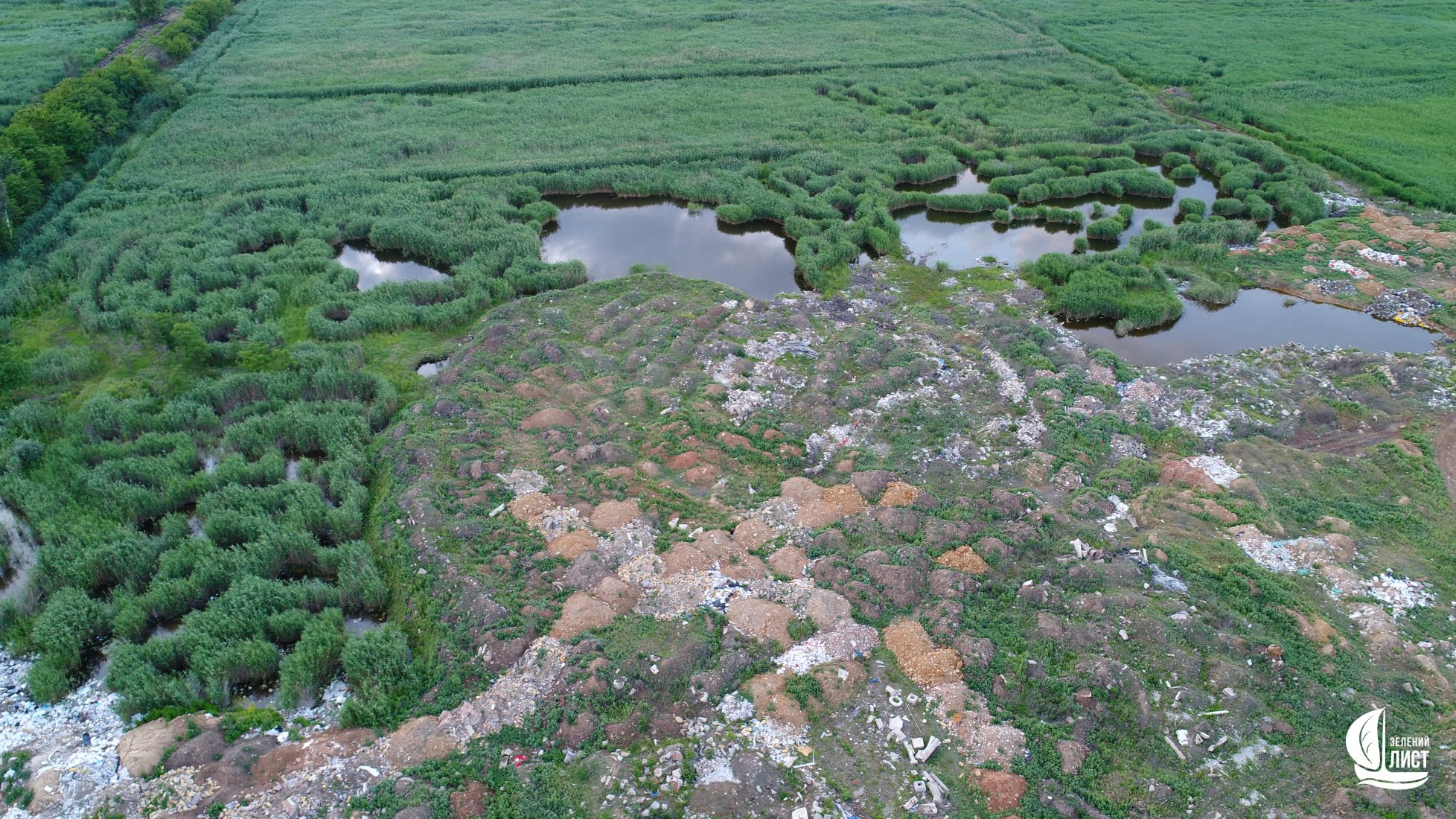
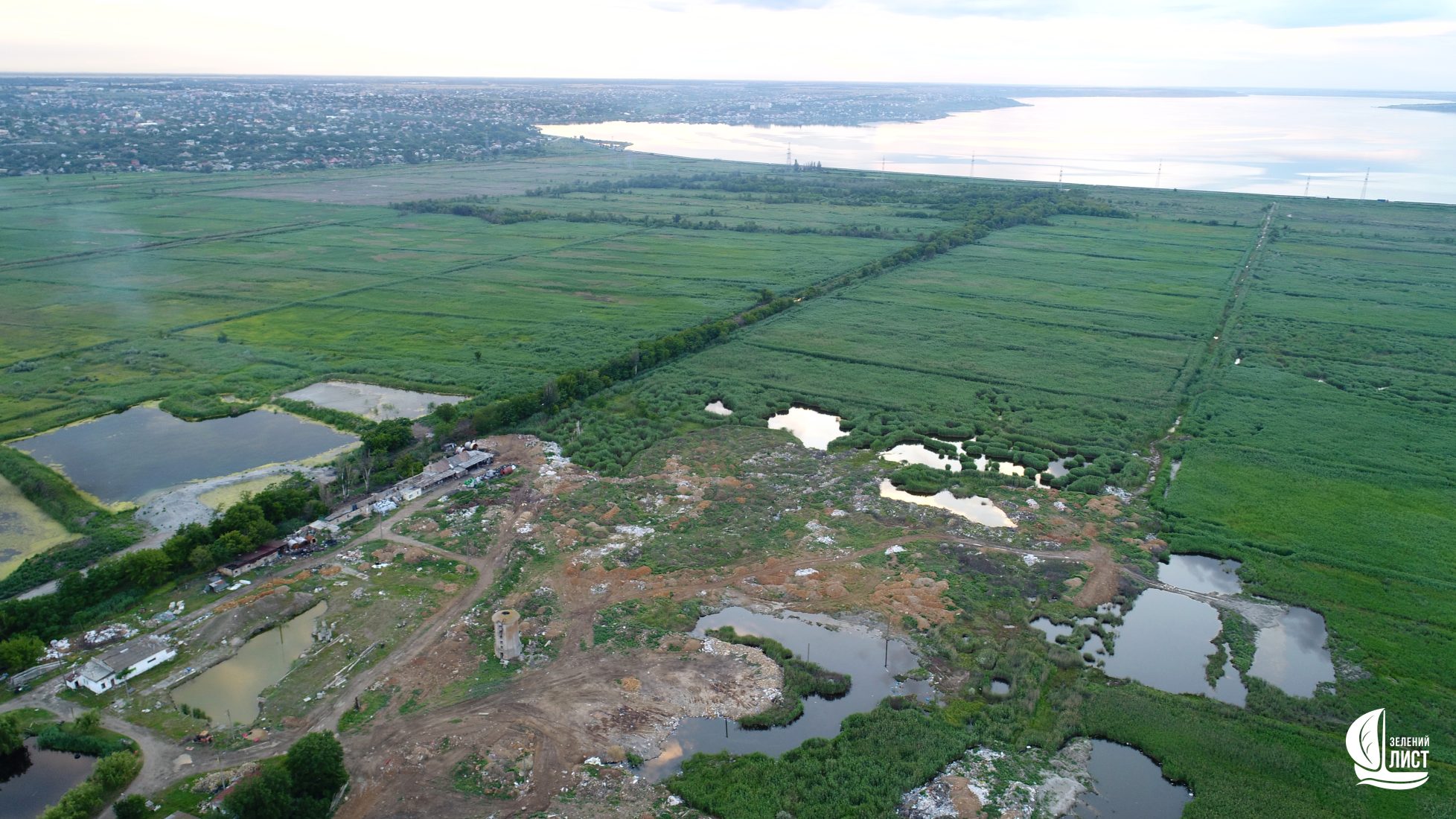
Backfilling of filtration fields in Odesa. Photo: 06.2020, Vladyslav Balinskyi
The private enterprise of Odesa’s new criminal masters needs ever more land. Because the country’s top officials sided at the time with the corporate interests of Odesa’s “international criminal group“, while no one listened to environmental activists, instead of investing in the modernisation of biological treatment stations and obtaining a sustainable source of technical water, they chose the simple option: discharge who-knows-what to who-knows-where. Still, I propose that we work out what exactly we are discharging and where; how freshwater input and pollution affect the environmentally vulnerable Odesa Bay; and what consequences this will have. To be continued. Vladyslav Balinskyi, chemist, biologist, editor-in-chief of the Green Leaf newspaper.