

What Odesa’s 2023 Budget Is Hiding
Odesa residents should not expect a public financial report, not even as a New Year gift from the city authorities. Green Leaf has prepared a digest of questionable financial decisions made by the city authorities in 2023. Budget figures are very dull information, but analysing them over time allows us to assess the effectiveness and priorities of the city authorities more objectively.
Of course, we will also look at the extent to which Trukhanov’s promises to help people affected by Russian shelling, or to allocate funds to the Armed Forces of Ukraine, were fulfilled. So, here we go.
Act One — assistance to people affected by Russian shelling
A budget reserve fund is a convenient tool for covering unforeseen expenditures that are non-recurring and cannot be taken into account when the draft budget is prepared. It would seem difficult to imagine a more convenient mechanism for restoring critical infrastructure, social facilities or residents’ homes during wartime… In Odesa, the reserve fund amounted to UAH 1 billion, but in 2023 it was reduced to UAH 0 and the money was redirected to other expenditures. Targeted financial assistance to residents whose homes were damaged was supposedly to be provided through another mechanism — the local district administrations. The key word here is “supposedly”. As always, the intentions set out in the city target programme for the provision of social services and other forms of assistance to vulnerable groups of Odesa residents for 2021–2023 turned out not to be backed by money. Judge for yourself.
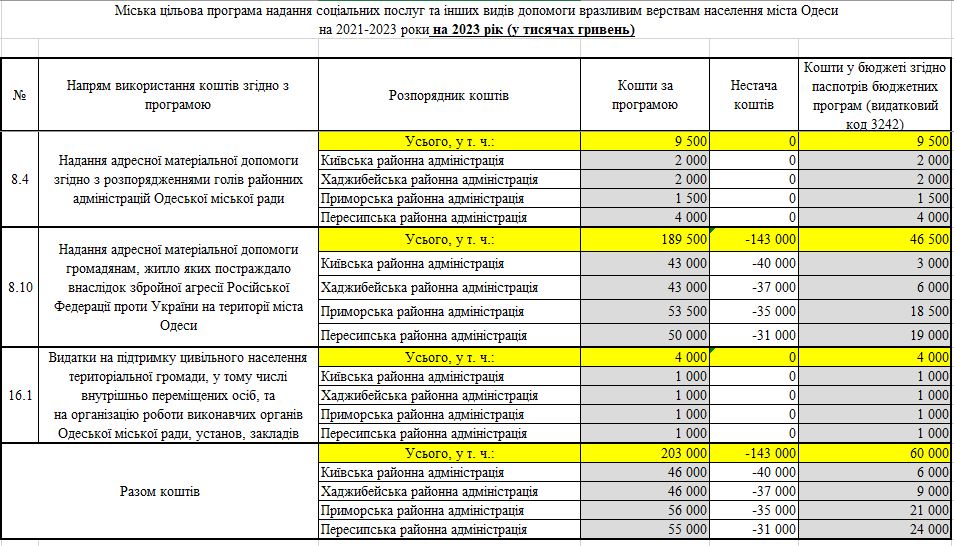
At first, Odesa City Council could not decide how much funding to provide to the district administrations for the above expenditures. The shifting nature of these ideas is clearly reflected in the city’s budget decisions. Thus, planned allocations under expenditure code 3242 changed constantly. Since the appendices to the city budget decision are published in an ‘as amended’ format, we additionally calculated how much money was added or withdrawn with each change.

Odesa suffered three large-scale missile attacks in 2023: on the night of 14 June; on the night of 23 July; and on the morning of 29 December. One can see how long people had to wait before the city authorities allocated money to help them. The procedure for providing assistance was approved only after the first large-scale attack on 14 June. It gives the impression that, even during wartime, the city authorities had not considered that the city might be attacked. Anyone can verify these figures by analysing Odesa City Council’s decision ‘On the budget of the Odesa City Territorial Community for 2023’ and the amendments made to it (the links to amendments in the text of the original decision need to be checked), as well as the budget programme passports of the Kyivskyi, Khadzhibeyskyi, Prymorskyi (the archive dated 27 November 2023 needs to be downloaded) and Peresypskyi district administrations, taking amendments into account. To sum up, the following conclusions can be drawn: although the city authorities had a UAH 1 billion reserve fund, they did not keep this money for unforeseen expenditure. Instead, they reduced the reserve fund to zero and spent the money thus ‘released’ on other, ‘extremely necessary’ needs. And when residents needed real help from the city authorities after Russian attacks on the city, the authorities, having already depleted the reserve fund, were in no hurry to assist those affected. On 15 November 2023, budget allocations to the city’s district administrations for assistance were reduced without changing the corresponding city target programme. Thanks to good fortune and the excellent work of air defence, Odesa had avoided large-scale direct strikes until recently. But as of today, it is unknown when people affected by the shelling during the night and morning of 29 December 2023 will receive assistance.
Act Two — repayment of loans. But at what cost?
As of today, the city has fully repaid the loans it took from commercial institutions. But it is very interesting to trace how funds were allocated to repay the principal and the interest on these loans. These indicators are reflected in different parts of the budget. Repayment of the principal is shown among the sources of budget financing, while interest payments appear on the expenditure side under expenditure code 8600, ‘Servicing local debt’. When we brought these figures together in one table, we saw a complete absence of a strategy for planning these important expenditures.
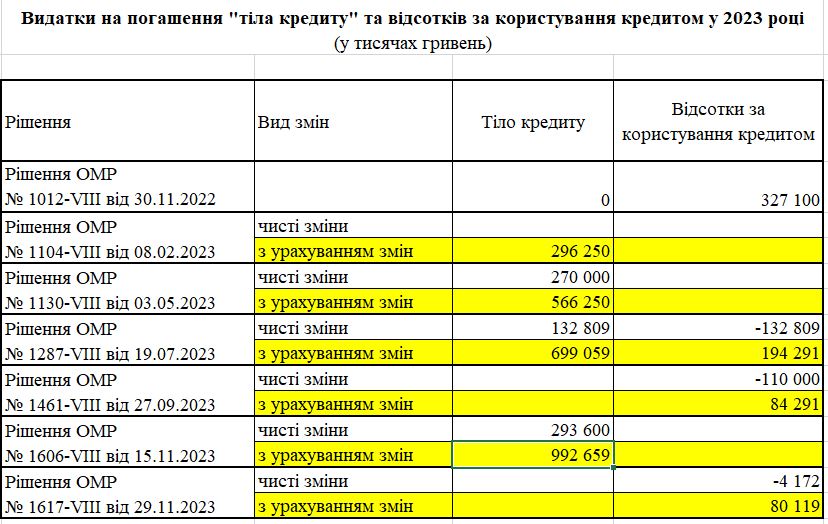
The initial decision provided only for payment of interest amounting to UAH 327.1 million. At that point, no one was even thinking about repaying the principal. But Decision No. 1104 already provided for repayment of UAH 296.25 million of principal, while expenditure on interest remained unchanged.
At the next session, Decision No. 1130 increased expenditure on principal repayment by another UAH 270 million. The amount allocated to interest again remained unchanged. The next time, Decision No. 1287 changed both the amount of principal repayment and the expenditure on interest. Looking at the figures, however, one cannot escape the impression that part of the amount planned for interest payments was simply moved to the principal-repayment line. This concerns UAH 132.809 million. The next time, Decision No. 1461 again reduced interest expenditure, this time by UAH 110 million. Decision No. 1606 once again increased expenditure on principal repayment, by UAH 293.6 million, while the amount allocated to interest did not change. At the next extraordinary session, Decision No. 1617 reduced interest expenditure by UAH 4.172 million.
To sum up, the following conclusion can be drawn: in the offices of Odesa City Council, no one really understood whether the Odesa budget would be able to repay the loan in full in 2023. Most likely, funds were allocated according to the principle that if spare money was available, it would be directed to loan repayment. But this approach to managing the city budget, when even loan repayment cannot be planned in advance, shows signs that control over the city budget has been lost.
Act Three — what about funding territorial defence?
Today, funding territorial defence is one of the highest-priority areas of local-budget expenditure. Yet the city leadership still cannot decide which chief spending unit should finance what and in what amount. Let us put the planned allocations into a table by chief spending unit of the budget.
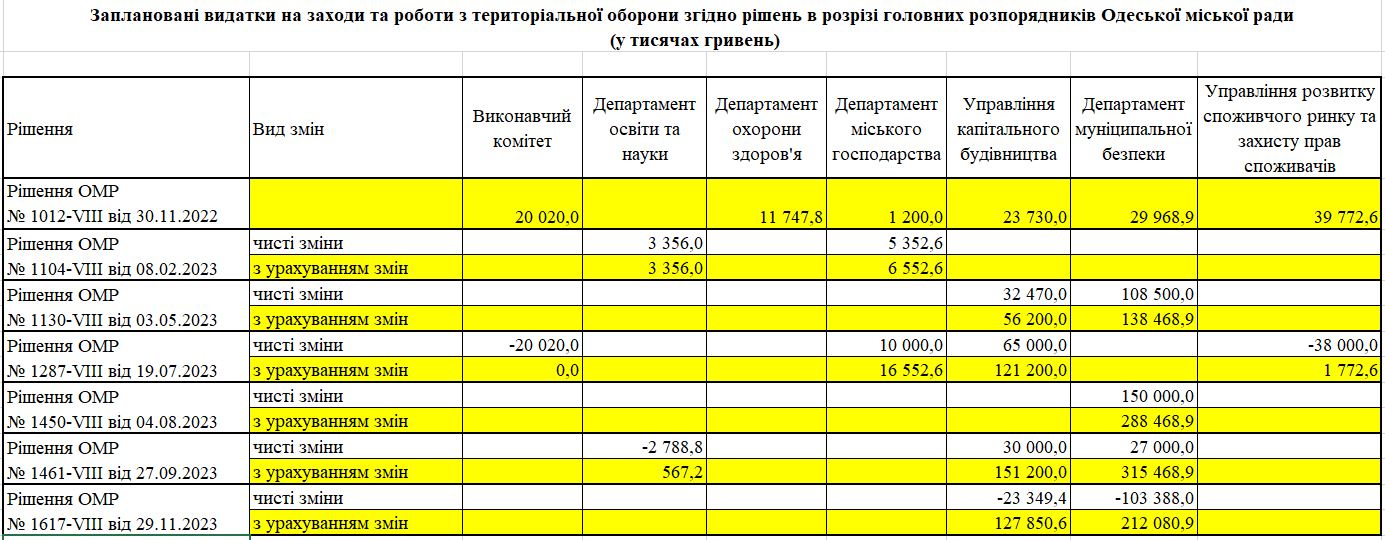
For the Odesa City Council Executive Committee, the proposed spending mainly concerned material support for units of the Territorial Defence Forces of the Armed Forces of Ukraine. But as can be seen from the table, Decision No. 1287 cancelled these expenditures. For the Department of Education and Science , nothing was proposed initially. But Decision No. 1104 provided that it would finance meals for units of the Territorial Defence Forces of the Armed Forces of Ukraine and volunteer formations within the Odesa territorial community for almost UAH 3.6 million. Later, however, they changed their minds and reduced this amount sixfold!!! The Department of Health received budget allocations for measures to provide the South territorial-defence forces with individual combined-arms first-aid kits and other medical supplies totalling almost UAH 12 million. The overall amount of budget allocations did not change afterwards. The Department of Municipal Services initially received UAH 1.2 million to repay accounts payable from the previous year. Decision No. 1104 increased the amount for repayment of accounts payable to almost UAH 1.6 million and allocated another UAH 5 million for repair of military-unit vehicles. Decision No. 1287 allocated UAH 15 million for repair of military-unit vehicles. For the Capital Construction Department , capital repairs were initially planned at eight facilities for a total of UAH 23.7 million. Decision No. 1130 increased the Department’s budget allocations to UAH 56.2 million, with plans to carry out capital repairs at one facility for UAH 37.2 million and reconstruction and restoration at another facility for UAH 19 million. Decision No. 1287 increased budget allocations by another UAH 65 million, to UAH 121.2 million. With this money, one facility was to undergo capital repairs, two facilities were to undergo reconstruction and restoration for a total of UAH 59 million, and current repairs were to be carried out at one more facility for UAH 25 million. Decision No. 1461 increased budget allocations by another UAH 30 million, to UAH 151.2 million. The plans were: capital repairs at two facilities for UAH 37.2 million, with 50% of the facilities expected to be completed by the end of 2023; reconstruction of four facilities for a total of UAH 89 million, with no percentage of completion specified; and current repairs at one facility for UAH 25 million. Decision No. 1617 reduced budget allocations by UAH 23.3 million, to UAH 127.8 million. The plans then became: capital repairs at three buildings; total expenditure in 2023 remained unchanged at UAH 37.2 million, with only the completion indicator changing to 33%; reconstruction of four facilities for UAH 65.7 million, with no completion percentage specified; and current repairs at one facility for UAH 25 million.
The Department of Municipal Security received almost UAH 30 million at the beginning of the year for logistical support of Odesa’s volunteer formations. Decision No. 1130 added UAH 108.5 million for the purchase of equipment and durable goods. Decision No. 1450 added another UAH 150 million. Thus, almost all UAH 288.5 million was directed to logistical support of Odesa’s volunteer formations. Decision No. 1461 increased this expenditure by UAH 27 million, to almost UAH 315.5 million. But this amount turned out to be too large for financing territorial-defence measures and activities in the city, and Decision No. 1617 reduced it at once by almost one third — UAH 103.4 million — to UAH 212.1 million. The Department for Consumer Market Development and Consumer Protection received UAH 39.8 million at the beginning of the year for procurement to organise logistical, medical and food support for units of the Territorial Defence Forces of the Armed Forces of Ukraine. But Decision No. 1287 reduced this amount by UAH 38 million, to UAH 1.8 million.
Another problem is that these plans are being implemented very slowly. Thanks to the state portal openbudget.gov.ua, it is possible to see how implementation of these plans has progressed over time.

As can be seen, there is substantial underperformance against the plans in almost every category. It should also be noted that the changes introduced by Decision No. 1617 of 29 November 2023 have not yet been reflected in the planned indicators on the state portal. One can also look at the transfer of budget allocations from spending units to recipients of budget funds. This is reflected under economic classification codes 2610 and 3210. Implementation there, however, is going well, which also raises troubling questions. To sum up, one simple conclusion can be drawn: the authorities have a poor understanding of what territorial-defence units need and what equipment standards apply. That is why there is such constant shifting in funding plans and such major problems with implementation, except for transfers of money from spending units to recipients of budget funds.
Conclusions
As can be seen from this analysis of several expenditure indicators in the Odesa city budget, the city authorities have no clear vision for the city’s development or plan for protecting ordinary Odesa residents. All these chaotic attempts to ‘do at least something’, reflected in the budget indicators, suggest that the city authorities are no longer monolithic and that each part of the system controls the processes only partially.

How Business and Politicians Use the Military to Plunder Natural Resources
On 12 December this year, the standing commission of Odesa Regional Council on ecology, natural-resource use, land relations, administrative-territorial organisation, prevention of emergencies and elimination of their consequences, and defence work held a meeting.
Such a long commission name indicates that it considers a wide range of issues that can even conflict with one another.
For example, when the interests of unscrupulous business intersect with the need to protect natural resources. Sometimes what Ukrainian entrepreneurs try to make money from harms, and even destroys, Ukraine’s environment. Unfortunately, local representatives of the authorities often defend business interests rather than environmental interests. They also involve the military, without whose permission many issues simply cannot be resolved during the full-scale war.
There were only two items on the agenda. Yet only one was high-profile: a request from the private company Institute of Marine Aquaculture concerning the possibility of operating the channel between the Black Sea and Burnas Estuary. To lobby this issue, the businesspeople enlisted regional councillors, representatives of local authorities and even the military leadership.
By contrast, members of the regional commission prohibited publication of the discussion, citing the war as justification — the head of the NGO Green Leaf , Vladyslav Balinskyi, was removed from the meeting.
But we will tell you who is really behind the attempts to use the channel and what they are trying to achieve.
Darkness is always afraid of light
The Russian Federation’s aggression has significantly changed Ukrainians’ lives, both directly and indirectly. Ukrainians are quite justifiably restricted in certain actions, including disclosure of information or coverage of certain events. For example, one must not immediately publish information about Russian missile or drone strikes so as not to help the enemy adjust its fire, or film the locations of military units or troop deployments.
Unfortunately, representatives of the authorities — among whom there are still many people with pro-Russian views — use these restrictions skilfully, deciding at their own discretion what may be made public and what is prohibited. The meeting of the regional council commission on 12 December became one such event closed to disclosure, even though it was considering an issue that was highly manipulative and important at the same time.
When Green Leaf NGO head Vladyslav Balinskyi came to film the regional council commission meeting, Russian-speaking people with unclear positions stood in his way, threatening repeatedly that his Ministry of Defence accreditation could be revoked.
The ban was explained by saying that only invited people could attend the meeting, while the press and civic activists were not allowed. Another argument was that the military personnel invited to the meeting objected to being filmed, even though the event was taking place deep in the rear, in the Odesa Regional Council building. After lengthy negotiations, Balinskyi was eventually allowed in. But not for long.
Commission members led by former Party of Regions member Valentyn Volkanov actively opposed the filming, claiming that it should have been arranged separately in advance. For several minutes, Odesa councillors, speaking Russian, explained why an event involving military personnel could not be filmed. Eventually Volkanov put a proposal to move the meeting into closed session to a vote. The regional councillors readily supported it.
Clearly, those present did not want details of the meeting disclosed to the wider public. After all, they were considering permission for a private company to conduct economic activity in a border region during Russia’s full-scale aggression against Ukraine.
We will clear the channel in exchange for mullet fishing
Institute of Marine Aquaculture LLC owns a plot at the second kilometre of the Black Sea sand spit, between the sea and Burnas Estuary, in Bilhorod-Dnistrovskyi district. The site contains a hydraulic structure, or channel. Before the full-scale war, the company had the right to catch fish there.
When Russia’s full-scale invasion began in February 2022, all activity in this area was prohibited for security reasons. These included protection of the border zone and prevention of espionage by the Russian Federation, among other concerns.
Military security there is currently provided by the Danube Operational Group of Forces, headed by Brigadier General Volodymyr Otroshchenko. Incidentally, he was present at the commission meeting on 12 December.
Precisely because of martial law and Russia’s full-scale attack, even the state conservation institution Tuzly Estuaries National Nature Park is prohibited from maintaining the hydrological regime in the area: the military block park employees’ work to restore water exchange and carry out patrols.
According to the park’s director, Iryna Vykhrystiuk, the person who lobbied for this ban on the national park from the spring of this year was former head of the Bilhorod-Dnistrovskyi District Council Hryhorii Melnychenko. He was, incidentally, detained by law enforcement officers in August 2023 over illegal appropriation of property. Notably, the park was patrolled even last year, when the security situation in the region was much worse.
For some reason, however, regional councillors and the military want to give a private company permission to operate, seeing no particular risks:
“For the second year in a row they (Institute of Marine Aquaculture LLC — ed.) supposedly have had no access to their property, just like everyone else in this area. But now, under the pretext that the estuary must be saved, this company is asking for access. And they are even using the military to achieve it,” says Iryna Vykhrystiuk, who attended the commission meeting. She stresses that if restrictions currently exist, they should apply to everyone.
However, restoring the hydrological regime is by no means what concerns the Institute of Marine Aquaculture: in exchange for ‘saving’ the waterbody, it is asking for a quota to catch mullet. And what a quota — 500 tonnes per season.
“Such a quota does not exist. There is not, and in the coming years there will not be, that quantity of mullet because it was barbarically depleted in the past, including by the same Institute of Marine Aquaculture company. Besides, they do not have the areas needed to catch such an enormous quantity of fish. Where are they going to catch it? On the territory of the Nature Reserve Fund?” Iryna Vykhrystiuk emphasises.
Mohylnikov’s company installed traps for catching mullet, 2016. Poaching under the supervision of border guards.
In her view, no emergency is currently occurring in the estuary, despite claims that such an emergency makes it necessary to permit economic activity by the Institute of Marine Aquaculture. Moreover, work to clear the channel in the shallow Burnas Estuary has only a local effect. Such explanations are merely manipulation:
“There are certain criteria. If this is an emergency condition, prove it. If this is an emergency situation, then we involve all existing natural-resource users and business representatives who lease these land plots on the sand spit, and we work together for one purpose. But without demands for fishing quotas.”
Iryna Vykhrystiuk stresses that public coverage and recording of such events is always undesirable for unscrupulous representatives of the authorities who lobby interests in profiting from the environment while hiding behind claims of protecting it. That is precisely why filming — and even Vladyslav Balinskyi’s presence at the commission meeting — was prohibited.
So who are these members of the regional council commission?
Misappropriation of public funds and pro-Russian views
Let us briefly analyse the activities of several members of the Odesa Regional Council commission on ecology, natural-resource use, land relations, administrative-territorial organisation, prevention of emergencies and elimination of their consequences, and defence work.
Let us start with the commission chair, Valentyn Volkanov, who proposed holding the event behind closed doors. He has been in politics for a long time: in 2010 Volkanov became a regional councillor for Viktor Yanukovych’s Party of Regions; in 2015 he switched sides and represented the Petro Poroshenko Bloc; and in 2020 he was elected for the For the Future party, which is associated with oligarch Ihor Kolomoiskyi’s Privat group. Kolomoiskyi, incidentally, is currently under investigation.

Valentyn Volkanov. Photo from the internet
Valentyn Volkanov and his wife came under law-enforcement scrutiny over the alleged misappropriation of UAH 24 million in public funds. Earlier, they had also been notified of suspicion over alleged corporate raiding. According to media reports, between 2017 and 2021 the Volkanov couple allegedly appropriated public funds allocated by the state for the repair and development of municipal and social facilities.
Volkanov’s fellow For the Future party member Tryfon Antov is listed on the Myrotvorets website as a distributor of Kremlin propaganda and an opponent of the Ukrainian church’s independence from Russia. Antov called the Orthodox Church of Ukraine ‘unclean’.
This is not his first term as a councillor: in 2015, Antov was elected to Odesa Regional Council from the Nash Krai party, which was under the influence of former Party of Regions MP Anton Kisse. Notably, he ran as someone temporarily unemployed. One might wonder what he lives on.

Tryfon Antov. Photo from the internet
Another commission member is retired councillor Oleksii Kobylnikov. Born in Russia, he ran in 2020 for the pro-Russian Opposition Platform — For Life party. The party’s activities are now banned in Ukraine, while its leader, Viktor Medvedchuk — a close associate and godfather to Russian President Vladimir Putin — is in Russia after being exchanged for Ukrainian prisoners of war.

Oleksii Kobylnikov. Photo from the internet
In 2015, Kobylnikov was elected as a regional councillor for the Vidrodzhennia party, one of whose leaders was former Party of Regions politician Vitalii Khomutynnik.
Yet these facts did not change the situation: Kobylnikov did not resign his mandate and is even involved in addressing security issues in Odesa Oblast, as are his no less ‘tainted’ colleagues. Apparently, these figures do not trouble the military either, including Volodymyr Otroshchenko, commander of the Danube Operational Group of Forces.
Are poachers hiding behind the mask of estuary rescuers?
LLC Institute of Marine Aquaculture was registered in 2015 in the village of Lebedivka, Odesa Oblast. The company’s current owner is listed as Sofiia Ilchyshyn, a resident of Lviv Oblast. But one of the company’s original co-founders was Valentyn Mohylnikov, a member of the Tatarbunary District Council from the Batkivshchyna party who was convicted of a corruption offence. Incidentally, the company was previously called Granite-2 Cooperative.

Valentyn Mohylnikov. Photo from the internet

Screenshot from the register of persons who committed corruption offences National Agency on Corruption Prevention
At Tuzly Estuaries National Nature Park, Mohylnikov is well known as a poacher. Several years ago, park employees repeatedly documented mullet traps installed by companies controlled by Mohylnikov — Institute of Marine Aquaculture and Granite Cooperative. Incidentally, Mohylnikov has attracted attention not only as an alleged poacher but also as a controversial Odesa property developer.
As for Institute of Marine Aquaculture, today’s ‘rescuers’ of the estuary came under law-enforcement scrutiny in 2021 for damaging protected natural areas. Company representatives illegally blocked the breach-channel with a sand embankment, obstructing fish migration to the Black Sea and water exchange between the sea and Burnas Lake.
Moreover, when Institute of Marine Aquaculture was still called Granite-2 Cooperative, Andrii Ivasiov, acting director general of the state enterprise Experimental Mullet Hatchery, worked for the company. This information is stated in his declaration for 2017.
And one more important remark. Oleksii Niedov was sent to represent the interests of Institute of Marine Aquaculture LLC at the commission meeting. He is one of the founders of the law firm Legal Force. His partner is Vasyl Domushchi, a lawyer with an extensive biography.
In 2016–2017, Domushchi worked at the State Tax Inspectorate of Odesa’s Malynovskyi district; in 2019, he was legal counsel for the Odesa City Council municipal institution Municipal Property Service; and from 2020 he became a member of Horodnie Village Council for Odesa mayor’s party Trust in Deeds. The village of Horodnie is located in Bolhrad district in southern Odesa Oblast.

Screenshot from the YouControl system
In other words, representatives of the authorities are effectively hidden behind the facade of the private company Institute of Marine Aquaculture. Having apparently secured the support of regional councillors and the military, they are trying to open the way to mullet fishing for themselves, despite security risks and environmental harm.

Why Are Odesa Authorities Still Playing into Putin’s Hands?
On 14 December 2023, Russian dictator Putin, who is wanted internationally, claimed that Odesa was supposedly a Russian city. Indeed, we still feel the echoes of years of attempts by pro-Russian politicians to cultivate hatred of Ukraine and Russify Ukrainian Odesa. Today, however, many of yesterday’s openly pro-Putin figures publicly play the patriotism card. One of the tools of Russia’s information war was and remains the current anti-Ukrainian Charter of the City of Odesa.
Let us recall how it was adopted.
The Odesa Charter was developed as part of the same package as the ‘Kivalov-Kolesnichenko Law’
On 26 August 2011, a draft law ‘On the Principles of State Language Policy’, better known as the ‘Kivalov-Kolesnichenko Law’, was submitted to the Verkhovna Rada. The law was adopted on 3 July 2012 and remained in force until 28 February 2018, when the Constitutional Court of Ukraine declared it unconstitutional and invalid.
Literally one day after the draft ‘Kivalov-Kolesnichenko Law’ was submitted, on 28
August 2011, Odesa City Council adopted the Charter of the City of Odesa. This makes it possible to assume that the Odesa Charter was developed as part of the same package as the ‘Kivalov-Kolesnichenko Law’. Its wording remains unchanged to this day.
Analysis of the Odesa Charter
In brief, all 44 articles of the Charter can be reduced to three propositions:
- Odesa is a city within the Russian Empire;
- only the Russian language is used in Odesa, and it even receives, for
unclear reasons, the status of the city’s cultural heritage; - all manifestations of civil-society activity — the so-called instruments of local democracy — are suppressed as much as possible.
Green Leaf NGO analysed the Charter of the City of Odesa a year and a half ago (the analysis is available via the link). On 21 June 2022, a letter with the relevant explanations was sent to the city mayor, but as of today this
anti-Ukrainian Charter remains in force. In practice, many of yesterday’s openly anti-Ukrainian figures continue to influence regional politics through the parliamentary factions of Opposition Platform — For Life and Trust in Deeds, and within the business empires of Kivalov, Markov, Hrynevetskyi and others.
Odesa still has, as its principal city document, an openly anti-Ukrainian Charter in which Odesa is a city within the Russian Empire, Russian is the only language in the city, and Odesa residents supposedly take pride in the exploits of Russian soldiers.
Not a single street named after fallen heroes!
Let us also recall that since 2014 the Odesa mayor’s office, controlled by Hennadii Trukhanov, has not named a single street after fallen heroes. Moreover, in 2020 Trukhanov statedthat streets renamed by the regional administration in 2017 in accordance with the decommunisation law would have their old Soviet names restored. This was preceded by corresponding decisions of the historical and toponymic commission of Odesa City Council.

For several years, the mayor’s office legal department spent local-budget funds challenging the name ‘Heroes of the Heavenly Hundred’ and other names in court, but lost.
Even after the start of the full-scale invasion, the city council refused to rename Bocharova Street after Hero of Ukraine Vladyslav Buvalkin and has not put other proposals submitted by the military command, relatives and the public up for public discussion. The composition of the historical and toponymic commission has effectively not changed since 2016, while Odesa’s toponymic space is being filled with ‘linoleum-and-tomato’ street names convenient for Russian propaganda. Are these not among the factors that give Russian forces confidence?

Battle for the Remains of a Dead Empire: How a Moldovan Quarry in Ukraine Was Nearly Seized
Mineral extraction means, on the one hand, large profits for those who extract resources and, on the other, major environmental risks. Many minerals, including valuable granite, were mined in Ukraine back in Soviet times. The environment was not given much consideration then.
Because borders in that monstrous country were rather nominal, while the word ‘union’ was only a label, quarries and other enterprises in Ukraine could belong to different republics, including Moldova.
Everything changed after the collapse of the Soviet Union and the demarcation of state borders. Solutions were found fairly quickly for some enterprises that had suddenly become foreign-owned, while others remain unresolved to this day.
NGO Green Leaf together with journalists from Moldova’s TV8 investigated the history of one such quarry in Mykolaiv Oblast. It found itself at the centre of a criminal story, a corporate raid and attempts by big business to ‘privatise’ it for themselves. And while all this continues, the quarry remains an environmental time bomb.
Flooded with water
In Mykolaiv Oblast in southern Ukraine there is a small settlement called Kinetspil. Granite was mined here, near the city of Pervomaisk, for many years. Granite is a rock used as a construction material for major structures — building foundations, railway-bridge piers, embankments, stairs and so on.
Talking with local residents
In Soviet times, about a thousand people worked at the enterprise in three shifts. Granite extraction then provided jobs for many Kinetspil residents. Now, however, according to local residents, the quarry has been flooded for many years. It is not operating.

According to Inna Tymchenko, associate professor at the Department of Ecology and Landscape Gardening at Shevchenko LNU, Mykolaiv Oblast is overloaded with quarries. Rock extraction is accompanied by a number of environmental risks, including landscape change and impacts on biodiversity:
“Pervomaisk district is a very valuable area. This is the steppe zone of southern Ukraine. It also means (quarry extraction — ed.) disruption of the water regime, both groundwater and surface water. This quarry really is quite large.”
The expert stresses that because the quarry is located close to the Southern Bug River, economic activity inevitably affects the river.
At the same time, Inna Tymchenko emphasises, simply flooding a quarry when an enterprise stops operating for one reason or another is not enough. To reduce negative impacts on the environment, the quarry must be properly mothballed.
Environmental risks
According to environmentalist Vladyslav Balinskyi, the quarry, which was abandoned and flooded about ten years ago, is now a unique area with biodiversity and an established ecosystem. Restarting the enterprise, however, would inevitably affect and pollute the environment. Risks include hazardous dust, which because of the quarry’s proximity to the town may affect local residents, and noise pollution from operating machinery. Nevertheless, negative environmental effects can already be observed today:
“This is an example of the disgraceful use of valuable territories and valuable land. Why? It is a consequence of the Soviet-era approach, because this industrial facility itself represents the Soviet approach. There is such an enormous enterprise almost within the boundaries of a pleasant town. Second, we see remnants of utilities, flooded power-line towers, transformer structures and remnants of the road…”
The greatest danger, in the environmentalist’s view, is the use of water that flows from the flooded quarry into the Southern Bug River. The river is, among other things, a source of drinking water, yet it potentially carries granite-related contamination from the flooded quarry. One of the greatest risks is an elevated radiation background from the granite.
Vladyslav Balinskyi notes that such unique places should serve the community, primarily as recreation and leisure areas. If the owners eventually decide to resume operation of the quarry, an environmental impact assessment procedure must be completed.
And it appears that resuming operation of the quarry is indeed part of the owners’ plans.
Restarting extraction — one month of pumping
Although the quarry is currently under water, restarting it would not be particularly difficult. Security guards at the enterprise’s administrative building in Kinetspil confirmed this to us off camera. According to them, the water simply needs to be pumped out, which would take about a month.
It should be noted that extraction has not taken place here for about ten years, yet the owners still have not liquidated the company. Moreover, an active struggle has developed over the flooded quarry. Until the ownership issue is resolved, the quarry will most likely remain under water.
Thus, since 1998, a foreign company called Pervomaisk Granite and Crushed-Stone Quarry (PGCQ) has been registered under Ukrainian law.
Its owner was the Inmacom concern, which was subordinate to the Ministry of Agriculture and Regional Development of the Republic of Moldova. In 2018, Moldova’s Public Property Agency was registered as the enterprise’s founder.
The Agency is the legal successor of the Moldovan enterprise that operated in Mykolaiv Oblast during the Soviet period.
The Republic of Moldova received ownership of two quarries in what is now Ukraine, one of them in Mykolaiv Oblast, in exchange for transferring control over the Naslavcea dam on the Dniester River.
However, in 2019 a clone of the Moldovan company appeared in the register — an LLC with exactly the same name, Pervomaisk Granite and Crushed-Stone Quarry. The legal address of this company is in Kyiv. Its founder is listed as Romanian citizen Yevhenii Buzhan, who is also a citizen of the Republic of Moldova.
At the same time, Buzhan is connected with a number of other companies, including enterprises that had also belonged to Moldova since Soviet times. Among them are recreation centres in the resort village of Serhiivka, including Plai and Lazo.

Screenshot from YouControl
It should also be noted that the Moldovan quarry in Mykolaiv Oblast had come under attack before. In 2007, during a struggle for influence over the enterprise, the former director of PGCQ, a 42-year-old Moldovan citizen, was killed. Two contract killers shot the man outside the building where he rented an apartment. The person who ordered the killing and one of the killers were detained immediately and have already received sentences. The second killer managed to escape. For 13 years he hid from justice for the murder, including in the Russian Federation. In 2020, however, he too was arrested.
In addition, there was reportedly an attempt to seize the property of the Pervomaisk Granite and Crushed-Stone Quarry by creating fictitious accounts payable. Law enforcement opened a case over this in 2015. According to the materials of the investigation, officials of several companies may have been involved in the scheme, including LLC Denkar and private enterprise Yavir.
In 2015, the latter company, together with PGCQ, founded LLC Chausove Granite and Crushed-Stone Quarry with a legal address in Kyiv.
At the beginning of 2021, during hearings of the parliamentary commission for control over public finances concerning Moldovan assets in Ukraine, Yevhenii Buzhan, then an employee of the Public Property Agency, said that the planned bankruptcy of the Moldovan quarry had been organised by Denys Danylchuk, son of the enterprise’s former manager.
“The company was artificially bankrupted by Denkar, 50% of whose shares belonged to the quarry director’s son, Denys Danylchuk, and the other 50% to a woman from the Russian Federation. They drove the company into bankruptcy without involving Moldova, or with the authorities’ tacit consent. The aim was to transfer it to a newly created enterprise and, through a joint-activity agreement, obtain a licence for the new enterprise. We cancelled the rehabilitation plan. I asked Ukraine’s State Property Fund to intervene in this process, and they cancelled the rehabilitation plan, but Moldova’s property was first stolen by the village council. The second time it was stolen by the Chausove Granite and Crushed-Stone Quarry company. The property has not been returned,” Buzhan told members of the commission.
Today, Denys Danylchuk is the manager of Chausove Granite and Crushed-Stone Quarry, while Rustam Mamedov is listed as the company’s beneficiary in its documents. He also owns the Yavir company.
Danylchuk also manages Denkar. As of now, the company’s founders are listed as a woman with Belarusian citizenship and a company from Russia that was liquidated in 2014. Through another Ukrainian company, Danylchuk was the beneficiary of this Moscow firm.
An international scheme
On 5 November 2021, former deputy speaker of the Moldovan parliament Alexandru Slusari wrote on social media that the Republic of Moldova had lost a granite quarry in Ukraine with rock reserves worth three billion euros.
Slusari alleged that former Democratic Party MP Vladimir Andronachi may have been involved in the scheme, with assistance from Yevhenii Buzhan. Buzhan was an employee of the Public Property Agency. According to Slusari, both acted in the interests of prominent Ukrainian businessman Volodymyr Prodyvus.
The matter is that on 5 November 2021, after several unsuccessful attempts, the State Service of Geology and Subsoil of Ukraine managed to sell at auction permits to use the central part of the granite-deposit site in Pervomaisk district, Mykolaiv Oblast. This is the same quarry owned by PGCQ. The sale price fell from an initial UAH 17.1 million — currently about EUR 430,000 — to UAH 8.9 million, or approximately EUR 220,000. The permit went to Bridge Construction Unit No. 112.

Bridge Construction Unit No. 112 is likely part of the business orbit of Ukrainian entrepreneur Volodymyr Prodyvus. For example, the LLC is a co-founder of the corporation Mostobud Group, one of whose beneficiaries is Prodyvus.
Volodymyr Prodyvus is a former member of the Verkhovna Rada of Ukraine and a member of the Party of Regions, which was controlled by fugitive president Viktor Yanukovych. The media have repeatedly reported alleged links between the businessman and the so-called amber mafia — illegal amber miners. In addition, the portal ‘War&and Sanctions‘ states that Prodyvus appeared as a member of a group of Russian ‘thieves-in-law’ in France.

Volodymyr Prodyvus. Photo from the internet
However, it appears that Prodyvus did not try to take over the granite quarry in Mykolaiv Oblast without assistance from representatives of the Moldovan authorities.
Thus, former representative of Moldova’s Public Property Agency in Ukraine Yevhenii Buzhan is listed as the founder of several companies whose legal address coincides with the legal address of Prodyvus’s company, namely Kyiv, 5 Pankivska Street.

Screenshot from YouControl
The connection between the granite quarry in Pervomaisk, Yevhenii Buzhan and former Moldovan MP Vladimir Andronachi is also confirmed by another Ukrainian citizen, Viktor Kanaiev, who acted as Andronachi’s intermediary in several transactions.

Vladimir Andronachi. Photo from the internet

Viktor Kanaiev was manager of the clone company Pervomaisk Granite and Crushed-Stone Quarry LLC founded by Buzhan.
In Chișinău, Kanaiev appeared as the founder of Furnizare Energie, a company associated with Andronachi. Kanaiev was also listed in documents as the founder of a UK company that owns the National Hotel, whose beneficiary is believed to be Andronachi.

Viktor Kanaiev is also linked to a scandal involving Moldova losing the consulate building in Odesa, whose trail also leads to Andronachi.
At parliamentary hearings two years ago, former Public Property Agency employee Yevhenii Buzhan denied being Andronachi’s man or acting in the interests of businessman Volodymyr Prodyvus.
Asked why he had registered the clone quarry company in Pervomaisk in his own name, Buzhan said that in this way he had blocked an attempt by the family of former enterprise director Anatolii Danylchuk to seize the quarry.
“I acted preventively, when I was not an employee of the Public Property Agency, by sending information notes to the authorities. After learning that Denys Danylchuk had already seized the quarry and told the local council in Pervomaisk that Moldova was launching a new company whose name he had already reserved, I asked registrars in Kyiv to register a company in my name unlawfully so as not to allow Denys to do it. They already had a council decision ready to transfer the assets to this new company. We registered the company in our name to prevent that from happening. The company was only registered; it had no bank accounts and nothing else at all.”
Journalists also sent a request to Prodyvus’s Mostobud company asking it to comment on its plans for the granite quarry. At the time of publication, however, the company had not responded.
The Moldovan company plans to obtain extraction permits
In October 2021, the Public Property Agency appointed a new manager for the Pervomaisk quarry. The new management went to court seeking cancellation of the licence issued through the auction to a company associated with businessman Volodymyr Prodyvus.
“This is connected primarily with the fact that in 2021 the State Service of Geology and Subsoil sold an extraction licence covering half of the land plot belonging to PGCQ to Prodyvus’s enterprise, Bridge Construction Unit 112. PGCQ has 63 hectares of land that were granted for permanent use back in Soviet times, and corresponding documents were signed with Ukraine. Yet in 2021, despite an ongoing court dispute over the extraction licence, the State Service of Geology and Subsoil put half of PGCQ’s licensed area up for auction for development of the quarry,” explains Nataliia Prometna, personal assistant to the acting director of PGCQ.
She says that the state service put the land plots up for auction twice. The auction was held only on the third attempt. However, Prodyvus’s enterprise cannot carry out extraction because it cannot formalise land-use documents, since these land plots belong to PGCQ.
According to her, the Republic of Moldova has so far participated in one court case, which concerned renewal of the special extraction permit for the company that should be issued by the State Service of Geology and Subsoil. The company lost its permit back in 2015 because the quarry had already ceased operating at that time. The Supreme Court considered the case in the summer of this year:
“As of now, following the Supreme Court’s decision obliging the State Service of Geology and Subsoil to consider PGCQ’s application, we have no information about the Service’s decision. We sent a request. It is with the State Service of Geology and Subsoil, and so far we have not been informed of the outcome of the review.”
In response to a request concerning the situation around the quarry, the State Service of Geology and Subsoil refused to provide information, citing martial law in Ukraine.
Nataliia Prometna stresses that PGCQ currently cannot extract granite because it lacks a permit.
According to her, the main task now is to restore the boundaries of PGCQ’s land plots after the territorial-administrative reform carried out in Ukraine in recent years. Previously the plots were located within village-council territories, but the territorial arrangement has since changed. Design documentation has already been prepared. The enterprise therefore plans to approve the land-plot boundaries in the near future.
Nataliia Prometna believes that registering an LLC with the same name as PGCQ was an attempt by Prodyvus to appropriate an enterprise belonging to the Republic of Moldova. She says Yevhenii Buzhan, a Romanian citizen who also holds Moldovan citizenship, assisted in this.
“In 2019 they appointed their own person as director of PGCQ. As far as I remember, it was Skrypnyk, a person controlled by Buzhan. They physically seized PGCQ. They entered the quarry grounds with guards. Later they sold all the equipment to neighbouring quarries and removed it for scrap metal. They then re-registered the foreign enterprise PGCQ, changing its location to 5 Pankivska Street, Kyiv. They created a clone and called it PGCQ Limited Liability Company.”
At the parliamentary commission hearings, Yevhenii Buzhan admitted entering the quarry grounds with security personnel but accused Denys Danylchuk of selling the quarry’s property for scrap.
“I wrote letters to the authorities saying that the quarry was being stripped. We had ten production lines. Some 1,200 people worked there. Now only one line remains. The others were dismantled for scrap. We entered the site with Alpha (a law-enforcement special unit — ed.), just so you understand,” he said.
The war halted work on the criminal investigation
Moldovan prosecutors have been investigating attempts to seize the property of the granite quarry in Pervomaisk illegally for almost three years. In response to a TV8 request, the Anti-Corruption Prosecutor’s Office said it was conducting a criminal case opened on 22 February 2021 by the General Prosecutor’s Office service responsible for investigating fraud against the environment and public interests.
So far, prosecutors have questioned several witnesses and examined documents and electronic devices seized from the Public Property Agency and the government. The process is being delayed by slow responses from the Ukrainian authorities.
“From 22 April 2021 to 10 September 2021, a number of requests for international legal assistance in criminal proceedings were sent to the competent Ukrainian authorities. As a result, for objective reasons (the introduction of martial law throughout Ukraine from 24 February 2022 because of Russia’s aggression — ed.), and on the basis of a communication from the Embassy of Ukraine in the Republic of Moldova, the letters rogatory (requests for information from other countries — ed.) were partially executed. At present, the investigative body must assess the relevance of the information received from Ukraine and decide whether it is appropriate to begin legal procedures for creating joint investigation teams with the competent Ukrainian authorities,” the Anti-Corruption Prosecutor’s Office clarified.
The institution did not say whether there are suspects or accused persons in the criminal case concerning the Pervomaisk quarry.
Public Property Agency director Roman Cojuhari said he did not know whether current or former Agency employees were subjects of criminal prosecution.
It was not possible to speak with Vladimir Andronachi, whom former MP Alexandru Slusari publicly accused of participating in the scheme to deprive the Republic of Moldova of the Pervomaisk quarry. A TV8 reporter attended one of the court hearings in a case in which the former Democratic Party MP is accused of fraud connected with financial manipulation at Banca de Economii. Andronachi, however, refused to comment.
The quarry audit was never carried out
Two years ago, the Public Property Agency announced that the Pervomaisk quarry would be audited. Because of the war, however, the audit was never conducted.
“Today we cannot speak about a classical audit carried out by an auditing company. It is more a review of activities, especially under conditions of war in Ukraine, when conducting full financial audits is a sufficiently difficult process. The activities of the previous management were reviewed, but an audit in the full sense was not carried out because of the war,” explained Public Property Agency director Roman Cojuhari.
In the near future, a Public Property Agency team plans to travel to the Pervomaisk quarry to inspect the actual situation on site.
Security guards employed by the Moldovan enterprise currently work on the quarry grounds. Although the quarry itself is flooded, there are plans to resume its operation.
“In a short period of time, we want to bring all the documentation and activities of these enterprises into compliance with the law so that they can function fully. We are confident that the war will end and that, during the country’s reconstruction, these quarries will be needed and will be able to provide substantial benefits both to the Republic of Moldova and to Ukraine,” Roman Cojuhari said.
According to information provided by the Public Property Agency, Ukraine’s State Service of Geology and Subsoil estimated that the Pervomaisk quarry could yield approximately 26 million cubic metres of granite. At market prices, the value of these reserves exceeds USD 44 million.
Thus, it is likely that the Pervomaisk Granite and Crushed-Stone Quarry will resume operation in the foreseeable future. In addition to bringing profits to its owners, this also threatens the region with environmental problems.
The investigation was conducted by Olena Chernyshova, Vladyslav Balinskyi, Yuliia Braslavska, Stela Mihailovici and Mariana Recean.
This material was produced with the support of Journalismfund Europe


Chronicle of Russia’s War Crimes Against Ukraine’s Environment: Odesa Oblast, November 2023
Russia’s genocidal terrorist war against Ukraine and the Ukrainian people continues. In November, attacks on port infrastructure in Odesa Oblast continued, while the Odesa Fine Arts Museum and residential buildings in central Odesa sustained significant damage.
We collect facts about the Russian Federation’s crimes against nature in Odesa and Odesa Oblast during the war: environmental pollution caused by explosions and damage to infrastructure, contamination of air, water and soil with toxic substances, destruction of ecosystems in protected areas and internationally important conservation areas, and more. We will update the information daily, so please send any facts you know to: zeleniy.list1@gmal.com
Read More