

What Odesa’s 2023 Budget Is Hiding
Odesa residents should not expect a public financial report, not even as a New Year gift from the city authorities. Green Leaf has prepared a digest of questionable financial decisions made by the city authorities in 2023. Budget figures are very dull information, but analysing them over time allows us to assess the effectiveness and priorities of the city authorities more objectively.
Of course, we will also look at the extent to which Trukhanov’s promises to help people affected by Russian shelling, or to allocate funds to the Armed Forces of Ukraine, were fulfilled. So, here we go.
Act One — assistance to people affected by Russian shelling
A budget reserve fund is a convenient tool for covering unforeseen expenditures that are non-recurring and cannot be taken into account when the draft budget is prepared. It would seem difficult to imagine a more convenient mechanism for restoring critical infrastructure, social facilities or residents’ homes during wartime… In Odesa, the reserve fund amounted to UAH 1 billion, but in 2023 it was reduced to UAH 0 and the money was redirected to other expenditures. Targeted financial assistance to residents whose homes were damaged was supposedly to be provided through another mechanism — the local district administrations. The key word here is “supposedly”. As always, the intentions set out in the city target programme for the provision of social services and other forms of assistance to vulnerable groups of Odesa residents for 2021–2023 turned out not to be backed by money. Judge for yourself.
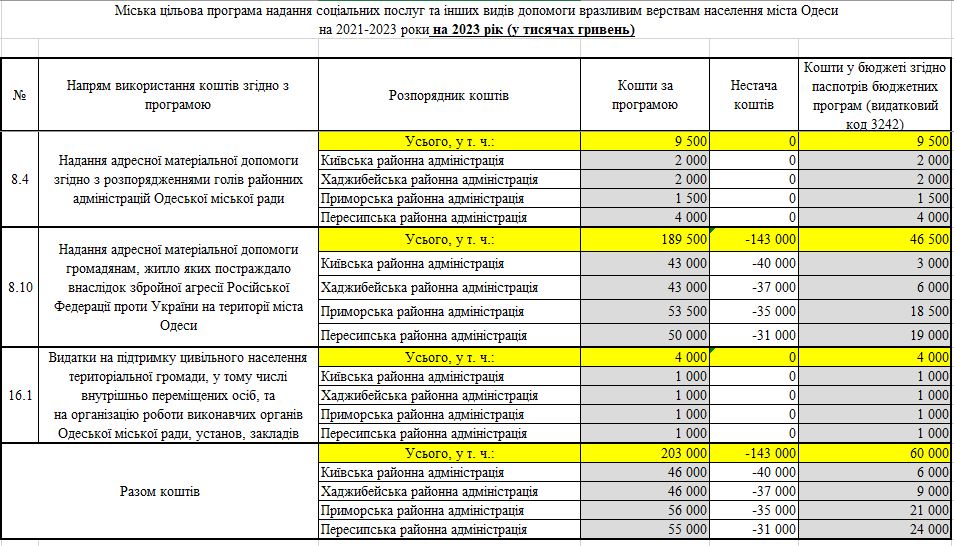
At first, Odesa City Council could not decide how much funding to provide to the district administrations for the above expenditures. The shifting nature of these ideas is clearly reflected in the city’s budget decisions. Thus, planned allocations under expenditure code 3242 changed constantly. Since the appendices to the city budget decision are published in an ‘as amended’ format, we additionally calculated how much money was added or withdrawn with each change.

Odesa suffered three large-scale missile attacks in 2023: on the night of 14 June; on the night of 23 July; and on the morning of 29 December. One can see how long people had to wait before the city authorities allocated money to help them. The procedure for providing assistance was approved only after the first large-scale attack on 14 June. It gives the impression that, even during wartime, the city authorities had not considered that the city might be attacked. Anyone can verify these figures by analysing Odesa City Council’s decision ‘On the budget of the Odesa City Territorial Community for 2023’ and the amendments made to it (the links to amendments in the text of the original decision need to be checked), as well as the budget programme passports of the Kyivskyi, Khadzhibeyskyi, Prymorskyi (the archive dated 27 November 2023 needs to be downloaded) and Peresypskyi district administrations, taking amendments into account. To sum up, the following conclusions can be drawn: although the city authorities had a UAH 1 billion reserve fund, they did not keep this money for unforeseen expenditure. Instead, they reduced the reserve fund to zero and spent the money thus ‘released’ on other, ‘extremely necessary’ needs. And when residents needed real help from the city authorities after Russian attacks on the city, the authorities, having already depleted the reserve fund, were in no hurry to assist those affected. On 15 November 2023, budget allocations to the city’s district administrations for assistance were reduced without changing the corresponding city target programme. Thanks to good fortune and the excellent work of air defence, Odesa had avoided large-scale direct strikes until recently. But as of today, it is unknown when people affected by the shelling during the night and morning of 29 December 2023 will receive assistance.
Act Two — repayment of loans. But at what cost?
As of today, the city has fully repaid the loans it took from commercial institutions. But it is very interesting to trace how funds were allocated to repay the principal and the interest on these loans. These indicators are reflected in different parts of the budget. Repayment of the principal is shown among the sources of budget financing, while interest payments appear on the expenditure side under expenditure code 8600, ‘Servicing local debt’. When we brought these figures together in one table, we saw a complete absence of a strategy for planning these important expenditures.
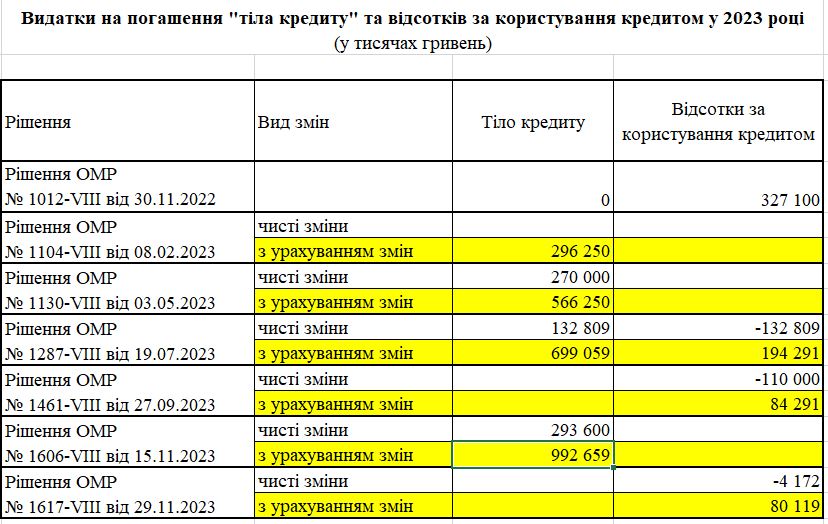
The initial decision provided only for payment of interest amounting to UAH 327.1 million. At that point, no one was even thinking about repaying the principal. But Decision No. 1104 already provided for repayment of UAH 296.25 million of principal, while expenditure on interest remained unchanged.
At the next session, Decision No. 1130 increased expenditure on principal repayment by another UAH 270 million. The amount allocated to interest again remained unchanged. The next time, Decision No. 1287 changed both the amount of principal repayment and the expenditure on interest. Looking at the figures, however, one cannot escape the impression that part of the amount planned for interest payments was simply moved to the principal-repayment line. This concerns UAH 132.809 million. The next time, Decision No. 1461 again reduced interest expenditure, this time by UAH 110 million. Decision No. 1606 once again increased expenditure on principal repayment, by UAH 293.6 million, while the amount allocated to interest did not change. At the next extraordinary session, Decision No. 1617 reduced interest expenditure by UAH 4.172 million.
To sum up, the following conclusion can be drawn: in the offices of Odesa City Council, no one really understood whether the Odesa budget would be able to repay the loan in full in 2023. Most likely, funds were allocated according to the principle that if spare money was available, it would be directed to loan repayment. But this approach to managing the city budget, when even loan repayment cannot be planned in advance, shows signs that control over the city budget has been lost.
Act Three — what about funding territorial defence?
Today, funding territorial defence is one of the highest-priority areas of local-budget expenditure. Yet the city leadership still cannot decide which chief spending unit should finance what and in what amount. Let us put the planned allocations into a table by chief spending unit of the budget.
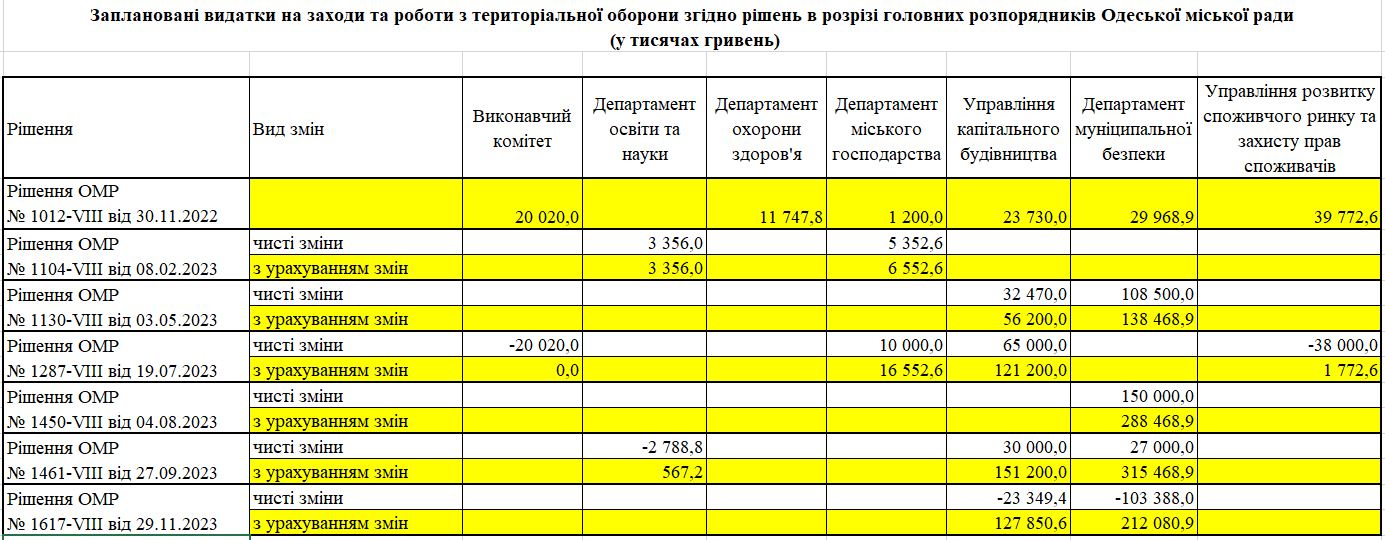
For the Odesa City Council Executive Committee, the proposed spending mainly concerned material support for units of the Territorial Defence Forces of the Armed Forces of Ukraine. But as can be seen from the table, Decision No. 1287 cancelled these expenditures. For the Department of Education and Science , nothing was proposed initially. But Decision No. 1104 provided that it would finance meals for units of the Territorial Defence Forces of the Armed Forces of Ukraine and volunteer formations within the Odesa territorial community for almost UAH 3.6 million. Later, however, they changed their minds and reduced this amount sixfold!!! The Department of Health received budget allocations for measures to provide the South territorial-defence forces with individual combined-arms first-aid kits and other medical supplies totalling almost UAH 12 million. The overall amount of budget allocations did not change afterwards. The Department of Municipal Services initially received UAH 1.2 million to repay accounts payable from the previous year. Decision No. 1104 increased the amount for repayment of accounts payable to almost UAH 1.6 million and allocated another UAH 5 million for repair of military-unit vehicles. Decision No. 1287 allocated UAH 15 million for repair of military-unit vehicles. For the Capital Construction Department , capital repairs were initially planned at eight facilities for a total of UAH 23.7 million. Decision No. 1130 increased the Department’s budget allocations to UAH 56.2 million, with plans to carry out capital repairs at one facility for UAH 37.2 million and reconstruction and restoration at another facility for UAH 19 million. Decision No. 1287 increased budget allocations by another UAH 65 million, to UAH 121.2 million. With this money, one facility was to undergo capital repairs, two facilities were to undergo reconstruction and restoration for a total of UAH 59 million, and current repairs were to be carried out at one more facility for UAH 25 million. Decision No. 1461 increased budget allocations by another UAH 30 million, to UAH 151.2 million. The plans were: capital repairs at two facilities for UAH 37.2 million, with 50% of the facilities expected to be completed by the end of 2023; reconstruction of four facilities for a total of UAH 89 million, with no percentage of completion specified; and current repairs at one facility for UAH 25 million. Decision No. 1617 reduced budget allocations by UAH 23.3 million, to UAH 127.8 million. The plans then became: capital repairs at three buildings; total expenditure in 2023 remained unchanged at UAH 37.2 million, with only the completion indicator changing to 33%; reconstruction of four facilities for UAH 65.7 million, with no completion percentage specified; and current repairs at one facility for UAH 25 million.
The Department of Municipal Security received almost UAH 30 million at the beginning of the year for logistical support of Odesa’s volunteer formations. Decision No. 1130 added UAH 108.5 million for the purchase of equipment and durable goods. Decision No. 1450 added another UAH 150 million. Thus, almost all UAH 288.5 million was directed to logistical support of Odesa’s volunteer formations. Decision No. 1461 increased this expenditure by UAH 27 million, to almost UAH 315.5 million. But this amount turned out to be too large for financing territorial-defence measures and activities in the city, and Decision No. 1617 reduced it at once by almost one third — UAH 103.4 million — to UAH 212.1 million. The Department for Consumer Market Development and Consumer Protection received UAH 39.8 million at the beginning of the year for procurement to organise logistical, medical and food support for units of the Territorial Defence Forces of the Armed Forces of Ukraine. But Decision No. 1287 reduced this amount by UAH 38 million, to UAH 1.8 million.
Another problem is that these plans are being implemented very slowly. Thanks to the state portal openbudget.gov.ua, it is possible to see how implementation of these plans has progressed over time.

As can be seen, there is substantial underperformance against the plans in almost every category. It should also be noted that the changes introduced by Decision No. 1617 of 29 November 2023 have not yet been reflected in the planned indicators on the state portal. One can also look at the transfer of budget allocations from spending units to recipients of budget funds. This is reflected under economic classification codes 2610 and 3210. Implementation there, however, is going well, which also raises troubling questions. To sum up, one simple conclusion can be drawn: the authorities have a poor understanding of what territorial-defence units need and what equipment standards apply. That is why there is such constant shifting in funding plans and such major problems with implementation, except for transfers of money from spending units to recipients of budget funds.
Conclusions
As can be seen from this analysis of several expenditure indicators in the Odesa city budget, the city authorities have no clear vision for the city’s development or plan for protecting ordinary Odesa residents. All these chaotic attempts to ‘do at least something’, reflected in the budget indicators, suggest that the city authorities are no longer monolithic and that each part of the system controls the processes only partially.