

Will Odesa City Council Fund Reconstruction of the Kyiv District Court Building in 2024?
Odesa authorities’ attempt to spend UAH 106 million on renovating the former kindergarten building that now houses the Kyiv District Court of Odesa led to the start of the civic protests “Money for the Armed Forces” in Odesa. The demands addressed to local self-government bodies — stop non-priority spending and direct local-budget funds to support the Armed Forces of Ukraine — immediately spread across the country. Odesa City Council deputies, not on their first attempt, managed to cancel UAH 12 million planned in the city’s 2023 budget and redirect the funds from the court renovation to more urgent needs.
On November 26, 2023, Odesa City Council deputy Petro Obukhov stated directly: “The Odesa City Council Budget Commission has finally voted to cancel funding for renovation of the Kyiv District Court. This is exactly why people came out to protest. We spoke at council sessions, but they did not want to hear us. Now the year is coming to an end, and the UAH 12 million allocated for this year can no longer be spent, so this UAH 12 million is being cancelled, and we will continue directing it to support the Armed Forces of Ukraine. No one will renovate this court next year. Next Wednesday we will formalize this at the session.”
The contract remains in force
Green Leaf decided to check the objective state of affairs as of today. The first thing that stands out is that the contract “Reconstruction of the building with an extension of additional premises, located at 3-B Varnenska Street, Odesa” remains in force. It appears that Odesa’s leadership never intended to stop the reconstruction. On December 7, 2023 — after statements that the funding had supposedly been cancelled — Additional Agreement No. 2 was signed.
The official ground for signing this additional agreement is stated as “improving the quality of the subject of procurement, provided that such improvement does not increase the amount specified in the procurement contract.” Cases in which essential contract terms may be amended are described in paragraph three of part five of Article 41 of the Law of Ukraine “On Public Procurement.” The law clearly states that quality is defined under the international ISO standard as the totality of characteristics of an object — activity or process, product, service, etc. — relating to its ability to satisfy established or anticipated needs.
The current Additional Agreement No. 2 does not touch Section II of the contract, “Quality of Work,” at all. It changes Section III, “Contract Price,” Appendix No. 2, “Work Performance Schedule,” and Appendix No. 3, “Work Financing Plan.” Under the circumstances, this looks highly manipulative. All work and budget expenditures are shifted to 2024.
For objectivity, we note that the current city budget contains no expenditure to finance this reconstruction contract. But then why all these additional agreements, you may ask. It is clearly a game, but it is interesting to see exactly how Hennadii Leonidovych intends to thread the needle on this issue.
Threading the needle
Because the contract for reconstruction of the former kindergarten building at 3-B Varnenska Street in Odesa, which now houses the Kyiv District Court of Odesa, remains valid, the Odesa authorities together with the contractor still have several mechanisms for implementing the contract. At present we see three main scenarios:
Scenario 1 — the reconstruction contract is terminated. This would satisfy the public, but clearly not Trukhanov, Chvankin, or Oleksandr Fridman, owner of PrJSC Odesholovpostach — a favorite of Odesa officials for budget-funded contracts — whom Green Leaf has already written about.
Scenario 2 — Odesa City Council votes to amend the budget so that UAH 106,134,345 is allocated from the budget to fulfill the contract. This would be stepping on the same rake again. Moreover, the public already remembers the deputies who previously refused to support amendments proposed by their colleagues to cancel the allocation of UAH 10 million for renovation of the Kyiv District Court.
Scenario 3 — repayment of accounts payable. Under this option, the contractor performs the work in 2024 but does not receive payment that year. In later years, either the city itself recognizes and repays the debt while placing the blame solely on the contractor, or the contractor goes to court and the court sides with the contractor because the contractor fulfilled the agreement while the city failed to pay for the work.
In any event, Green Leaf will continue to monitor this issue closely. Especially since volunteers did not believe Trukhanov either and, for the fifth month in a row, continue to gather outside Odesa City Hall every week at 10:00.

UAH 191 Million Worth of Negligence by Odesa’s Capital Construction Department
Green Leaf has already written that funds allocated to Odesa as a subvention under Cabinet of Ministers Order No. 534-r of June 16, 2023 were used during the war to dig up the city from one end to the other — from Bahrytskoho Street via Fontanska Road–Akademichna–Frantsuzkyi Boulevard–to Haharina Avenue. In total, UAH 340 million of UAH 475 million was directed to construction of a new branch of trunk water-supply networks for a high-rise commercial development. In other words, this part of the project was purely development-oriented from the outset. Many city residents had many questions about the priority of such work during a bloody war. Why is excavation being carried out hastily, without organizing detours, accounting for vehicle traffic, or considering the historic value of the cobblestone surface of Frantsuzkyi Boulevard? Why, in the end, should this work be financed from the state budget? Another UAH 135 million was directed to construction of a kindergarten at Pestelia Lane in Odesa and major repairs to Building G for the cardiology department of Municipal Non-Profit Enterprise City Clinical Hospital No. 11 at Akademika Vorobiova Street in Odesa. The city budget allocated part of the funds as co-financing.
In general, Green Leaf is very interested in the principle by which the state allocated a subvention to Odesa during wartime for an openly commercial project. A commercial road-construction corporation associated with Trukhanov and Angert is using public funds to expand the customer base of the commercial enterprise Infox LLC, owned by Mykola Zlochevskyi, including for the development of new sites for commercial high-rise construction. The formally social component of this subvention was provided by the kindergarten construction project and the cardiology renovation — apparently as cover.
Funds returned to the state budget
However, there is a serious problem. According to the Unified Web Portal for the Use of Public Funds, by the end of 2023 none of the listed facilities had been fully financed. The status of the contracts can be seen at the following links: 1. Construction of trunk water-supply networks: Phase 1; Phase 2; Phase 3; Phase 4 2. Construction of a kindergarten at 4 Pestelia Lane, Odesa 3. Major repairs to Building G for the cardiology department of Municipal Non-Profit Enterprise City Clinical Hospital No. 11 at 5 Akademika Vorobiova Street, Odesa
As it turned out, the city authorities, represented by the Capital Construction Department, failed to use the allocated funds, and at the end of 2023 more than UAH 191 million was returned to the state budget. The response of the Odesa City Council Finance Department to Green Leaf’s information request is shown below.
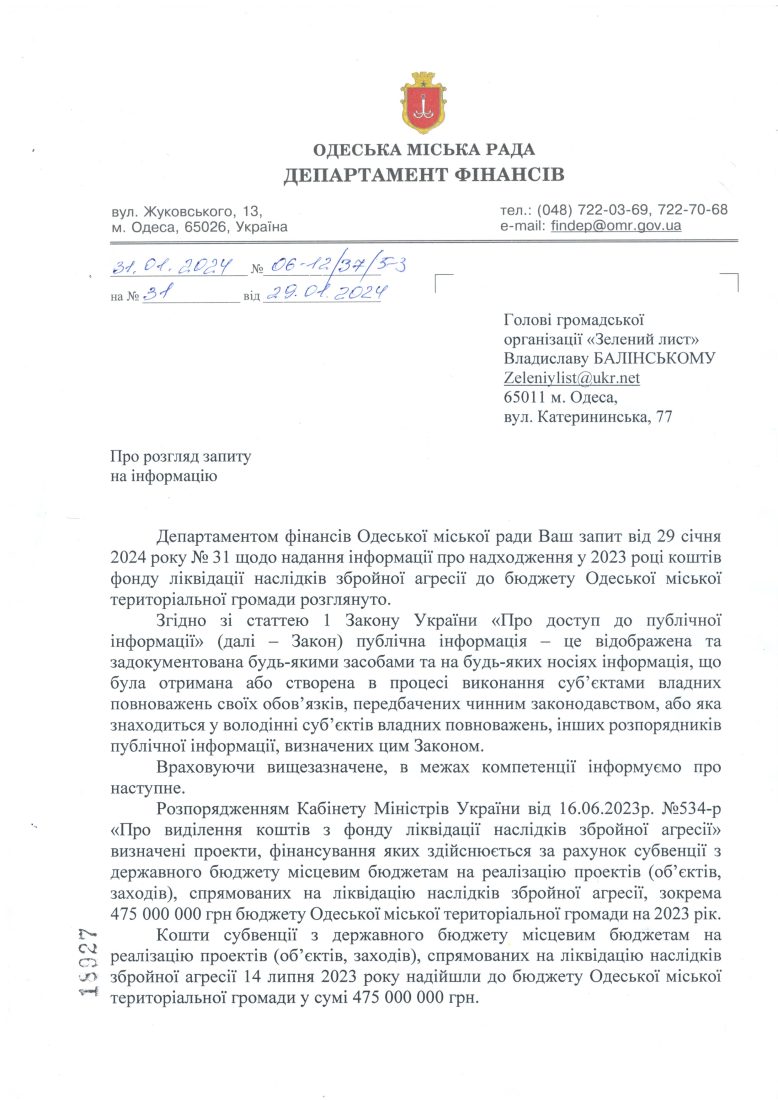
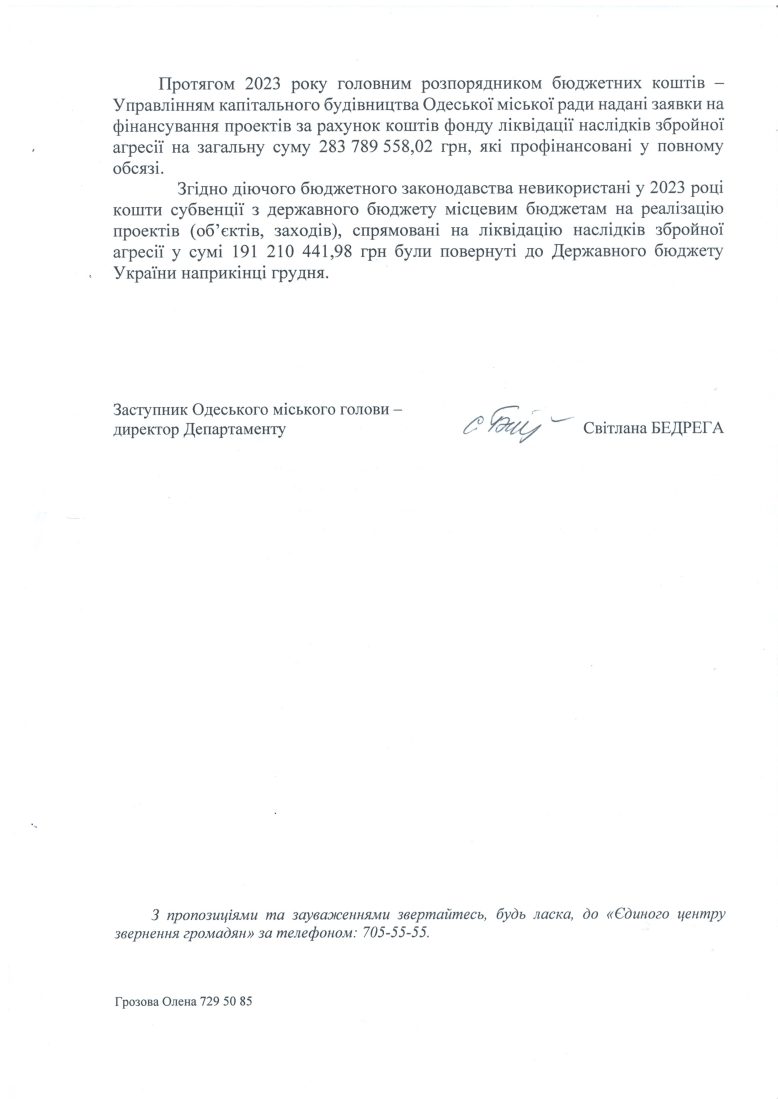
This raises a number of questions:1. Will officials be held responsible for negligence that resulted in unused funds being returned to the state budget?2. From what sources will financing of these projects continue in 2024 to replace the more than UAH 191 million that was lost? 3. How will engineering protection of the historic cobblestone roadway of Frantsuzkyi Boulevard be organized during the works? How will conservation be arranged if funding is unavailable?
In any event, Green Leaf will keep monitoring this issue. First, many questions remain for those who decided to allocate the funds “from above.” Second, it will be interesting to see how far Hennadii Leonidovych can stretch after the arrangements were cancelled. And third, trenches on Frantsuzkyi Boulevard during the autumn-winter period without drainage or conservation measures are already an offense in themselves.