Odesa Budget: What Is Being Prepared for the February 21 Session?
The Odesa City Council session scheduled for February 21 raises far too many questions, especially regarding amendments to the city budget. Green Leaf examined the issue in detail.
What financial resources does the city have available for distribution?
At present, the city has the ability to distribute more than UAH 3 billion in financial resources. This amount consists of:
1. Balances from previous periods totaling UAH 1,537.8 million. If UAH 2 million in working cash balance is excluded, the city can distribute UAH 1,535.8 million.
2. The reserve fund, which at the beginning of the year amounted to UAH 1,645.4 million, but was reduced by UAH 92.9 million — to UAH 1,552.5 million — by Odesa City Council Decision No. 1773-VIII of January 17, 2024. Under the Budget Code, the reserve fund is formed to cover unforeseen expenditures that are not permanent and could not have been anticipated when the draft budget was prepared. However, as Green Leaf previously noted, the Odesa authorities do not use the reserve fund for its intended purpose.
What is proposed to be changed in the city budget
On the city’s official website, in the section “Draft City Council Decisions”, there is only a draft decision on amendments to the city budget, published on February 7 and 9.
If these changes are presented in table form, they look as follows:

More extensive changes to the draft are introduced by Amendment No. 1 of the Standing Commission on Planning, Budget and Finance. But there is no point looking for it on the official website. Although the amendment was sent to deputies on the afternoon of Friday, February 16, it was still absent from the city’s official website on Friday evening. Thanks to information sources in Odesa City Council and the assistance of Iryna Hryb, Green Leaf obtained the document.
An analysis of the proposed amendment gives us the following:
1. The city’s revenue receives UAH 18,255,108 from the regional budget from the unused balance of the education subvention carried over at the beginning of the budget period.
2. UAH 3,504,586 is allocated from balances of previous periods to finance expenditures.
3. The expenditure side, broken down by chief spending units, is as follows:

The figures reveal nothing fundamentally new. They include multimedia equipment for schools, financed both from the subvention and co-financing from the city budget, as well as office equipment for executive bodies. There are also expenditures to close out contracts concluded in previous years for major repairs of Shota Rustaveli Street and the passage from Zhytomyrska Street to Ovidiopolska Road. And all of this is financed mainly by reducing the reserve fund.
The only unclear point is why the draft budget contains no proposal from any city council deputy on distributing the deputies’ fund. It is also unknown whether any such proposals were submitted by deputies at all.
In summary
Looking at the proposed draft amendments to the city budget, it is hard to escape the feeling that either the city authorities are completely incompetent or the city authorities themselves consider Odesa residents fools.
With about UAH 2.8 billion still undistributed, it is difficult to believe that the UAH 337.2 million included in the budget under budget program 2218240 for purchasing equipment and durable goods for volunteer formations and military units of the Territorial Defense Forces of the Armed Forces of Ukraine — most of which, though not all, can be transferred to the Armed Forces — is an adequate contribution to the fight against Russian aggression.
This is despite protesters demanding every week that the city authorities direct funds specifically toward the immediate needs of Armed Forces personnel defending Ukraine at the front.
Another possible scenario is that part of the money is being held back to finance projects opposed by the public, or that additional financing has to be found because of negligence by local officials.
Green Leaf has already written about problematic unfunded city projects, including uncertainty over what sources will be used to replace the UAH 191 million returned to the state budget because of negligence by the Capital Construction Department or the still-uncancelled contract for reconstruction of the Kyiv District Court building, which became the trigger for the “Money for the Armed Forces” civic protests across the country.
In any event, Green Leaf will continue to monitor the city’s budget process closely.

Will Odesa City Council Fund Reconstruction of the Kyiv District Court Building in 2024?
Odesa authorities’ attempt to spend UAH 106 million on renovating the former kindergarten building that now houses the Kyiv District Court of Odesa led to the start of the civic protests “Money for the Armed Forces” in Odesa. The demands addressed to local self-government bodies — stop non-priority spending and direct local-budget funds to support the Armed Forces of Ukraine — immediately spread across the country. Odesa City Council deputies, not on their first attempt, managed to cancel UAH 12 million planned in the city’s 2023 budget and redirect the funds from the court renovation to more urgent needs.
On November 26, 2023, Odesa City Council deputy Petro Obukhov stated directly: “The Odesa City Council Budget Commission has finally voted to cancel funding for renovation of the Kyiv District Court. This is exactly why people came out to protest. We spoke at council sessions, but they did not want to hear us. Now the year is coming to an end, and the UAH 12 million allocated for this year can no longer be spent, so this UAH 12 million is being cancelled, and we will continue directing it to support the Armed Forces of Ukraine. No one will renovate this court next year. Next Wednesday we will formalize this at the session.”
The contract remains in force
Green Leaf decided to check the objective state of affairs as of today. The first thing that stands out is that the contract “Reconstruction of the building with an extension of additional premises, located at 3-B Varnenska Street, Odesa” remains in force. It appears that Odesa’s leadership never intended to stop the reconstruction. On December 7, 2023 — after statements that the funding had supposedly been cancelled — Additional Agreement No. 2 was signed.
The official ground for signing this additional agreement is stated as “improving the quality of the subject of procurement, provided that such improvement does not increase the amount specified in the procurement contract.” Cases in which essential contract terms may be amended are described in paragraph three of part five of Article 41 of the Law of Ukraine “On Public Procurement.” The law clearly states that quality is defined under the international ISO standard as the totality of characteristics of an object — activity or process, product, service, etc. — relating to its ability to satisfy established or anticipated needs.
The current Additional Agreement No. 2 does not touch Section II of the contract, “Quality of Work,” at all. It changes Section III, “Contract Price,” Appendix No. 2, “Work Performance Schedule,” and Appendix No. 3, “Work Financing Plan.” Under the circumstances, this looks highly manipulative. All work and budget expenditures are shifted to 2024.
For objectivity, we note that the current city budget contains no expenditure to finance this reconstruction contract. But then why all these additional agreements, you may ask. It is clearly a game, but it is interesting to see exactly how Hennadii Leonidovych intends to thread the needle on this issue.
Threading the needle
Because the contract for reconstruction of the former kindergarten building at 3-B Varnenska Street in Odesa, which now houses the Kyiv District Court of Odesa, remains valid, the Odesa authorities together with the contractor still have several mechanisms for implementing the contract. At present we see three main scenarios:
Scenario 1 — the reconstruction contract is terminated. This would satisfy the public, but clearly not Trukhanov, Chvankin, or Oleksandr Fridman, owner of PrJSC Odesholovpostach — a favorite of Odesa officials for budget-funded contracts — whom Green Leaf has already written about.
Scenario 2 — Odesa City Council votes to amend the budget so that UAH 106,134,345 is allocated from the budget to fulfill the contract. This would be stepping on the same rake again. Moreover, the public already remembers the deputies who previously refused to support amendments proposed by their colleagues to cancel the allocation of UAH 10 million for renovation of the Kyiv District Court.
Scenario 3 — repayment of accounts payable. Under this option, the contractor performs the work in 2024 but does not receive payment that year. In later years, either the city itself recognizes and repays the debt while placing the blame solely on the contractor, or the contractor goes to court and the court sides with the contractor because the contractor fulfilled the agreement while the city failed to pay for the work.
In any event, Green Leaf will continue to monitor this issue closely. Especially since volunteers did not believe Trukhanov either and, for the fifth month in a row, continue to gather outside Odesa City Hall every week at 10:00.

UAH 191 Million Worth of Negligence by Odesa’s Capital Construction Department
Green Leaf has already written that funds allocated to Odesa as a subvention under Cabinet of Ministers Order No. 534-r of June 16, 2023 were used during the war to dig up the city from one end to the other — from Bahrytskoho Street via Fontanska Road–Akademichna–Frantsuzkyi Boulevard–to Haharina Avenue. In total, UAH 340 million of UAH 475 million was directed to construction of a new branch of trunk water-supply networks for a high-rise commercial development. In other words, this part of the project was purely development-oriented from the outset. Many city residents had many questions about the priority of such work during a bloody war. Why is excavation being carried out hastily, without organizing detours, accounting for vehicle traffic, or considering the historic value of the cobblestone surface of Frantsuzkyi Boulevard? Why, in the end, should this work be financed from the state budget? Another UAH 135 million was directed to construction of a kindergarten at Pestelia Lane in Odesa and major repairs to Building G for the cardiology department of Municipal Non-Profit Enterprise City Clinical Hospital No. 11 at Akademika Vorobiova Street in Odesa. The city budget allocated part of the funds as co-financing.
In general, Green Leaf is very interested in the principle by which the state allocated a subvention to Odesa during wartime for an openly commercial project. A commercial road-construction corporation associated with Trukhanov and Angert is using public funds to expand the customer base of the commercial enterprise Infox LLC, owned by Mykola Zlochevskyi, including for the development of new sites for commercial high-rise construction. The formally social component of this subvention was provided by the kindergarten construction project and the cardiology renovation — apparently as cover.
Funds returned to the state budget
However, there is a serious problem. According to the Unified Web Portal for the Use of Public Funds, by the end of 2023 none of the listed facilities had been fully financed. The status of the contracts can be seen at the following links: 1. Construction of trunk water-supply networks: Phase 1; Phase 2; Phase 3; Phase 4 2. Construction of a kindergarten at 4 Pestelia Lane, Odesa 3. Major repairs to Building G for the cardiology department of Municipal Non-Profit Enterprise City Clinical Hospital No. 11 at 5 Akademika Vorobiova Street, Odesa
As it turned out, the city authorities, represented by the Capital Construction Department, failed to use the allocated funds, and at the end of 2023 more than UAH 191 million was returned to the state budget. The response of the Odesa City Council Finance Department to Green Leaf’s information request is shown below.
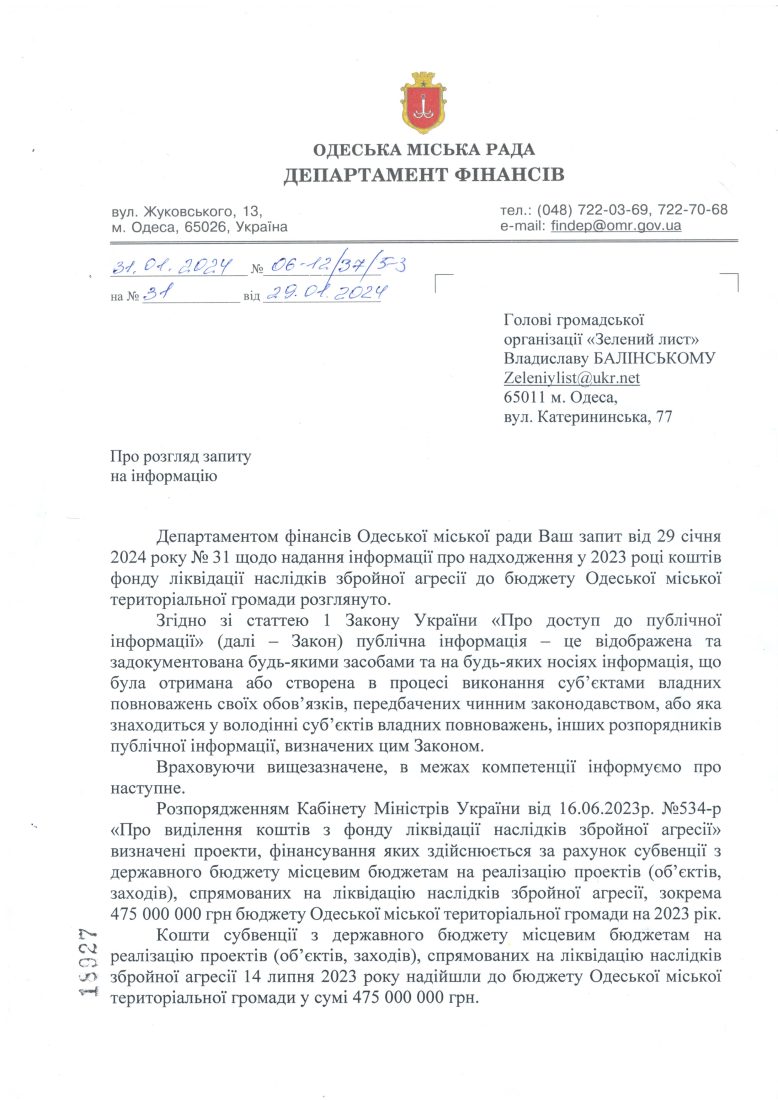
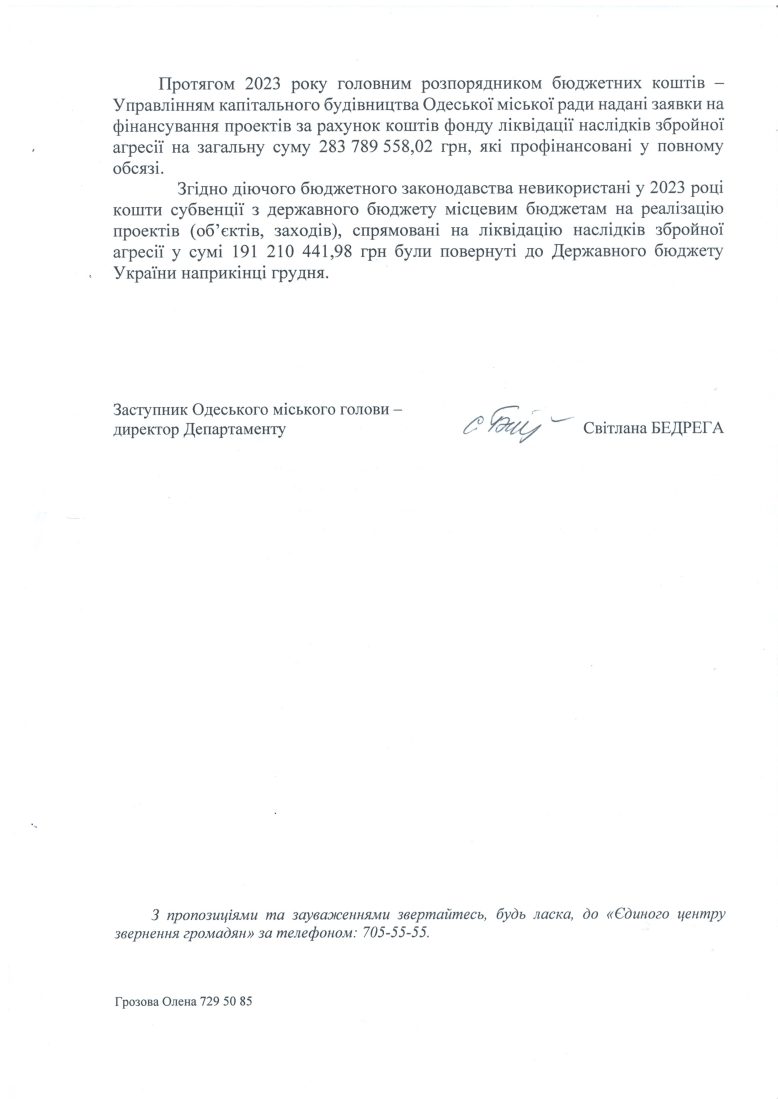
This raises a number of questions:1. Will officials be held responsible for negligence that resulted in unused funds being returned to the state budget?2. From what sources will financing of these projects continue in 2024 to replace the more than UAH 191 million that was lost? 3. How will engineering protection of the historic cobblestone roadway of Frantsuzkyi Boulevard be organized during the works? How will conservation be arranged if funding is unavailable?
In any event, Green Leaf will keep monitoring this issue. First, many questions remain for those who decided to allocate the funds “from above.” Second, it will be interesting to see how far Hennadii Leonidovych can stretch after the arrangements were cancelled. And third, trenches on Frantsuzkyi Boulevard during the autumn-winter period without drainage or conservation measures are already an offense in themselves.


Chronicle of Russia’s War Crimes Against Ukraine’s Environment: Odesa Oblast, January 2024
In the first month of 2024, the Russian army’s terror of Odesa continued. Russian forces practised the accuracy of missile and drone strikes on residential buildings and civilians.
We collect facts about the Russian Federation’s crimes against nature in Odesa and Odesa Oblast during the war: environmental pollution caused by explosions and damage to infrastructure, contamination of air, water and soil with toxic substances, destruction of ecosystems in protected areas and internationally important conservation areas, and more. We will update the information daily, so please send any facts you know to: zeleniy.list1@gmal.com
Read more: Chronicle of Russia’s War Crimes Against Ukraine’s Environment: Odesa Oblast, January 202408.01.2024
At night, the Southern Defence Forces, using their air-defence units, shot down all eight enemy Shahed-131/136 drones that the Russians launched from the Black Sea toward Odesa Oblast and Mykolaiv Oblast.
Seven UAVs were destroyed over Odesa Oblast by air defenders from Air Command South, the Navy’s combined-force grouping and mobile fire groups, as well as other components of the Defence Forces; another one was destroyed over Mykolaiv Oblast.
Debris from one of the downed UAVs fell in an open area of Odesa district and caused a fire. The blaze was quickly extinguished. There was no destruction and no one was injured.
17.01.2024
At night, the Russian army attacked Odesa with drones. Eleven drones were shot down over the region. Most of them fell into the water, but debris from several struck civilian facilities. Three people were injured.
This was reported by the Southern Defence Forces, the Odesa Regional Military Administration and the city council.
As a result of the Russian attack, heating networks were damaged and 58 buildings in Odesa were left without heating. In total, the overnight attack on Odesa damaged 10 buildings, 124 apartments, more than 200 windows and 94 balconies, the city council reported. The buildings have gas, water and electricity. Heating is unavailable because a heating main and a heat chamber were damaged.

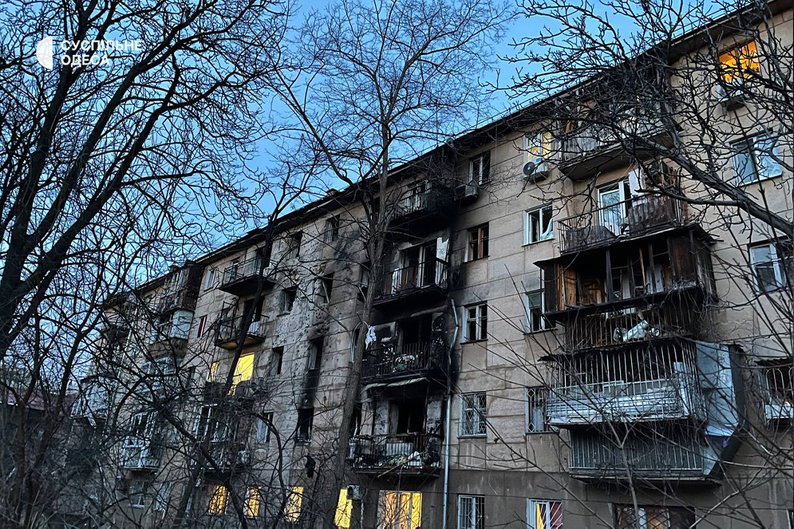
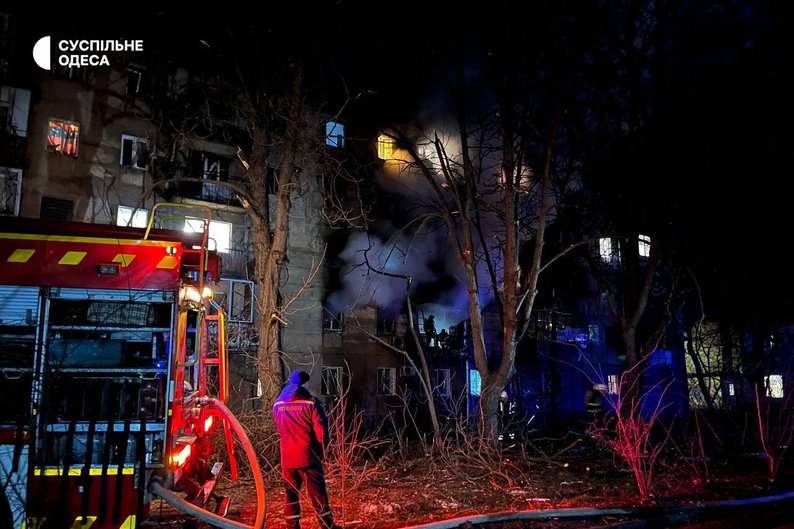
After the overnight drone attack on 17 January, the Russian army attacked Odesa Oblast with Oniks missiles before dawn, and strikes were recorded.
This was reported by the Southern Defence Forces of Ukraine.
The missiles struck agricultural land and an agricultural enterprise in Odesa and Bilhorod-Dnistrovskyi districts.

24.01.2024
On the evening of 24 January, air-raid sirens sounded in Odesa Oblast, followed by explosions. The enemy attacked the southern regions in two waves with Shahed-131/136 UAVs.
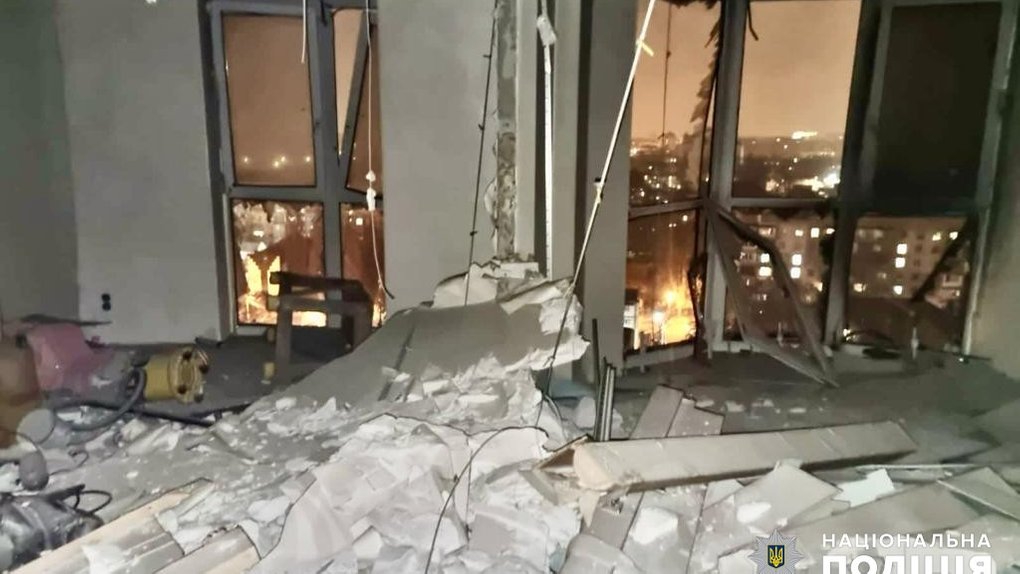
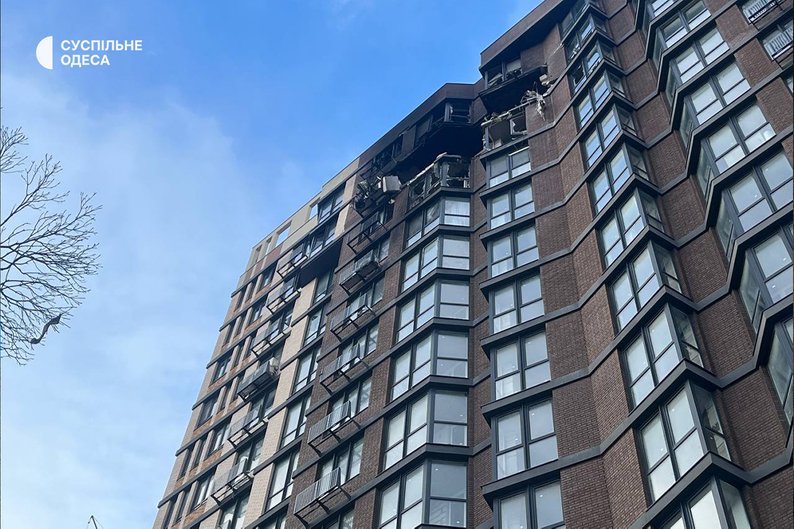
According to the Southern Defence Forces, air defence units shot down ten UAVs over the region. One of the downed drones struck a partially occupied newly built high-rise in Odesa’s Khadzhibeyskyi district and caused a fire. Several apartments were damaged; one person suffered burns and was hospitalised.
Another intercepted drone pierced the roof of a two-storey residential building in the city’s Prymorskyi district. Another UAV fell in the same residential neighbourhood, next to an apartment building damaged in the previous attack. The blast wave shattered windows in buildings, completely burned out a car parked in the courtyard and damaged several others. Four people were injured and received assistance at the scene. Rescuers freed one of the injured people from the rubble.
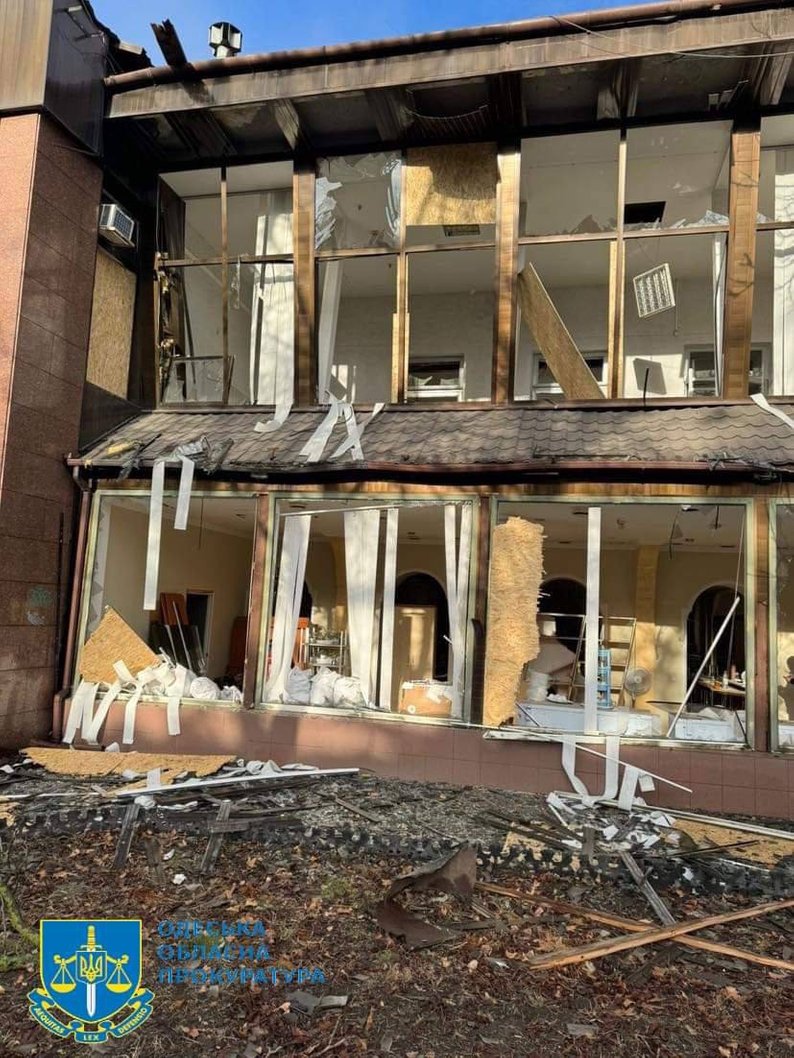
A warehouse at a furniture factory in Odesa’s industrial district was also hit. A man who was cycling nearby was injured by fragments of various objects and thrown to the ground by the blast wave. He received medical assistance.
As a result of the overnight Russian attack, 177 apartments were damaged in two districts of Odesa.