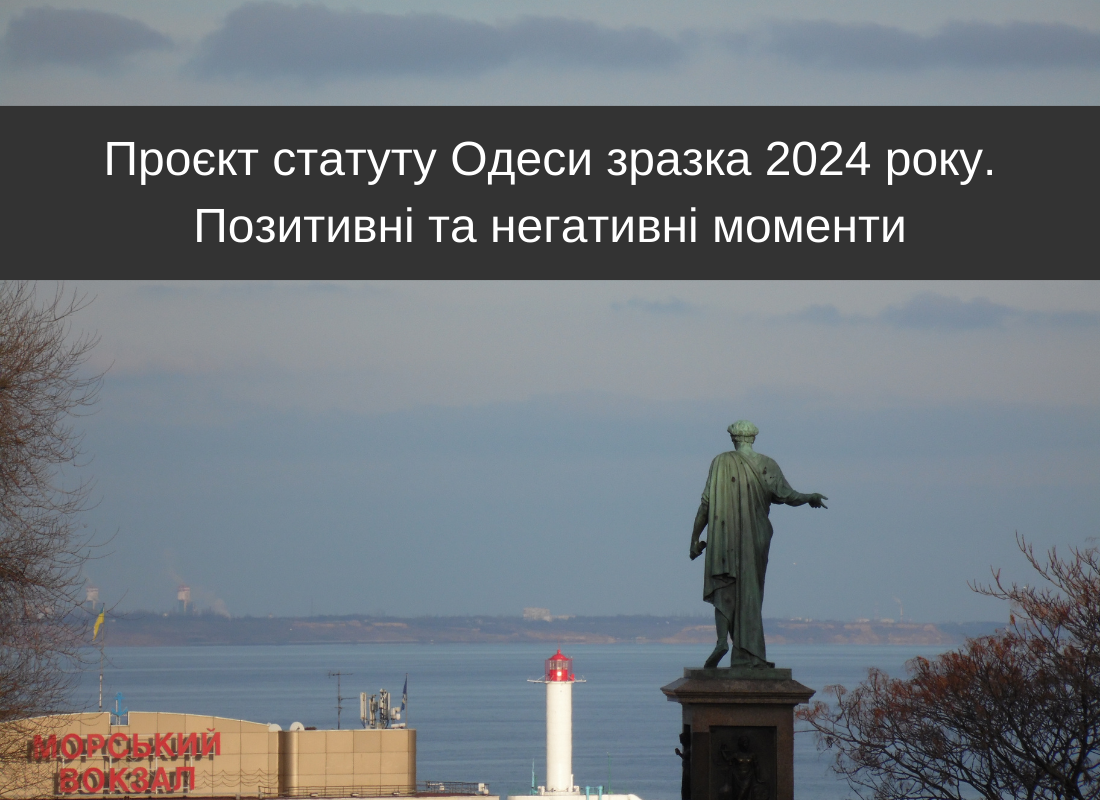

Odesa’s 2024 Draft City Charter: Positive and Negative Aspects
Since 2022, Green Leaf has devoted considerable attention to the current Charter of the City of Odesa, adopted in its 2011 version. In our analysis “Charter of the City of Odesa: Analysis of Shortcomings” we showed that the Charter has an openly anti-Ukrainian wording, makes any civic activity more difficult, and expands the powers of the executive committee at the expense of the powers of the elected council. After that, taking into account the problems exposed by this analysis, the city began developing a new City Charter.
The first draft of the new Charter was published in 2023. At the same time, the city administration announced that it would collect comments and proposals from the public on the draft. In addition to Green Leaf NGO, which presented its position in “Comments and Proposals on the Draft Charter of the City of Odesa”, other civic associations and individual specialists also examined the document, each in their own field and each submitting comments and/or proposals.
It took the city authorities more than a year to take public opinion into account, after which they presented the 2024 draft Charter of the City of Odesa, for which comments and proposals are being accepted through 9 September 2024.
The good
In terms of content, one positive aspect of the new draft is that many of the identified errors and shortcomings have indeed been corrected. At long last, Odesa City Council has acknowledged that Odesa is a city within Ukraine! Finally!!! To recall, the 2011 version stated the following: “Odesa residents are proud of their traditions of courage and patriotism, rooted in the exploits of Russian servicemen and Ukrainian Cossacks.” It was also possible to push through the abandonment of the practice of publishing civic activists’ personal data on the official website and to bring the number of votes required for civic initiatives down to objectively reasonable levels.
The bad
The proposals we submitted in 2023 to include the following provisions in the draft Charter:
- — on transparency of the city budget and public involvement in the budget process (not to be confused with the participatory budget);
- — on municipal enterprises;
- — on municipal property and its disposal;
- — on negligent performance by city-council deputies of their duties, negligent performance by officials of local self-government executive bodies of their official duties, and remuneration for their work;
were ignored altogether. This points to a selective approach and a desire on the part of the local authorities to preserve their political influence and financial influence that creates corruption risks.
The city authorities’ reluctance to include young people aged 14 to 18 in the city’s political life and to give them voting rights in forms of direct participation in resolving issues of local importance, subject to restrictions established by law, is difficult to understand. It is true that voting rights in elections and referendums begin at age 18. Yet in other forms of local democracy the city authorities demonstrate a clear reluctance to involve people aged 14 to 18. Whether this is fear of young people, who are one of the drivers of change in Ukraine, or something else is difficult to say. But the exclusion of this age group from the current Charter and the 2023 draft, and the granting of only an advisory vote to this age group in the 2024 draft Charter, clearly point to this. This is despite the fact that young people in this age group may serve on the youth council under the mayor.
There is no indication whatsoever of an intention to use the right provided by current legislation to establish rules of deputy ethics and measures to be applied to city-council deputies who violate those rules.
Some provisions of the draft Charter do not comply with current legislation.
- 1. Clause 5 of Part 5 of Article 23 refers to “self-taxation,” which was abolished at the end of 2010.
- 2. Although the law directly requires local self-government bodies to publish information about publicly owned property, the city council merely “facilitates” the creation and maintenance of such a register for some reason.
- 3. A mayoral oath has now also been added, but the procedure for taking it is incorrect. Moreover, once the new Law enters into force, the text of the Oath set out in the draft Charter will not correspond to the text of the Oath in the new Law. It is even less clear why this provision should be included in the Charter at all when it is already regulated by legislation.
- 4. Russian narratives again appear among the city’s holidays and commemorative dates, such as 2 September as City Day, even though it has long been demonstrated that this is an artificial date. They also want to introduce an unclear celebration on 3 September as “Twin City and Partner City Day.” Yet the internationally recognized date is World Twinning Day, established in 1963 by the World Federation of United Cities and observed on the last Sunday of April. The proposal to establish city holidays and commemorative dates by analogy with the way the Verkhovna Rada of Ukraine does so was also ignored.
- 5. They are also trying to leave unchanged the mayor’s right, acting alone or through a city-council decision, to establish other distinctions and awards of the territorial community at any time.
- 6. The situation with the city’s district administrations is unclear, as their functions duplicate those of specialized structures within the executive bodies. Yet city-budget funds are continuously spent on them.
- 7. It is unclear on what grounds those collecting signatures in support of civic initiatives or public hearings are to be required to verify the documents of people signing in support of such an initiative or hearing. Current legislation does not provide for this.
- 8. It is unacceptable to replace the city-council deputies’ obligation to consider draft decisions arising from a civic initiative with the deputies’ discretion over whether to consider such issues at all. Instead of mandatory consideration, the central requirement would become merely placing such a proposal before the council chamber.
- 9. There are also questions about reducing the number of votes required to amend or repeal the Charter.
On renaming toponymic objects.
We will separately address the renaming of toponymic objects. The 2023 draft Charter sought to allow city toponymic objects to be named or renamed after individuals only ten years after their death. In effect, this would prohibit naming toponymic objects after fallen service members — people who gave their lives defending Ukraine from the Russian horde.
To date, five streets in Odesa have been renamed after Heroes, but the process was accompanied by numerous scandals. The 2024 draft Charter introduces an exception: for commemorating fallen warriors whose life and/or activity was connected with the city of Odesa and who, since February 2014, received the title Hero of Ukraine; were full holders of the Order for Courage (Classes I, II and III together); the Order of Bohdan Khmelnytskyi (Classes I, II and III together); or, for women, the Order of Princess Olha (Classes I, II and III together). In effect, all warriors who died defending Ukraine would be divided into those who received state awards and those who, for whatever reason, did not.
Conclusion
Green Leaf NGO is currently completing its analysis of the proposed 2024 draft Charter. After we submit our comments and proposals to Odesa City Council, they will be published. Summing up the above, we believe that even the revised 2024 draft Charter requires fundamental reworking.