Operation ‘Midas’ by NABU and SAPO, centred on corruption schemes at Energoatom and the influence of an informal back office on the state energy sector, became an ideal X-ray of the entire system for managing large sums of money in Ukraine. What investigators describe as a 10–15% ‘toll gate’ on every contract directly echoes how the ‘Big Construction’ programme operated and how wartime reconstruction funds are used today.
The Odesa examples make this especially clear. The road built under Big Construction near the Kuialnyk Estuary and the construction of a water main to French Boulevard using money from the fund for eliminating the consequences of aggression are not merely infrastructure projects. They are cases where corruption, land schemes, developers’ interests, companies such as Avtomahistral-Pivden, and the role of local authorities (including Odesa Regional Council head Hryhorii Didenko of Servant of the People) converge in the same model that ‘Midas’ highlighted at the national level.
1. ‘Midas’: when a sector is run not by a ministry but by a back office
According to NABU and SAPO, a high-level criminal organisation operated in the energy sector and influenced the work of strategic state-owned companies, above all Energoatom (JSC NNEGC Energoatom). At its core was an informal ‘back office’ in central Kyiv through which, investigators say, up to USD 100 million passed. LB.ua
The key instrument of this structure was the so-called ‘toll gate’: Energoatom counterparties were allegedly subjected to a systematic kickback practice of 10–15% of contract value in exchange for unblocking payments and retaining supplier status. Interfax-Ukraine
Seven people are named in the notices of suspicion: a businessman as the alleged organiser, a former adviser to the energy minister, a top Energoatom manager, and back-office staff involved in laundering funds. Five of them were detained under Article 208 of the Criminal Procedure Code. LIGA.net
Ukrainian and international media, citing law-enforcement sources, report that the informal role of the scheme’s ‘Carlson’ has been attributed to businessman Timur Mindich, a long-time partner of Zelenskyy from Kvartal 95. RBC-Ukraine At the time of writing this column, Mindich is a suspect, not a convicted person, and is fully entitled to the presumption of innocence.
For a systemic analysis, however, the important thing here is not the surnames but the architecture:
a strategic sector with large contracts;
an informal decision-making centre — the back office;
a 10–15% ‘tax’ for everyone who wants to work with the state;
cash laundering through a network of shell entities. Interfax-Ukraine
This is the same model that investigative journalists and experts have described for years in relation to road contracts: cartelisation of the market, inflated estimates, and favouritism toward a handful of companies. Kyiv24
‘Midas’ matters because for the first time it makes this scheme an official subject of criminal proceedings specifically at the sector-wide level, rather than as a single case of ‘budget spending’ in some territorial community.
Photo 1. Bags of cash seized during Operation ‘Midas’. Photo: National Anti-Corruption Bureau of Ukraine / Specialised Anti-Corruption Prosecutor’s Office
2. ‘Big Construction’: an ideal substrate for the same scheme
The ‘Big Construction’ programme was officially presented as a story of national modernisation: roads, bridges, schools, stadiums, and hospitals. It did include objectively necessary projects, but in our view it simultaneously created an environment ideally suited to ‘Midas-style’ logic.
2.1. Concentration of money and favourites
In roads — the heart of the programme — tens and hundreds of billions of hryvnias were concentrated among a limited pool of contractors. In 2020–2021, the top 10 companies received UAH 116 billion in road contracts, of which:
Avtomahistral-Pivden — more than UAH 30 billion;
Onur — more than UAH 26 billion;
Rostdorstroy — about UAH 13.6 billion.
In some years, Avtomahistral-Pivden participated in and won one third of all Ukravtodor tenders. This gives a contractor enormous influence and makes it a natural target for any back office seeking to ‘cut off the oxygen’ of access to state funds.Nakypilo
2.2. A centralised curator
The political face of ‘Big Construction’ was Deputy Head of the Office of the President Kyrylo Tymoshenko, who oversaw the programme both publicly and informally. Investigative journalism repeatedly raised questions about possible conflicts of interest and manual allocation of contracts.
Again, what matters for our logic is something else: the existence of a coordination centrethat sees all the money and all major contractors always creates a temptation to turn a transparent policy into a ‘toll gate’.
2.3. Special funds as easy access to resources
During COVID-19, the government redirected part of the Pandemic Response Fund to roads, drawing criticism even then: asphalt instead of hospitals and support for healthcare, and asphalt that was very useful for election campaigns. Kyiv24
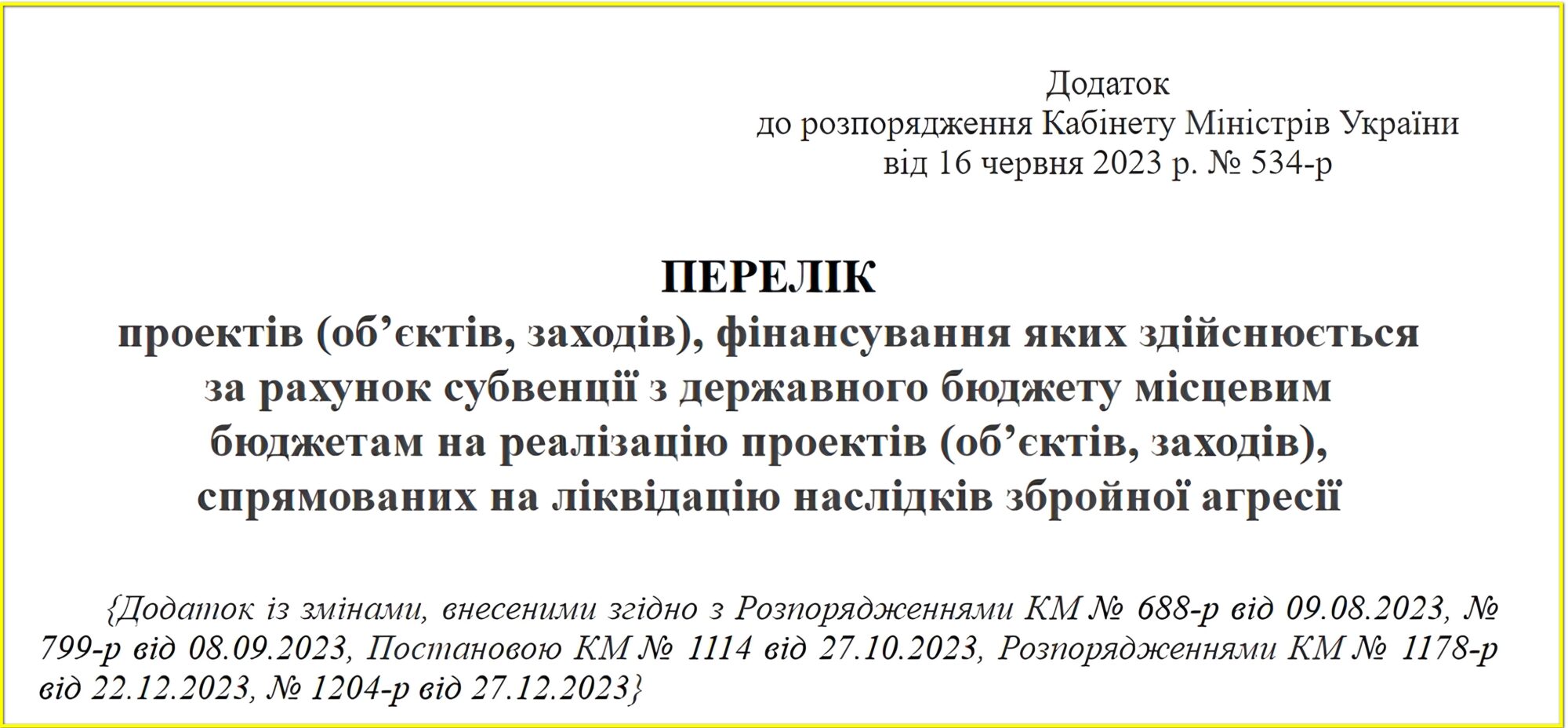
After the start of the full-scale war, a fund for eliminating the consequences of armed aggressionwas created, established by Cabinet of Ministers Order No. 534-r of 16 June 2023 ‘On the Allocation of Funds from the Fund for Elimination of the Consequences of Armed Aggression’. Donor- and credit-funded reconstruction programmes were added. Some of this money logically goes to critical infrastructure, but the boundary between ‘what was actually destroyed and is necessary’ and ‘a convenient project on which to spend funds’ became very blurred.
This is precisely where ‘Big Construction’ and ‘Midas’ meet: there it is energy, here it is roads and utilities, but the principle is the same:
wartime or special fund → attractively packaged infrastructure project → limited circle of contractors → back office with a ‘toll gate’.
Photo 2. Annex to Cabinet of Ministers of Ukraine Order No. 534-r of 16 June 2023 listing projects financed from the fund for eliminating the consequences of armed aggression.
3. Odesa: miniatures of a larger scheme
The Odesa cases are not local ‘unfortunate coincidences’. They are practical demonstrations of how a large architecture turns into land, trenches, traffic jams and damaged ecosystems.
3.1. Kuialnyk Estuary: a road as a pretext for ‘golden land’
The Kuialnyk Estuary has the status of a resort of national significance — under Law of Ukraine No. 2637-VIII of 5 December 2018 ‘On Declaring the Natural Areas of the Kuialnyk Estuary in Odesa Region a Resort of National Significance’.
In addition, Kuialnytskyi National Nature Park was created on its territory by Presidential Decree No. 3/2022 of 1 January 2022 ‘On the Creation of Kuialnytskyi National Nature Park’.
Formally, this is an area of special protection, where any construction should pass through the filter of strict environmental procedures and the requirements of the Law ‘On the Nature Reserve Fund of Ukraine’.
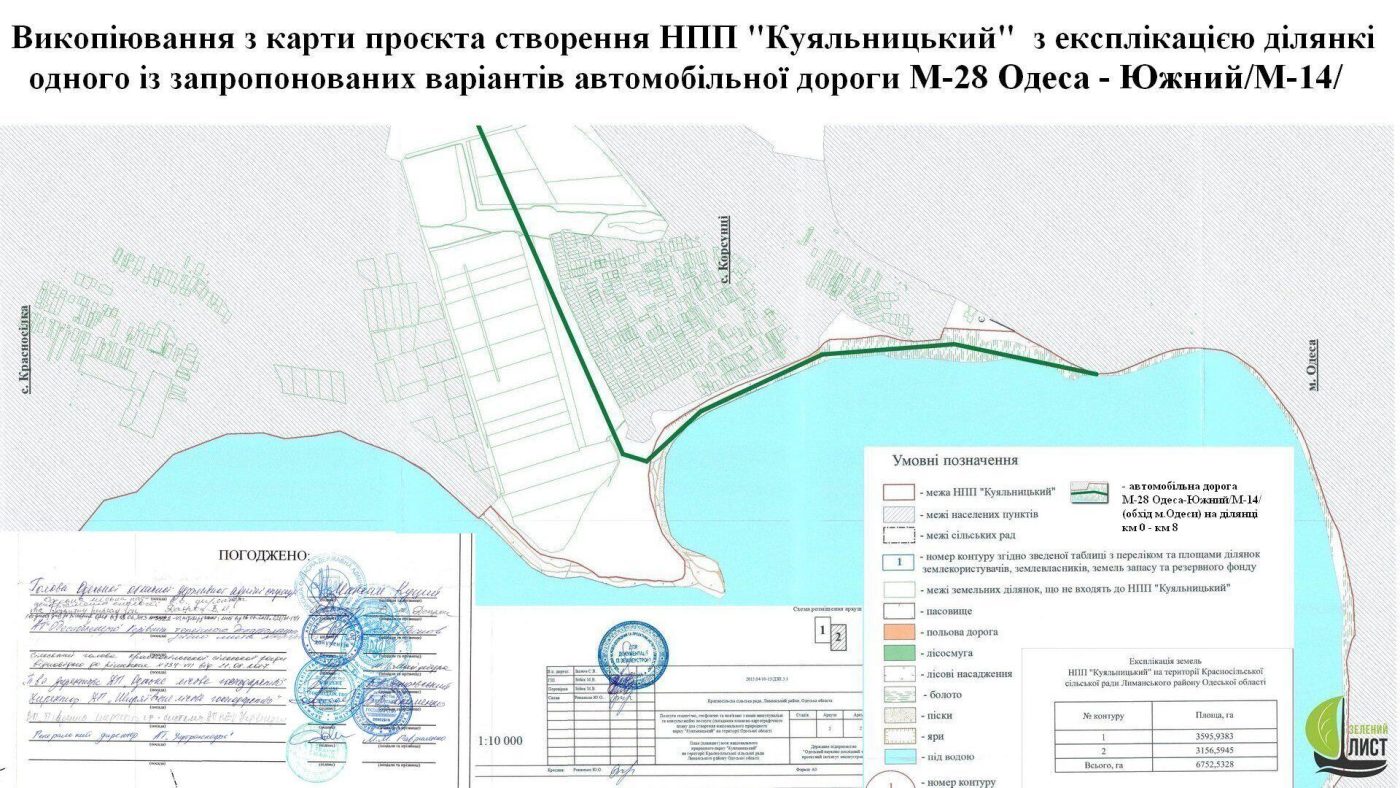
In 2021, the Road Service in Odesa Region (then headed by Dmytro Rybalko) proposed construction of a new section of the M-28 bypass road. Four route options were considered, but officials called the one running along the shore the ‘most advantageous’, while in practice it would run across the Kuialnyk Estuary floodplain.
Photo 3. Scheme of a possible road route under ‘Big Construction’ near the Kuialnyk Estuary and land plots that, according to a Green Leaf investigation, belong to families of local officials and related businesses.
A key political role in this process was played by Hryhorii Didenko — the current head of the Odesa Regional Council from the Servant of the People party (elected on its list). Key decisions passed through the regional council, and Didenko himself handled public communication with the community and officials. Another detail in the picture of power: his wife is a member of parliament from the same political force.
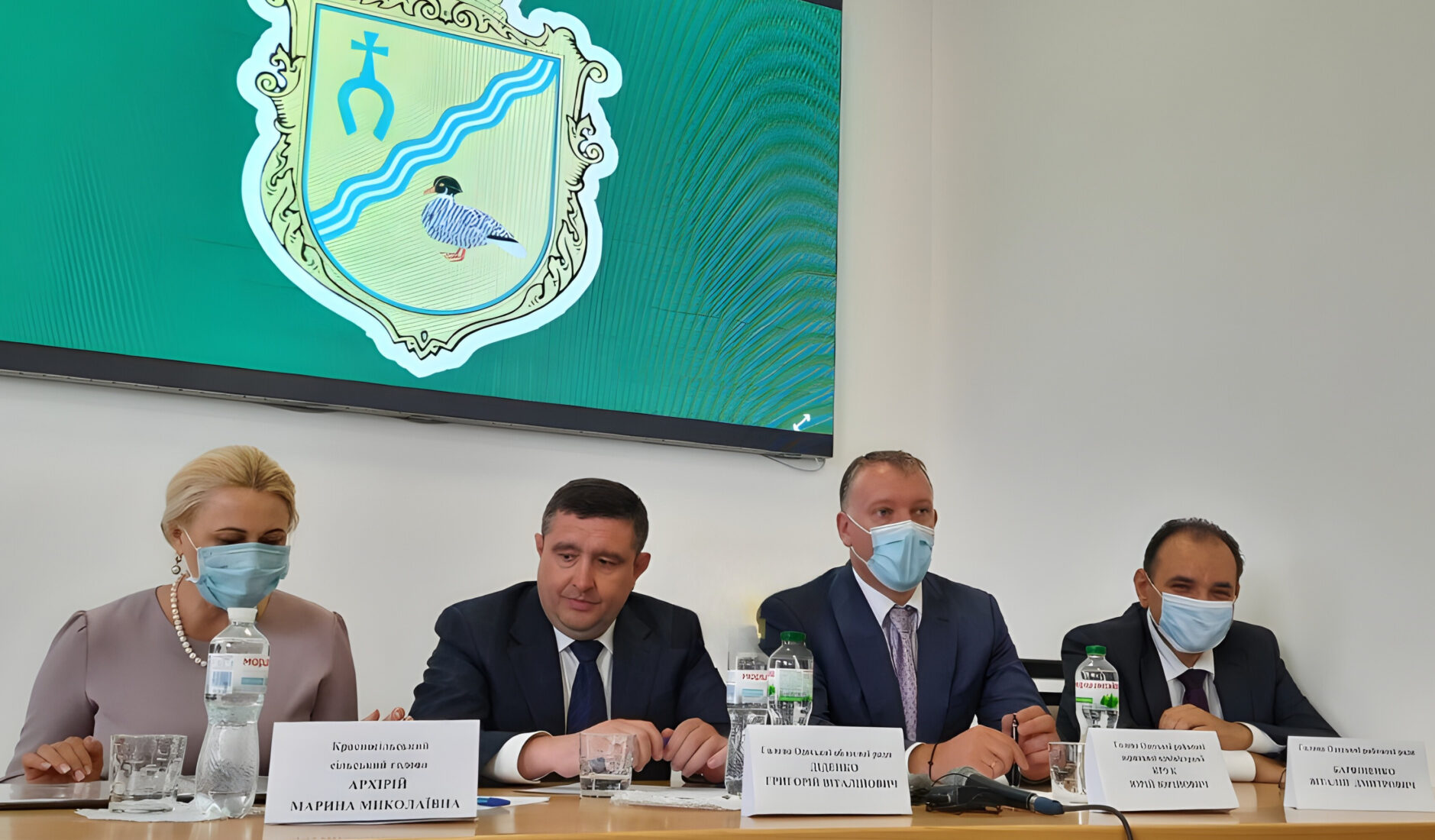
Photo 4. 19 May 2021, Krasnosilska Village Council. Discussion of the decision to build a road along the Kuialnyk Estuary floodplain, with the participation of (left to right): Maryna Arkhirii — head of Krasnosilska village; Hryhorii Didenko — head of the Odesa Regional Council (Servant of the People faction); Yurii Kruk — head of the Odesa District State Administration of Odesa Region; Vitalii Barvinenko — head of the Odesa District Council.
An investigation by the Green Leaf NGO showed that, several years before the planned road, land in the future route area had come into the hands of:
the family of long-serving Krasnosilska Village Council head Mykola Maidebura and his relatives;
the mother of the current community head, Maryna Arkhirii;
relatives of village council secretary Horduzenko;
former district council deputy Artak Yuzbashian, whose company Berezivkaahroshliakhbud regularly received road contracts;
a number of businesspeople linked to Odesa elites, including the orbit of Volodymyr Galanternik.
The logic is simple and cynical:
if the road passes through the plots, the state will buy the land at an inflated price; if it passes nearby, land prices will rise severalfold.
Thus, ‘Big Construction’ here is not only a potential road contract for construction firms but, above all, a tool for monetising land bought in advance by ‘their own people’, with the active participation of regional council leaders representing the ruling party.
In parallel, the environmental dimension is completely ignored: the risk of destroying the estuary, disrupting hydrology, and degrading a resort of national significance. Only the beginning of the full-scale war prevented this road project from being implemented in its original form. Yet it has effectively already been ‘relaunched’ in another form — through the newly created Kuialnytskyi National Nature Park ‘Kuialnytskyi’, registered in 2024 and headed by director Oleksandr Shestun. According to local activists and participants in the process, Odesa Regional Council head Hryhorii Didenko lobbied for his appointment, which they say allows political control over the floodplain to be maintained under the guise of nature protection.
As with the water-main project, the same political actors appear in the processes surrounding the route near Kuialnyk, including Odesa District Council head Vitalii Barvinenko. This recurring ‘set of faces’ is the clearest answer to why these projects are pushed so persistently despite environmental and public risks
3.2. Water main to French Boulevard: war as a pretext for a developer’s dream
The second Odesa example is the construction of trunk water-supply networks from Bahrytskoho Street to French Boulevard, which began in 2023, already during the full-scale war. The official procurement name is ‘New construction of trunk water-supply networks from Bahrytskoho Street to French Boulevard in Odesa (Phase 1 — from Bahrytskoho Street to Fontanska Road; Phase 2 — from Fontanska Road to Akademichna Street)’.
Photo 5. Screenshot from Spending.gov.ua: Contract No. 22-23/P dated 18 August 2023 for ‘construction of trunk water-supply networks from Bahrytskoho Street to French Boulevard in Odesa (Phase 1 — from Bahrytskoho Street to Fontanska Road)’ worth UAH 111,924,836.22. Contractor — Avtomahistral-Pivden LLC.
Officially, this is described as ‘improving water-supply reliability’. In practice, we have:
two major contracts with Avtomahistral-Pivden worth a total of about UAH 217.55 million for the first and second phases of the water main (2023 tenders).
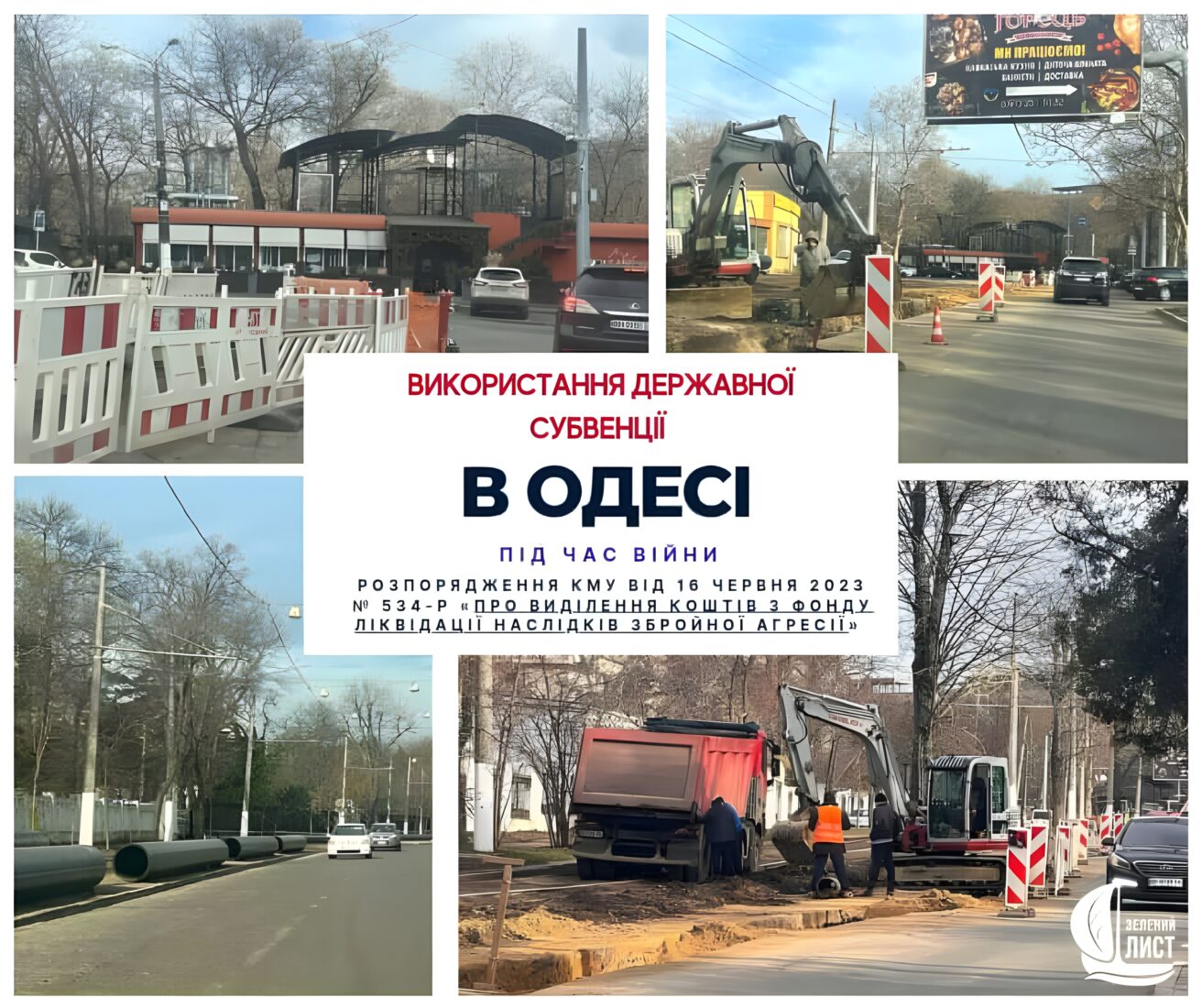
financing from a subvention from the fund for eliminating the consequences of armed aggression under Cabinet of Ministers Order No. 534-r of 16 June 2023 and co-financing from the city development budget (as shown in the explanatory notes on implementation of Odesa’s budget).
a route that digs up key thoroughfares — French Boulevard, Krasnova, Hovorova, Vodoprovidna and Akademichna streets — simultaneously, effectively blocking connections between the city centre and the Kyivskyi and Khadzhybeiskyi districts.
The logic is familiar again:
the ‘fund for eliminating the consequences of aggression’ → a ‘good’ water-main project → a contract for a ‘Big Construction’ favourite → a trunk line that conveniently serves new development.
Viewed through the prism of the war, another dimension of this project becomes apparent. Money from the fund for eliminating the consequences of aggression could have gone to genuine security of urban infrastructure: : construction and modernisation of shelters, upgrading treatment facilities, building stormwater drainage, and strengthening protection of energy facilities against strikes. Instead, taxpayers’ money is effectively being invested in servicing commercial real estate — new high-rise buildings along French Boulevard and in the Fontan area.
This example clearly shows how, in the authors’ view, developers draw budget resources toward themselves under the guise of ‘infrastructure recovery’. Investments that, under normal market logic, a developer would make at its own expense (bringing high-capacity utility networks to its projects) are paid for from state and city budgets. Financially, the state receives almost nothing additional from such ‘investments’ — apart from potentially higher property tax in the future, which does not cover either the scale of expenditure or the risks.
It creates the impression that somewhere between a ‘good’ project and a budget line there is a shadow officethat allocates funds not according to the logic of security and sustainable development, but according to access to taxpayers’ wallets. In this configuration, the key question is no longer ‘does the city need a water main?’ but ‘who exactly earns how much from its construction?’
At the same time, almost no one asks the basic engineering question: do the new water-supply technical conditions correspond to the actual capacities of wastewater and sewage-treatment systems? If the city sharply increases water supply to densely built-up neighbourhoods without modernising sewerage, stormwater drainage and treatment facilities, it gets not progress but future accidents, flooding and environmental problems. The water-main project is rarely considered from this perspective — the pipe ‘to the site’ is treated as more important than the city’s integrated water cycle.
It is telling that the same person appears both in the Kuialnyk Estuary story and in the scheme surrounding the water main — Vitalii Barvinenko, head of the Odesa District Council and a long-standing player in Odesa politics. He is present both in decision-making processes around the route near Kuialnyk and in the configuration of influence surrounding major infrastructure projects in the city. It is therefore unsurprising that local activists increasingly voice the view that, if NABU wants to see the full picture, Barvinenko may be someone with information relevant to investigators.
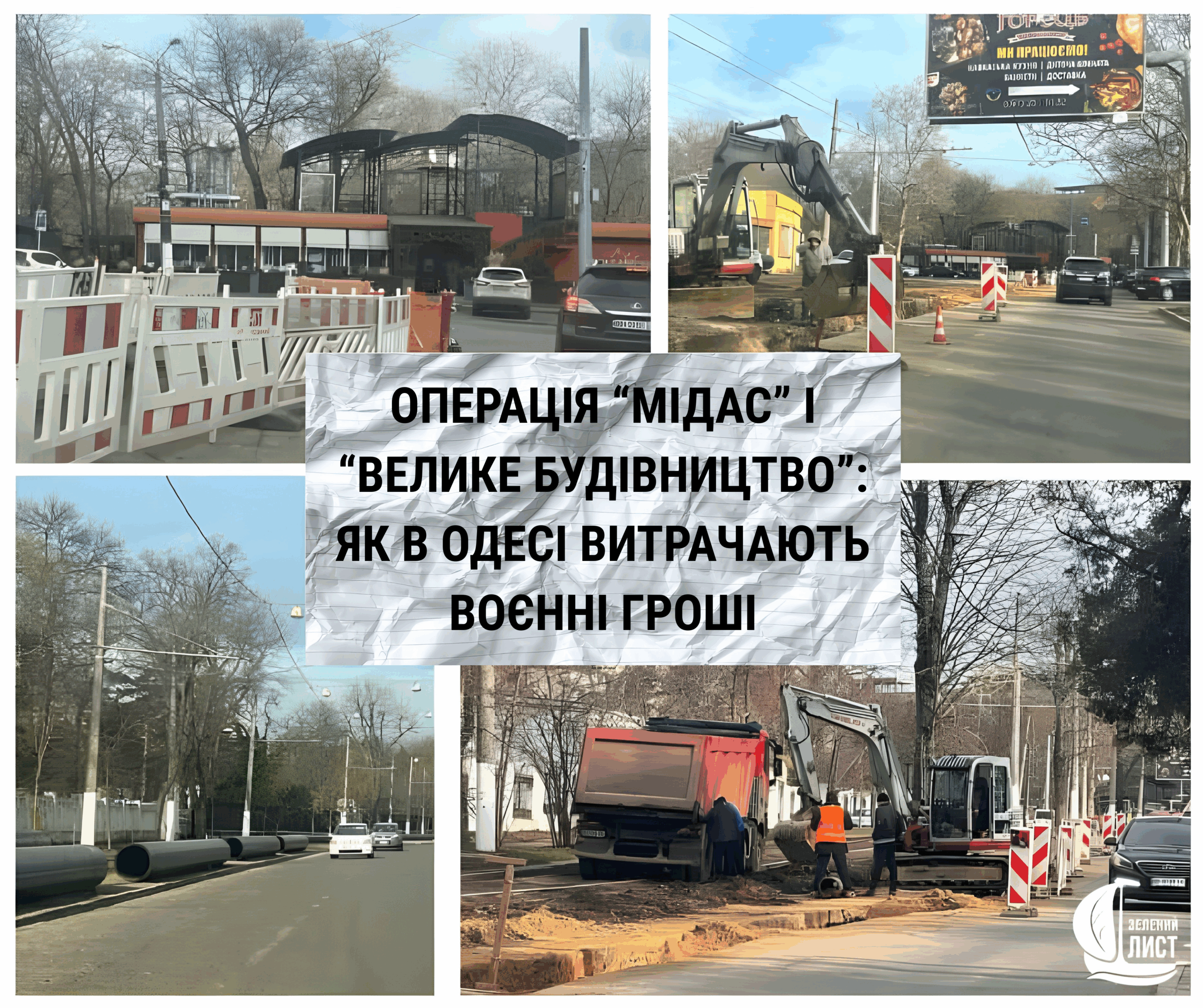
Photo 6. A Green Leaf NGO collage about the use of a state subvention in Odesa during the war: construction of the trunk water main and road works on French Boulevard under Cabinet of Ministers Order No. 534-r ‘On the Allocation of Funds from the Fund for Elimination of the Consequences of Armed Aggression’.
4. What is at stake and who must make the move
Operation ‘Midas’ showed that the back-office model has reached the level of strategic sectors in Ukraine. It operates not only in a hypothetical territorial community or city council but also in multibillion-hryvnia structures such as Energoatom. There, a 10–15% ‘toll gate’ on each contract turns into tens of millions of dollars in cash that bypassed the budget for years.
‘Big Construction’ created an ideal substratefor this model: concentration of funds, a few favoured contractors, a political curator at the centre, weak tender transparency, and a willingness to redirect special funds (COVID, wartime, reconstruction) toward ‘needed’ projects. The Odesa stories about Kuialnyk and the water main show how this scheme has already learned to disguise itself as reconstruction: on paper, a wartime fund goes to ‘eliminating the consequences of aggression’, while in practice it services new commercial real estate and the land interests of local elites.
The stakes here are much higher than one water main or one road across a floodplain. If back offices survive ‘Midas’ and calmly adapt to post-war reconstruction, we will get:
loss of donor confidence, with every new scandal providing an argument to reduce assistance or attach stricter conditions;
damage to European integration, where the rule of law and anti-corruption are not a box-ticking exercise but a basic filter;
a chronic shortage of money for genuine security — shelters, network modernisation, protection of energy facilities — because resources will continue to go into pipes serving high-rise buildings rather than cities.
If, however, ‘Midas’ becomes the beginning of dismantling this system, painful but obvious steps will have to be taken. At the national level — not merely bring the case to verdicts, but extend the logic of this investigation to other sectors: infrastructure, reconstruction, and local budgets. This requires public registers of all projects financed from wartime funds, with transparent information on contractors, amounts, and links to actual destruction.
At the local level — stop pretending that any pipe or road built during wartime automatically becomes a sacred project. Communities, media and activists should ask simple questions: does this project really protect people from the war, or does it simply raise the price per square metre? are new networks synchronised with sewerage, treatment facilities and stormwater drainage, or are future technological accidents being prepared for us?
And finally, at the level of personal responsibility — stop pretending that recurring surnames mean nothing. When the same figures appear in schemes around Kuialnyk, the water main, road tenders and wartime funds, this is no longer coincidence but a political construction. And this is a question not only for NABU but also for voters who press the same buttons on the ballot each time.
In the end, the choice is very simple. Either we dismantle the back offices — and then wartime and reconstruction money works for shelters, networks, protection of energy facilities, and genuine modernisation. Or they dismantle the country — methodically, one piece at a time, from Energoatom to every individual city, hiding behind attractive labels such as ‘Midas’, ‘Big Construction’ and ‘eliminating the consequences of aggression’.
If the second scenario prevails, ‘Big Construction’ will be remembered not as an infrastructure leap but as a dress rehearsal for a grand carve-up of post-war Ukraine. And then no attractive recovery strategies will change a simple fact: a country fighting for freedom continues to lose to its own back offices.