After the Russian strike on the Pivdennyi port, thousands of tonnes of sunflower oil reached Odesa beaches
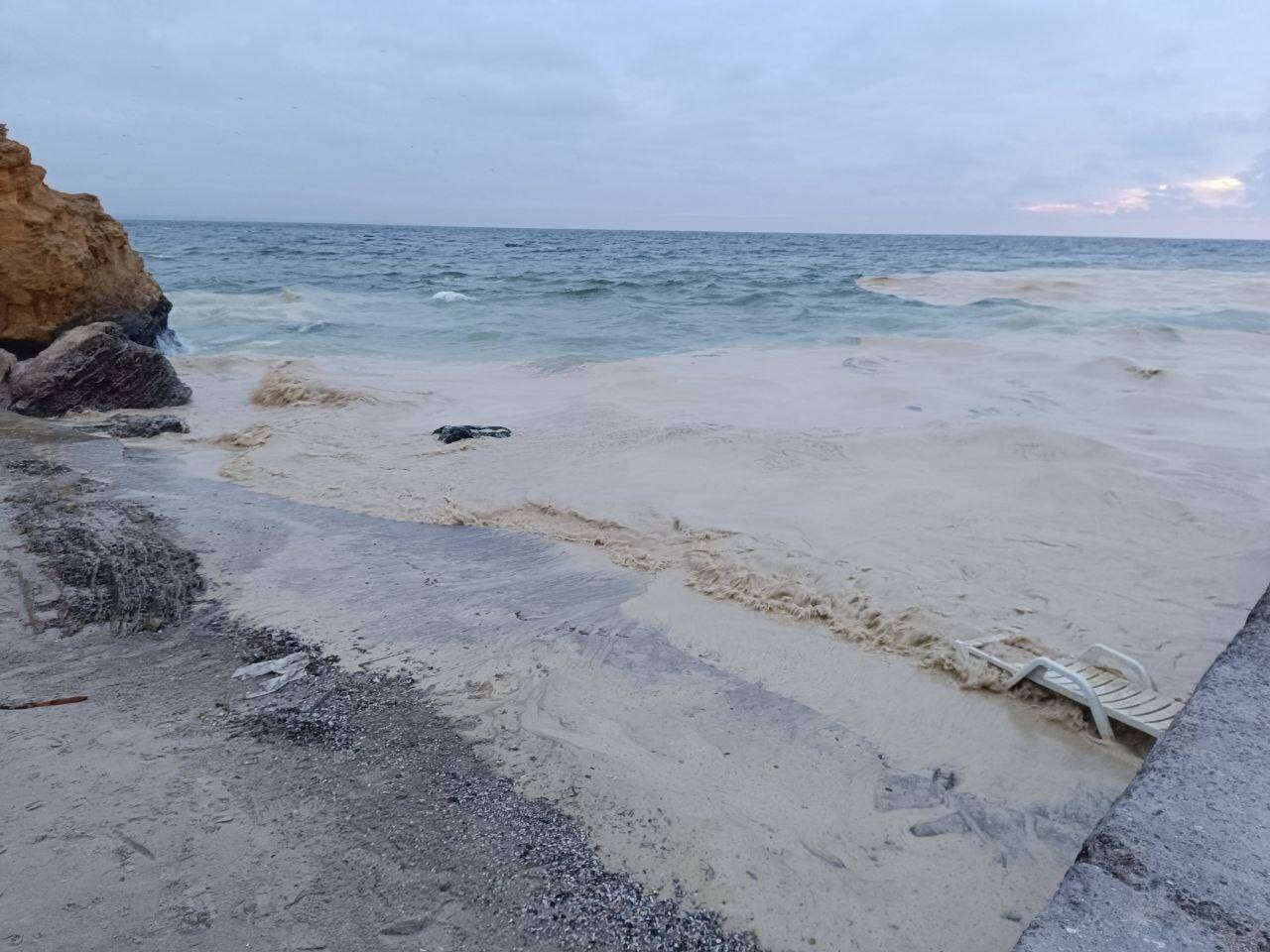
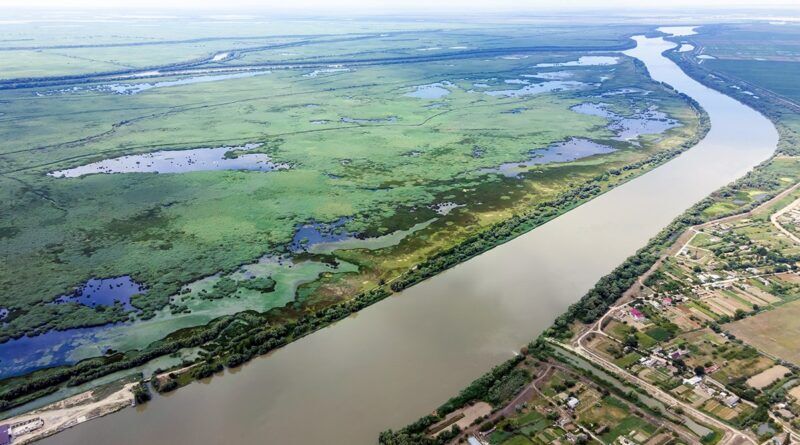
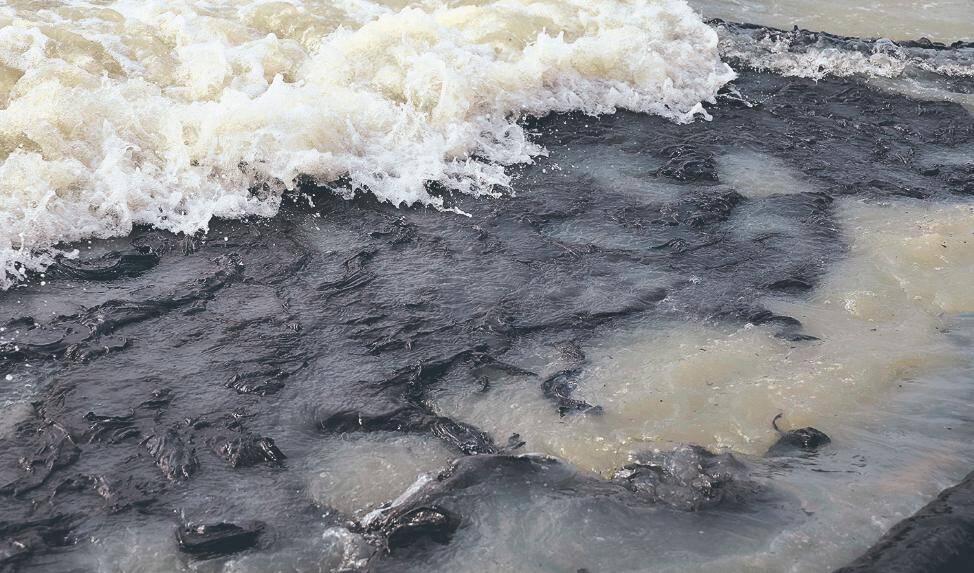
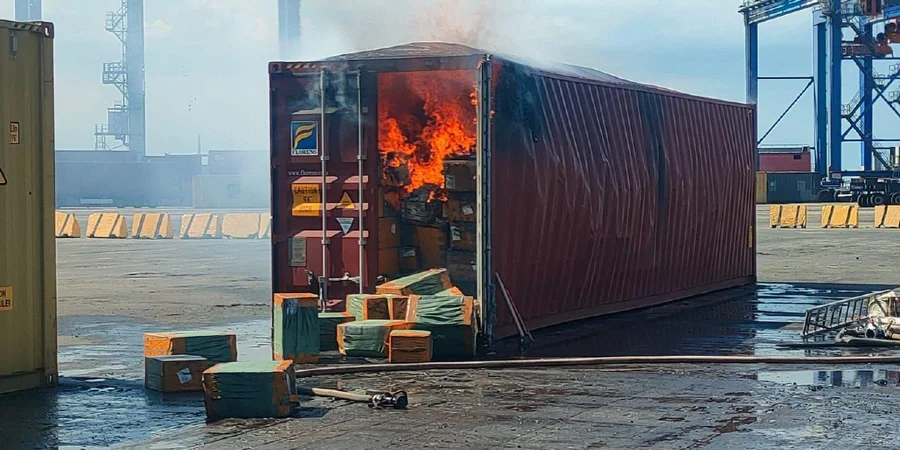
A Russian attack on Ukraine’s civilian port infrastructure led to one of the largest environmental disasters in Odesa Bay in the Black Sea since the start of the full-scale war. After the shelling of a vegetable-oil terminal at the Pivdennyi port, thousands of tonnes of sunflower oil entered the marine environment and reached the Odesa coast several days later.
The consequences were recorded on city beaches: an oil film on the water, bird deaths, and a threat to unique coastal ecosystems.
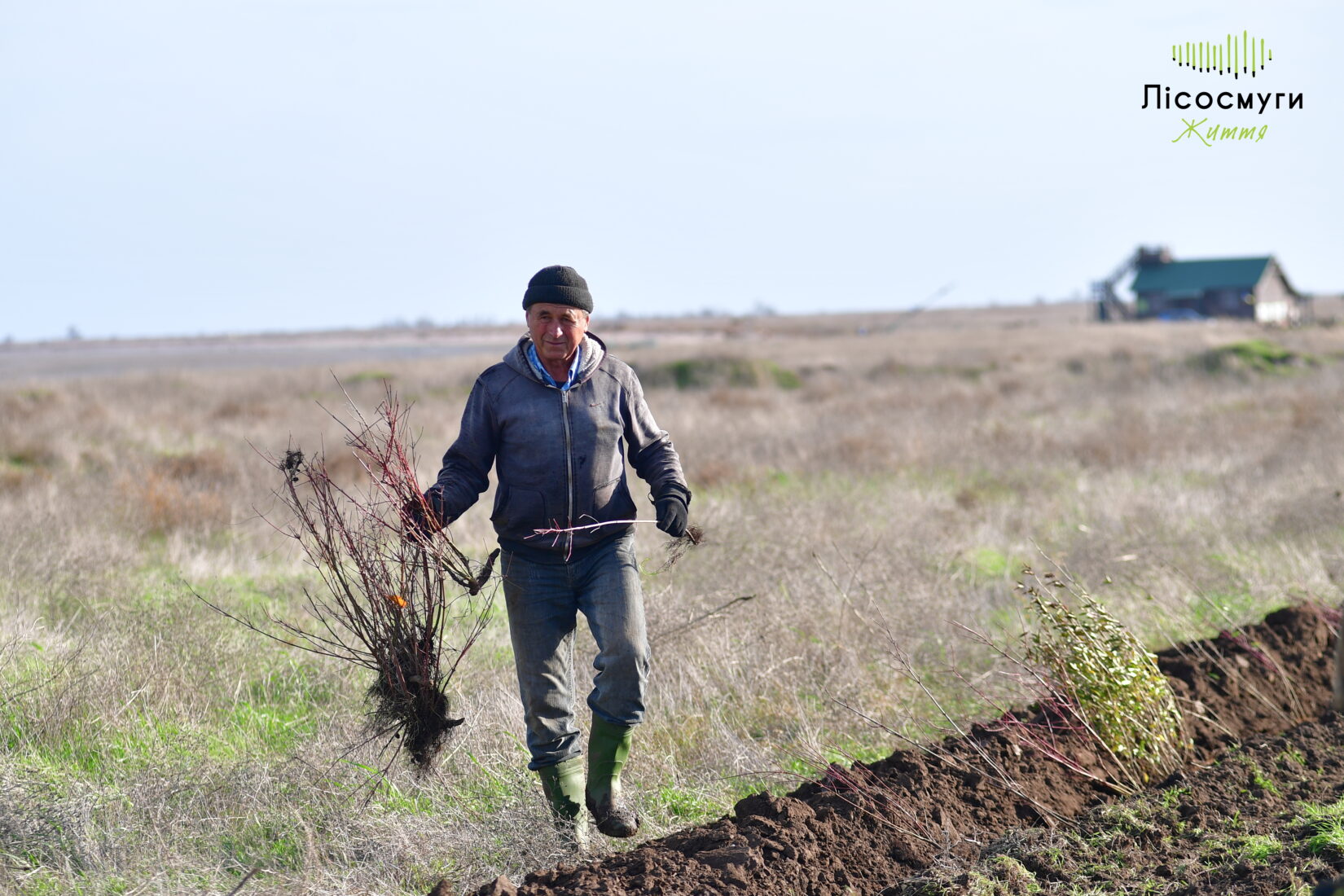
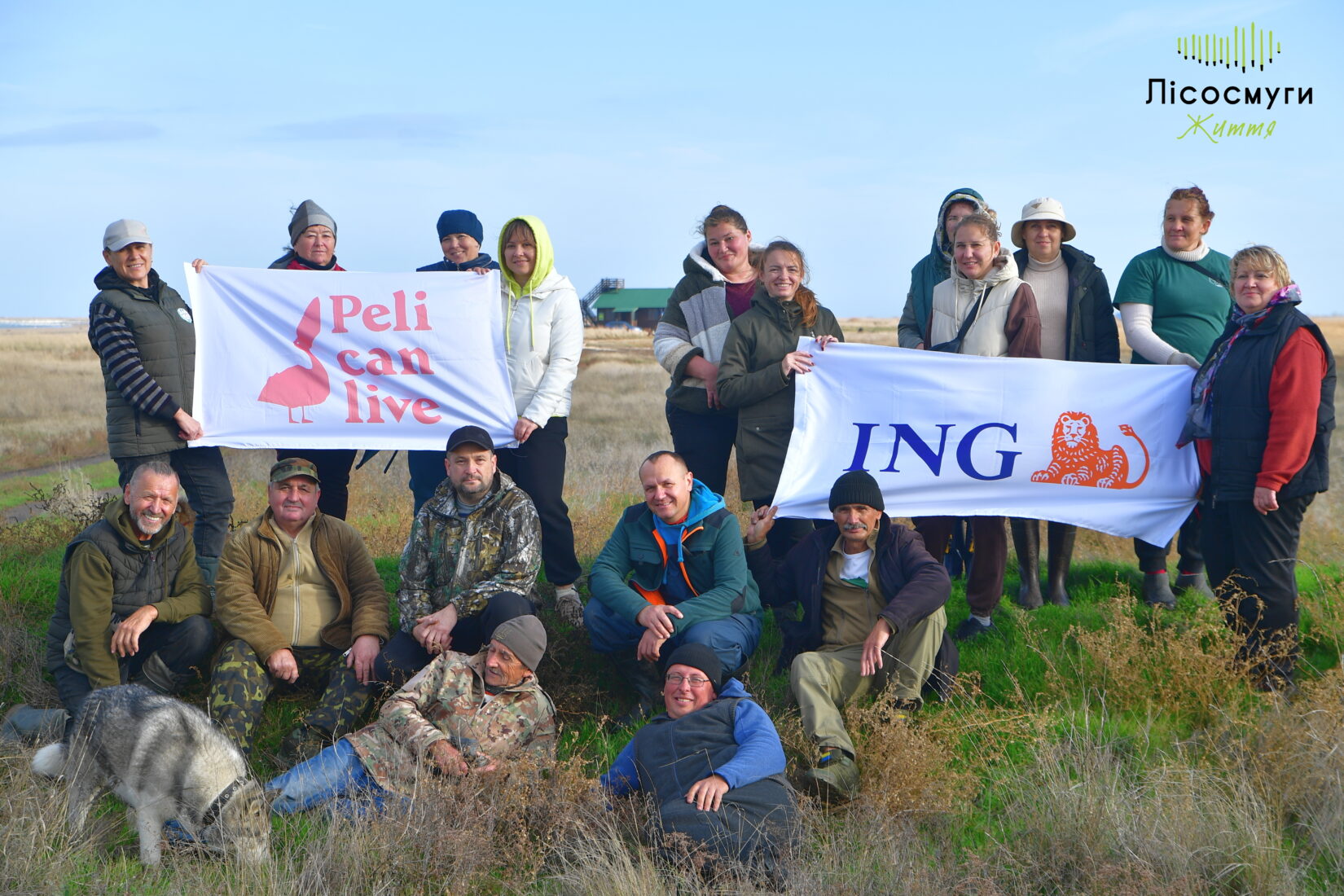
At the end of 2025, the steppe near Tuzlivski Lymany National Nature Park changed. Along the boundary between the protected area and arable land, a new living line of defence appeared: the first one and a half thousand trees and shrubs were planted as part of the Forest Belts of Life project, implemented by the Peli can live charitable foundation in partnership with NUBiP Ukraine with financial support from #INGBankUkraine.
This is not a one-off ‘planting campaign’ but the beginning of systematic work to demarcate the steppe, protect soils, and introduce a European approach to sustainable farming under climate change.
A living boundary instead of another furrow
The national park team set an ambitious goal: to create demarcation forest belts on the parts of the steppe most affected by illegal ploughing. These are narrow but extremely important strips of land along the Park boundary, where every year farmers may be tempted to ‘move the plough a little’ into protected steppe areas.
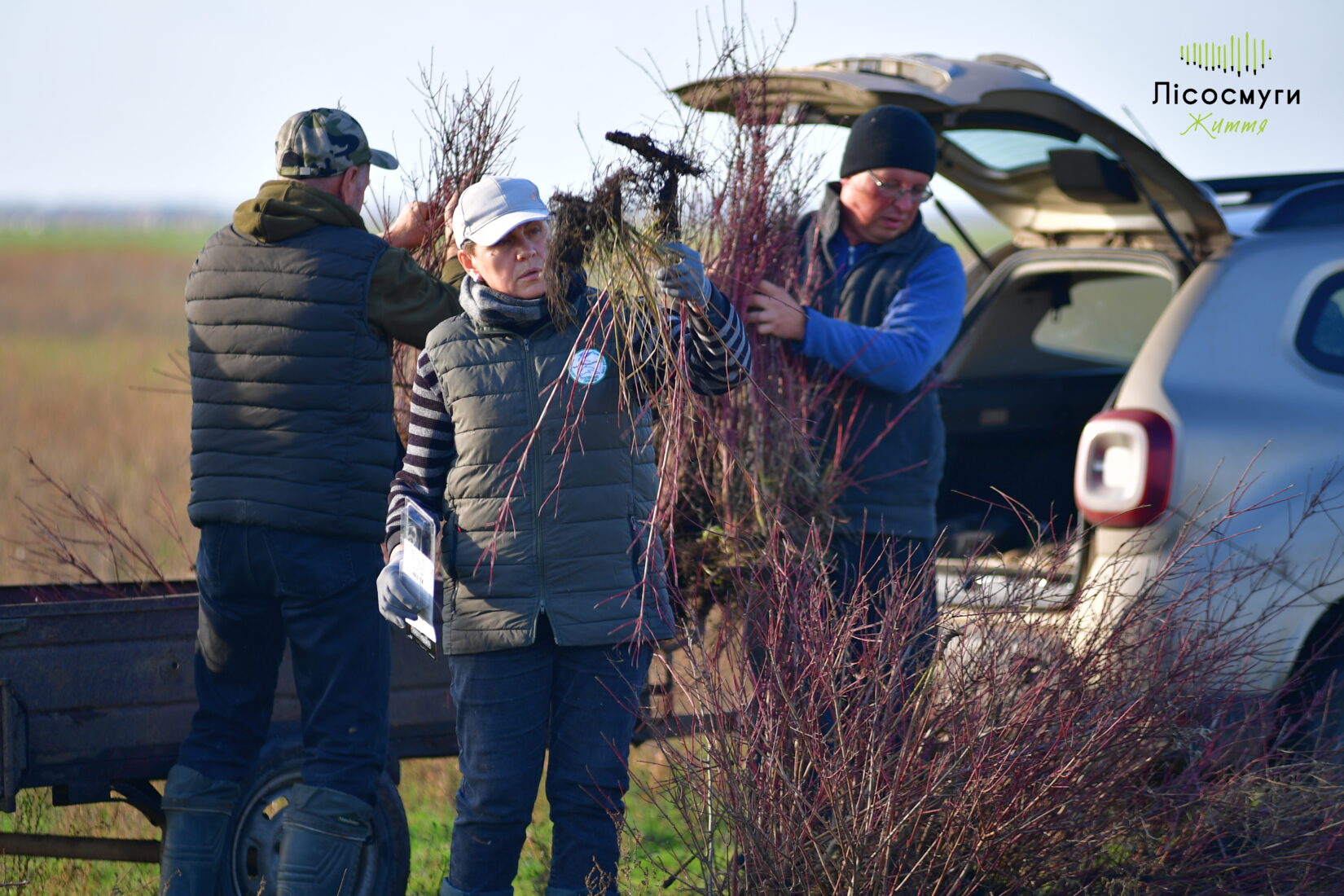
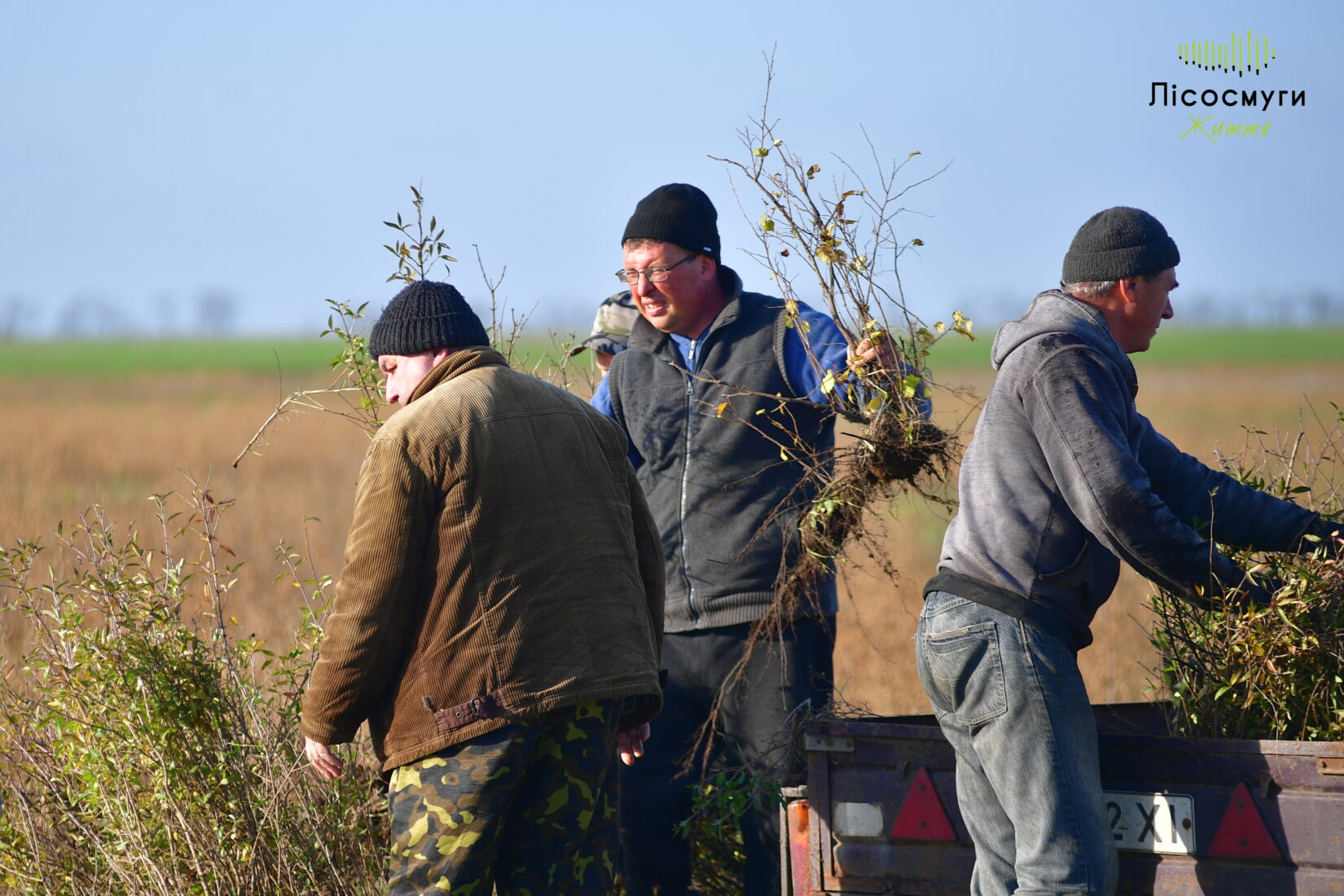
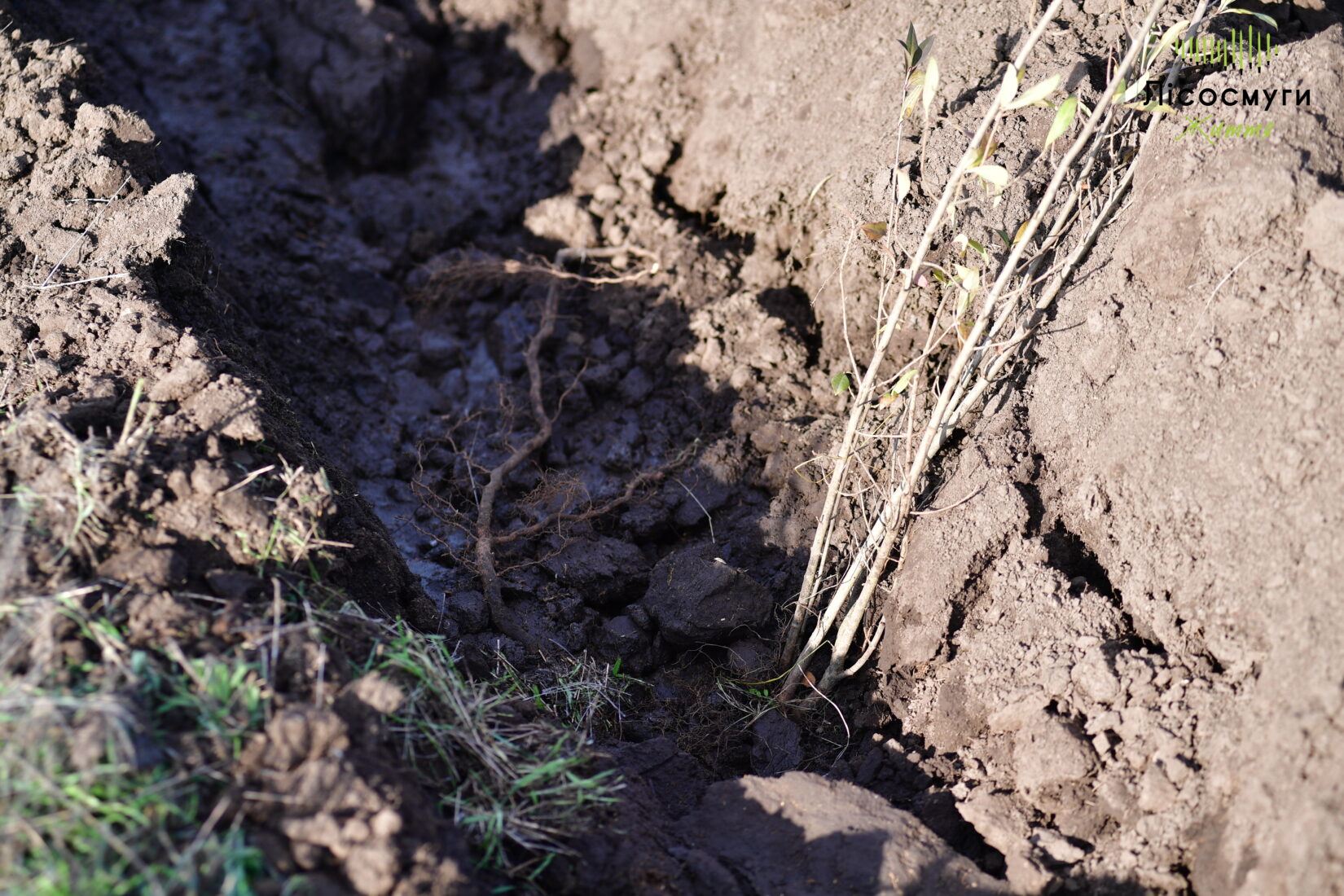
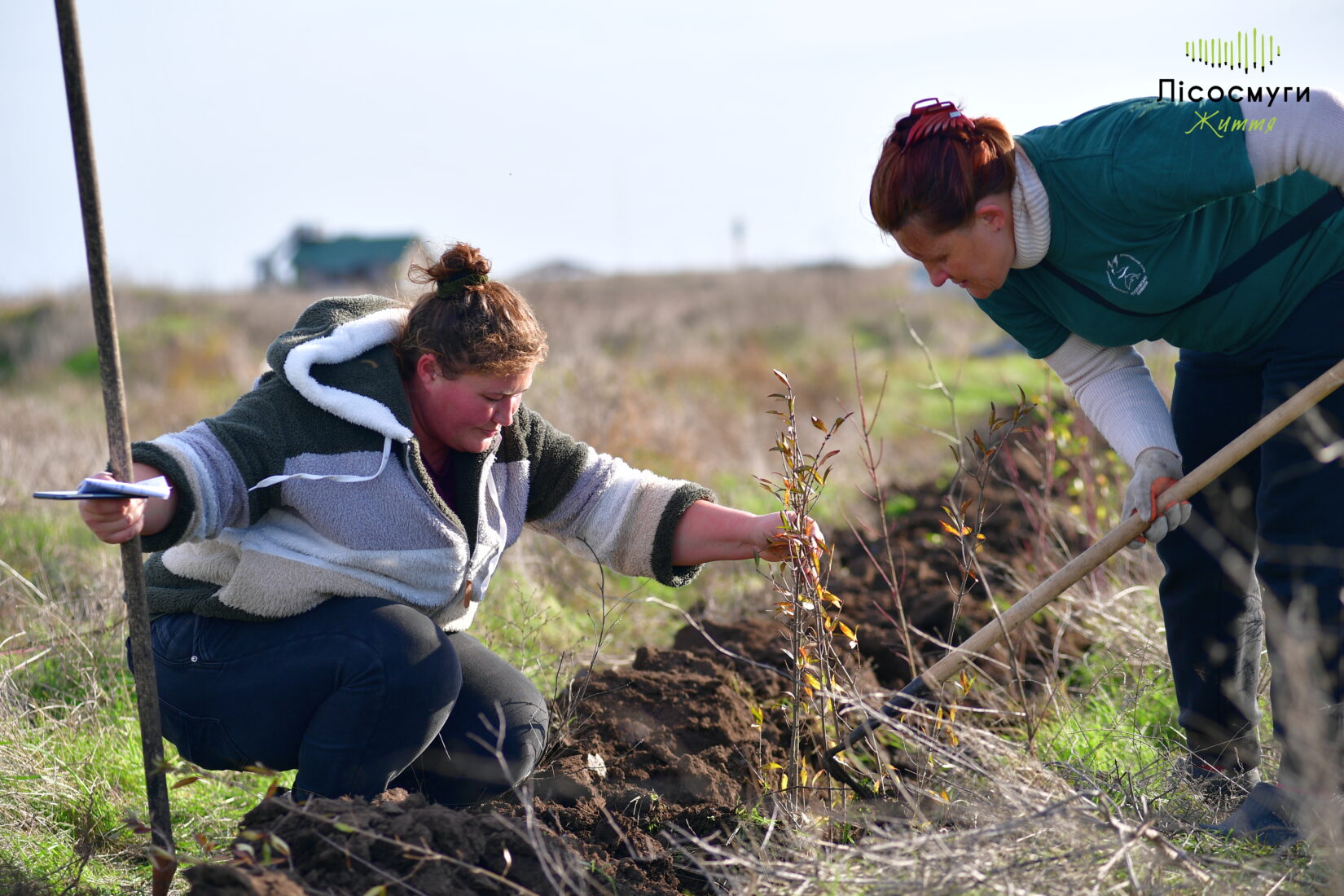
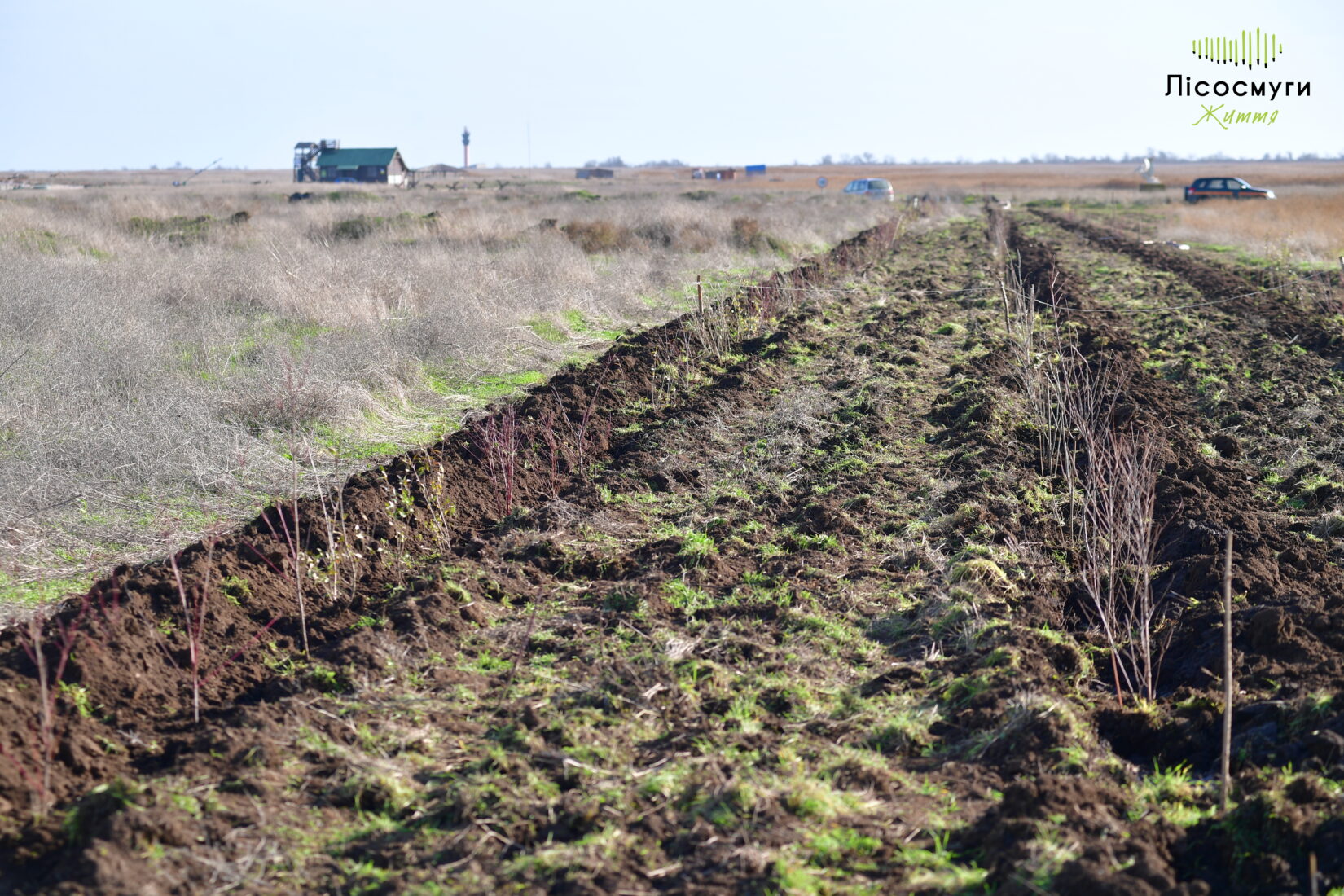
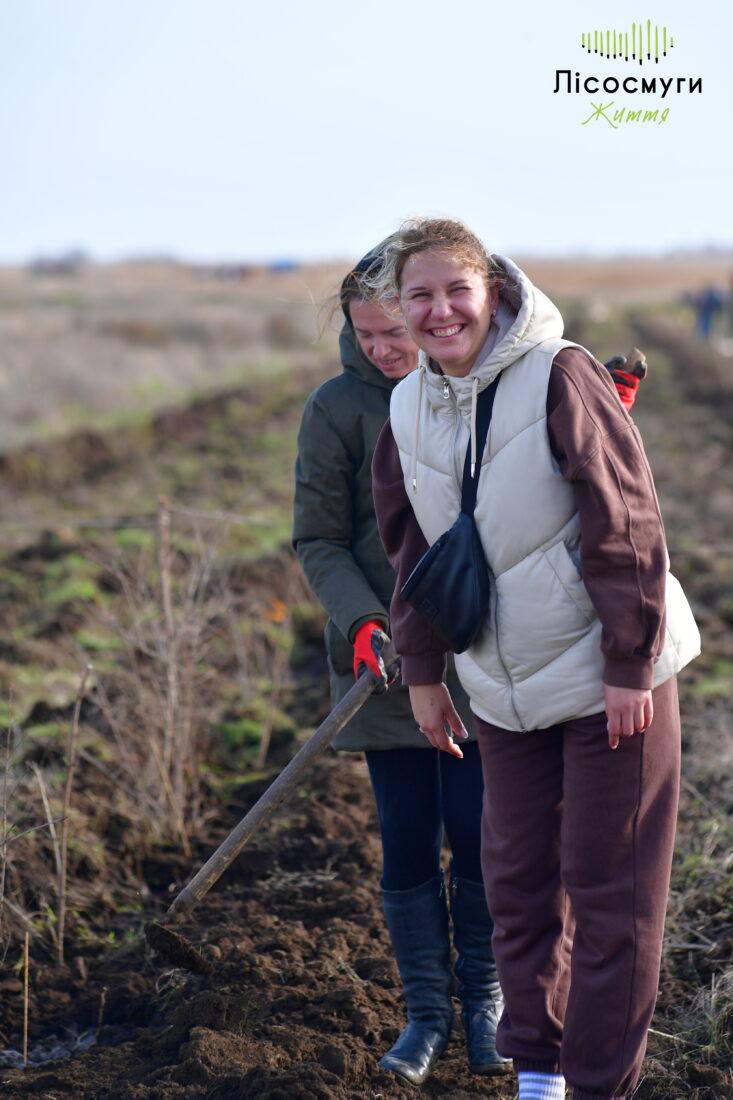
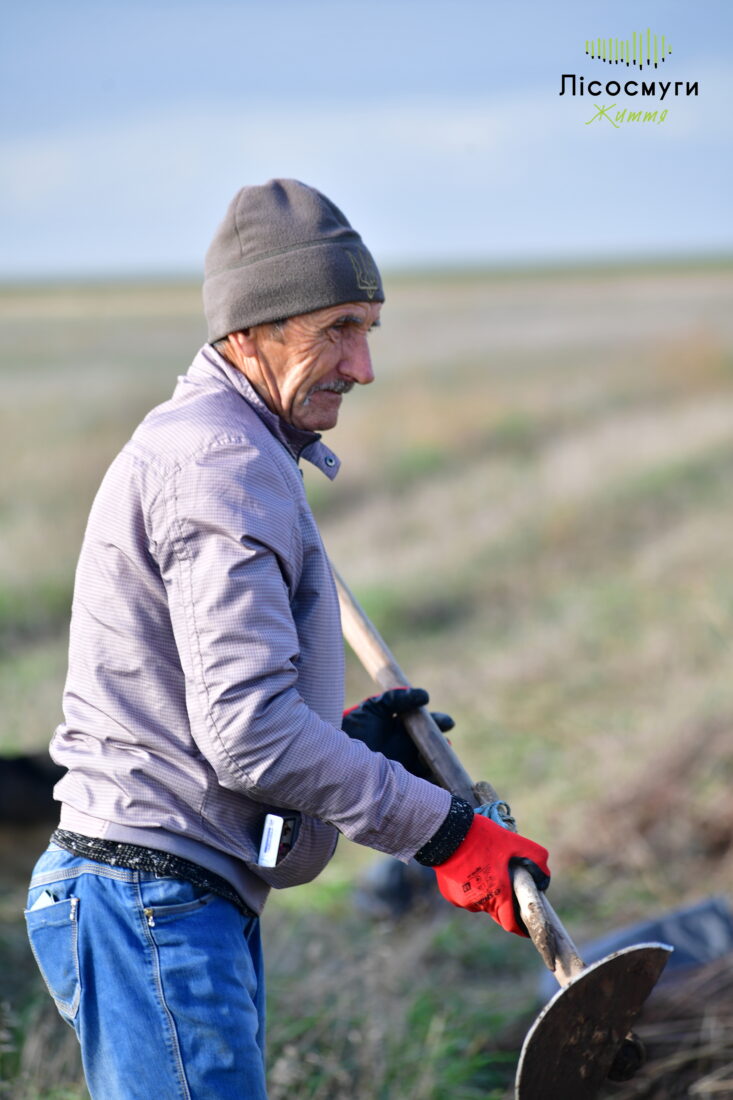
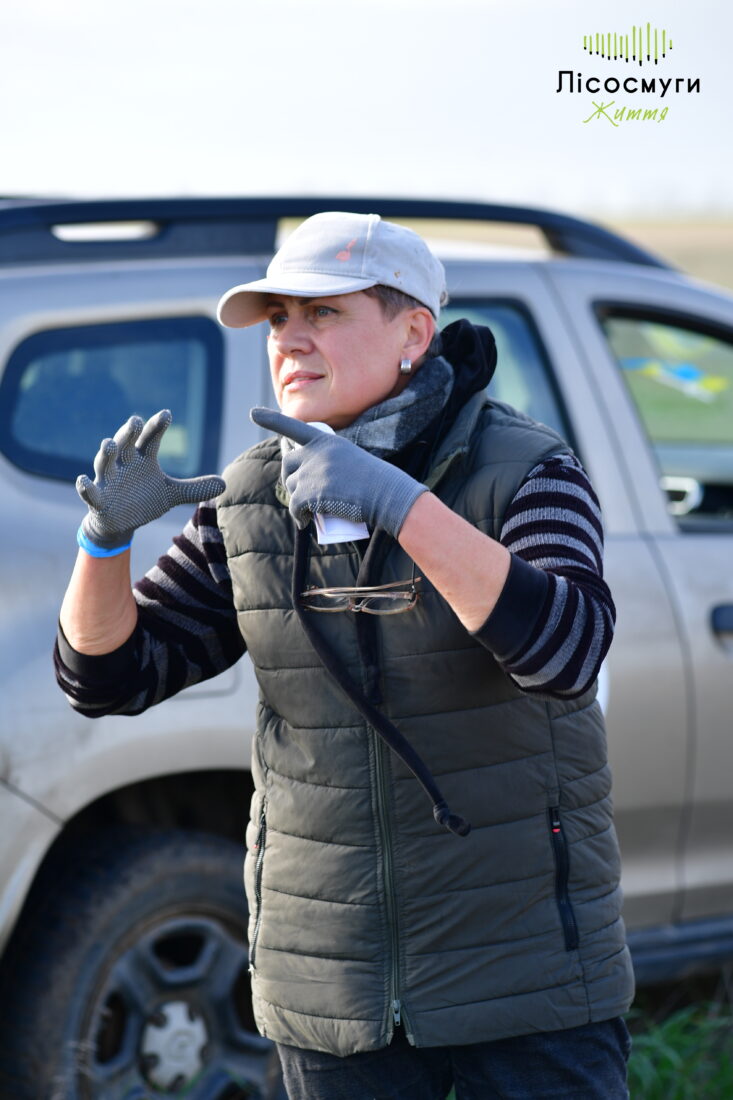
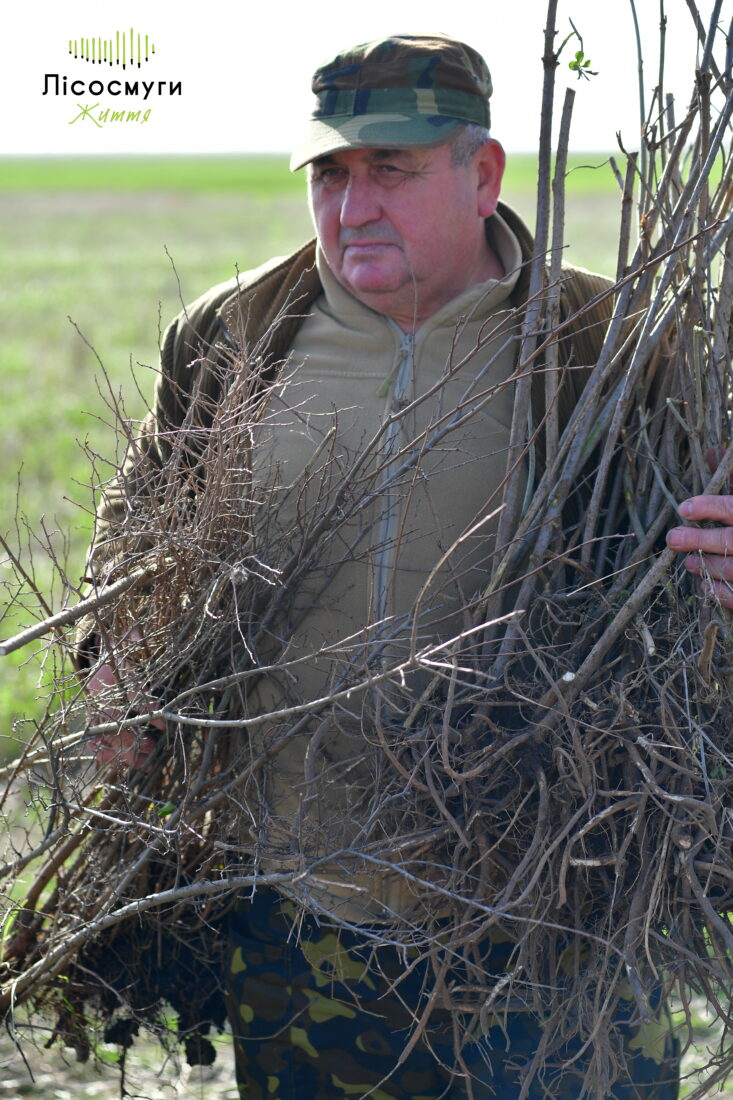
The first step is a pilot section, near the Shagany Lagoon, close toPrymorske village, about 500 metres long, planted in three rows of trees and shrubs.Here, rangers of Tuzlivski Lymany National Nature Park, park staff, botanists and volunteers, supported by the #ForestBeltsOfLife project, worked together to establish a new forest belt that already marks a living boundary between arable land and virgin steppe.
In the future, forest belts are also planned on other problematic sections of the Park; they will become the next link in a single protective belt around Tuzlivski Lymany National Nature Park. In the longer term, these separate sections are intended to become a continuous green line — a hedgerow that will not only physically prevent ‘creeping’ ploughing but also create an integrated ecological corridor along the Park.
For land users, such a forest belt is a clear signal: the arable field ends here and protected virgin steppe begins. For the steppe, it is a shield against machinery and erosion that will grow stronger each year; for the community, it is a visible marker that land has not only cadastral but also ecological value.
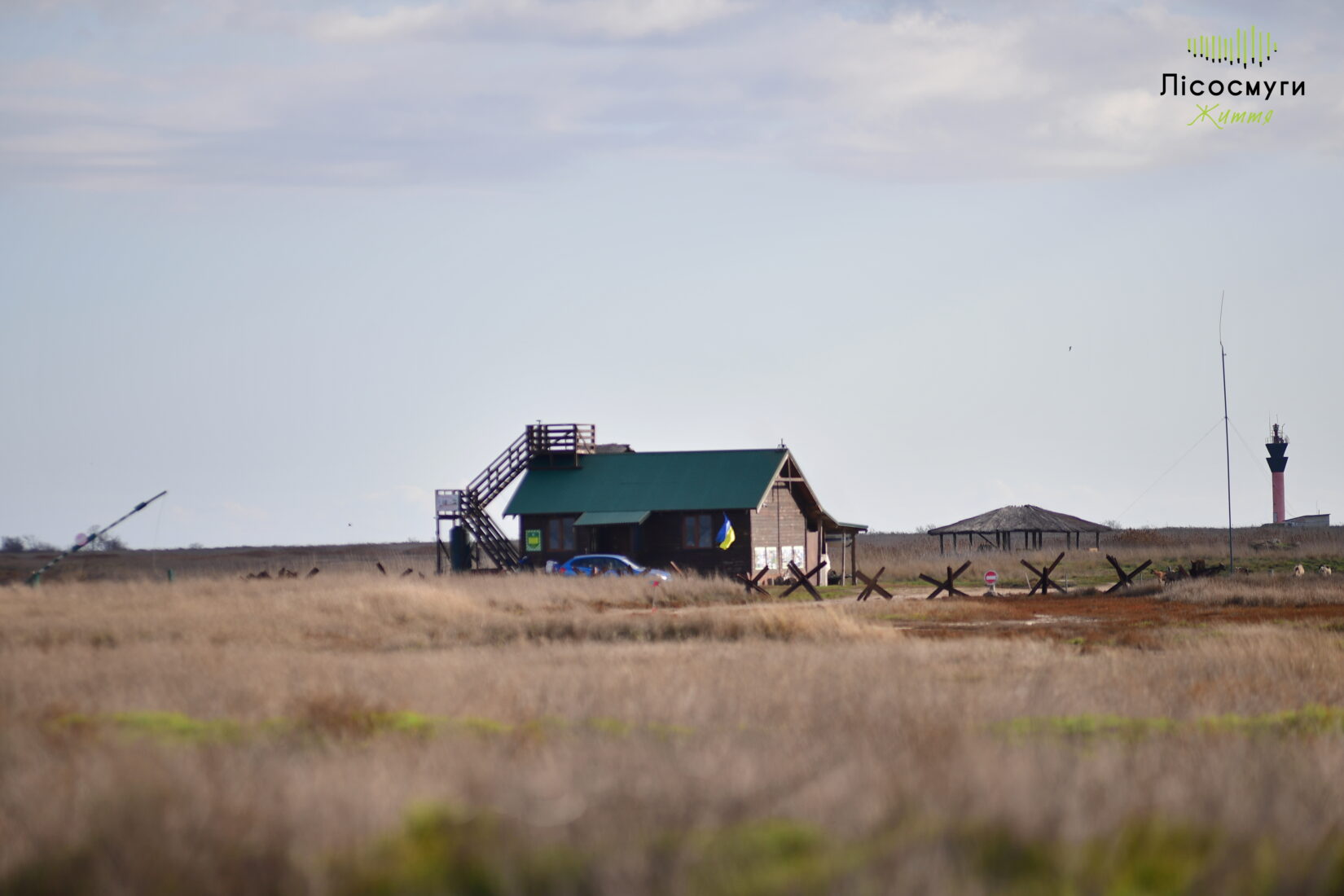
A protection post of Tuzlivski Lymany National Nature Park — the point from which rangers monitor the condition of biogeocenoses every day.
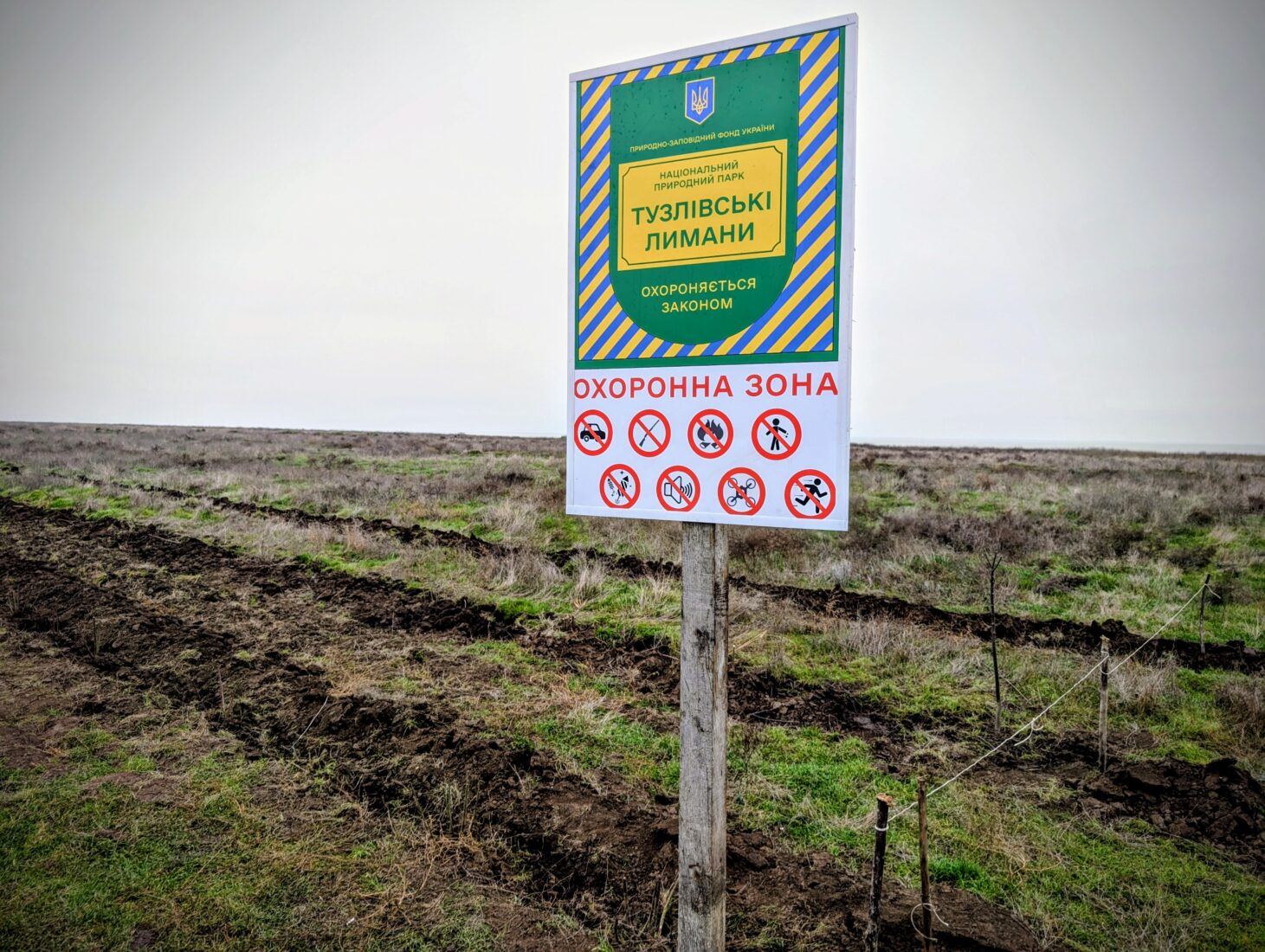
An information sign marking the protected zone of Tuzlivski Lymany National Nature Park clearly identifies the Park boundary beside the new demarcation forest belt.
The right to the steppe: a legal compromise with farmers
The Forest Belts of Life project near the Tuzlivski Lymany shows how confrontation can be replaced by cooperation. Conscientious farmers whose fields directly border the national park voluntarily agreed to allocate narrow strips of their land for the creation of demarcation forest belts.
For farmers, this means losing several metres of land, but in return they receive:
a clearly marked and legally understandable plot boundary;
a natural barrier against wind erosion and dust storms;
a better microclimate and more stable yields on the rest of the field in the long term.
The national park, in turn, undertakes:
scientific substantiation and planning;
organisation of the work and monitoring of plant survival;
subsequent care of the plantings.
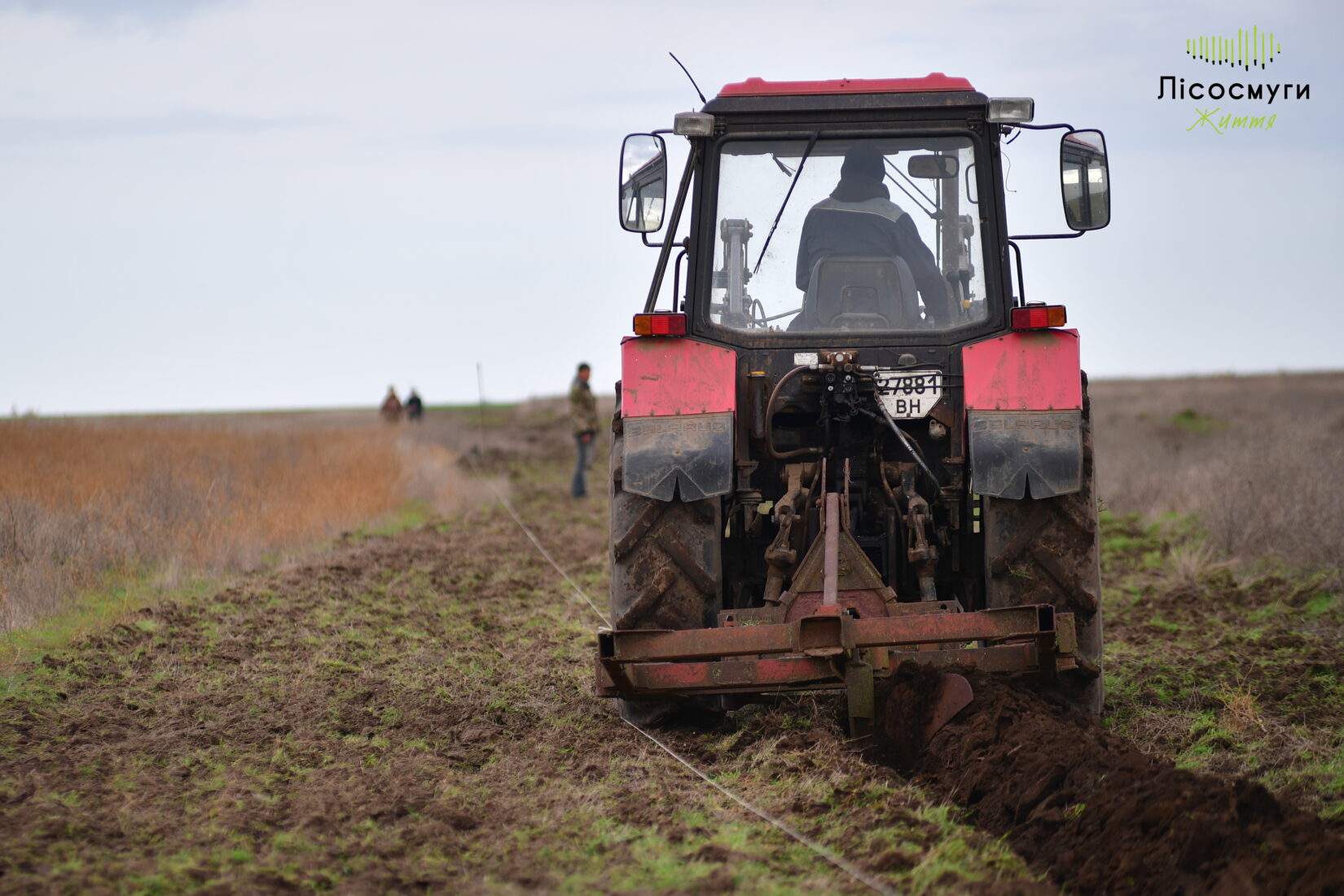
Ploughing the site — the first step towards a new demarcation forest belt.
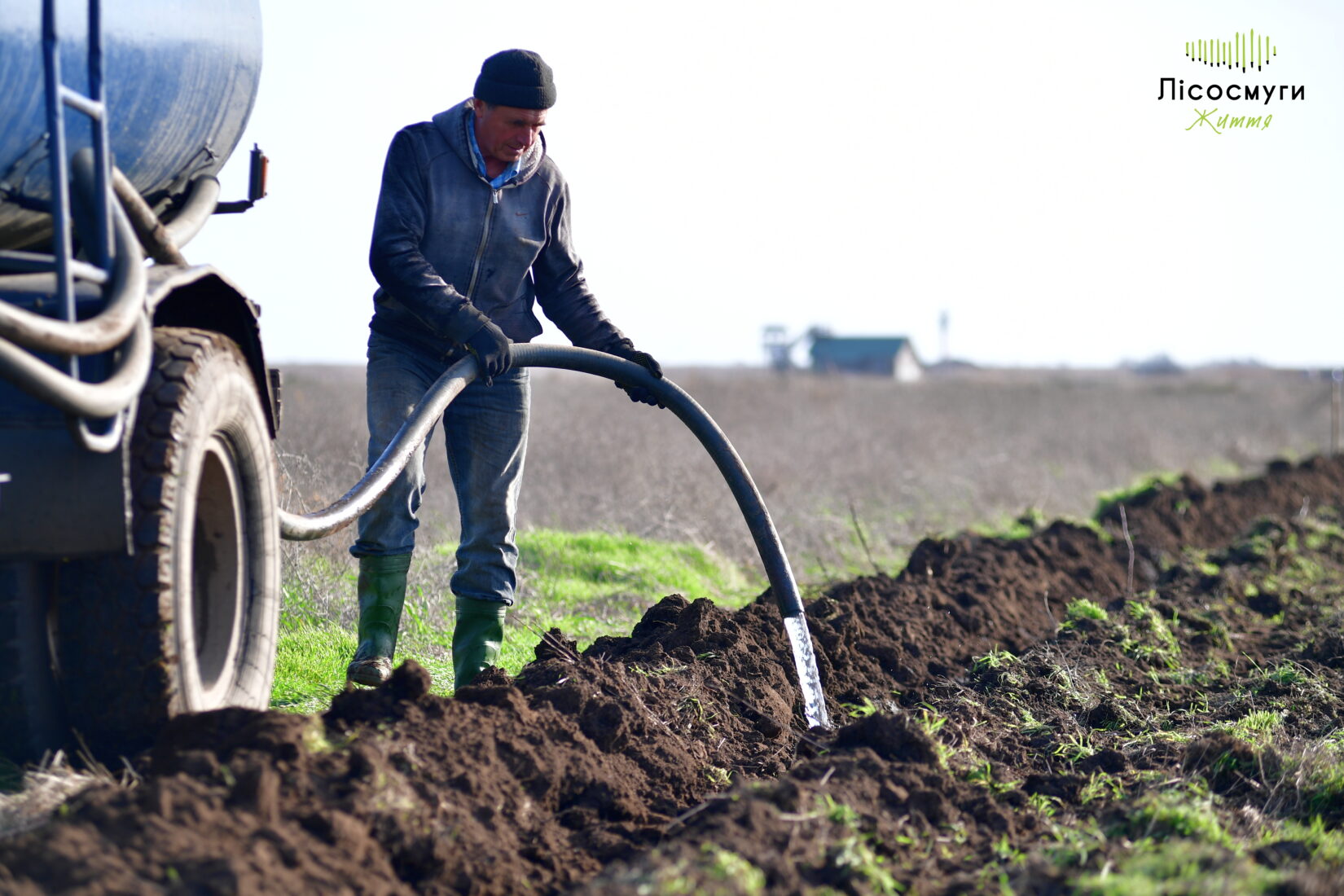
A Park employee waters the furrow, preparing the soil for planting trees and shrubs along the boundary of Tuzlivski Lymany National Nature Park.
The charitable foundationPeli can live and NUBiP provide the project with
expertise both at the planning stage and during plant-care stages;
material resources for organising planting and caring for the plants (property worth a total of UAH 110,397.00 was purchased for the Park and transferred into its ownership, including a walk-behind tractor, wood chipper, auger, electric fence energiser, and other items);
information support.
This model of work fully corresponds to the European approach to sustainable land use, where shelterbelts, hedgerows and buffer strips are regarded as integral infrastructure of the agricultural landscape, on a par with roads or irrigation.
Agroforestry as a response to climate change
Southern Odesa, Mykolaiv and Kherson regions are already living with the reality of aridification: droughts are becoming more fSouthern Odesa, Mykolaiv and Kherson regions are already living with the reality of aridification: droughts are becoming more frequent, hot dry winds stronger, and chernozem soils are losing humus.
Under such conditions, a forest belt is not merely ‘green decoration’ but a vital piece of natural engineering infrastructure.
The new demarcation forest belts near Tuzlivski Lymany National Nature Park will:
reduce wind speed and the intensity of dust storms;
retain snow and rainwater moisture in the fields;
lower air and soil temperatures during hot periods;
improve soil structure and promote humus accumulation;
create favourable conditions for plants to establish on neighbouring plots.
This is the classic effect ofagroforestry: when a sufficiently substantial belt of trees and shrubs forms, surrounding plants can better withstand climate extremes and establish their roots.
That is why the first stage of the project prioritised the most resilient shrub species — above all privet and wild rose, which tolerate drought and wind well. Once these have created a suitable microclimate, more demanding tree species can be added.
A botanical experiment under real field conditions
The project on the boundary of Tuzlivski Lymany National Nature Park is also a full-scale botanical experiment. The planting scheme and species composition were developed specifically for the Park by the scientific experts of the Forest Belts of Life project Oleksandr SovakovandNataliia Pashkevychtogether with the national park’s botanistsOlena BronskovaandOlena Popova.
All trees and shrubs being planted are native species historically characteristic of the forest-steppe gullies and ravines of this area. The plantings include, in particular:
Tree species:
pedunculate oak (Quercus robur) — a key long-lived species of steppe gullies;
European ash (Fraxinus excelsior);
field elm (Ulmus minor);
field maple (Acer campestre).
Shrub species:
common privet (Ligustrum vulgare);
wild rose (Rosa spp.);
dogwood (Cornus spp.);
smoke tree (Cotinus coggygria);
black elder (Sambucus nigra);
spindle (Euonymus spp.);
hawthorn (Crataegus spp.) and other species characteristic of steppe shrub communities.
The planting scheme consists of three rows. A dense shrub barrier is formed on the windward side, behind it a layer of trees of varying heights and longevity, and in some places an understorey and herbaceous cover. This structure closely resembles a natural gully and creates diverse microhabitats for birds, insects, small mammals and other steppe inhabitants.
For scientists, this is a unique opportunity to observe how species traditional to the region behave under new climatic conditions — in an open steppe zone exposed to constant winds, where droughts have already become the norm.
The steppe — Ukraine’s cradle and corridors of life
The steppe is often perceived as an ‘empty field’, but in reality it is one of the country’s most complex and vulnerable ecosystems. Rare plant and animal species associated with open landscapes survive here — from steppe orchids to larks and birds of prey.
The new forest belts are woven into this mosaic asbiological corridors:
for birds — safe routes between nesting sites in the steppe and feeding areas on the lagoons;
for small mammals, reptiles and amphibians — places for shelter, wintering and reproduction;
for pollinating insects — uninterrupted ‘lines of flowering’ and nectar throughout the season.
Where yesterday there was only a bare tractor track, tomorrow there will be a shrub where a bunting sings, a hedgehog hides, and wild bees settle. The steppe, Ukraine’s cradle, is gaining threads of life that connect separate fragments of natural habitat into a single network.
The people who hold the steppe
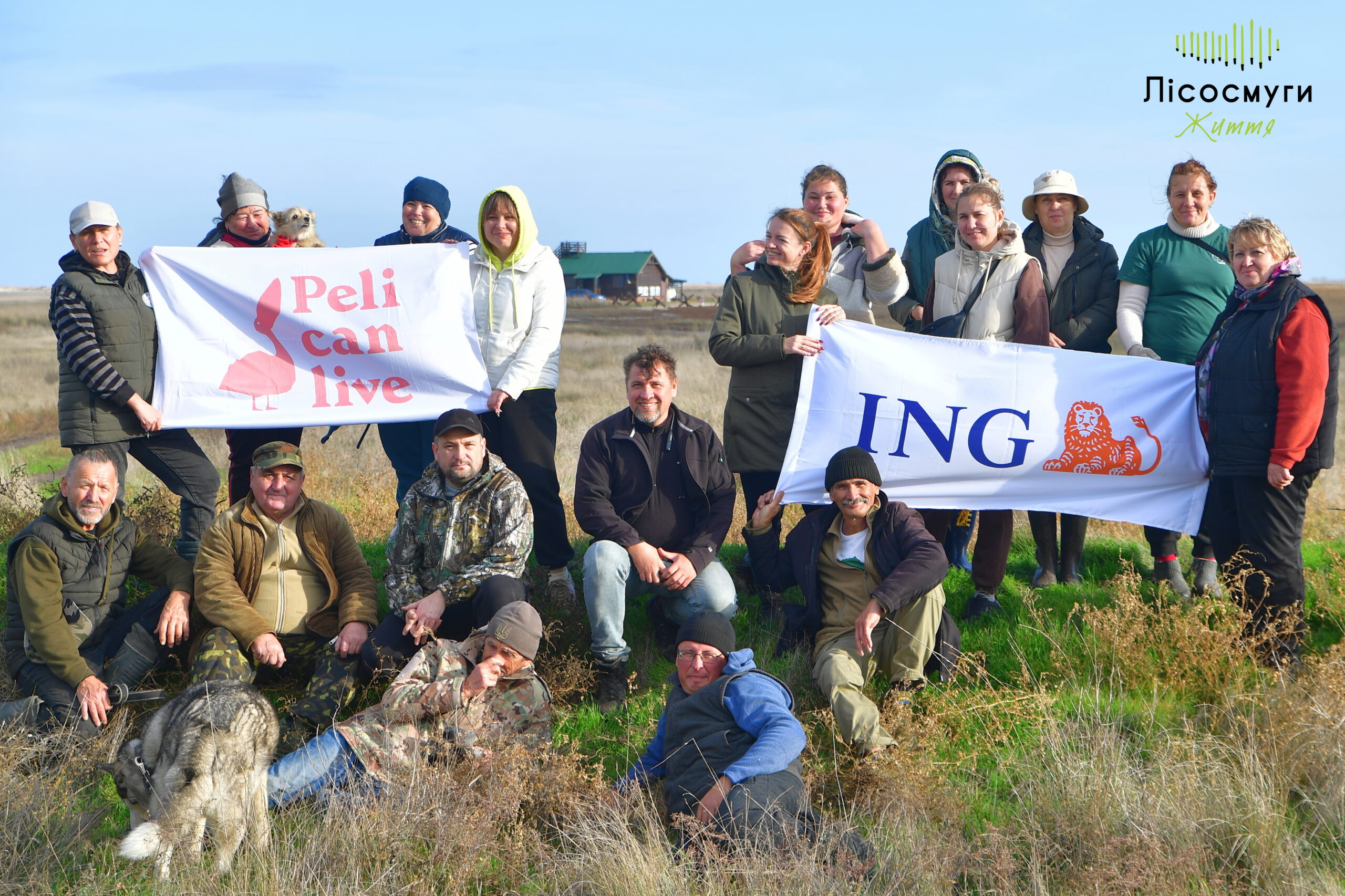
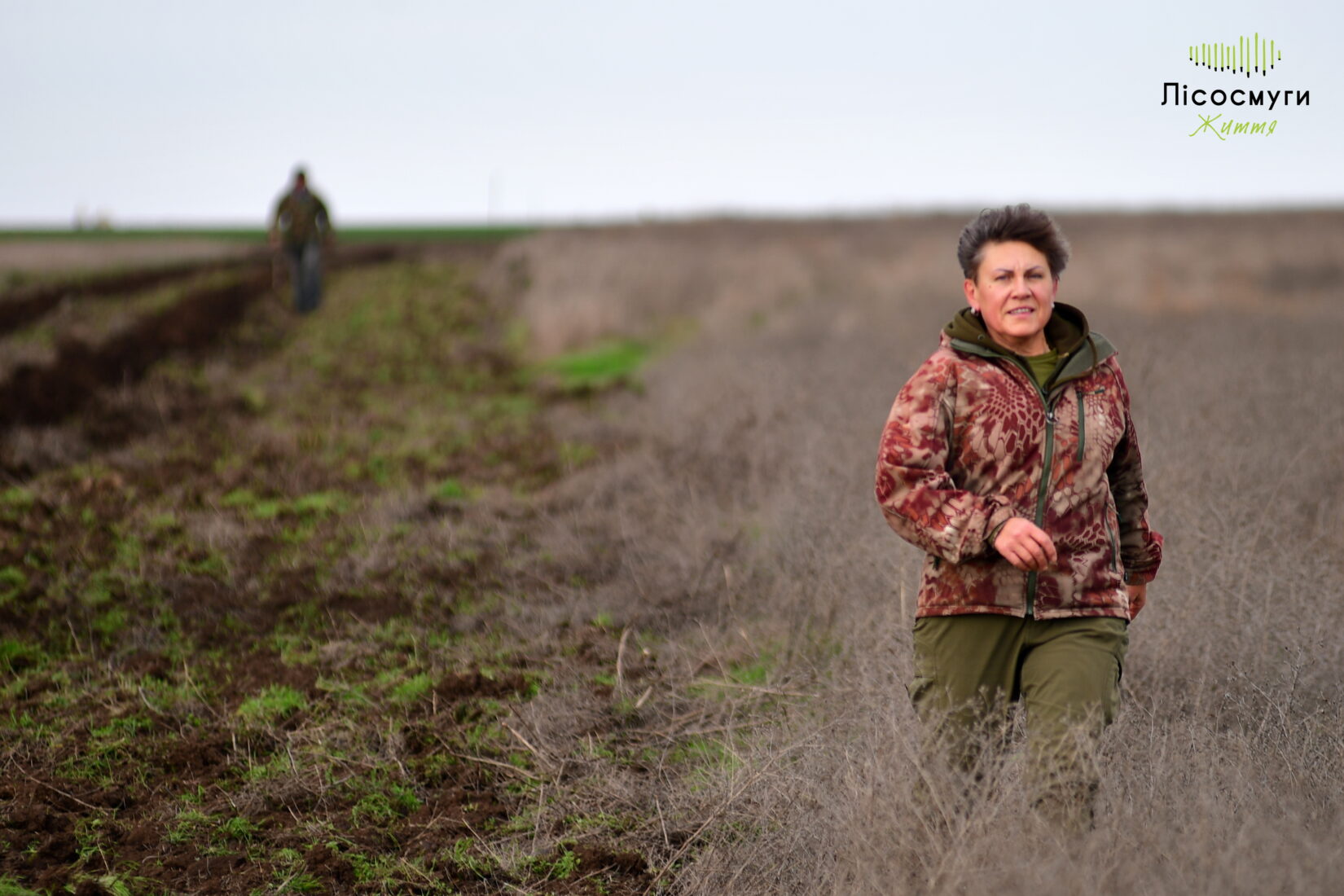
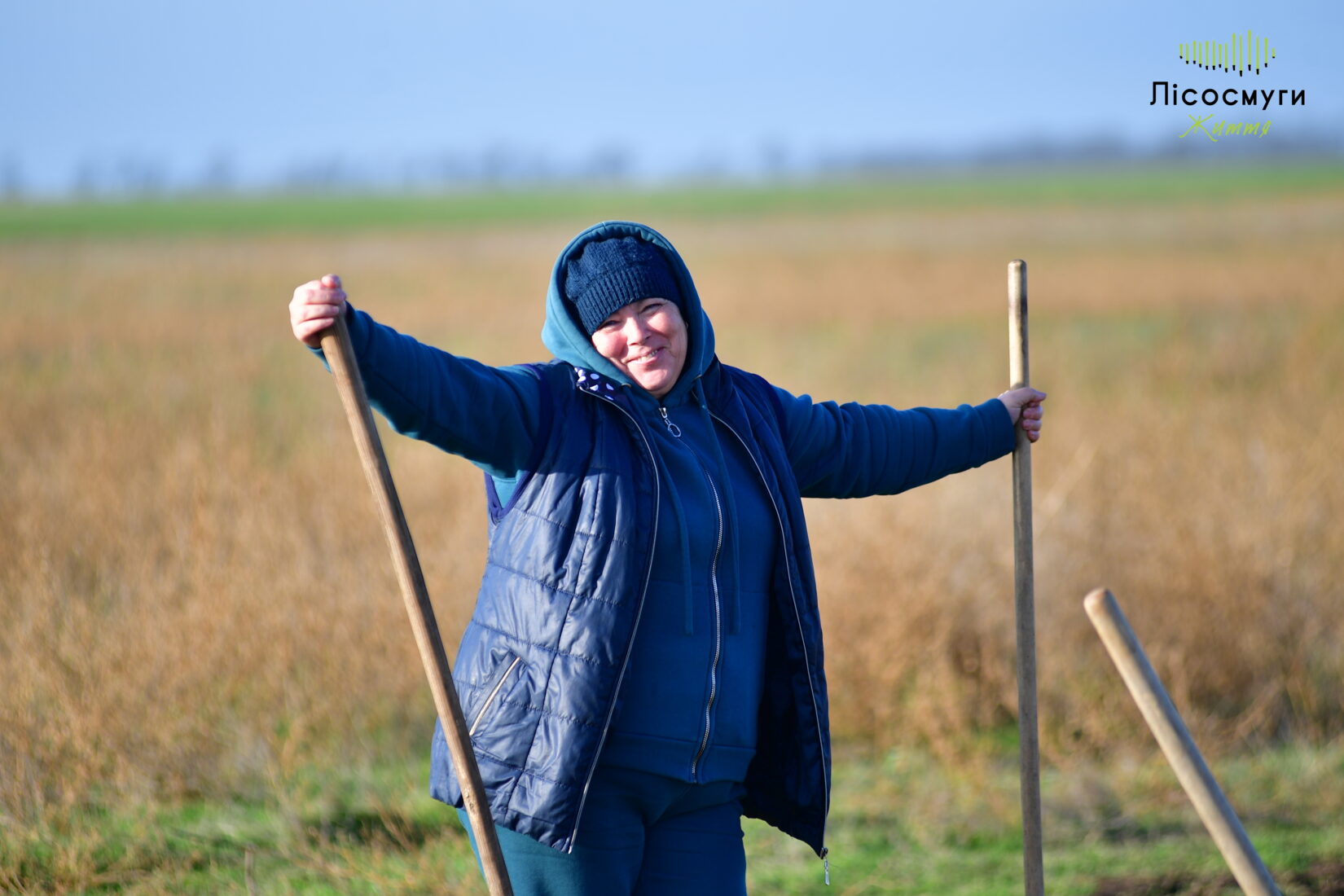
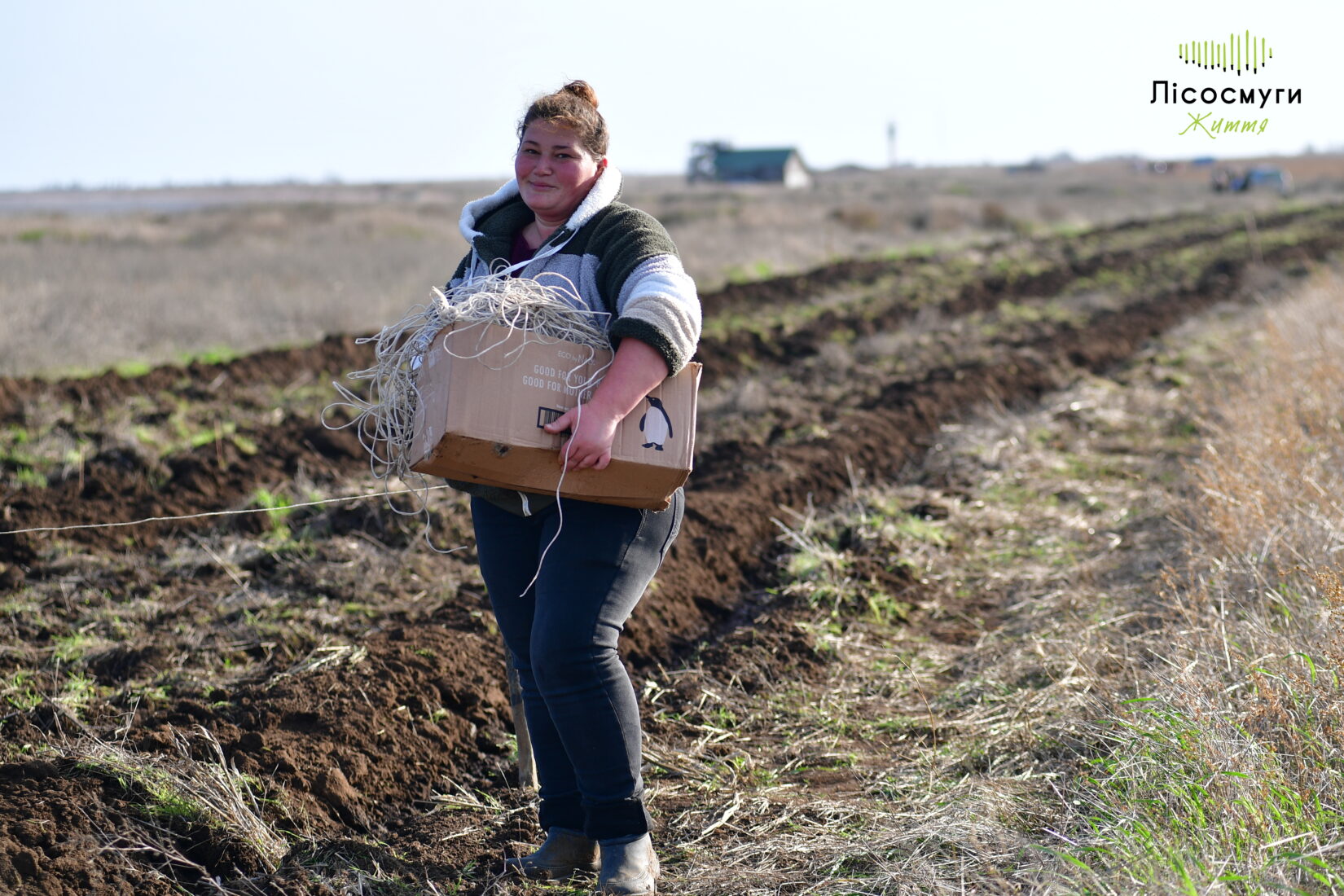
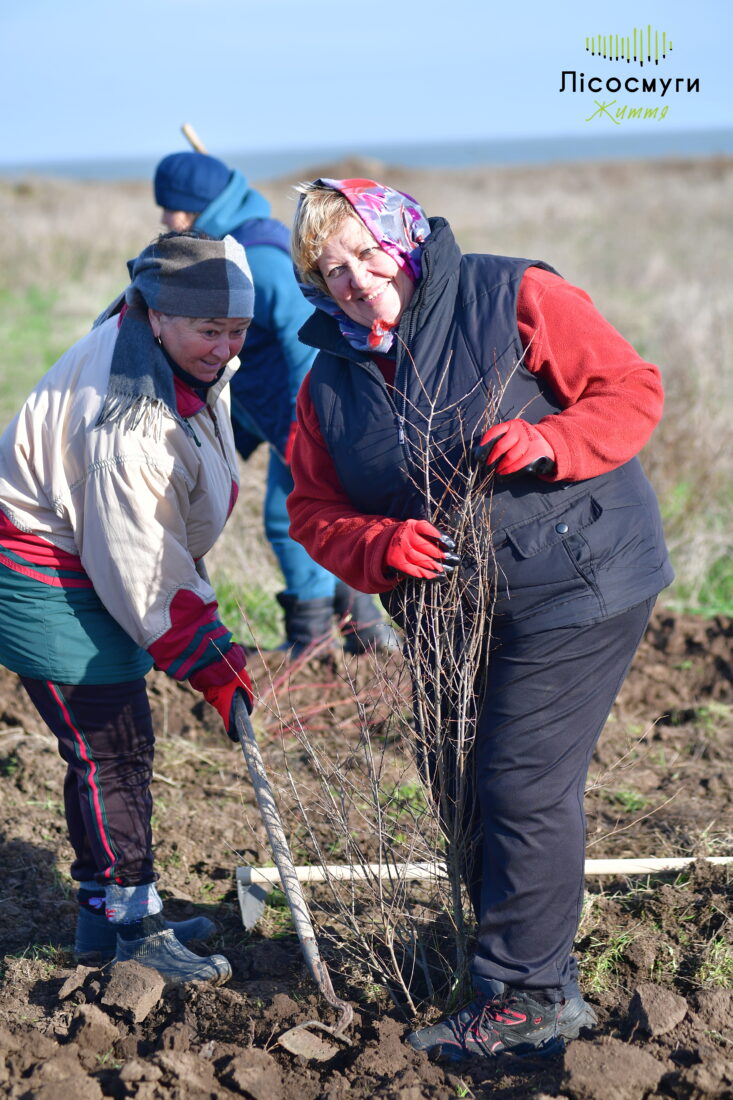
Behind every young sapling are real people. Rangers of Tuzlivski Lymany National Nature Park go out into the steppe every day — patrolling the Park boundaries, documenting violations, talking with farmers, and rescuing injured birds. On planting day they worked alongside scientists, volunteers, partners and local residents. Dogs ran through the fields with them — faithful companions of the steppe rangers. For these people, these landscapes are not an abstract ‘protected area’ but a home they return to every day.
This is the human and deeply emotional side of the project: native land is protected not only by laws and protocols, but by living daily work and the hands of specific people.
From Skarzhynskyi to today’s Forest Belts of Life
The idea of combining steppe, forest and water is not new. As early as the 19th century, Viktor Petrovych Skarzhynskyi established systems of forest belts and artificial forests on his Trykraty estate in Mykolaiv region, showing that even in the arid Kherson Governorate it was possible to grow trees and increase soil fertility without exhausting the land.
Today, as Ukraine moves towards European standards of environmental protection and sustainable agriculture, the Forest Belts of Life project near the Tuzlivski Lymany effectively continues this tradition — now under new climate-change conditions, drawing on modern science, civil society and partnership with farmers.
A European path for sustainable farming
In many EU countries, hedgerows and forest belts are supported as a distinct area of agri-environmental measures. They work simultaneously as:
means of storing carbon in biomass and soil;
a way to prevent soil erosion and degradation;
key elements of biocorridor networks in rural landscapes.
This is the understanding of the role of forest belts that our pilot project is also advancing. It shows that nature protection does not conflict with farmers’ interests. On the contrary, it strengthens the resilience of agricultural businesses to drought, winds and market fluctuations, making farming more predictable over the long term.
The Forest Belts of Life team and partners
The #ForestBeltsOfLife project is implemented by the Peli can live charitable foundation in partnership with NUBiP Ukraine with financial support from #INGBankUkraine
The first demarcation forest belts became possible thanks to cooperation among:
ING Bank Ukraine
the charitable foundationPeli can live;
NUBiP Ukraine
local residents and farmers who agreed to share part of their land for the common future of the steppe
volunteers
the team of Tuzlivski Lymany National Nature Park and its ranger service;
What comes next
The first forest belt is only the beginning.
Still ahead:
monitoring the success of sapling establishment under the arid conditions of southern Ukraine;
additional planting of more demanding tree species once the shrub layer creates a favourable microclimate;
developing standard agreements with land users that can be applied in other regions;
in spring 2026, work is planned to establish a nursery that will later serve as a donor source for plantings both for the national park’s hedgerow and for local communities.
scaling the approach to other Park boundaries and steppe areas of Odesa, Mykolaiv and Kherson regions.
The steppe is our cradle and our shared test of maturity. If we learn not only to plough but also to restore, not only to take but also to give back, then the demarcation forest belts near Tuzlivski Lymany National Nature Park will become not an isolated experiment but a new standard for the Ukrainian agricultural landscape.
And every oak, every privet in this living boundary will remind us:our native land begins where we are ready to protect it. for the Ukrainian agricultural landscape.
And every oak, every privet in this living boundary will remind us: our native land begins where we are ready to protect it.
Operation ‘Midas’ by NABU and SAPO, centred on corruption schemes at Energoatom and the influence of an informal back office on the state energy sector, became an ideal X-ray of the entire system for managing large sums of money in Ukraine. What investigators describe as a 10–15% ‘toll gate’ on every contract directly echoes how the ‘Big Construction’ programme operated and how wartime reconstruction funds are used today.
The Odesa examples make this especially clear. The road built under Big Construction near the Kuialnyk Estuary and the construction of a water main to French Boulevard using money from the fund for eliminating the consequences of aggression are not merely infrastructure projects. They are cases where corruption, land schemes, developers’ interests, companies such as Avtomahistral-Pivden, and the role of local authorities (including Odesa Regional Council head Hryhorii Didenko of Servant of the People) converge in the same model that ‘Midas’ highlighted at the national level.
1. ‘Midas’: when a sector is run not by a ministry but by a back office
According to NABU and SAPO, a high-level criminal organisation operated in the energy sector and influenced the work of strategic state-owned companies, above all Energoatom (JSC NNEGC Energoatom). At its core was an informal ‘back office’ in central Kyiv through which, investigators say, up to USD 100 million passed. LB.ua
The key instrument of this structure was the so-called ‘toll gate’: Energoatom counterparties were allegedly subjected to a systematic kickback practice of 10–15% of contract value in exchange for unblocking payments and retaining supplier status. Interfax-Ukraine
Seven people are named in the notices of suspicion: a businessman as the alleged organiser, a former adviser to the energy minister, a top Energoatom manager, and back-office staff involved in laundering funds. Five of them were detained under Article 208 of the Criminal Procedure Code. LIGA.net
Ukrainian and international media, citing law-enforcement sources, report that the informal role of the scheme’s ‘Carlson’ has been attributed to businessman Timur Mindich, a long-time partner of Zelenskyy from Kvartal 95. RBC-Ukraine At the time of writing this column, Mindich is a suspect, not a convicted person, and is fully entitled to the presumption of innocence.
For a systemic analysis, however, the important thing here is not the surnames but the architecture:
a strategic sector with large contracts;
an informal decision-making centre — the back office;
a 10–15% ‘tax’ for everyone who wants to work with the state;
cash laundering through a network of shell entities. Interfax-Ukraine
This is the same model that investigative journalists and experts have described for years in relation to road contracts: cartelisation of the market, inflated estimates, and favouritism toward a handful of companies. Kyiv24
‘Midas’ matters because for the first time it makes this scheme an official subject of criminal proceedings specifically at the sector-wide level, rather than as a single case of ‘budget spending’ in some territorial community.
Photo 1. Bags of cash seized during Operation ‘Midas’. Photo: National Anti-Corruption Bureau of Ukraine / Specialised Anti-Corruption Prosecutor’s Office
2. ‘Big Construction’: an ideal substrate for the same scheme
The ‘Big Construction’ programme was officially presented as a story of national modernisation: roads, bridges, schools, stadiums, and hospitals. It did include objectively necessary projects, but in our view it simultaneously created an environment ideally suited to ‘Midas-style’ logic.
2.1. Concentration of money and favourites
In roads — the heart of the programme — tens and hundreds of billions of hryvnias were concentrated among a limited pool of contractors. In 2020–2021, the top 10 companies received UAH 116 billion in road contracts, of which:
Avtomahistral-Pivden — more than UAH 30 billion;
Onur — more than UAH 26 billion;
Rostdorstroy — about UAH 13.6 billion.
In some years, Avtomahistral-Pivden participated in and won one third of all Ukravtodor tenders. This gives a contractor enormous influence and makes it a natural target for any back office seeking to ‘cut off the oxygen’ of access to state funds.Nakypilo
2.2. A centralised curator
The political face of ‘Big Construction’ was Deputy Head of the Office of the President Kyrylo Tymoshenko, who oversaw the programme both publicly and informally. Investigative journalism repeatedly raised questions about possible conflicts of interest and manual allocation of contracts.
Again, what matters for our logic is something else: the existence of a coordination centrethat sees all the money and all major contractors always creates a temptation to turn a transparent policy into a ‘toll gate’.
2.3. Special funds as easy access to resources
During COVID-19, the government redirected part of the Pandemic Response Fund to roads, drawing criticism even then: asphalt instead of hospitals and support for healthcare, and asphalt that was very useful for election campaigns. Kyiv24
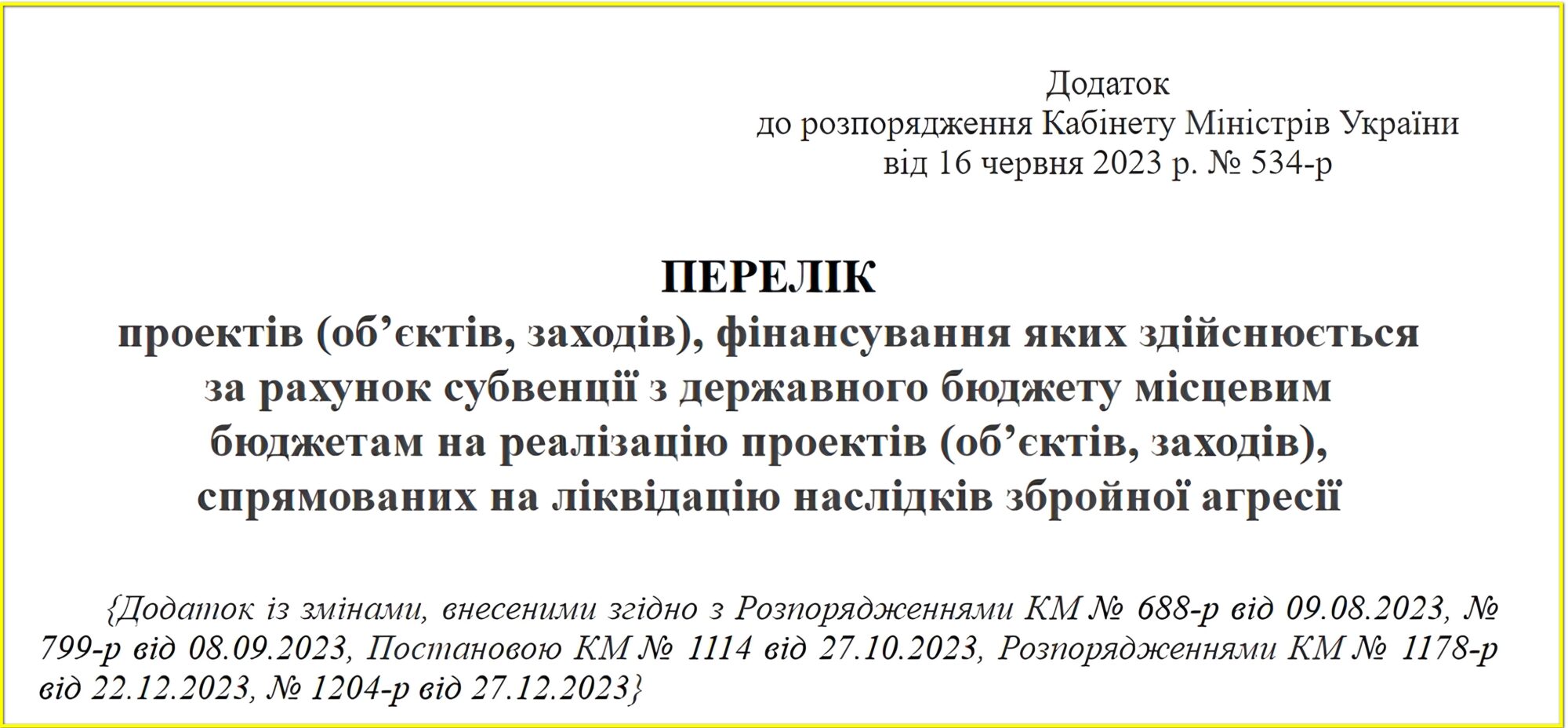
After the start of the full-scale war, a fund for eliminating the consequences of armed aggressionwas created, established by Cabinet of Ministers Order No. 534-r of 16 June 2023 ‘On the Allocation of Funds from the Fund for Elimination of the Consequences of Armed Aggression’. Donor- and credit-funded reconstruction programmes were added. Some of this money logically goes to critical infrastructure, but the boundary between ‘what was actually destroyed and is necessary’ and ‘a convenient project on which to spend funds’ became very blurred.
This is precisely where ‘Big Construction’ and ‘Midas’ meet: there it is energy, here it is roads and utilities, but the principle is the same:
wartime or special fund → attractively packaged infrastructure project → limited circle of contractors → back office with a ‘toll gate’.
Photo 2. Annex to Cabinet of Ministers of Ukraine Order No. 534-r of 16 June 2023 listing projects financed from the fund for eliminating the consequences of armed aggression.
3. Odesa: miniatures of a larger scheme
The Odesa cases are not local ‘unfortunate coincidences’. They are practical demonstrations of how a large architecture turns into land, trenches, traffic jams and damaged ecosystems.
3.1. Kuialnyk Estuary: a road as a pretext for ‘golden land’
The Kuialnyk Estuary has the status of a resort of national significance — under Law of Ukraine No. 2637-VIII of 5 December 2018 ‘On Declaring the Natural Areas of the Kuialnyk Estuary in Odesa Region a Resort of National Significance’.
In addition, Kuialnytskyi National Nature Park was created on its territory by Presidential Decree No. 3/2022 of 1 January 2022 ‘On the Creation of Kuialnytskyi National Nature Park’.
Formally, this is an area of special protection, where any construction should pass through the filter of strict environmental procedures and the requirements of the Law ‘On the Nature Reserve Fund of Ukraine’.
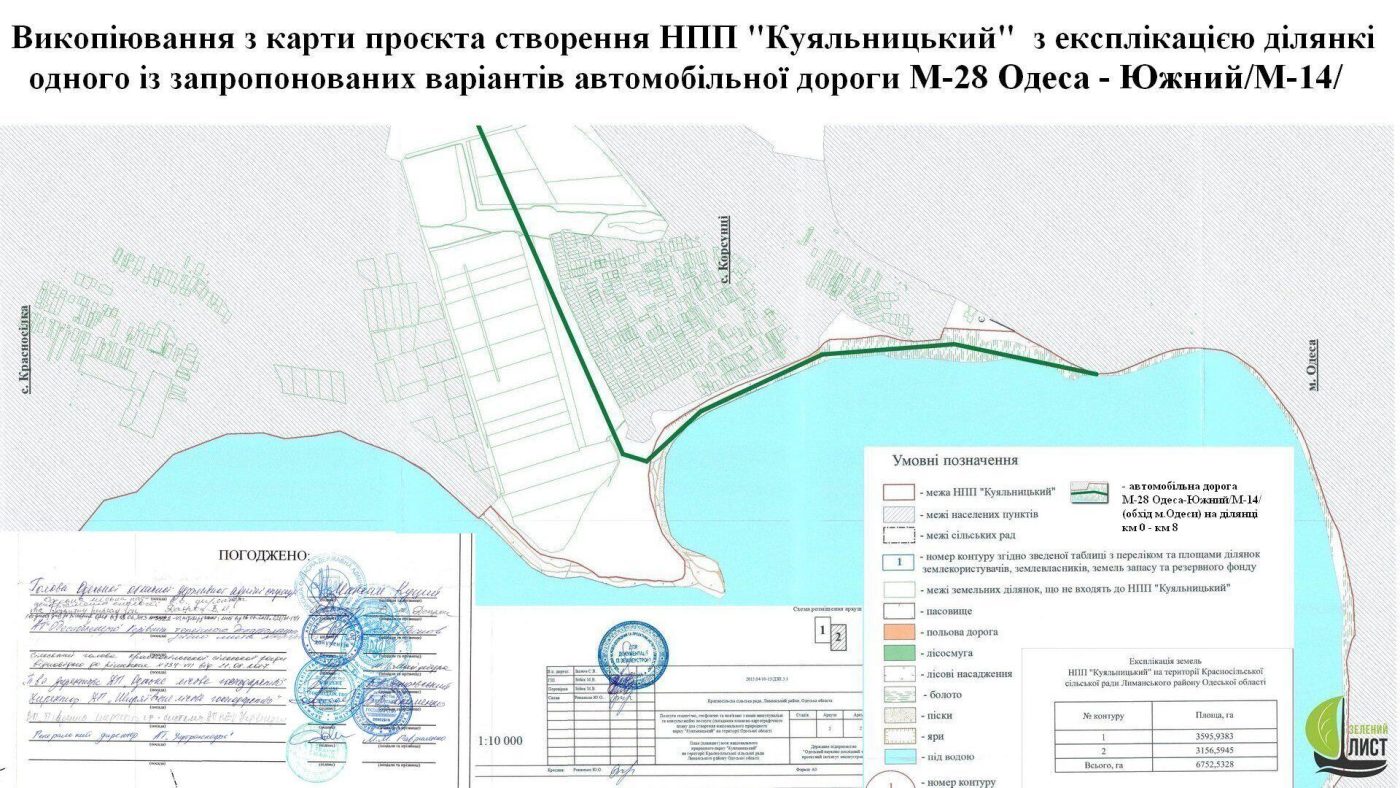
In 2021, the Road Service in Odesa Region (then headed by Dmytro Rybalko) proposed construction of a new section of the M-28 bypass road. Four route options were considered, but officials called the one running along the shore the ‘most advantageous’, while in practice it would run across the Kuialnyk Estuary floodplain.
Photo 3. Scheme of a possible road route under ‘Big Construction’ near the Kuialnyk Estuary and land plots that, according to a Green Leaf investigation, belong to families of local officials and related businesses.
A key political role in this process was played by Hryhorii Didenko — the current head of the Odesa Regional Council from the Servant of the People party (elected on its list). Key decisions passed through the regional council, and Didenko himself handled public communication with the community and officials. Another detail in the picture of power: his wife is a member of parliament from the same political force.
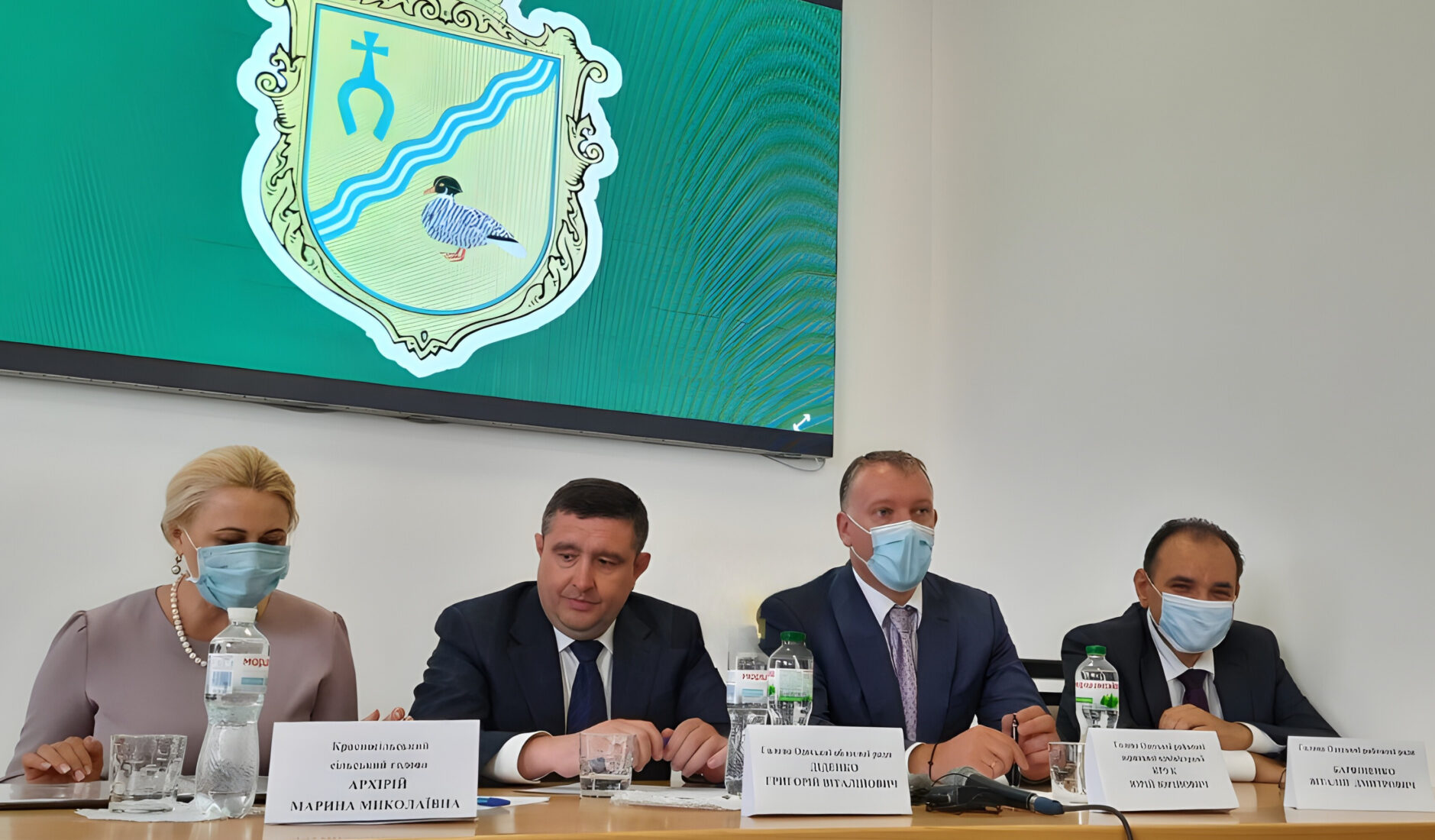
Photo 4. 19 May 2021, Krasnosilska Village Council. Discussion of the decision to build a road along the Kuialnyk Estuary floodplain, with the participation of (left to right): Maryna Arkhirii — head of Krasnosilska village; Hryhorii Didenko — head of the Odesa Regional Council (Servant of the People faction); Yurii Kruk — head of the Odesa District State Administration of Odesa Region; Vitalii Barvinenko — head of the Odesa District Council.
An investigation by the Green Leaf NGO showed that, several years before the planned road, land in the future route area had come into the hands of:
the family of long-serving Krasnosilska Village Council head Mykola Maidebura and his relatives;
the mother of the current community head, Maryna Arkhirii;
relatives of village council secretary Horduzenko;
former district council deputy Artak Yuzbashian, whose company Berezivkaahroshliakhbud regularly received road contracts;
a number of businesspeople linked to Odesa elites, including the orbit of Volodymyr Galanternik.
The logic is simple and cynical:
if the road passes through the plots, the state will buy the land at an inflated price; if it passes nearby, land prices will rise severalfold.
Thus, ‘Big Construction’ here is not only a potential road contract for construction firms but, above all, a tool for monetising land bought in advance by ‘their own people’, with the active participation of regional council leaders representing the ruling party.
In parallel, the environmental dimension is completely ignored: the risk of destroying the estuary, disrupting hydrology, and degrading a resort of national significance. Only the beginning of the full-scale war prevented this road project from being implemented in its original form. Yet it has effectively already been ‘relaunched’ in another form — through the newly created Kuialnytskyi National Nature Park ‘Kuialnytskyi’, registered in 2024 and headed by director Oleksandr Shestun. According to local activists and participants in the process, Odesa Regional Council head Hryhorii Didenko lobbied for his appointment, which they say allows political control over the floodplain to be maintained under the guise of nature protection.
As with the water-main project, the same political actors appear in the processes surrounding the route near Kuialnyk, including Odesa District Council head Vitalii Barvinenko. This recurring ‘set of faces’ is the clearest answer to why these projects are pushed so persistently despite environmental and public risks
3.2. Water main to French Boulevard: war as a pretext for a developer’s dream
The second Odesa example is the construction of trunk water-supply networks from Bahrytskoho Street to French Boulevard, which began in 2023, already during the full-scale war. The official procurement name is ‘New construction of trunk water-supply networks from Bahrytskoho Street to French Boulevard in Odesa (Phase 1 — from Bahrytskoho Street to Fontanska Road; Phase 2 — from Fontanska Road to Akademichna Street)’.
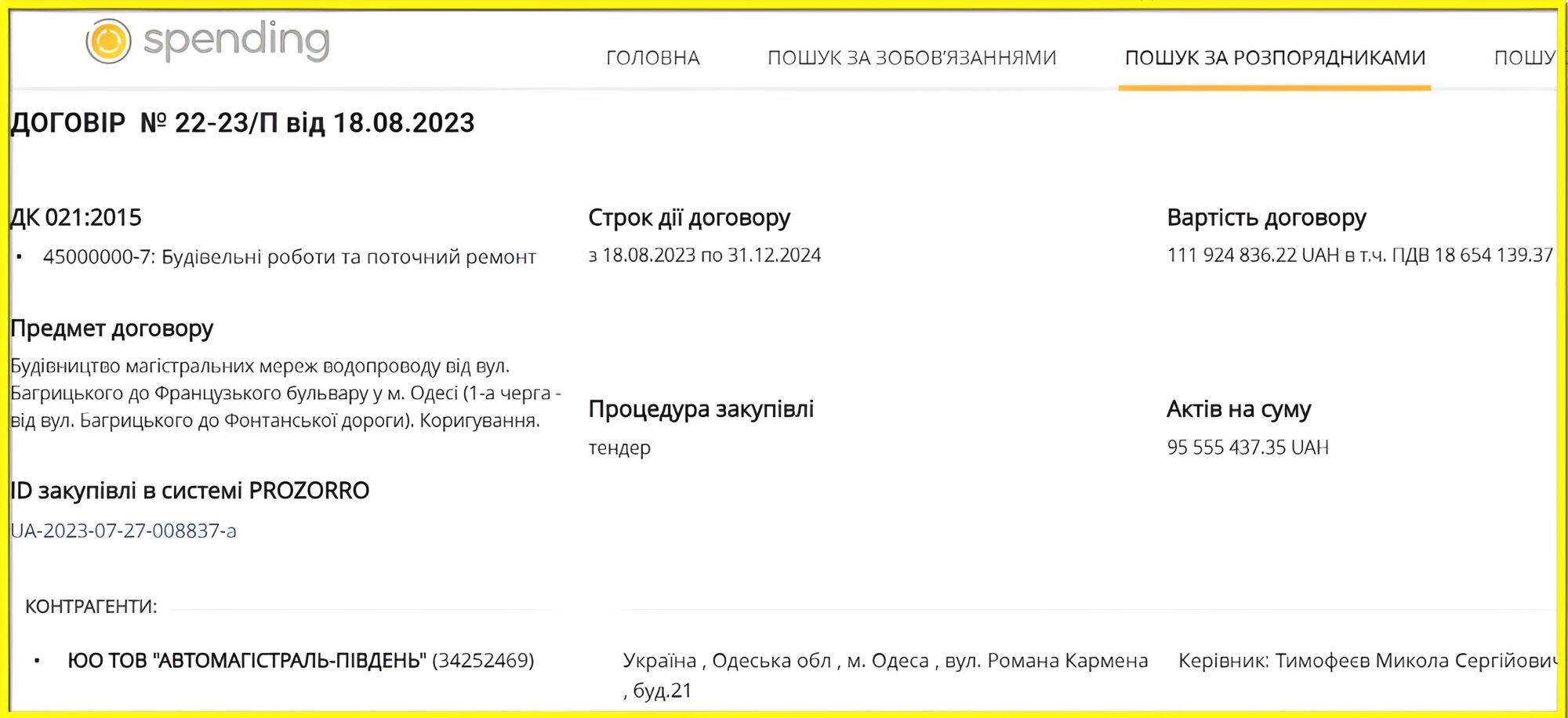
Photo 5. Screenshot from Spending.gov.ua: Contract No. 22-23/P dated 18 August 2023 for ‘construction of trunk water-supply networks from Bahrytskoho Street to French Boulevard in Odesa (Phase 1 — from Bahrytskoho Street to Fontanska Road)’ worth UAH 111,924,836.22. Contractor — Avtomahistral-Pivden LLC.
Officially, this is described as ‘improving water-supply reliability’. In practice, we have:
two major contracts with Avtomahistral-Pivden worth a total of about UAH 217.55 million for the first and second phases of the water main (2023 tenders).
financing from a subvention from the fund for eliminating the consequences of armed aggression under Cabinet of Ministers Order No. 534-r of 16 June 2023 and co-financing from the city development budget (as shown in the explanatory notes on implementation of Odesa’s budget).
a route that digs up key thoroughfares — French Boulevard, Krasnova, Hovorova, Vodoprovidna and Akademichna streets — simultaneously, effectively blocking connections between the city centre and the Kyivskyi and Khadzhybeiskyi districts.
The logic is familiar again:
the ‘fund for eliminating the consequences of aggression’ → a ‘good’ water-main project → a contract for a ‘Big Construction’ favourite → a trunk line that conveniently serves new development.
Viewed through the prism of the war, another dimension of this project becomes apparent. Money from the fund for eliminating the consequences of aggression could have gone to genuine security of urban infrastructure: : construction and modernisation of shelters, upgrading treatment facilities, building stormwater drainage, and strengthening protection of energy facilities against strikes. Instead, taxpayers’ money is effectively being invested in servicing commercial real estate — new high-rise buildings along French Boulevard and in the Fontan area.
This example clearly shows how, in the authors’ view, developers draw budget resources toward themselves under the guise of ‘infrastructure recovery’. Investments that, under normal market logic, a developer would make at its own expense (bringing high-capacity utility networks to its projects) are paid for from state and city budgets. Financially, the state receives almost nothing additional from such ‘investments’ — apart from potentially higher property tax in the future, which does not cover either the scale of expenditure or the risks.
It creates the impression that somewhere between a ‘good’ project and a budget line there is a shadow officethat allocates funds not according to the logic of security and sustainable development, but according to access to taxpayers’ wallets. In this configuration, the key question is no longer ‘does the city need a water main?’ but ‘who exactly earns how much from its construction?’
At the same time, almost no one asks the basic engineering question: do the new water-supply technical conditions correspond to the actual capacities of wastewater and sewage-treatment systems? If the city sharply increases water supply to densely built-up neighbourhoods without modernising sewerage, stormwater drainage and treatment facilities, it gets not progress but future accidents, flooding and environmental problems. The water-main project is rarely considered from this perspective — the pipe ‘to the site’ is treated as more important than the city’s integrated water cycle.
It is telling that the same person appears both in the Kuialnyk Estuary story and in the scheme surrounding the water main — Vitalii Barvinenko, head of the Odesa District Council and a long-standing player in Odesa politics. He is present both in decision-making processes around the route near Kuialnyk and in the configuration of influence surrounding major infrastructure projects in the city. It is therefore unsurprising that local activists increasingly voice the view that, if NABU wants to see the full picture, Barvinenko may be someone with information relevant to investigators.
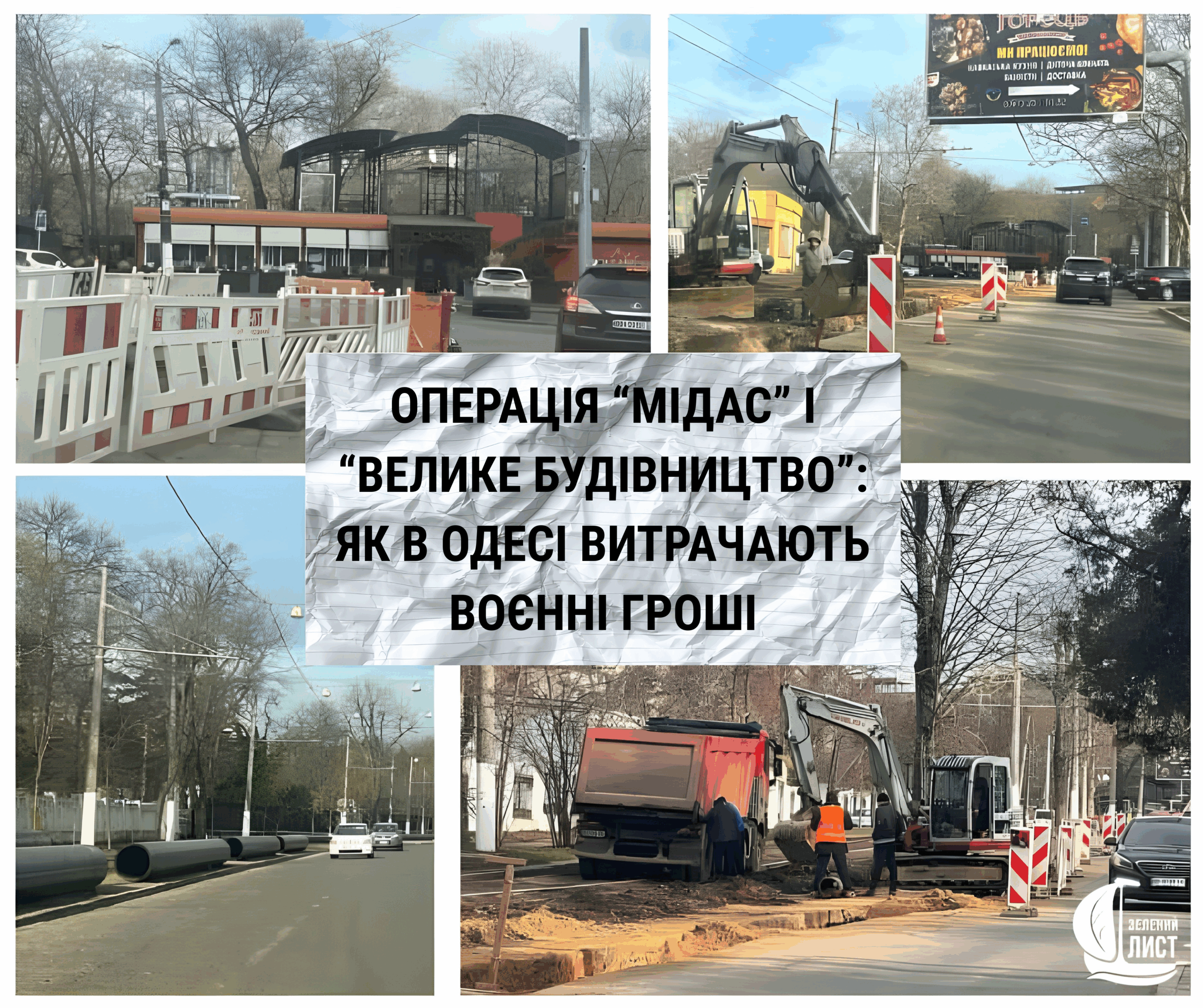
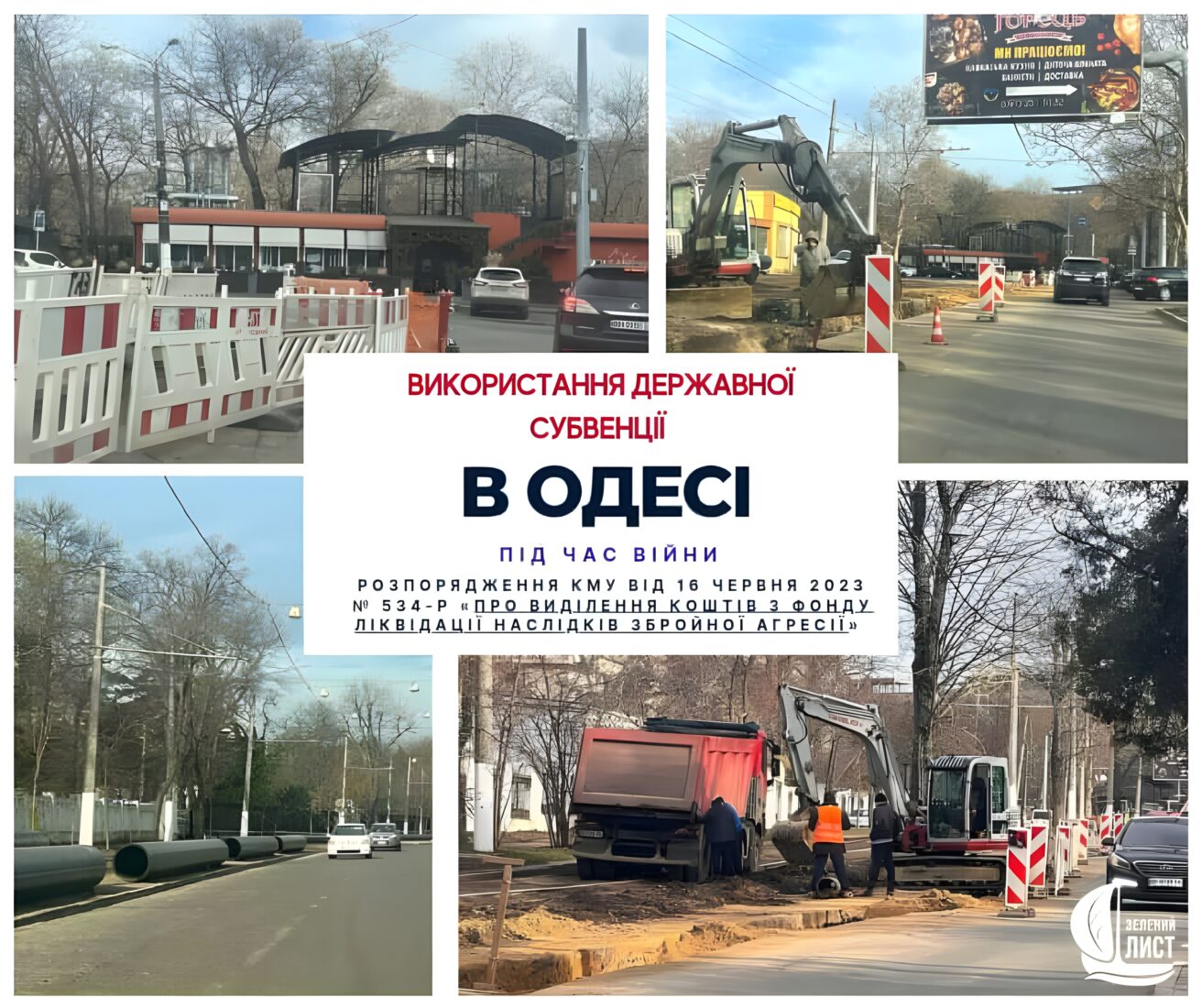
Photo 6. A Green Leaf NGO collage about the use of a state subvention in Odesa during the war: construction of the trunk water main and road works on French Boulevard under Cabinet of Ministers Order No. 534-r ‘On the Allocation of Funds from the Fund for Elimination of the Consequences of Armed Aggression’.
4. What is at stake and who must make the move
Operation ‘Midas’ showed that the back-office model has reached the level of strategic sectors in Ukraine. It operates not only in a hypothetical territorial community or city council but also in multibillion-hryvnia structures such as Energoatom. There, a 10–15% ‘toll gate’ on each contract turns into tens of millions of dollars in cash that bypassed the budget for years.
‘Big Construction’ created an ideal substratefor this model: concentration of funds, a few favoured contractors, a political curator at the centre, weak tender transparency, and a willingness to redirect special funds (COVID, wartime, reconstruction) toward ‘needed’ projects. The Odesa stories about Kuialnyk and the water main show how this scheme has already learned to disguise itself as reconstruction: on paper, a wartime fund goes to ‘eliminating the consequences of aggression’, while in practice it services new commercial real estate and the land interests of local elites.
The stakes here are much higher than one water main or one road across a floodplain. If back offices survive ‘Midas’ and calmly adapt to post-war reconstruction, we will get:
loss of donor confidence, with every new scandal providing an argument to reduce assistance or attach stricter conditions;
damage to European integration, where the rule of law and anti-corruption are not a box-ticking exercise but a basic filter;
a chronic shortage of money for genuine security — shelters, network modernisation, protection of energy facilities — because resources will continue to go into pipes serving high-rise buildings rather than cities.
If, however, ‘Midas’ becomes the beginning of dismantling this system, painful but obvious steps will have to be taken. At the national level — not merely bring the case to verdicts, but extend the logic of this investigation to other sectors: infrastructure, reconstruction, and local budgets. This requires public registers of all projects financed from wartime funds, with transparent information on contractors, amounts, and links to actual destruction.
At the local level — stop pretending that any pipe or road built during wartime automatically becomes a sacred project. Communities, media and activists should ask simple questions: does this project really protect people from the war, or does it simply raise the price per square metre? are new networks synchronised with sewerage, treatment facilities and stormwater drainage, or are future technological accidents being prepared for us?
And finally, at the level of personal responsibility — stop pretending that recurring surnames mean nothing. When the same figures appear in schemes around Kuialnyk, the water main, road tenders and wartime funds, this is no longer coincidence but a political construction. And this is a question not only for NABU but also for voters who press the same buttons on the ballot each time.
In the end, the choice is very simple. Either we dismantle the back offices — and then wartime and reconstruction money works for shelters, networks, protection of energy facilities, and genuine modernisation. Or they dismantle the country — methodically, one piece at a time, from Energoatom to every individual city, hiding behind attractive labels such as ‘Midas’, ‘Big Construction’ and ‘eliminating the consequences of aggression’.
If the second scenario prevails, ‘Big Construction’ will be remembered not as an infrastructure leap but as a dress rehearsal for a grand carve-up of post-war Ukraine. And then no attractive recovery strategies will change a simple fact: a country fighting for freedom continues to lose to its own back offices.
This study is an attempt to take an honest look at how much water actually remained in Crimea in the summer of 2025. It was carried out by the team of the civic organisation Green Leaf together with the National Ecological Centre of Ukraine (NECU).
We did not rely on old reports or official figures. We used open satellite imagery, digital elevation maps and archival water-quality data to build our own independent picture.
The North Crimean Canal, which gave life to the peninsula for half a century, is now a dead artery. After the destruction of the Kakhovka Hydroelectric Power Plant, restoring it in its old form is impossible: there is no source, no volume of water, and no longer the ecosystem it once supplied. We can see steppe reservoirs drying up one by one or turning into salt flats, while some have simply been ploughed up for fields.
Our goal was not to create another set of statistics. We wanted to answer three simple questions:
where in Crimea is there still living fresh water?
which reservoirs can be saved and restored?
what would happen if someone tried tomorrow to send water through the old system again?
Our analysis shows that the balance has shifted: some basins have lost their water completely, while others are only half full. More importantly, the water in many reservoirs is no longer fresh. This is not merely a crisis. It is the point at which it will be decided whether the peninsula can regain water without losing its land.
Crimea’s water infrastructure
Crimea is not only sea and mountains. It is also an entire network of water arteries created by people and nature. More than two dozen large and several dozen smaller reservoirs were once connected through a complex system of canals, tunnels and pumping stations that supplied the peninsula with water.
Two different stories
There are two groups of Crimean reservoirs, and their trajectories diverged after 2014.
The steppe cascade and Mezhhirne are off-channel storage basins that existed only because of the North Crimean Canal. Water came from the Dnipro, and the entire system worked as a single mechanism. When the canal stopped operating, these reservoirs began drying up one after another. Within a few years, many turned into cracked beds, salt flats, or were even ploughed up for fields.
Naturally fed reservoirs — Chornorichenske, Zahorske, Simferopolske, Partyzanske and Feodosiiske — survived. They receive water from local rivers and rainfall, so they remain the basis of drinking-water supply for southern and central Crimea.
The hidden part of the system
Crimea’s water infrastructure is not only the basins shown on a map. It also includes:
the Baidar hydraulic tunnel, which carries water from the Chornorichenske Reservoir to Sevastopol.
the underground galleries of the Zahorske basin, which regulate the Belbek River.
branches of the North Crimean Canal that supplied the steppe hubs.
When these links are broken, a reservoir ceases to function as a reservoir even when it still contains water.
Why this matters today
When we analysed this system, we looked at more than cubic metres of water. We tried to understand what is still alive, what can be saved, and what has already become a different landscape. In this sense, Crimea’s reservoirs are not only about water; they are about function: sustaining life on the land.
When water became a weapon
Russia seized Crimea in 2014 not to develop the region but as a military foothold. The needs of people, drinking water and the peninsula’s natural balance were of no importance to the occupation regime.
After the annexation, Crimea’s resources began to be used exclusively in the interests of the Russian Federation, without regard for ecosystems or long-term consequences. By blocking the North Crimean Canal after the territory was seized, Ukraine was protecting its own water resources and preventing their unlawful use by the occupying forces to support military infrastructure.
Russia responded in a barbaric way: with massive extraction of groundwater, depletion of steppe aquifers, and soil degradation. As a result, within several years steppe Crimea began losing not only water but also land: reservoirs turned into salt flats, and arable land became affected by secondary salinisation.
On 6 June 2023, the occupation military leadership blew up the Kakhovka Hydroelectric Power Plant. The explosion became the largest environmental crime in modern Ukrainian history. In an instant, towns and villages were destroyed, hundreds of square kilometres were flooded, and people and thousands of animals died. But another blow was less visible: the North Crimean Canal finally lost its source of supply.
This was not a technical accident or a ‘side effect of war’. It was a deliberate act of ecocide. It ended the history of Crimea’s old water system and opened a new chapter — the survival of the remaining aquatic ecosystems under completely altered conditions.
How we calculated water volumes in the reservoirs
We wanted to do more than look at maps and count cubic metres. The task was different: to understand where fresh water still survives in Crimea and which reservoirs can be saved.
1️⃣ What we used as a basis
For this purpose we used:
recent satellite images to see the actual water boundaries in July 2025;
digital elevation maps showing how full each basin is;
archival water analyses to distinguish fresh-water reservoirs from saline ones;
historical hydrological maps to compare the current condition with the situation before 2014.
We relied not on documents produced by the occupation authorities but on data that anyone can verify: open satellite imagery and international digital elevation models.
2️⃣ How we calculated volumes
A satellite shows the surface area of water but not its depth. We therefore combined it with digital elevation maps. This made it possible to estimate how much water each reservoir actually holds, even where the level has fallen by half.
We did not build complex 3D models. We needed a simple but accurate answer: how much water is there now, and how does that compare with the design capacity?
3️⃣ How we assessed water quality
Not all water is the same. Some reservoirs, especially in the steppe, have turned into saline lakes or salt flats. To distinguish fresh-water reserves from unusable ones, we used:
colour analysis in infrared image bands, which indicates elevated mineralisation;
comparison with archival chemical analyses carried out before the occupation.
If a reservoir consistently showed signs of salinity and this was supported by historical data, we did not include it in the fresh-water balance.
4️⃣ What else we observed
The analysis showed not only where water remains, but also the risks:
which basins have become sources of salinisation and could damage soils if water were sent into them tomorrow;
which dried beds have already been ploughed and lost their protective layer;
where land around reservoirs has become vulnerable to secondary salinisation.
5️⃣ Why this matters
Since 2014 there have been no systematic hydrometric measurements in Crimea. Satellite data and digital elevation models are therefore now the only way to see the real picture.
This methodology provides two answers:
how much fresh water actually remains;
what will happen to land and water systems if someone tries tomorrow to ‘restore the canal’ without preparation.
Crimea’s fresh-water balance
We brought all the data together to obtain an honest picture of how much fresh water actually remained in Crimea in the summer of 2025.
Eastern cascade
Water is still present here. The Frontove and Feodosiiske reservoirs are more than half full and are the main sources for eastern Crimea. But smaller reservoirs show signs of increasing salinity — an early warning sign.
Central cascade
The Simferopolske and Partyzanske reservoirs have retained their role as the main source for the centre of the peninsula. But their volumes have fallen by almost half. Mezhhirne has dried up completely; only the shape of the basin remains. This is a warning that even in the central zone the system is operating at its limit.
Southern segment
Chornorichenske and Zahorske supply Sevastopol and the Southern Coast of Crimea. The situation here is the best: these reservoirs receive water from rivers rather than the canal. Even so, they are only about two-thirds full.
Steppe cascade
This is the area of greatest loss. Most reservoirs are either completely dry or have turned into salt flats and saline lakes. Parts of some beds have already been ploughed. No more than one tenth of the former volume of fresh water remains in the steppe cascade.
Overall picture
Taken together, the figures amount to about one third of the nominal fresh-water capacity. More important, however, is that half of this water is concentrated in only a few naturally fed reservoirs. Steppe Crimea has practically lost its water system.
Why this matters
These data show more than a shortage of water. They show an ecosystem changing. Where there were wetlands and canals, there are now salt flats and dry land. If water is sent through the old system tomorrow without preparation, this saline land will return not life but disaster.
Risks of secondary salinisation
When we looked at the steppe reservoirs, one thing became clear: the greatest threat is not simply the lack of water. The most dangerous consequences would begin if these basins were rapidly refilled.
Why this is dangerous
Many dried reservoirs have turned into salt flats. Over years without water, salts have risen to the surface and formed a concentrated crust. If the first flow of water arrives tomorrow, it will dissolve that crust and carry saline brines further along the canals — directly onto arable fields.
Some reservoirs have already become saline lakes. This is not merely ‘bad water’; it is a systemic change in the reservoir bed. Restoring them would require years of flushing and sums of money comparable to building new reservoirs.
There is another alarming sign: ploughed reservoir basins. Where the bed dried out, people brought in ploughs. This land has lost the protective layer of bottom sediments. If water is released here, it will carry away not only salts but also agricultural chemicals that will enter the irrigation system.
What this means for the entire system
Restarting the North Crimean Canal quickly and without preparation would not bring life back to the steppe. It could turn hundreds of hectares of chernozem into dead white patches of salt. The greatest risk is in the Krasnoperekopsk and Tarkhankut hubs, where arable areas are tied to degraded basins.
Why we need to talk about this now
This is not a forecast for the ‘distant future’. It is a risk for the coming years. If someone decides tomorrow to ‘give water to Crimea’ without environmental preparation, we will get not green fields but a miniature Aral Sea.
Conclusions
1️⃣ How much water remains Our analysis showed that of more than 600 million m³ of nominal reservoir capacity in Crimea, only about 200 million m³ was fresh water in July 2025. That is one third of the capacity for which the systems were designed.
2️⃣ Where the balance remains
The southern segment (Chornorichenske and Zahorske) retains up to 65% of actual filling and remains the basis of drinking-water supply.
The central cascade operates at 40–43% of normal levels but requires protection from silting and increasing salinity.
The eastern cascade retains only half of its volumes.
The steppe cascade has effectively been lost: fresh water amounts to no more than 10–11% of design values.
3️⃣ Not only quantity, but quality Spectral analysis confirmed that a significant share of steppe reservoirs has become brackish. This means that without reclamation, even restored water supplies would not be suitable for irrigation.
4️⃣ Why this method matters For the first time since 2014, an independent audit of Crimea’s water resources was obtained based not on closed statistics but on open satellite data and digital elevation models. The methodology showed that even without field measurements, water volumes and quality can be estimated with an error margin of only 5–10%.
5️⃣ What should be done next The figures provide a simple answer: restoration of irrigation is possible only after years of environmental preparation. Without this, the risk of secondary soil salinisation is too high, and the losses could become irreversible.
“The first and most important principle in achieving the objectives of war is to exert, from the outset, the utmost effort with all forces available, until they are completely exhausted.” — von Clausewitz, On War, 1832
Introduction
An analytical note ‘On the problems of supplying service members with everything they need and ways to address them’
was prepared in response to a deep systemic crisis that, despite the third year of the full-scale war, remains unresolved. The issue is not only shortages of clothing and technical supplies, but the absence of effective mechanisms that would ensure systematic and efficient coverage of the needs of the Armed Forces of Ukraine at the level of state policy.
This document, prepared as a civic initiative with the participation of volunteers, service members and experts, is not merely a critical analysis of the situation but also a concrete roadmap for addressing the problems. Particular attention is paid to the possibility of using local-budget resources, which, despite declared autonomy, are often spent on secondary needs during wartime.
The note contains proposals for changing property-accounting mechanisms, cooperation with volunteers, and the creation of special local defence funds. It presents a comprehensive vision requiring not only political will but also coordinated cooperation among all branches of government.
For this reason, in early December 2024 the document was officially sent to all members of the Verkhovna Rada of Ukraine (except representatives of pro-Russian political forces), as well as to key state institutions: the Office of the President, the Cabinet of Ministers of Ukraine, and the Ministries of Defence and Finance.
This article records the response to that initiative, because actions rather than replies are the indicator of whether the state mechanism is ready to act under critical wartime circumstances.
Responses from members of parliament
General overview:
about 15 MPs did not receive the letter for technical reasons (full mailboxes);
some MPs provided written replies;
some took action without replying (by sending appeals).
Public actions by individual MPs:
Mariana Bezuhla, Larysa Bilozir — appeal to the Ministry of Defence;
Olha Vasylevska-Smahliuk — appeals to the Ministry of Defence and Ministry of Finance;
Oleksii Honcharenko — information taken into consideration;
Oleksandr Horobets — appeal to the Verkhovna Rada Committee on National Security;
Viktoriia Kinzburska — will take the proposals into account in her work;
Olena Kryvoruchkina — appeals to a number of state authorities; responses forwarded to the National Security and Defence Council;
Ivan Krulko — appeal to the Prime Minister;
Maslov, Natalukha, Skorokhod, Sovsun, Tarasenko, Fris, Cherniev, Shpak, Yuzhanina, Yurchenko — took the note into account in their work.
Additionally:
Anton Yatsenko — mentioned in the Ministry of Defence response;
Oleksii Leonov — response provided by the Odesa City Council.
Response from state authorities
National Security Committee: appeal to the Cabinet of Ministers;
Cabinet of Ministers: forwarded our appeal to the Ministry of Defence. No replies were received to letters from other authorities, including those that directly asked for Green Leaf to be informed.
Summary
Invitation to discussion
We recognise that supplying the army is not solely the responsibility of the state or parliament. It is a moral challenge for society as a whole. While some give their lives and health on the front line, others should not allow themselves the luxury of standing aside — especially when billions of hryvnias accumulate in community budgets that could be spent on strengthening defence.
We therefore call for a balanced, evidence-based discussion of the proposed mechanisms. This is not about slogans — it is about responsibility. Open dialogue among the public, authorities and the military is the only path to fair and effective use of resources during wartime.
The note was perceived as a serious and professional document and prompted a response from some members of parliament and individual ministries. However, the absence of clear coordination at the level of the Cabinet of Ministers and the Ministry of Finance indicates that a systematic state policy on this issue has still not been formed.
Conclusion: combining the efforts of local budgets and volunteer structures within state policy could not only reduce losses in the Armed Forces of Ukraine but also lower social tension in communities. Instead, we have a situation in which, rather than urgently supplying military units, the state allows communities to spend billions on decorative projects in the rear.
On 25 June 2025, a petition was submitted through the Odesa City Council’s electronic petition service calling for the repeal of Odesa’s current pro-Russian City Charter. It prompted public attention but has still not been published, despite the clear requirements of the procedure.
must be published within 2 working days after submission;
or, if it does not comply with the law, the author must receive an official refusal with reasons provided.
? As of 4 July (the 8th working day), neither of these requirements had been fulfilled.
?️ Screenshot of the petition on the City Council website — status: awaiting moderation
Why are the authorities delaying?
1. The petition meets all legal requirements
It does not violate the Law of Ukraine ‘On Citizens’ Appeals’, contains clear reasoning, identifies the author, and sets out a logical request.
2. There is a strong likelihood of collecting the required signatures
Because of repeated attacks on Odesa and attempts by the Russian Federation to impose a Russian identity on the city, the petition is likely to collect 1,000+ signatures quickly. This would require the council to put it before a session.
3. Political vulnerability of the mayor
If the Charter is repealed, this would directly contradict the position expressed by Hennadii Trukhanov in a 2022 interview: The New York Times:
To determine why the procedure was violated, I sent official appeals to:
Mayor Hennadii Trukhanov;
City Council Secretary Pavlo Koval;
the Standing Commission on Emergencies, Environment and Digital Transformation.
Conclusions
The City Council’s silence is not a mistake but a political tactic. But the process has already begun, and repeal of the ideologically outdated Charter is only a matter of time.
? Call to the community
Share this information. We demand that the authorities provide an open review and act in accordance with the law.
? Published: July 2025 ✍️ Author: Serhii Bondarenko for Green Leaf
On 27 June in Odesa a meeting was held with representatives of the Ministry of Environmental Protection and Natural Resources of Ukraine, the State Agency of Water Resources, basin administrations, international environmental organisations and WWF-Ukraine. Participants discussed the important role of the Danube for millions of people and the need to protect the Danube basin, the implementation status of the Danube River Basin Management Plan (RBMP) and those of other rivers in Ukraine. They stressed the need for effective coordination among all parties involved — the government, local authorities, communities and international partners.
After the accident involving two Russian Volgoneft oil tankers in the Kerch Strait on 15 December 2024, half a year has already passed. The topic is gradually disappearing from the information agenda. This is a problem because three fragments of the Volgoneft tankers still have not been raised from the seabed. Fuel oil from two of the fragments continues to leak and poison the Black Sea ecosystem.
May 2025 was no different from previous months: the same senseless terror against civilians by the occupying country, the destruction of civilian infrastructure and residential buildings, tears, pain and blood. War crimes by the Russian Federation against Ukraine and the Ukrainian people continue.