
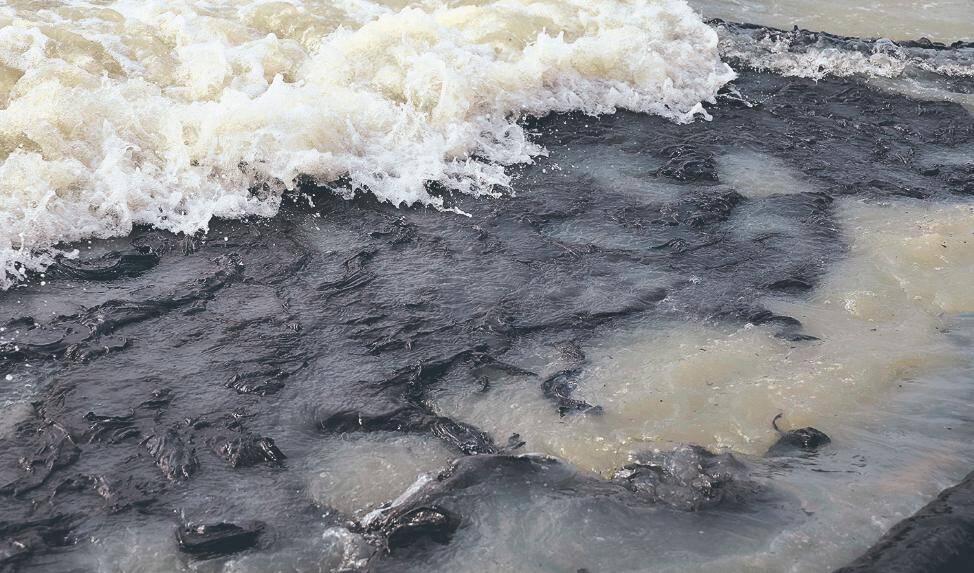
After the accident involving two Russian Volgoneft oil tankers in the Kerch Strait on 15 December 2024, half a year has already passed. The topic is gradually disappearing from the information agenda. This is a problem because three fragments of the Volgoneft tankers still have not been raised from the seabed. Fuel oil from two of the fragments continues to leak and poison the Black Sea ecosystem.
Clumps of fuel oil from the Volgoneft tankers are sometimes found on the Black Sea coast of Odesa region. For example, within the territory of Tuzlivski Lymany National Nature Park.
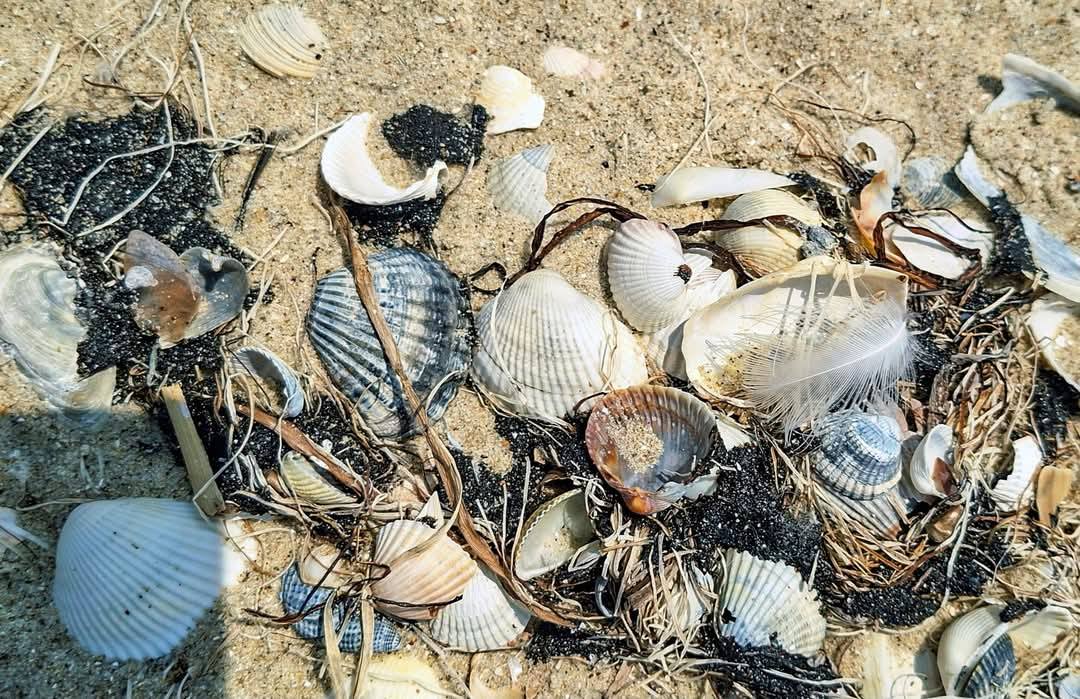
Fuel oil in Tuzlivski Lymany National Nature Park. Photo by Ivan Rusiev
“Most of the fuel oil that could have reached the north-western Black Sea region from the site of the accident on 15 December 2024 is already dissolving as temperatures rise and becoming ‘embedded’ in the food chains of aquatic organisms in the marine ecosystem and the Tuzlivski Lymany,” believes Ivan Rusiev, head of the scientific department of Tuzlivski Lymany National Nature Park.
Fuel-oil pollution has a complex character. Surface films spread under the influence of wind as plumes and slicks; some of the material settles on the seabed, while part of it in the water column breaks down into sediments and suspended particles that are carried over considerable distances by marine currents.
New fuel-oil leaks from tanker fragments are being recorded by Vladyslav Balinskyi, head of the Odesa regional branch of NECU. In his research, Balinskyi uses a reverse-plume-tracing methodology based on Sentinel-1 SAR data and Sentinel-2 optical imagery, taking into account the morphology of dark zones (dark core), meteorological and hydrodynamic factors, and models of the vertical rise of emulsified particles.
The Odesa environmentalist presented this methodology at the XXV International Scientific and Practical Conference ‘Ecology. Human. Society’, held online on 12 June 2025. The event was organised by the National Technical University of Ukraine ‘Igor Sikorsky Kyiv Polytechnic Institute’.

Presentation of the methodology for identifying sources of fuel-oil pollution. Screenshot by Vitalii Hulevets
Oil spills in the open sea often produce thin-film plumes whose spatial spread can be detected using satellite imagery. However, determining the coordinates of an underwater leak source itself without physical access to the disaster zone remains a difficult task.
Balinskyi’s proposed dark-core tracing methodology is effective for identifying the coordinates of underwater pollution sources without physical access. It is based on a combination of SAR analysis, hydrodynamic models and optical verification. Using this methodology, the researcher identified in January 2025 the coordinates of the Volgoneft tanker fragments lying on the seabed of the Kerch Strait.

Determining the coordinates of the Volgoneft tanker fragments. Screenshot by Vitalii Hulevets.
Balinskyi believes that the use of such approaches makes it possible to monitor underwater spills in crisis regions, including areas affected by hostilities.
This research was carried out with support from the European Union under the Horizon Europe programme through the project SUNDANSE — Innovative sediment management framework for a sustainable Danube–Black Sea system under Grant Agreement No. 101156533, implemented by the team of the National Ecological Centre of Ukraine.
Main photo: Fuel oil from the Volgoneft tankers washed ashore in Krasnodar Krai. Photo: ITAR-TASS