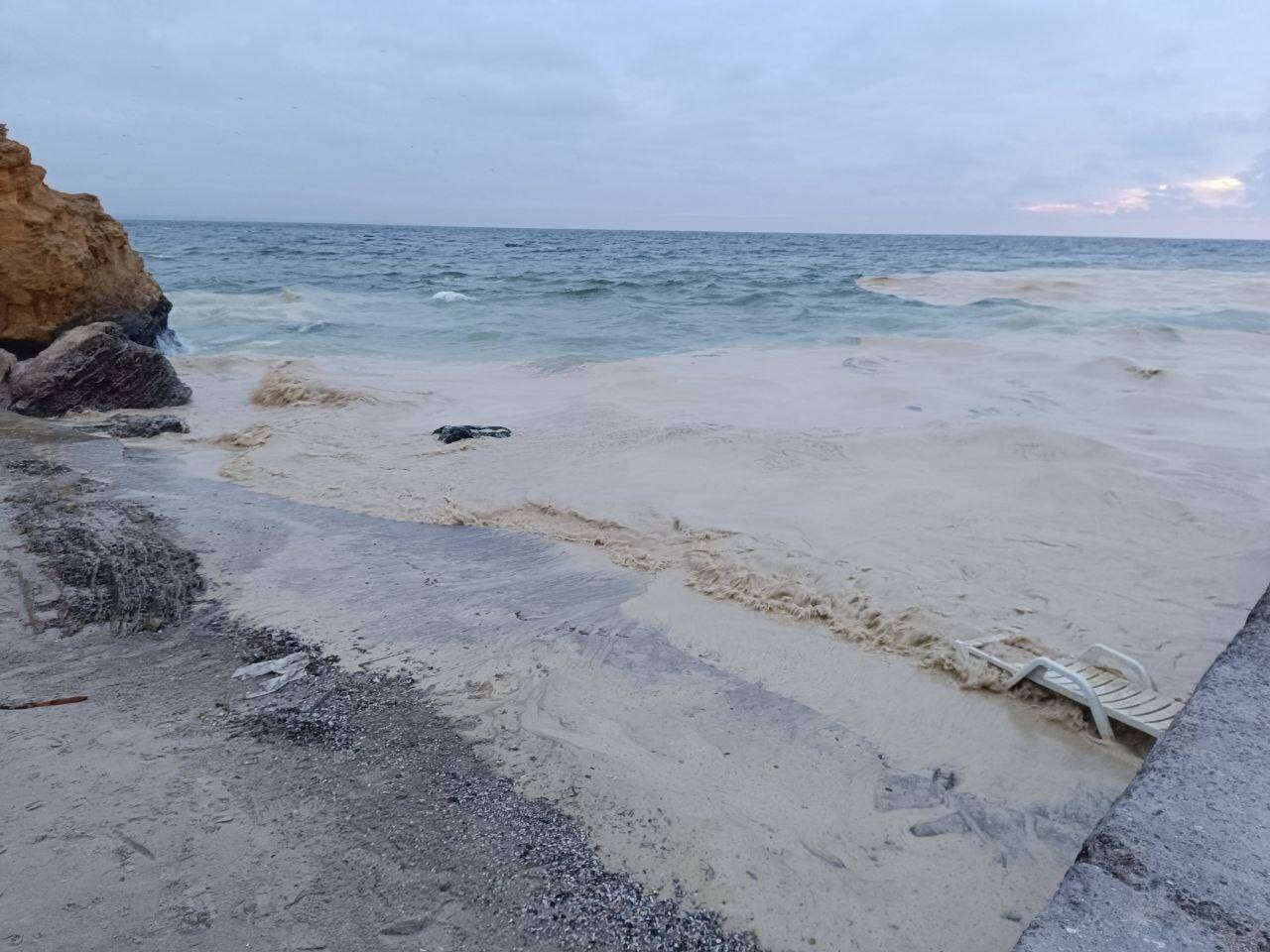
After the Russian strike on the Pivdennyi port, thousands of tonnes of sunflower oil reached Odesa beaches
A Russian attack on Ukraine’s civilian port infrastructure led to one of the largest environmental disasters in Odesa Bay in the Black Sea since the start of the full-scale war. After the shelling of a vegetable-oil terminal at the Pivdennyi port, thousands of tonnes of sunflower oil entered the marine environment and reached the Odesa coast several days later.
The consequences were recorded on city beaches: an oil film on the water, bird deaths, and a threat to unique coastal ecosystems.
Pollution reaches Odesa
24 December 2025, after the wind shifted to the east, the oil film from the Pivdennyi port area reached Odesa’s city beaches. The most affected areas were Otrada and Lanzheron.
This was reported on Facebook by the head of the Green Leaf NGO, a chemist and biologist Vladyslav Balinskyi:
“This is not an ‘incident.’ This is an environmental disaster. Otrada and Lanzheron are covered in an oily film. On the shore are dozens of dead birds, mostly little grebes.”
Photo by Vladyslav Balinskyi
The environmental expert stresses that Odesa Bay is a natural trap for surface pollution. What might partly disperse in the open sea becomes concentrated here, is driven ashore, and significantly increases the duration and scale of environmental damage.
Context: shelling of the Pivdennyi port
The pollution was caused by a Russian attack on civilian infrastructure.
20 December 2025 the Russian army carried out a missile-and-drone strike on the terminal of Allseeds at the Pivdennyi port, one of Ukraine’s largest vegetable-oil export hubs. The shelling damaged tanks containing sunflower oil.
According to open-source information, the incident involved a spill of thousands of tonnes of vegetable oil. In the first days after the attack, the sea remained relatively calm, but as weather conditions changed, the pollution began spreading actively through the Black Sea and reached the Odesa coast.
Vladyslav Balinskyi notes that such strikes are systematic:
“russia deliberately attacks civilian facilities whose destruction predictably leads to large-scale environmental consequences: ports, terminals, and tanks containing fuel or oil. This is not a side effect but a foreseeable result of such strikes.”
The lost ‘golden window’ for containment
According to the expert’s assessment, in the first days after the attack there was a real opportunity to contain the pollution within the Velykyi Adzhalytskyi Estuary, where the Pivdennyi port is located. However, this was not done.
“I do not know whether the spill could have been completely contained during the first calm, windless days. But now that the pollution has entered Odesa Bay, the environmental and economic consequences will be significant,” Balinskyi says.
On the morning of 24 December the head of the Odesa City Military Administration, Serhii Lysak, reported oil-like slicks and dead birds near the Dolphin and Lanzheron beaches.
Representatives of the State Environmental Inspectorate, the municipal enterprise Uzberezhzhia, the rescue and diving service, and other city agencies were involved in the inspection.
The official website of the Odesa City Council on 24 Decemberreported that to clean the city beaches of oil, the detected pollution had been contained and removed using an appropriate absorbent.
Planned measures:
installation of containment booms;
collection of oil slicks using specialised equipment;
Of particular concern is the risk of oil entering the Kuialnyk Estuary — a closed ecosystem where such pollution could have catastrophic and practically irreversible consequences.
Balinskyi insists on the need to temporarily stop the inflow of seawater into the estuary.
On 25 December a post appeared on the Facebook page of Kuialnytskyi National Nature Park stating that the park management had informed the operator responsible for the hydraulic structure — the municipal enterprise Obltransbud — of the need for urgent measures.
Monitoring has not yet detected oil entering the estuary.
‘Safe organic matter’ — a dangerous manipulation
Balinskyi sharply criticises claims that vegetable oil is supposedly harmless:
under U.S. EPA (40 CFR 112) vegetable oils are treated in the same way as petroleum products;
under MARPOL (Annex II) they are hazardous marine pollutants (Category Y/Z).
In seawater, oil polymerises, forming a dense film that:
blocks access to oxygen;
physically kills birds;
causes mass mortality of marine organisms.
Birds as an indicator of the disaster
An acute environmental and humanitarian crisis continues. Hundreds of birds are dying of hypothermia because their feathers have become matted together.
Birds killed by the oil on the Odesa coast. Photo by Oleksandr Hymanov
The entire burden of rescue has fallen on volunteers and the Odesa Zoo, which has already taken in more than 300 birds.
“The birds are not merely contaminated — they are freezing alive and drowning in icy water. The Odesa Regional Military Administration should have set up temporary care points and allocated funding within hours,” Balinskyi says.
Sentinel-1 satellite data: objective evidence of lost time
A key body of evidence showing how the disaster developed is a series of radar images from Sentinel-1 (22–24 December 2025). These data make it possible to trace the spill of vegetable oil over time — from local pollution in the Velykyi Adzhalytskyi Estuary area to the formation of an extended plume that covered Odesa Bay completely.
Unlike optical satellites, Sentinel-1 detects pollution regardless of cloud cover, lighting, or weather conditions. An oil film on the water changes the characteristics of radar backscatter, allowing its contours to be clearly identified in the images. This makes such data especially valuable as an objective and technically verifiable source of information.
Chronology:
20 December — the moment of the attack
A missile-and-drone strike damaged the tanks at the Allseeds terminal. A massive release of vegetable oil into the Velykyi Adzhalytskyi Estuary began. At this stage, the pollution was localised and remained within an area that was technically manageable.
21 December — the ‘golden window’ for containment
During this period, the oil mass remained in the area of the estuary channel. It was precisely then that there was a real opportunity to:
block the estuary’s ‘bottleneck’ with effective containment booms;
organise active recovery of the pollutant using skimmers;
prevent the oil from reaching the open sea.
Satellite data show that the pollution had not yet reached a scale that made it impossible to control.
22 December — the beginning of the release into the sea
The radar image records for the first time the oil film moving from the estuary channel into the open sea. This means that containment was either not carried out or was performed only formally and ineffectively.
23 December — rapid growth in the polluted area
The polluted area increases substantially and a branching plume forms. Given the meteorological conditions, it was already clear at this stage that the slick would reach the Odesa coast. At the same time, there are no signs of a full-scale public response — the establishment of a crisis headquarters, warnings to the public, or preparation of the shoreline.
24 December — the phase of an uncontrolled disaster. A plume more than 40 kmlong fills Odesa Bay
The images show a fully formed, extended oil plume more than 40 km long that completely filled Odesa Bay and began spreading along the coast. At this stage, stopping the process in the marine environment is practically impossible, and the consequences inevitably shift to the shoreline and wildlife.
The Sentinel-1 image series records not only the fact of pollution but also its development over time. It clearly demonstrates that during the critical initial period effective containment of the accident was not ensured. It was the loss of time at the early stage that multiplied the consequences and transformed a local accident into a regional environmental disaster.
Thus, the satellite data provide:
objective evidence of lost response time;
clear confirmation of the ineffectiveness or absence of containment measures;
an appropriate evidentiary basis for legal assessment of the actions of both the aggressor state and the officials responsible for responding to the accident.
The analysis used a tested methodology for interpreting Sentinel-1 and Sentinel-2 satellite imagery, developed jointly with the NECU team within the international project Horizon / Sundanse Project. This methodology was presented at the XXV International Scientific and Practical Conference ‘Ecology. Human. Society’ (Igor Sikorsky Kyiv Polytechnic Institute, Kyiv, 12 June 2025) and has scientific validation.
Legal assessment: indications of a war crime and ecocide
The attack on the Pivdennyi port shows indications of:
violations of the Geneva Conventions;
ecocide (Article 441 of the Criminal Code of Ukraine);
a crime under the Rome Statute of the ICC.
The actions or inaction of officials may also show indications of offences under Articles 236, 242 and 367 of the Criminal Code of Ukraine .
Demands to the authorities: a public report and immediate decisions
Balinskyi is demanding an official public report.
from the Odesa Regional Military Administration and the central government. In particular, he insists that the Odesa Regional Military Administration immediately publish specific, verifiable data on the response to the emergency spill of vegetable oil in the Velykyi Adzhalytskyi Estuary during 20–24 December 2025, namely:
– Provide information on the number and types of oil-debris collectors and skimmers that actually worked to pump out the oil. We demand publication of the vessels’ names, ownership, routes, and operational logs.
– Report the exact date and time when the estuary’s ‘bottleneck’ was fully closed with containment booms. Separately explain why, in calm conditions, the pollution was able to reach the open sea unhindered.
– Publish verified data on the actual volume of oily mixture removed from the water during the first 48 hours after the accident. NECU stresses that without active pumping, the use of booms is ineffective and merely creates the appearance of a response.
– Provide information on the officials who signed the terminal-readiness certificates where the bunding system (in accordance with DBN V.2.2-58:2011) proved unable to retain the hazardous cargo on land.
– State exactly when the order was given to physically close the gates on the gravity-flow channel and provide evidence that this decision was implemented before the oil slick came into contact with the hydraulic structures.
Balinskyi also appealed to the central state authorities and law-enforcement agencies, demanding immediate intervention and an appropriate legal response:
State Bureau of Investigation (SBI) — open criminal proceedings concerning the leadership of the Odesa Regional Military Administration and the Ukrainian Sea Ports Authority in connection with what he describes as criminal delay in deploying emergency spill-response forces.
Specialised Environmental Prosecutor’s Office of the Office of the Prosecutor General — place under procedural supervision the investigation into the actions of officials whose inaction led to pollution leaving the estuary and spreading into Odesa Bay.
Ministry of Finance of Ukraine — urgently provide funding to establish a professional Wildlife Rehabilitation Centre at the Odesa Zoo municipal institution and/or Tuzlivski Lymany National Nature Park. The state must assume systematic responsibility for rescuing and caring for affected birds rather than shifting it to volunteers.
The aggressor’s war crime developed into a large-scale regional disaster because of lost time, lack of coordination, and systemic inaction by responsible authorities. Instead of saving the sea, officials were writing ‘reassuring’ reports.
Deadlines and procedures for authorities to respond to media information requests
Ignoring media publications is a violation of the law.
Green Leaf reminds readers:
under Article 214 of the Criminal Procedure Code of Ukraine, investigators and prosecutors are required, without delay and no later than 24 hours, to enter information into the Unified Register of Pre-Trial Investigations when they independently identify, from any source including media publications, circumstances that may indicate a criminal offence. Ignoring information published in the media contradicts an explicit requirement of the law.
The published facts contain indications of offences under Articles 236 (violation of environmental safety rules), 242 (violation of water-protection rules), 367 (official negligence), and 441 (ecocide) of the Criminal Code of Ukraine, and also concern threats to environmental and national security. Accordingly, state authorities and law-enforcement agencies are required to provide these publications with an appropriate legal assessment and ensure a procedural response.
The demands for a public report by the Odesa Regional Military Administration and other authorities are based on direct provisions of the Constitution of Ukraine and specific legislation. Under Articles 34 and 50 of the Constitution of Ukraine, information about the state of the environment, environmental accidents, and the authorities’ response to them is open and may not be restricted. A similar obligation is established by Articles 5, 13 and 15 of the Law ‘On Information’ and Article 6 of the Law ‘On Access to Public Information’, which directly require authorities to proactively disclose environmentally significant information.
Shortened and mandatory response deadlines apply to the media. Under Article 20 of the Law ‘On Access to Public Information’, a response to a media information request must be provided no later than five working days and, where it concerns a threat to the environment, an accident, or an emergency, within 48 hours.
Refusal, delay, or provision of incomplete information on the amount of equipment deployed, the effectiveness of spill response, the timing of boom installation, or management decisions taken is a direct violation of the law.
Ignoring media requests and media publications has legal consequences.
Under Article 214 of the Criminal Procedure Code of Ukraine, law-enforcement agencies are required to respond to information about possible crimes obtained from any source, including journalistic materials. The published facts may contain indications of criminal offences under Articles 236, 242, 367 and 441 of the Criminal Code of Ukraine, which obliges the state not only to provide responses within the statutory deadlines but also to ensure an appropriate legal assessment of officials’ actions and inaction.
Green Leaf is a registered media outlet Media identifier: R40-03818 Odesa, 77 Yevropeiska Street