
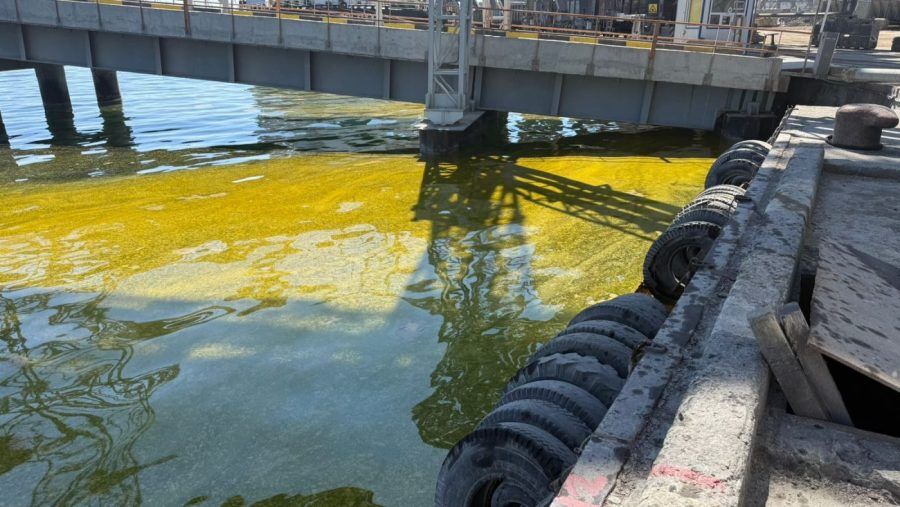
On April 26, 2026, an oil spill in Chornomorsk occurred as a result of a Russian strike on port infrastructure: tanks containing sunflower oil were damaged at the Chornomorsk Commercial Sea Port. According to data from the StateEnvironmental Inspectorate of the South-Western District, a tank with a capacity of about 6,000 tonnes was destroyed during the fire, causing oil to spill both on port territory and into the waters of the Sukhyi Estuary.

The Chornomorsk Commercial Sea Port is located directly on the shore of the Sukhyi Estuary, and its internal harbour area is effectively part of the estuary. At the site, officials recorded a slick approximately 400 by 200 metres in size, which at the time of inspection was being contained by booms.

Services of the Ukrainian Sea Ports Authority reported an operational response: stormwater drains were blocked, containment booms and a Lamor skimmer were deployed, and specialized vehicles were used to pump out the pollution. The port operator localized the spill by building sand barriers around the drainage network and along the directions in which the pollution was spreading. Formally, this followed the basic response scenario — rapid containment, control of the leak and minimization of impacts.
Pollution escapes the estuary: the point of no return
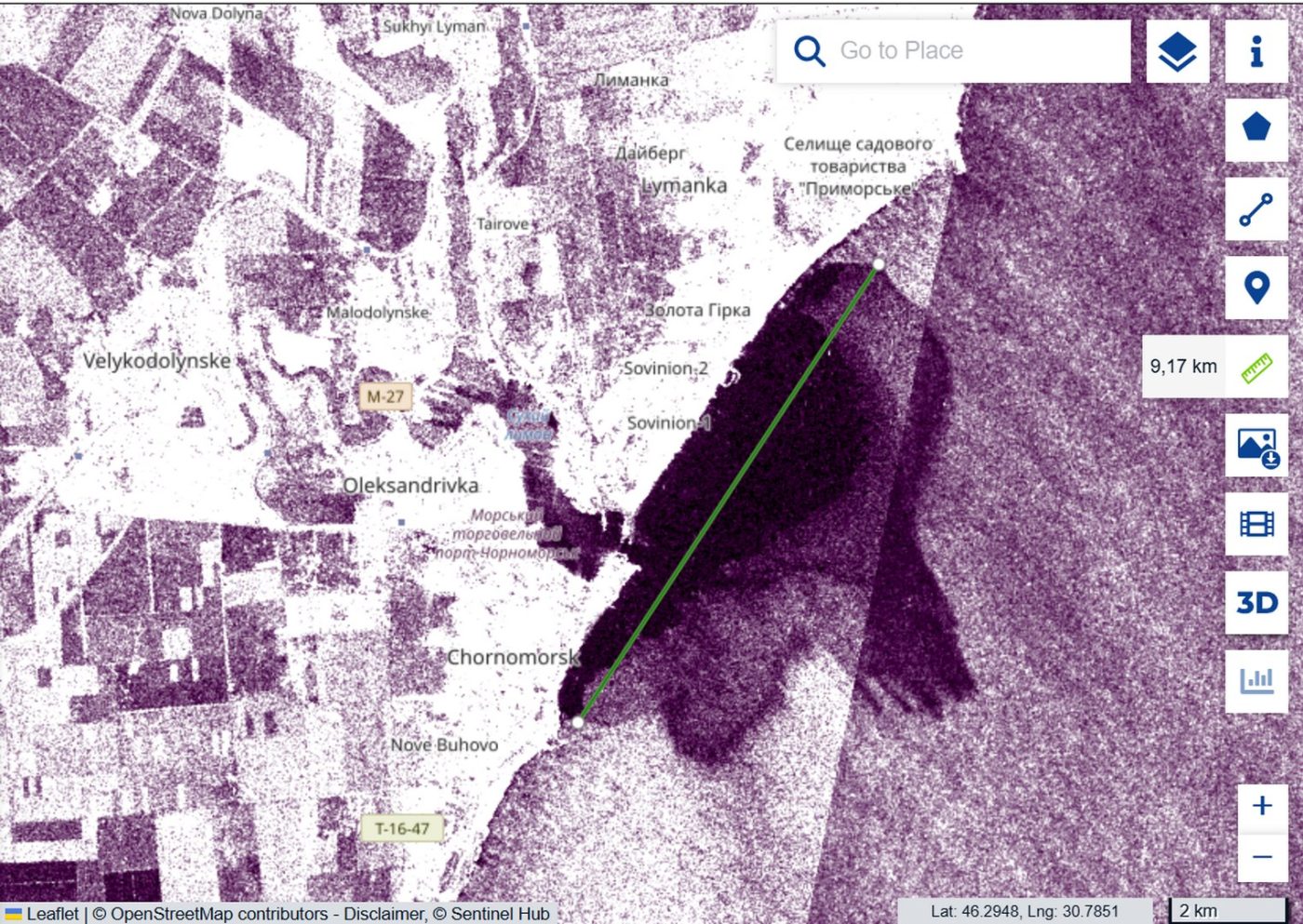
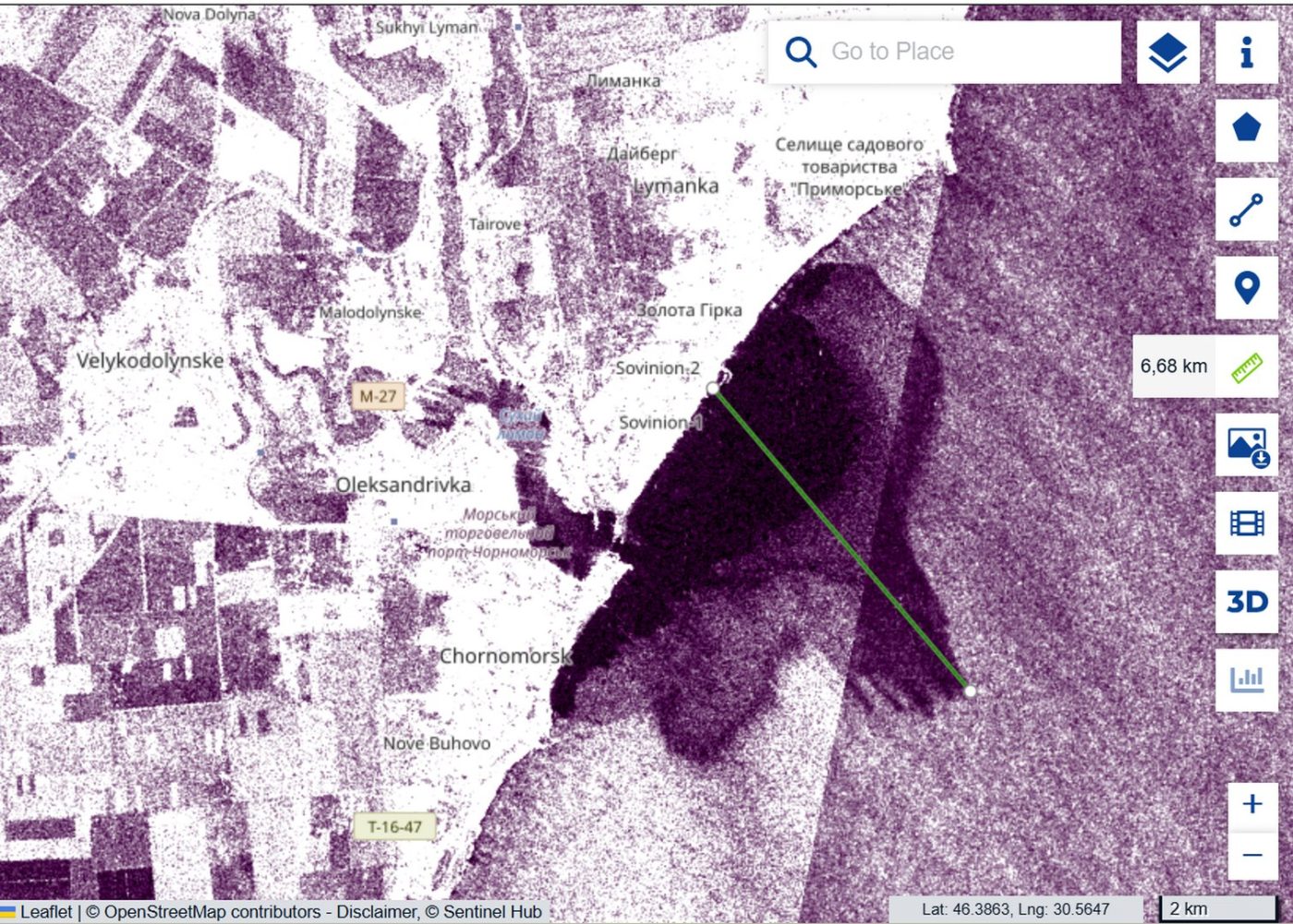
Yet by the next day, the picture had changed dramatically. According to estimates by Vladyslav Balinskyi, chemist, biologist and head of the Odesa branch of the National Ecological Centre of Ukraine, based on Sentinel-1 (Copernicus) radar satellite imagery from April 27, 2026, the polluted area had expanded to about 40 square kilometres. The oil film, visible on radar imagery as a dark anomaly because it suppresses the return signal, had moved beyond the port waters, spread toward the Sukhyi Estuary and then into the open sea.

Wind that destroys any control
Weather conditions played a key role in this process. According to Balinskyi’s observations, strong westerly and north-westerly winds dominated the Black Sea area on April 25–26, reaching up to 18 m/s with gusts up to 22 m/s. Such offshore winds literally push surface pollution away from the coast into the open sea — precisely where it becomes almost impossible to recover with technical equipment. During the night of April 27, the wind began shifting to the south-east, an onshore direction for Odesa Bay, meaning that polluted water masses would be driven back toward the coast.
Most likely, between the evening of April 26, when the accident occurred, and the morning of April 27, 2026 — roughly the first 12–18 hours after the spill — the “golden window” for containing the spill was lost. In other words, control was lost even before the wind changed, at a stage when the spill was still technically manageable. During this period, official data indicate that the slick was still contained within the port waters and the Sukhyi Estuary, with a recorded size of about 400×200 m.
What the Ukrainian Sea Ports Authority should have done — and what it failed to do
Formally, the Ukrainian Sea Ports Authority carried out the basic actions: blocking stormwater drains, deploying booms and bringing in a skimmer. But with such a large volume — up to 6,000 tonnes — that was not enough to prevent the pollution from reaching the sea.
In incidents like this, the key is not merely to place booms near the source of a spill but to fully block the water area’s “bottleneck” — in the case of the Sukhyi Estuary, the outlet to the sea. If that direction is not blocked with a cascading system, any wind will inevitably push the surface film outward. A single line of booms works only in calm conditions; with real wind speeds of 12–18 m/s, a multi-level system is required. Otherwise, pollution flows over the barriers, leaks beneath them or causes them to rupture.
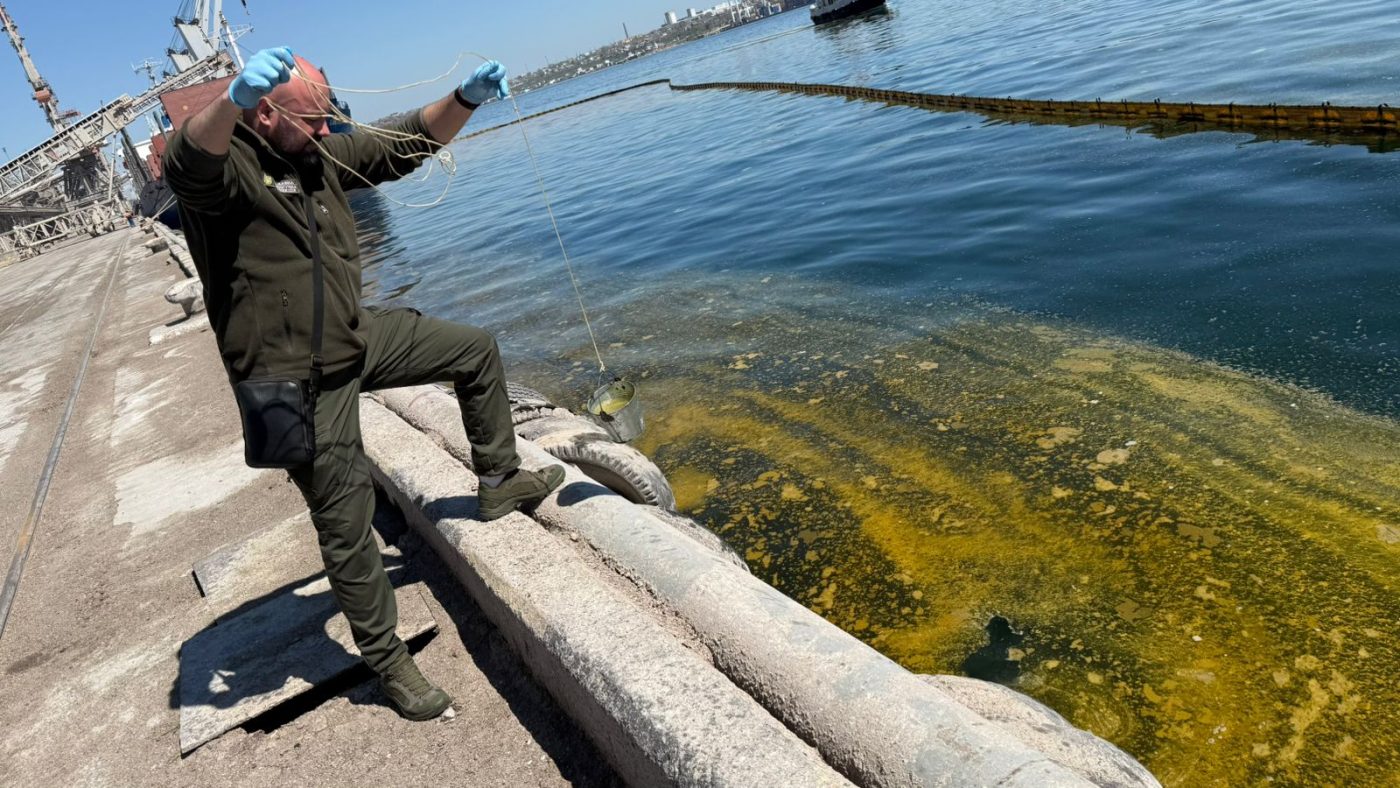
The intensity of pollution recovery is equally critical. A common mistake is to rely on “containment” without active pumping. Without continuous skimmer operation, booms only delay the slick temporarily; they do not reduce its volume, and under the first significant load the system effectively stops working.
Another problem is the night-time response phase. This is precisely when a slick is still compact and manageable, yet operations often slow down, the full response fleet is not deployed and control over the condition of the barriers is lost. The situation is further complicated when weather conditions are underestimated: if strong forecast winds are not taken into account in advance, the containment system is designed for “ideal” conditions rather than real storm loads, and decisions begin to be made only after the pollution is already out of control.
International spill-response practice, summarized by the International Maritime Organization, International Tanker Owners Pollution Federation and the National Oceanic and Atmospheric Administration, clearly identifies the first 24–48 hours after an accident as critical for containing pollution. During this period, the slick remains compact, manageable and suitable for effective mechanical recovery.
If, during this period, the water area is not fully closed off with a multi-level boom system and continuous skimming, the pollution quickly leaves the controlled zone. It is then stretched by wind and currents, and the response shifts from preventing impacts to merely mitigating them. This is exactly the pattern that explains how the spill expanded from the waters of the Chornomorsk Commercial Sea Port into the open sea.
Copernicus satellite data, field observations and experience from previous accidents lead to a fundamental conclusion: even when formally correct actions are taken in the first hours after an incident, the decisive factor is not the mere fact of containment, but its effectiveness during the first 24–48 hours and the ability to keep the pollution within a controlled water area. In the Chornomorsk case, judging by the dynamics of the slick, that control was lost almost immediately after the wind conditions changed.
A recurring scenario
This scenario is not new. It is already the third major vegetable-oil spill in Odesa region in less than two years.
In October 2024, after a strike on port infrastructure, about 125 tonnes of oil entered the same Sukhyi Estuary, while environmental inspectors estimated the damage at UAH 10.9 billion.
In December 2025, after a strike on the Pivdennyi port , thousands of tonnes of oil entered the sea, and satellite data showed a polluted area covering hundreds of square kilometres. The consequences became apparent only several weeks later: more than 5,000 dead birds, mass mortality of benthic organisms including Red Book seahorses, and extensive coastal pollution.
How birds and marine ecosystems die
The mechanism of this catastrophe is significantly underestimated. Vegetable oil is not toxic in the conventional sense, but in the marine environment it behaves as a dangerous pollutant.
According to NOAA / Office of Response and Restoration, spills of this kind have physical effects similar to light crude-oil spills: they can suffocate animals, destroy thermal insulation and cause mass fouling of birds and aquatic organisms.
Under the influence of sunlight, oxygen and salt, the oil polymerizes and forms dense sticky masses that settle on the seabed. These deposits accumulate in natural depressions — exactly where key components of marine ecosystems live, including mussels, crustaceans and seahorses. During storms, these masses are resuspended in the water column and can block organisms’ respiration. According to Balinskyi’s working hypothesis, this mechanism explains the mass mortality of seahorsesrecorded in January 2026.
For birds, the mechanism is different but no less destructive. Oil mats the feathers and destroys their insulating properties. As a result, birds lose the ability to retain heat, drown and die from hypothermia even in relatively warm water. Practical experience from previous spill responses shows that rescue success is extremely low — out of hundreds of birds rescued, only a few survive.
Where the slick is moving: a scenario of a technological accident with large-scale environmental consequences
Copernicus Sentinel-2 images from April 28 showed that overnight the oil slick had stretched north and north-east, toward Ochakiv and beyond. The measured area of polluted sea surface was about 793 square kilometres. The far edge of the slick toward the Dnipro-Buh Estuary was hidden by clouds, so the actual size may be larger. The scale of the current pollution is already comparable to the vegetable-oil spill of December 2025.

The cause is the same — wind. A strong south-westerly wind in Odesa Bay is predominantly offshore and drives surface water masses north and north-east. The oil slick continues moving northward and toward the Dnipro-Buh Estuary. There is a risk that the estuary will be polluted.

In the short term — the coming weeks — birds will bear the brunt because the spill coincides with the peak of spring migration and the start of nesting. In the medium term — over several months — the effects will appear as degradation of benthic communities. In the long term — in autumn and winter — repeated waves of marine-organism mortality may occur as polymerized deposits are resuspended.
Balinskyi stresses that this incident is not isolated. It is part of a systemic processin which strikes on port infrastructure lead to predictable environmental consequences. Each new spill overlaps with the previous one, creating a cumulative effectthat is already moving beyond local accidents and approaching signs of regional degradation of the marine ecosystem.
Against this background, every satellite image, every recorded coordinate of the slick and every field observation matters not only to science but also to law. These data can and should be used as evidence under the Bucharest Convention, the United Nations Environment Programme framework for assessing the environmental consequences of armed conflicts, and in the context of international efforts to recognize ecocide as a distinct crime.
The situation in Chornomorsk shows that the question is no longer whether the next environmental disaster will happen, but how large it will be — and whether the same “golden window” that is repeatedly lost will finally be used.
Regional authorities and response bodies — the Odesa Regional State Administration and its Department of Ecology, the Ukrainian Sea Ports Authority, including its Chornomorsk, Odesa and Pivdennyi branches, the State Emergency Service of Ukraine, the State Environmental Inspectorate of the South-Western District, local governments of coastal communities, and specialized scientific institutions — therefore need to move from a reactive model to a system of permanent readiness: with pre-designated points for closing estuary outlets, reserve response equipment, mandatory satellite monitoring and round-the-clock response during the first 24 hours. Without this, every new incident will inevitably escalate from a local accident into a regional environmental disaster.
Legal assessment: indications of ecocide and a war crime
The attack by the Russian armed forces on the Chornomorsk Commercial Sea Port on April 26, 2026 shows indications of an internationally wrongful act against the environment and may be considered in the context of ecocide as well as a violation of international humanitarian law.
First, the Port of Chornomorsk is civilian infrastructure that does not perform military functions. Articles 52 and 54 of Additional Protocol I to the Geneva Conventions prohibit attacks on civilian objects and actions that may cause excessive harm to civilians and the environment on which they depend.
Second, striking tanks containing large volumes of vegetable oil creates foreseeable and large-scale environmental consequences. These include marine pollution, deaths of aquatic and coastal species and long-term ecosystem degradation. In nature and scale, such consequences may meet criteria of severe, widespread and long-term environmental damage used in international approaches to defining ecocide.
Third, the described actions may fall under Article 441 of the Criminal Code of Ukraine, which establishes liability for ecocide as the mass destruction of flora and fauna, poisoning of water resources and other actions capable of causing an environmental disaster.
In addition, Article 8(2)(b)(iv) of the Rome Statute of the International Criminal Court prohibits intentional attacks when it is known that they will cause excessive environmental damage that is clearly disproportionate to the anticipated military advantage.
The systematic nature of strikes on ports, terminals and facilities containing hazardous substances may indicate an established pattern of conduct with predictable environmental consequences. This strengthens the grounds for international legal assessment of such cases not only as war crimes but also as potential crimes against the environment.