
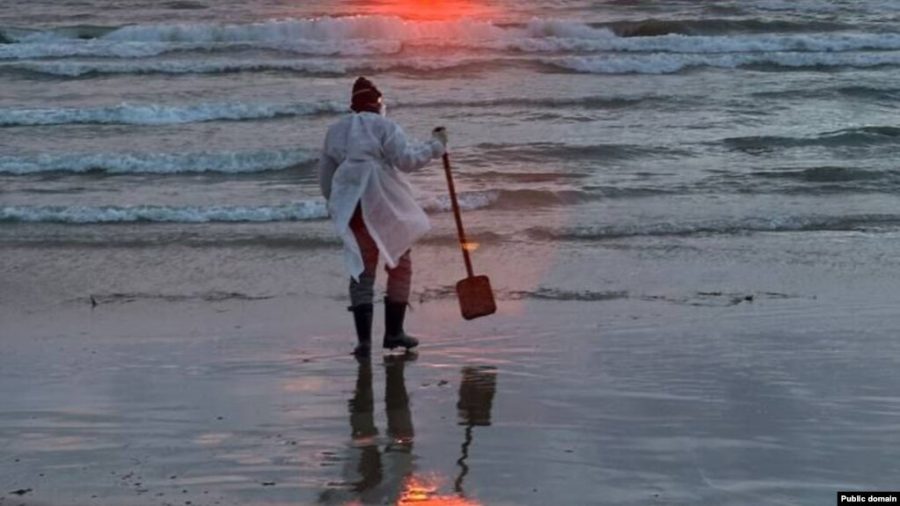
After 15 December 2024, the most important topic in Russian and Ukrainian media became the accident in the Kerch Strait involving the oil tankers Volgoneft 212 and Volgoneft 239, from which more than 9,000 tonnes of fuel oil spilled into the Black Sea. Journalists in the two countries, however, covered the event very differently.
Context
According to estimates by the Ukrainian Scientific Centre of Ecology of the Sea and Ukraine’s Ministry of Environmental Protection and Natural Resources, toxic petroleum products cause plankton deaths, poison fish and seabirds, and contaminate bottom sediments and coastal zones. This will lead to long-term changes in the biodiversity of the Black Sea and the wider Black Sea region, while some species may need decades to recover.
At present, the Ministry estimates damage to the Black Sea ecosystem from the fuel-oil spill at more than USD 14 billion. This estimate will form the basis for compensation for environmental damage caused to our country if such compensation is awarded following consideration of Ukraine’s lawsuit against Russia in an international court.
Ukrainian investigators are already examining media publications, primarily Russian ones, that may provide important information about the causes of the accident and its consequences. It is therefore interesting to analyse how Russian outlets cover the tanker accident and fuel-oil spill.
For the analysis, we selected the Russian state news agency TASS and the independent media outlet Meduza. We decided to compare their coverage with how the same events were presented by Ukrainian media — the state Ukrainian National News Agency Ukrinform and the independent outlet Ukrainska Pravda.
These examples were chosen to represent different types of media — state and independent. This allows us to analyse different approaches to covering events, assess the presence of manipulation in the presentation of information, and compare editorial policies.
State media generally serve as mouthpieces for official government positions and may be used to promote political messages or influence public opinion. Independent outlets, by contrast, seek to preserve objectivity, although they too may be subject to political or economic pressure that affects their content.
For effective news selection, we used the keywords: fuel oil, disaster, Black Sea, consequences, pollution, Volgoneft 212, Volgoneft 239, Kerch Strait. The materials were analysed for the period from 15 December 2024 to 22 January 2025.
When examining news reports, attention was paid to their content, sources, the presence of comments, and possible manipulation.
TASS
The state news agency TASS published numerous reports about the Black Sea shipwreck in its official Telegram channel during the period under review. From the day of the accident through 22 January, seventy-two reports on the topic were found and analysed using the selected keywords.
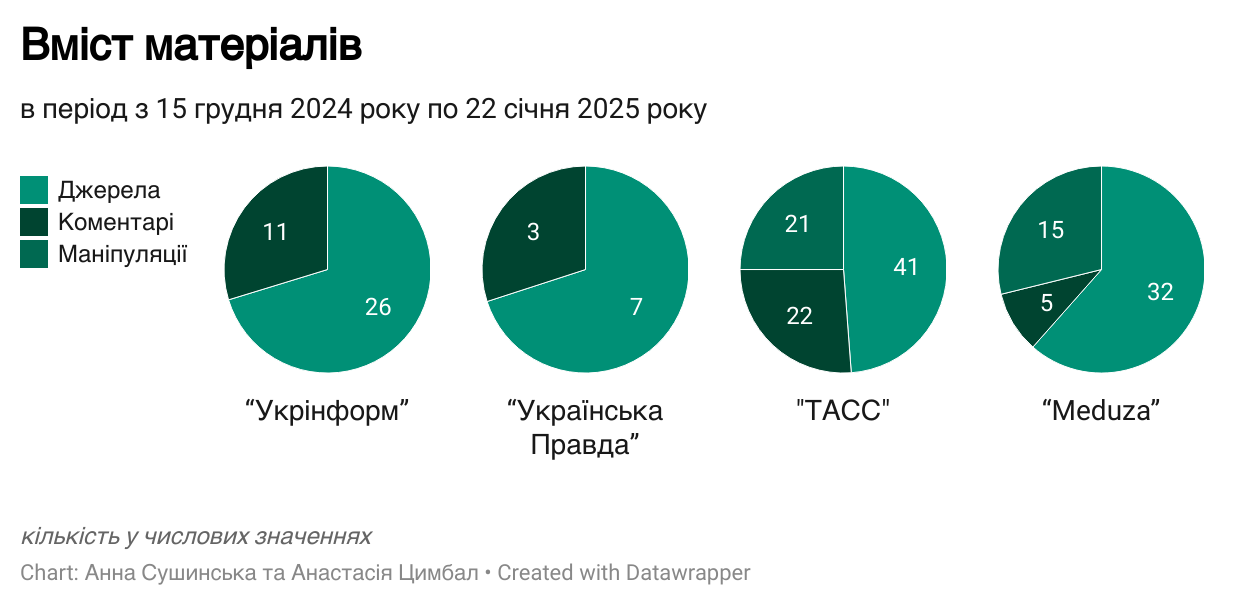
Only forty-one reports included sources. The outlet actively published information about the accident and most often cited regional emergency headquarters, especially the Krasnodar Krai headquarters, which it cited twelve times. It also frequently used official comments from Russia’s Ministry of Emergency Situations or referred to statements by an adviser to Sergei Aksyonov without naming anyone. It should be recalled that after Russia’s annexation of Crimea in 2014, Aksyonov was appointed chairman of Crimea’s Council of Ministers and later head of the ‘Republic of Crimea’.
Manipulation was identified in twenty-one news reports.
The first example of manipulation is the use of the term ‘insufficient’ in comments by Russian President Putin. This may evoke an emotional response in society by reinforcing the impression that the authorities are supposedly taking the response to the accident seriously. It may also be a deliberate way of shaping a particular attitude: ‘everything is under control’.
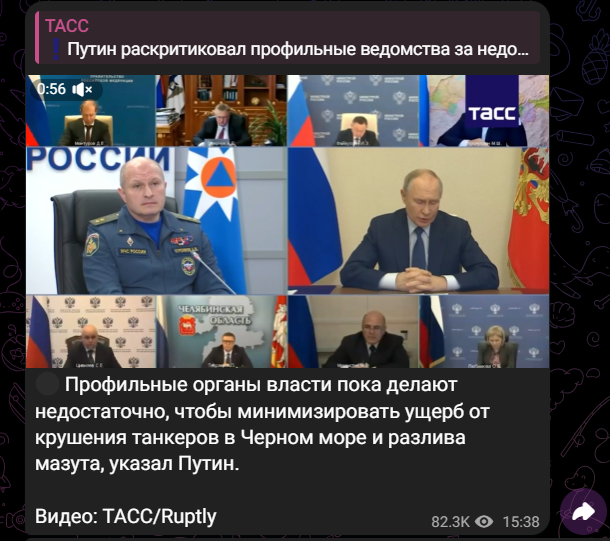
It is worth stressing here that, according to Ukraine’s Ministry of Foreign Affairs, from the first day of the shipwreck the Russian authorities took no effective action to address the consequences of the Black Sea accident. Only when the scale of the disaster became undeniable did the Russian authorities begin actively broadcasting their ‘concern’.
“Vladimir Putin’s instructions on dealing with the consequences of the large-scale environmental disaster in the Black Sea look openly demonstrative,” states on its official page Facebook Ministry of Foreign Affairs of Ukraine
Signs of manipulation were also observed in coverage of volunteer work at the scene. Reports such as: ‘Volunteers helped a swan by cleaning fuel oil off it. It spent the night on a farm, and in the morning said goodbye to its rescuers and flew away’, or the claim ‘About 100 birds stained with fuel oil were rescued in Novorossiysk. They are under observation and receiving special care’, exert a strong emotional influence on the reader. In turn, such stories serve as a vivid means of manipulation because, through sympathy, they divert attention from more serious questions.
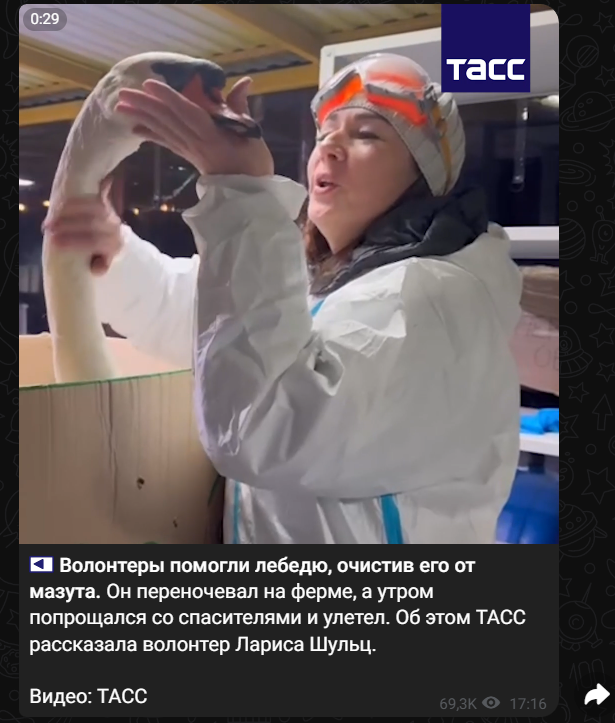
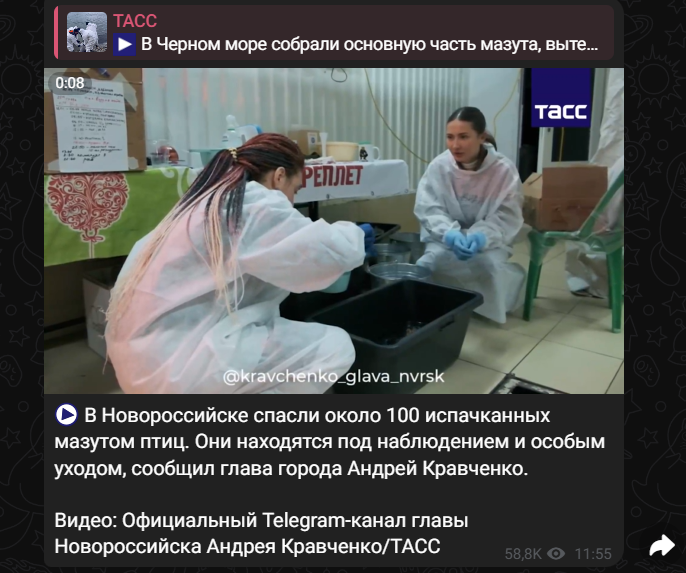
Screenshots from the TASS Telegram channel
Meduza
After analysing all news items in the official Telegram channel using the keywords for this period, we found thirty-six reports. Despite the seriousness of the incident, almost half — fifteen reports and posts — contained elements of manipulation that distort perception of the situation.
For example, manipulation can be seen in the emphasis on religious and cultural aspects: reports about Epiphany bathing near the polluted area divert attention from the seriousness of events. The Krasnodar Krai operational headquarters emphasises a rapid response and control of the situation, stressing that ‘the water is clean and warm’. Yet pollution clean-up work continues, and traces of fuel oil are still being found in some areas. Such a description creates an illusion of safety but does not reflect the full picture of the environmental and social consequences.
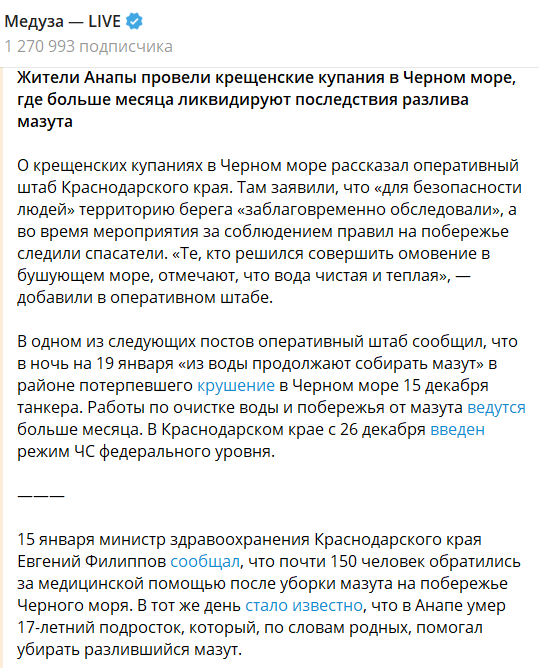
Another example of manipulation can be seen in reports about the death of a 17-year-old student who, according to relatives, helped clean up the spill. The lack of clear explanations and contradictory statements from relatives, the technical school and the emergency headquarters generate speculation and heighten emotional tension.
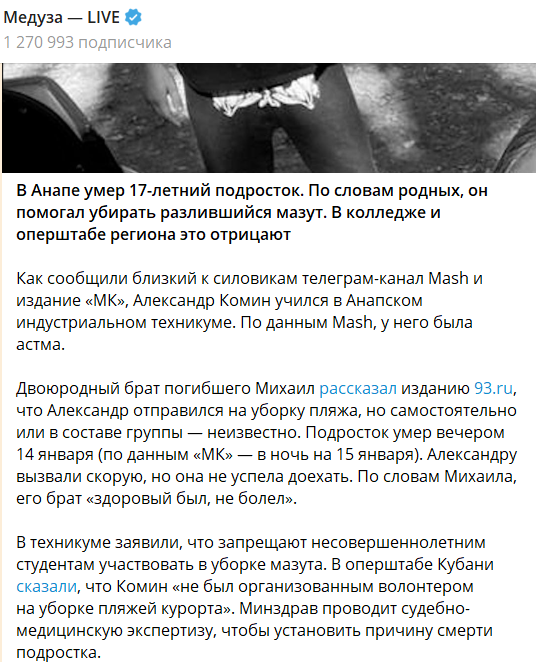
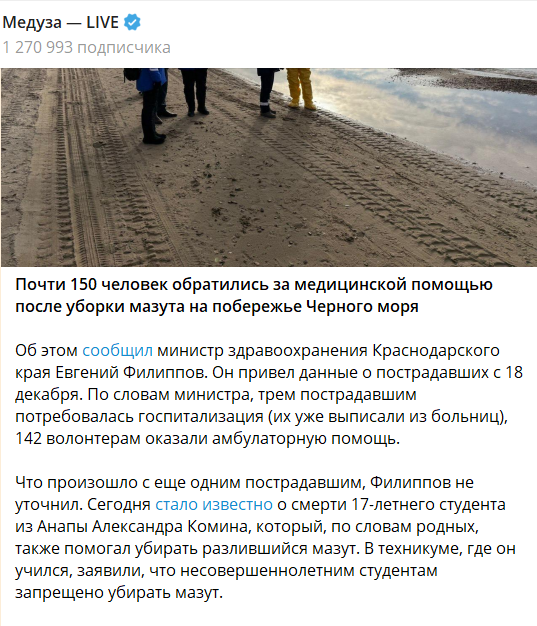
Screenshots from the Meduza Telegram channel
Independent experts, including Greenpeace representatives, emphasise significant environmental risks associated with shoreline pollution and the deaths of waterbirds. Official sources, however, try to downplay the scale of the disaster by describing it as local. For example, one report states: ‘There is no mass shoreline pollution in Sevastopol, but traces of fuel oil are being found in different places,’ says Razvozhayev, the acting ‘governor’ of Sevastopol appointed by Russia after the 2014 annexation of Crimea. Such a statement gives the impression of an attempt to reduce the perceived seriousness of the situation. In addition, the Russian Ministry of Transport’s emphasis that the volume of the fuel-oil spill was smaller than earlier estimates weakens the perception of the problem’s critical nature.
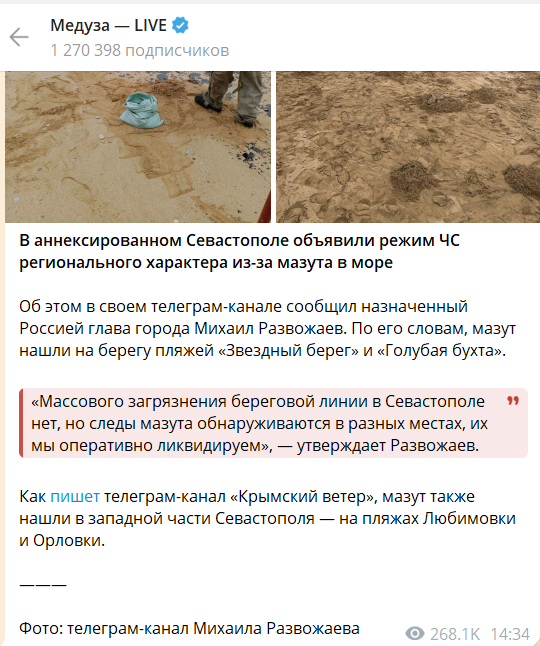
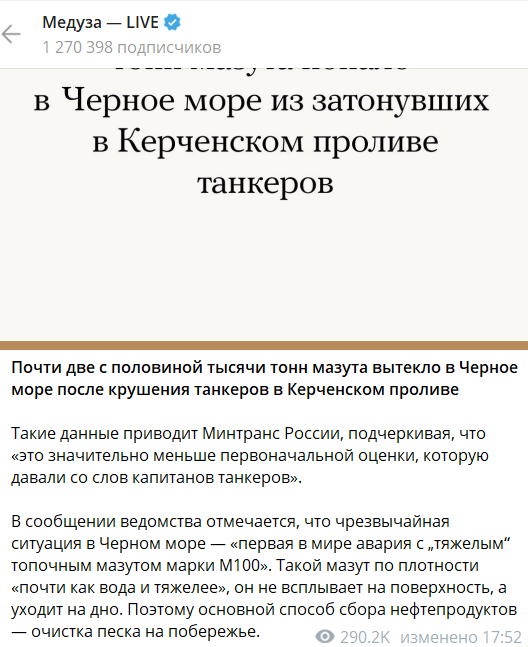
Screenshots from the Meduza Telegram channel
Five reports included comments, among them two from Sergei Aksyonov, head of annexed Crimea, as well as comments from Aleksan Mkrtchyan, a Russian tourism expert and director general of the Pink Elephant travel-agency network, and Tetiana Bieliei, an environmental specialist and representative of the Delfa Centre for Environmental Wellbeing. In general, most information came from official bodies such as operational headquarters, Russian-appointed officials and state media, including RIA Novosti, Interfax and TASS. Some data were provided by scientific and environmental organisations such as the Delfa Centre and Greenpeace. Unofficial sources included Telegram channels such as Krymsky Veter, Mash, Baza and Shot.
At the same time, four reports did not identify a source, making it more difficult to verify their reliability.
Ukrinform
The state news agency Ukrinform published a considerable amount of information about the Black Sea shipwreck during the period under review. The outlet placed strong emphasis on the environmental disaster and was among the first to actively share details in a dedicated Black Sea section.
Analysis of news by the selected keywords identified twenty-six materials about the Russian tanker accident, none of which contained manipulation. Eleven materials included expert comments, three of them republished from media such as Suspilne and Crimea.Realities. Ukrinform also interviewed Yevhen Khlobystov, dean of the Faculty of Natural Sciences at the National University of Kyiv-Mohyla Academy and adviser to the chair of the Crimean Tatar Resource Centre. Most comments were taken from Telegram channels or television broadcasts.
On this topic, among Russian Telegram channels Ukrinform cited the independent Russian resource ASTRA three times and the Shot channel twice. Among Ukrainian channels, Krymsky Veter and Baza were used as sources. The news agency also cited official sources including the Ukrainian Navy, the Ministry of Environmental Protection and Natural Resources of Ukraine, and the Centre for Countering Disinformation.
The main emphases in the news included environmental consequences, the condition of affected birds and dolphins, the causes of the accident, the scale and spread of pollution, the response of the Russian authorities, and the situation in Odesa Oblast.
Ukrainska Pravda
From the beginning of the Black Sea disaster caused by the Russian tankers, specifically from 15 December to 22 January, Ukrainska Pravda published seven materials on the topic using the selected keywords.
After analysing the news, we found no manipulation. Six materials were short, informative news items, and one was an article about Tuzlivski Lymany National Nature Park, where birds covered in an oily liquid resembling fuel oil were found. All of these texts describe the current situation and possible consequences of the environmental disaster.
The main sources of information were Ukraine’s Ministry of Environmental Protection and Natural Resources, Radio Liberty, the Ukrainian Scientific Centre of Ecology of the Sea, and several Russian media outlets, including Interfax, Meduza and RIA Novosti. Comments were used in three of the seven analysed news items. The article about birds affected by the fuel-oil spill included comments from leading experts: Doctor of Biological Sciences Pavlo Holdin of the I. I. Schmalhausen Institute of Zoology of the National Academy of Sciences of Ukraine, and Paul Johnston, head of research laboratories at the University of Exeter in the United Kingdom.
Conclusion
The tanker accident in the Kerch Strait became not only an environmental disaster but also an important media topic. Ukrainian media such as Ukrinform and Ukrainska Pravda mainly focused on environmental consequences without obvious manipulation, while Russian media, including TASS and Meduza, used elements of manipulation that reduced the perceived seriousness of the event.
Independent experts and environmental organisations emphasise the importance of impartial coverage of such disasters for an accurate understanding of the situation and for minimising its consequences.
Authors: fourth-year journalism students at Vasyl Stus Donetsk National University, Anna Sushynska and Anastasiia Tsymbal
Lead photo: A volunteer with a shovel on the Black Sea shore polluted with petroleum products, December 2024. Photo: Crimea.Realities.