
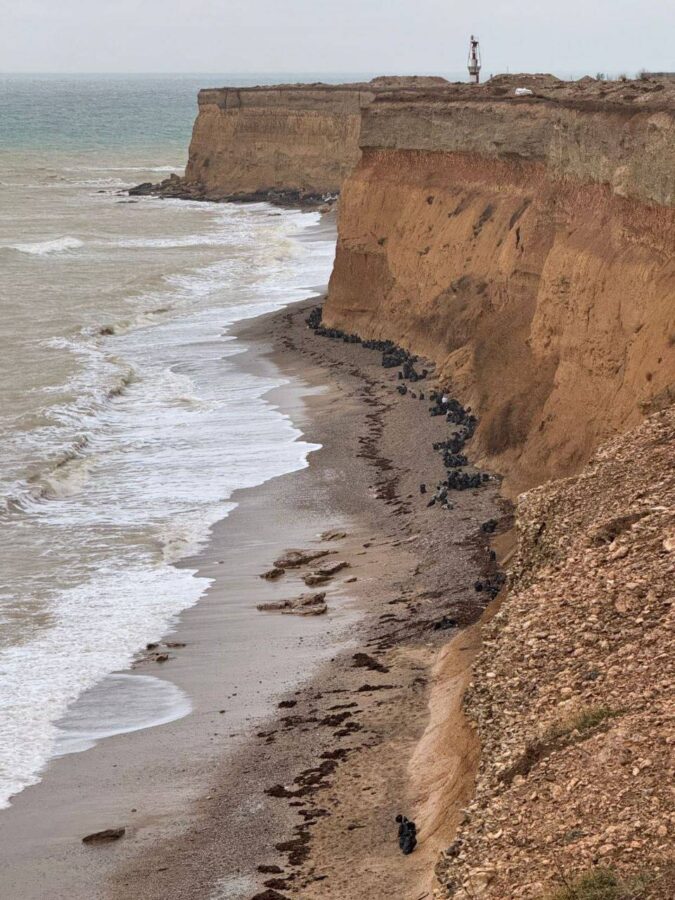
On 9 March, additional information appeared on Russian social media about the nature of the fuel oil whose contamination of the Black Sea waters and coastline began after the Volgoneft tanker disaster on 15 December 2024. This was reported by the Association of Reintegration of Crimea.
“One fuel oil melts and flows while the other still lies in lumps”

Photo — Association of Reintegration of Crimea
According to the Association: “The warmer weather that arrived in occupied Crimea revealed new properties of the fuel oil that continues to be washed ashore by the sea. As collectors write, it turned out that ‘these are two different fuel oils’. ‘In the warmth … some of the fuel oil collected on the beach remained in cakes, while some melted and flowed downward, soaking into the sand.’
As it ‘suddenly’ became clear almost three months later, ‘the tankers carried fuel oil from two different refineries with very different properties. One is straight-run fuel oil, similar to M-100, while the other is cracking residue with a high benzo(a)pyrene content. One fuel oil floats, the other sinks. One melts and flows while the other still lies in lumps.’
It was also noted that ‘the producing refineries are silent, … Rosneft pretends it has nothing to do with this’. No comments on the matter were provided by the aggressor state’s authorities.”
Investigation of the criminal case
This information is extremely important for holding Russia accountable. It failed to ensure the safe operation of vessels in its oil-transport fleet, which led to unprecedented fuel-oil pollution of the Black Sea. However, building an evidence base on the scale and consequences of the pollution is extremely difficult. Ukraine currently has no direct access to the accident site or to the Crimean coast, which was affected the most. Satellite monitoring data, mathematical modelling of the spread of petroleum products at sea, and pollution monitoring in coastal marine zones therefore need to be used actively. Testimony from observers and residents of coastal areas is also important. This is the view of Yurii Tuchkovenko, a leading researcher at the Institute of Marine Biology of the National Academy of Sciences of Ukraine, oceanographer and professor. Combining these three methods will make it possible to determine unequivocally the source of the petroleum products and calculate the scale of the damage caused.
Environmental prosecutors from territorial prosecutor’s offices in Odesa Oblast are currently providing procedural supervision in criminal proceedings under Part 1 of Article 243 of the Criminal Code of Ukraine — marine pollution. Specialists from the State Environmental Inspectorate of the South-Western District have been involved in the investigation. The scene was inspected, samples of the substances that polluted the Odesa Oblast coast were seized and sent for examination, and witnesses were questioned. In addition, pollution of the Sea of Azov in Zaporizhzhia Oblast is being investigated within another criminal proceeding. In particular, NECU expert Vladyslav Balinskyi was questioned. The environmental expert established the precise coordinates of the wreckage of the Volgoneft vessels and the period during which fuel oil was leaking into the marine environment.
Why birds are important evidence of the crime
Fuel-oil contamination of birds may become important evidence of the Russian crime because birds carry fuel oil on their wings and plumage. Unfortunately, however, state agencies in Odesa Oblast for some reason resist examining fuel-oil-contaminated birds that have reached the Black Sea coast of Odesa Oblast. On 4 January, Ivan Rusiev, head of the scientific department of Tuzlivski Lymany National Nature Park, wrote that in Tuzlivski Lymany National Nature Park a third bird had already been found covered in fuel oil — a red-throated diver listed in the Red Data Book of Ukraine. It should be recalled that it was on the territory of this protected area that the first clumps of fuel oil appeared in the third decade of January this year.
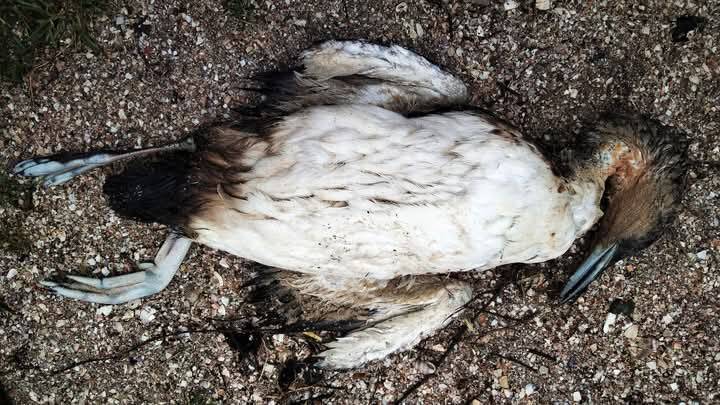
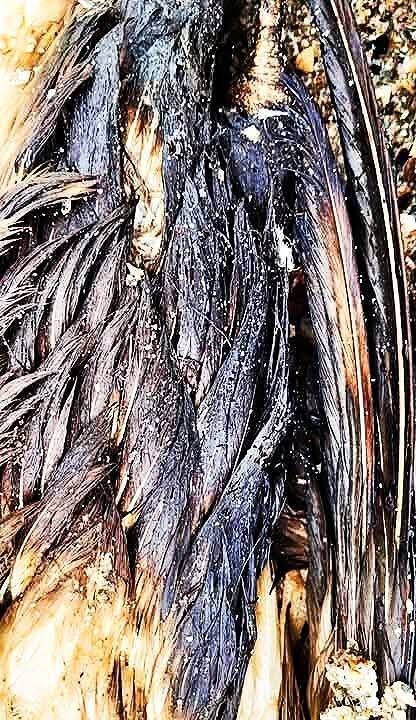
“Fuel oil can penetrate a bird’s skin through contaminated feathers only when the fuel oil is liquid,” Rusiev wrote. “Therefore, the bird probably found itself in the epicentre of the fuel-oil spill at the very beginning of the environmental disaster in the Kerch Strait. At that time, the still-liquid toxic fuel oil penetrated through the bird’s skin and oral cavity while it actively cleaned its feathers with its beak, and simply killed it. Two months later, drifting, the bird reached our shores 630 km from the accident in the Kerch Strait. This is incredibly important information, including within the criminal proceeding opened by the specialised environmental prosecutor’s office, for proving that this is the same fuel oil that Russian tankers spilled into the Black Sea. The Ukrainian Scientific Centre of Ecology of the Sea under the Ministry of Environmental Protection refused to take the first bird for examination, even though it too could have provided invaluable information about the origin of the fuel oil.”
Problems with collecting evidence
Rusiev described in detail how state authorities are resisting the examination of birds contaminated with fuel oil on his Facebook page: “Under an instruction from the Ministry of Environmental Protection, the national park administration transferred the fuel-oiled bird, with an accompanying letter, to the head of the Tatarbunary veterinary medicine unit of the Bilhorod-Dnistrovskyi District State Veterinary Hospital, although she resisted in every possible way. After lengthy negotiations, the bird was accepted.
That institution was then supposed, under the protocol of the Odesa Regional Military Administration emergency commission, to transfer the bird to the environmental inspectorate so that the properties of the fuel oil on the bird could be examined, but…
Recently, we received a strange letter from a State Service of Ukraine on Food Safety and Consumer Protection unit saying that they did not examine the fuel-oiled bird at all and simply destroyed it completely, without even transferring fuel-oil samples to the environmental inspectorate for further examination. This is absurd and, in our view, indicates typical sabotage of efforts to establish the causes of the fuel-oil pollution.”
Everything possible must now be done to document the consequences of the Volgoneft tanker accident in the Kerch Strait and record the damage for future court proceedings, so the situation described by Doctor of Biological Sciences Professor Ivan Rusiev must be corrected immediately.
Prepared by Tetiana Herasymova.