

The founder and long-time director general of the well-known Odesa company Marine Engineering Bureau Hennadii Yehorov warned the Russian authorities more than 10 years ago about the danger of transporting fuel oil by sea in old Volgoneft tankers. He had extensive experience not only investigating accidents similar to the one that occurred on 15 December 2024 in the Kerch Strait, but also directly managed projects to convert these tankers.
What Volgoneft tankers are and what an Odesa company has to do with them
Volgoneft vessels are river-sea oil tankers, the most numerous series of tankers of this class in the USSR and modern Russia. The vessels are designed to transport crude oil and petroleum products.
These large single-deck, twin-screw tankers have double sides and bottoms, with the engine room and superstructure in the stern. In general, such tankers can carry up to 4,800–5,000 tonnes of cargo. Their main purpose is to transport petroleum products on rivers.
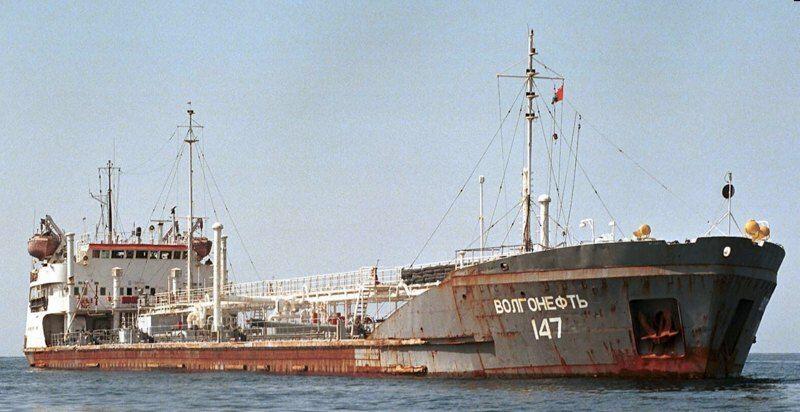
According to Russian media, 81 Volgoneft tankers were listed in the register of the Russian Classification Society in 2024. The youngest was built in 1982, 43 years ago. Even before the Kerch Strait accident, specialists described these vessels as excessively old.
Yet in Russia these tankers are converted to modern river-sea tanker standards — for example, in 2018 their length was deliberately reduced to comply with new MARPOL requirements (theInternational Convention for the Prevention of Pollution from Ships). To reduce the size of the tankers, their middle sections were cut out — and according to eyewitnesses, it was precisely along the welded seam that the vessels broke during the storm.
Some projects to convert Volgoneft tankers were carried out by specialists from the Marine Engineering Bureau. We do not know, however, whether these projects involved Volgoneft 212 and Volgoneft 239, the vessels wrecked in the Kerch Strait on 15 December 2024. Here is an example of the Marine Engineering Bureau’s work converting a Volgoneft tanker into a dry-cargo vessel.
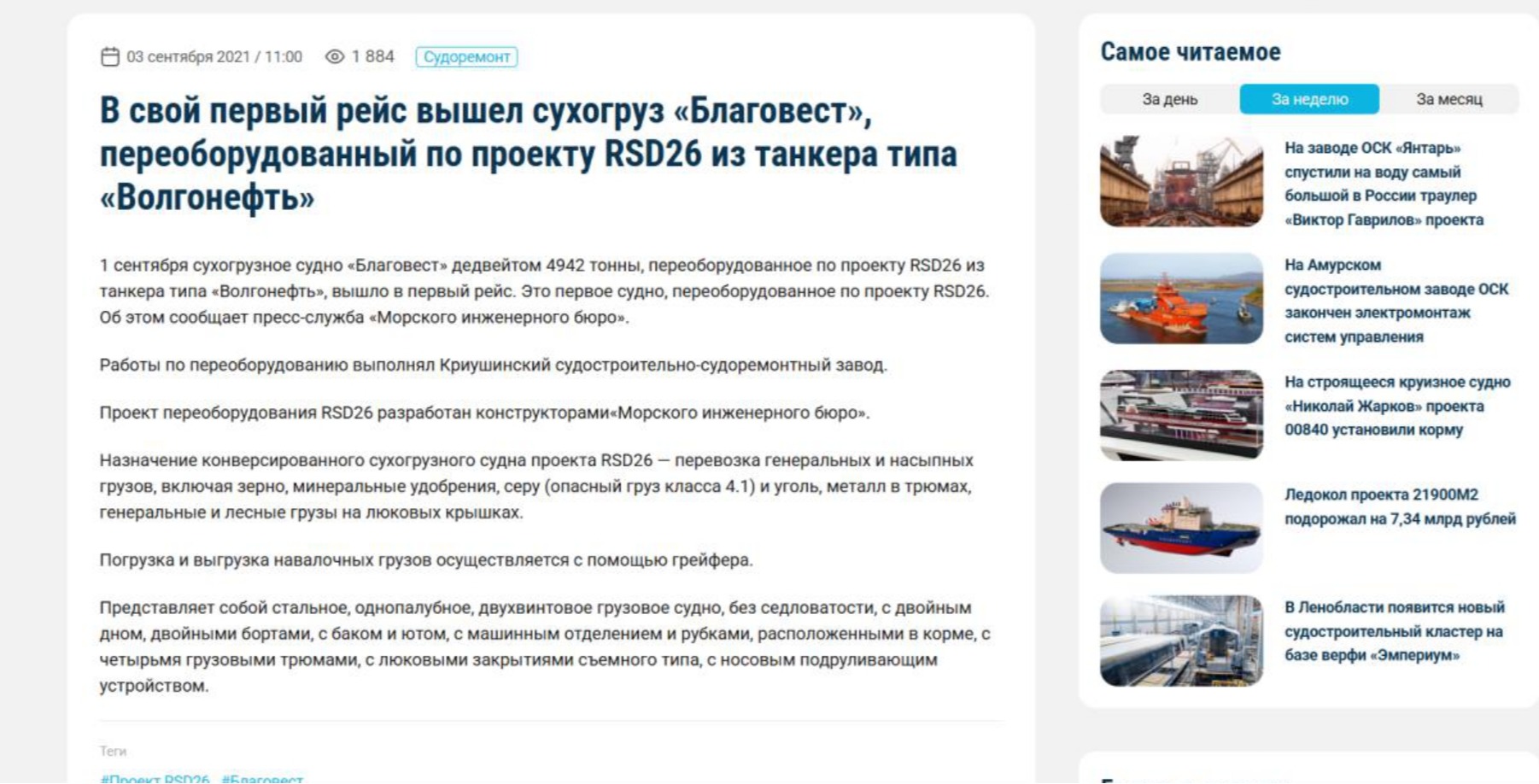
Screenshot of an article on the Russian media website Paluba about the conversion of a Volgoneft tanker into a dry-cargo vessel under a Marine Engineering Bureau project
Moreover, the bureau’s founder and long-time director general, Hennadii Yehorov, was a categorical opponent of operating old tankers to transport fuel oil by sea.
What the Marine Engineering Bureau is
The Marine Engineering Bureau was founded 30 years ago by a group of young scientists from the shipbuilding faculty of Odesa National Maritime University, formerly the Odesa Institute of Marine Engineers. In March 2000, bureau founder Hennadii Yehorov, who died in 2021, established a company with the same name in St Petersburg and headed both enterprises until the last day of his life.
Since 2000, the bureau has developed and supported new technical and detailed engineering projects. By the end of May 2018, 330 sea-going, cargo and mixed river-sea vessels had been built under 96 projects. In addition to fully completed ships, another 11 vessels had been launched, while more than 30 were in shipyard docks.
On this page of the official website, all the bureau’s projects can be found, including oil tankers, chemical tankers and bunkering vessels.
Projects to convert and renovate old vessels
Here is an interesting passage from Hennadii Yehorov’s biography : “Continuing work on modernisation, conversion, renovation and increasing carrying capacity that began in 1995, Hennadii Viacheslavovych created a new approach to preserving the fleet: vessel conversions and construction of vessels using elements from donor ships. This approach was used to build dry-cargo vessels, railway ferries, oil tankers and passenger vessels.
In 2006, Hennadii Yehorov created the Emergency Response Service — ERS MEB. ERS MEB has software that makes it possible to calculate damage stability and residual strength and assess possible oil spills during collisions, groundings, structural failures, fires, explosions and similar situations involving emergency changes.
Participation in emergency rescue operations
In addition to servicing tankers with deadweight of 5,000 tonnes and more, Yehorov personally directed engineering support for a large number of emergency rescue operations: the mass tragedy in the Kerch Strait on 11 November 2007 involving mixed-navigation vessels during a storm (when the Russian tanker Volgoneft-139 broke in two in the southern part of the strait and about 1.2 tonnes of fuel oil entered the sea); the grounding and flooding of the vessel Palmali Discovery on 3 June 2010; the Bulgaria disaster on 11 July 2011; the unique salvage operation to simultaneously raise sunken floating dock No. 154 and the tanker Volgoneft-263 at the Illichivsk Ship Repair Yard on 8 September 2011; the rescue of the tanker Grigoriy Bugrov from a grounding with 6,138 tonnes aboard; and support for the railway ferry Feruz after it was refloated on 8–9 February 2012.
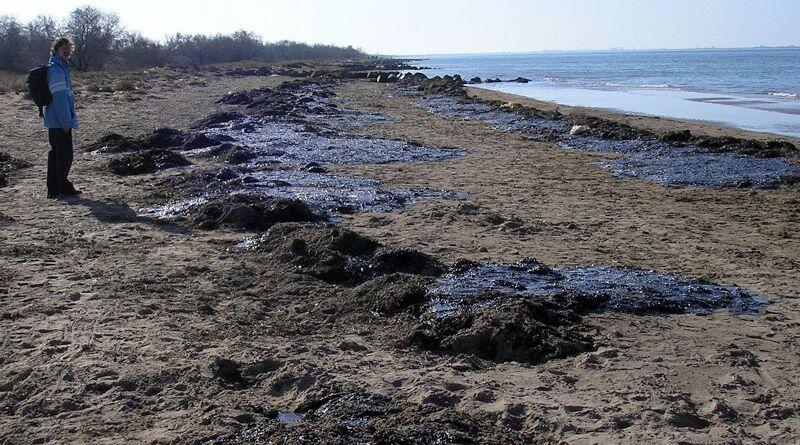
Fuel oil on the coast of the Kerch Peninsula after the 2007 accident. Photo by Pavlo Holdina
Yehorov also participated in the operation to rescue and haul ashore the bunkering tanker Delfi in August–September 2020, providing engineering calculations and even receiving a letter of appreciation from the Odesa mayor.

Playing on the edge of a foul
“The average age of the early Volgoneft series is 50.5 years, and of the newer series 45.4 years. It is therefore time to end the discussion about the prospects of Volgoneft vessels in the context of transporting dangerous cargo; I think this is playing on the edge of a foul,” Hennadii Yehorov said in 2020. His extensive experience studying accidents involving Volgoneft oil tankers gave weight to this conclusion.
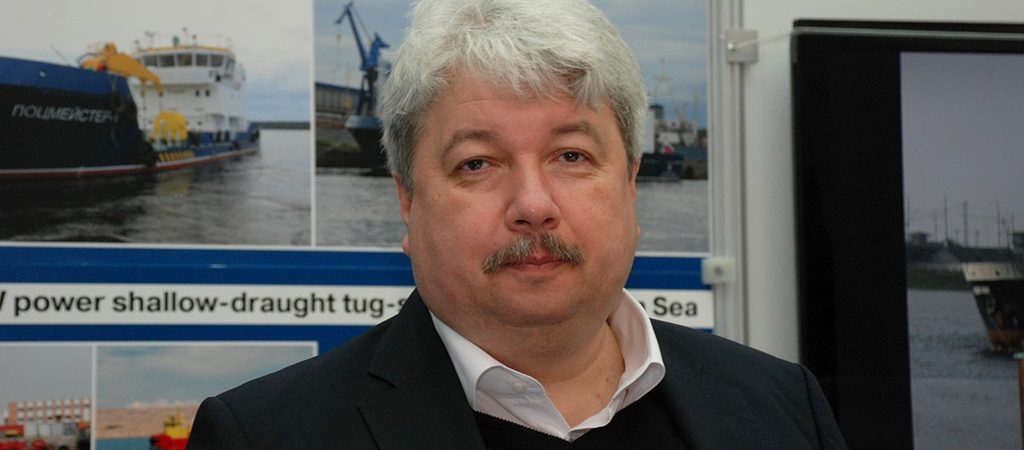
Hennadii Yehorov. Photo — sudostroy.com
As early as 2013, in an article entitled ‘Prospects for Volgoneft-Type Tankers’, Yehorov concluded that tankers of this type should not transport heavy petroleum fractions by sea. The article was based on an analysis of 169 accidents and disasters involving these vessels. His conclusions, translated from the original, were:
“Hennadii Yehorov’s conclusions:
1. In practice, the extensive use of structural elements only 5–7 mm thick made it possible to minimise the tanker hull weight and accordingly increase its carrying capacity on rivers. However, the reverse side of this advantage was a noticeable reduction in the vessel’s service life — that is, the period during which the tanker could be operated safely without repairs.
The original structural thicknesses of Volgoneft-type tankers ensured 20 years of operation without repairs only in class M, meaning without going to sea. In class M-PR, a significant part of the structural members had a service life of 10–20 years, while in class M-SP the vessels could operate without repairs for no more than 5–10 years.
In terms of overall strength, Volgoneft vessels without reinforcement by overlay strips on the deck and bottom do not meet the requirements of class M-SP 2.5 and only barely meet class M-PR 2.5.
Intensive corrosion wear of hull structures is observed throughout the tanker group, and as a result the volume of repair and restoration work increases every year. Yet even these repair volumes, growing year after year, do not meet actual needs — vessels are put into operation with minimal strength reserves that are insufficient for the five-year cycle between classification surveys. The volume of annual repairs has risen sharply and amounts to 100–200 tonnes of replacements for Volgoneft-type vessels.
Operating these tankers at sea has resulted in enormous volumes of restoration of worn hull elements, including complete replacement of the cargo area from the forepeak bulkhead to the forward bulkhead of the pump room.”
Volgoneft vessels should not operate at sea carrying heavy petroleum fractions
The scientist’s view was based on the conclusions of his analysis of tanker disasters:
“2.1. «“Because of their reduced strength standard, Volgoneft vessels have lower strength reserves than comparable unrestricted-navigation vessels. Therefore, all factors that lead to design-exceeding increases in loads in calm water and in waves affect the severity of the consequences when these hazards act on Volgoneft hulls.
2.2. Volgoneft vessels operate under difficult conditions in shallow water and undergo frequent lock passages, up to 30 in a single voyage, in summer and in ice conditions in winter, which increases the significance of the hazard ‘Contact with ice, contact with quay and lock walls, collision with another vessel’, because accumulated deformation damage and abrasion of the outer shell reduce the load-bearing capacity of the vessel hulls.
2.3. The greatest hazards for Volgoneft vessels are hazard 1.2, leakage of the shell, 1.4, failure to identify defects during inspection, and 3.13, violation of technical operating rules by the crew. The existing level of risk for these hazards falls within the ‘unacceptable risk’ zone.
Managing the risk posed by hazard 1.2 requires substantial replacement of shell plates and deck plating during repairs. Hazards 1.4 and 3.13 fall within the area of human-factor management.
3. There is a sustained increase in accident rates for vessels older than 20 years, peaking for vessels aged 30 years. As of 1 January 2013, the average age of 131 Volgoneft-type tankers was 45.2 years for the original 558/550 design, 21 vessels, and 38.5 years for project 1577/550A, 110 vessels. Of these, 23 tankers were rated ‘unfit’.
4. It was found that disasters involving Volgoneft-type vessels occur, as a rule, because of hull damage — 87.5% — while fires and explosions account for only 12.5%, which is quite unusual for a tanker.
5. Given that the total number of tankers of the project under study in annual operation was about 150 vessels, the shipwreck frequency for Volgoneft vessels in 1991–2012 reached approximately 2–3 per 1,000 vessels per year. This estimate can be considered sufficiently reliable because cases with consequence levels C = 4 and C = 5 are extremely difficult to conceal. For the period from 2001 to 2012, this figure approximately doubled to 4–5 disasters per 1,000 vessels per year.
The annual probability of accidents and accident-related incidents involving Volgoneft vessels in 1991–2012 is roughly 53 cases per 1,000 vessels per year. However, the data available to the author on cases with consequence levels C = 1, C = 2 and C = 3 cannot be considered complete. In reality, this figure should be substantially higher, possibly in the range of 100–150 cases per 1,000 vessels per year.
6. The main environmental problem of Volgoneft-type vessels is the height of the double bottom, which does not meet the requirements of the MARPOL Convention, excessive cargo-tank lengths, and the absence of slop tanks. In essence, these vessels should not have been operating at sea transporting heavy oil and petroleum products — cargoes with a density of 0.900 t/m³ or more — since 2008.“
The Russian authorities were warned about the danger of Volgoneft tankers
The scientist also recommended a course of action to the Russian authorities regarding the continued operation of these tankers:
“Possible ‘long-term’ measures to ensure the safe operation of Volgoneft tankers:
“- transport only light petroleum products, meaning cargoes with a density of 0.900 t/m³ or less;
– conversion into dry-cargo vessels;
– raising the double bottom without changing the year of construction, as a modernisation;
– replacement of the cargo area with a change in the year of construction, as a conversion.”
But no one listened to him. Volgoneft-type fuel-oil tankers continue to carry heavy petroleum fractions by sea and expose neighbouring countries to the risk of severe environmental disasters.
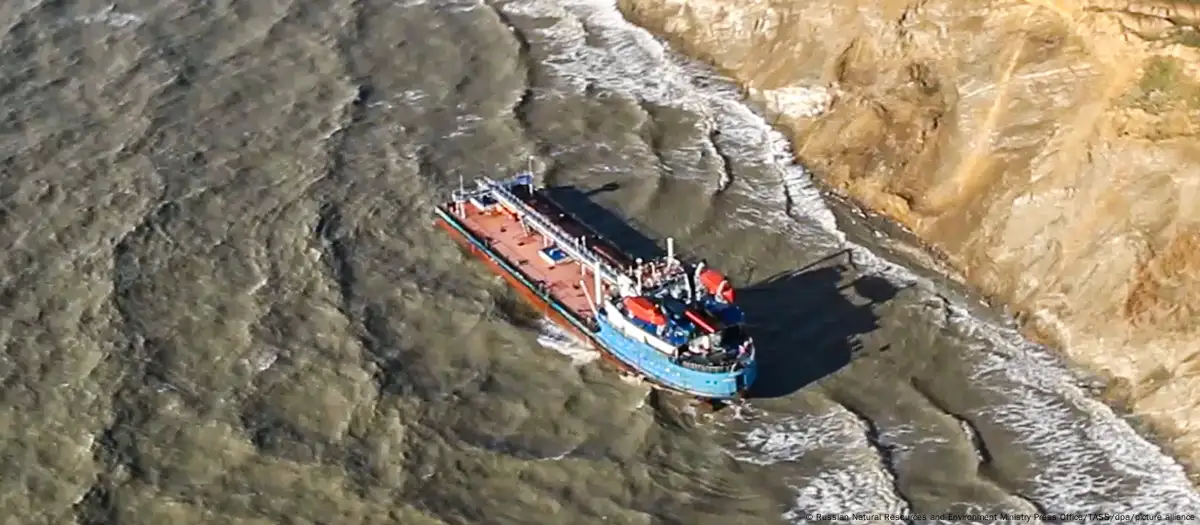
It should be recalled that on 15 December 2024, as a result of the accident involving two Russian tankers, more than 8,000 tonnes of fuel oil may have spilled into the sea. The Ministry of Environmental Protection and Natural Resourcesestimatesdamage to the Black Sea ecosystem from the fuel-oil spill caused by the Russian tanker accident in the Kerch Strait at more than USD 14 billion.
This material will be sent to the Specialised Environmental Prosecutor’s Office of Ukraine for inclusion in the investigation materials concerning the fuel-oil spill in the Kerch Strait on 15 December 2024 as evidence that the Russian authorities had been warned about the danger of operating these vessels but failed to take appropriate measures to remove them from service.