
The fuel-oil spill resulting from the accident involving two oil tankers in the Kerch Strait on 15 December 2024 brought long-term threats to the Black Sea ecosystem. What caused the accident, and what is happening to the fuel oil now, a month and a half after the incident? What are the consequences of the environmental disaster for the entire Black Sea ecosystem? How will the fuel-oil spill affect Odesa Bay? Will fuel oil appear on the coasts of Romania, Bulgaria and Türkiye? We tried to document the situation as it stands now and answer these questions.
Why the fuel-oil spill became possible
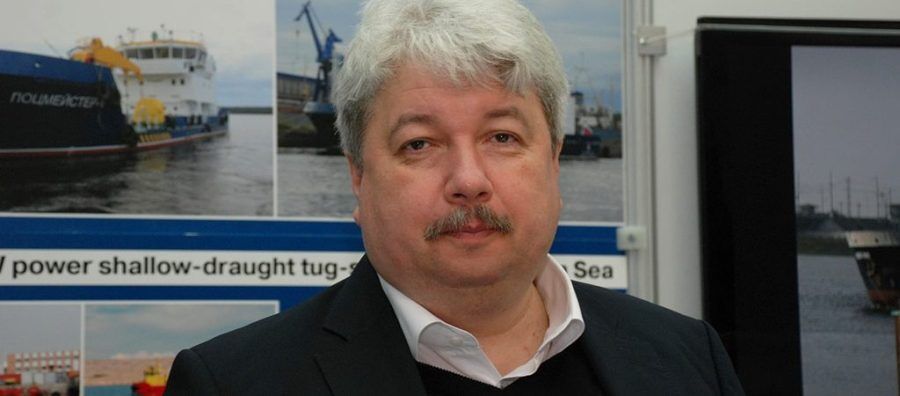
“It is time to end the discussion about the prospects for Volgoneft vessels in the context of transporting dangerous cargo. This is a game on the edge of a foul,” said Doctor of Technical Sciences Professor Hennadii Yehorov, founder and long-time director general of the Marine Engineering Bureau (which operates in Odesa, St Petersburg and Baku).
He was referring to old Soviet oil tankers of the Volgoneft series, which are widely used in Russia to transport petroleum products. These tankers are poorly suited to rough-sea navigation and cannot be operated at wave heights above 2.5 metres. During the Black Sea storm on 15 December 2024, waves of 3–3.5 metres were observed.
Today, however, between 80 and 140 Volgoneft-series vessels are in operation in Russia. Most are old, rusty ships built in the 1970s. They have completely exhausted their service life and need to be decommissioned as soon as possible. Formally, each has been repaired many times and usually has permission from the Russian Classification Society to go to sea.
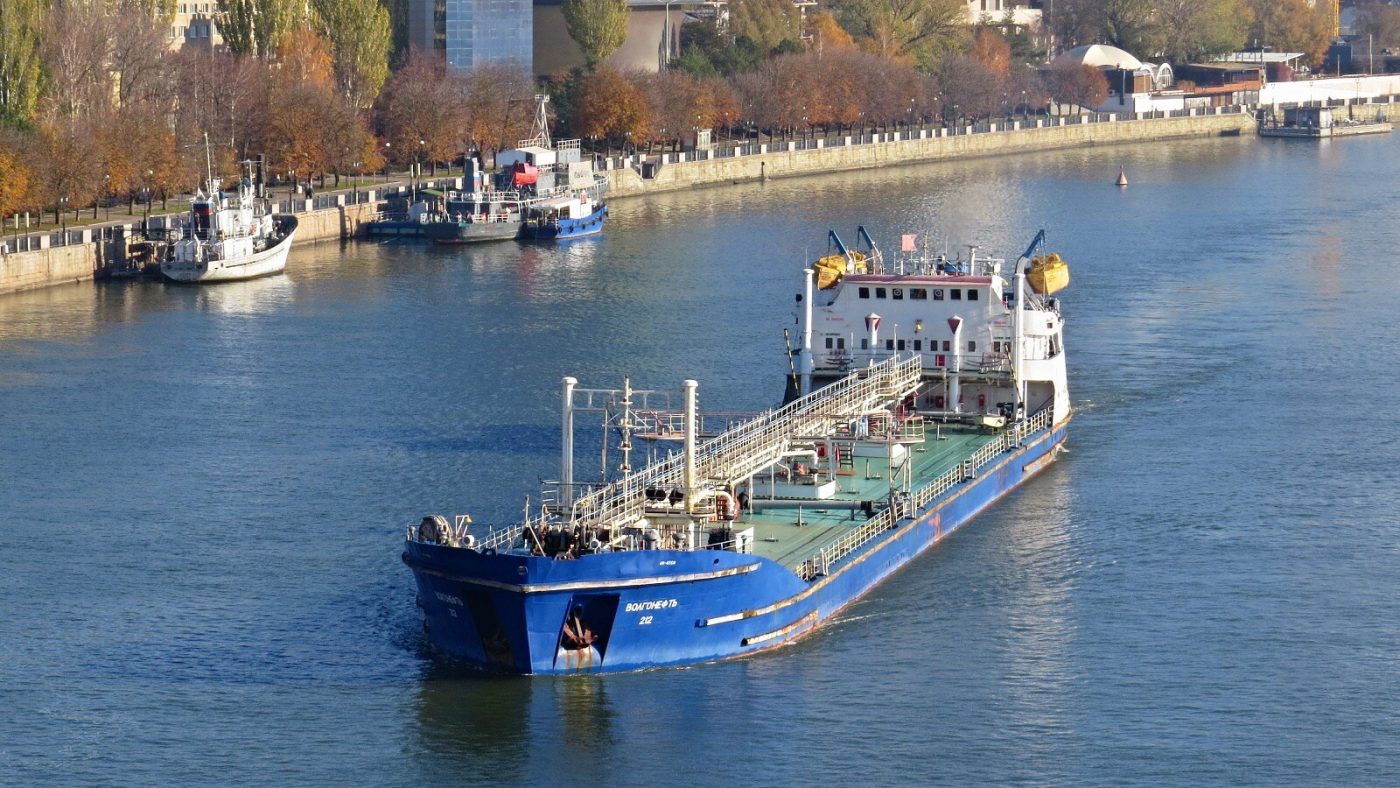
Most of the tankers were converted to modern standards for river-sea tankers — their length was deliberately reduced to meet new MARPOLrequirements. To reduce the size of the tankers, their middle sections were cut out. According to eyewitnesses, it was precisely along the welded seam that the break-up occurred on two such tankers — Volgoneft 212 and Volgoneft 239 — during the storm in the Kerch Strait on 15 December 2024. The first vessel sank immediately, while the stern section of the second was washed ashore near Cape Panagia on the Taman Peninsula.
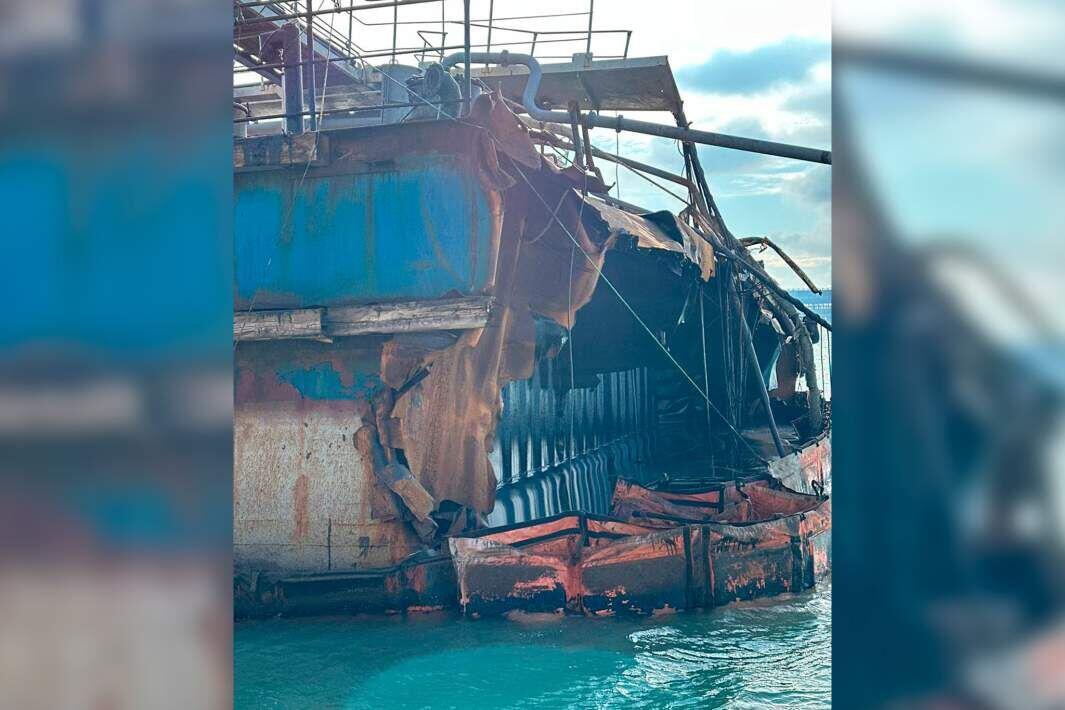
Conversion of old Soviet Volgoneft tankers
Together, the two vessels were carrying more than 9,000 tonnes of fuel oil. According to various estimates, more than 5,000 tonnes of fuel oil entered the sea, causing a genuine environmental disaster along the Black Sea coast of Russia’s Krasnodar Krai and occupied Ukrainian Crimea.

Among the hundreds of projects undertaken by the Marine Engineering Bureau were projects to convert old Soviet Volgoneft tankers into dry-cargo vessels. Bureau head Yehorov — one of the best-known Ukrainian-Russian designers of sea-going and river vessels — implemented many shipbuilding and ship-repair projects in Ukraine and Russia until the last day of his life in May 2021.
He opposed using old tankers to transport heavy petroleum fractions such as fuel oil by sea because he had seen first-hand what this could lead to. Yehorov also worked professionally on calculations of ships’ emergency stability and personally managed engineering support for many emergency and rescue operations. In particular, he was involved in overcoming the consequences of the major accident in the Kerch Strait on 11 November 2007. At that time, the Russian tanker Volgoneft-139 broke in two in the southern part of the strait, releasing about 1,200 tonnes of fuel oil into the sea.
After analysing 169 accidents and disasters involving these vessels, Yehorov concluded in a 2013 article in the journal Russian Shipping that tankers of this type should not transport heavy petroleum fractions by sea.
But the Russian agencies responsible for maritime transport did not heed either Yehorov or other specialists.
Volgoneft tankers as part of Russia’s shadow fleet
The war has greatly increased the threat to Black Sea ecosystems from petroleum pollution of marine waters and coastlines. Since Russia occupied Crimea and areas of Kherson and Zaporizhzhia regions adjoining the Sea of Azov and the Black Sea, marine ecosystems have systematically been exposed to negative impacts, including the construction of infrastructure facilities, extraction of construction materials, military exercises, changes in the status of protected areas and petroleum spills into seawater.
A major threat of oil pollution of the seas caused by the war in Ukraine comes from the risks posed by the ‘shadow fleet’ — tankers that export Russian oil unhindered at prices above the cap established by the G7 sanctions regime and the Western governments that joined it.
The 4,300 tonnes of fuel oil carried by the Volgoneft-212 before the accident was intended for loading onto the seagoing tanker FIRN, which is part of Russia’s shadow fleet. This was established by the Ukraine War Environmental Consequences Work Group (UWEC), whose members include Russian and Ukrainian environmental specialists.
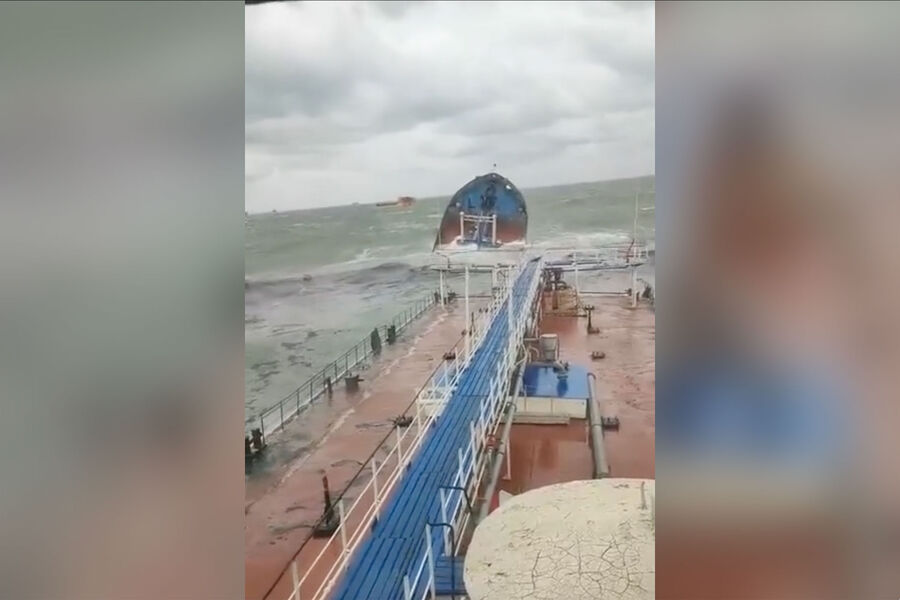
For a month after the accident, fuel oil was not pumped out of the tankers, while fragments of Volgoneft 212 drifted freely
During the first month after the accident, the Russian authorities did almost nothing to minimise the consequences of the disaster. For at least 28 days, the damaged fuel-oil tanks were not isolated, fuel oil was not pumped out, and the wreckage was not even surrounded by booms. This was the conclusion of an expert from the National Ecological Centre of Ukraine (NECU), Green Leaf NGO head Vladyslav Balinskyi, based on an analysis of satellite images of the vessel break-up sites.
The environmental expert established that two fragments of the Volgoneft 212 drifted freely, spilling tonnes of fuel oil into the sea, at least until 12.01.2025. Most of the Volgoneft 239 — its stern without the bow — was on shore and accessible to machinery, but despite serious fuel-oil leaks, pumping operations began only after 20 January.
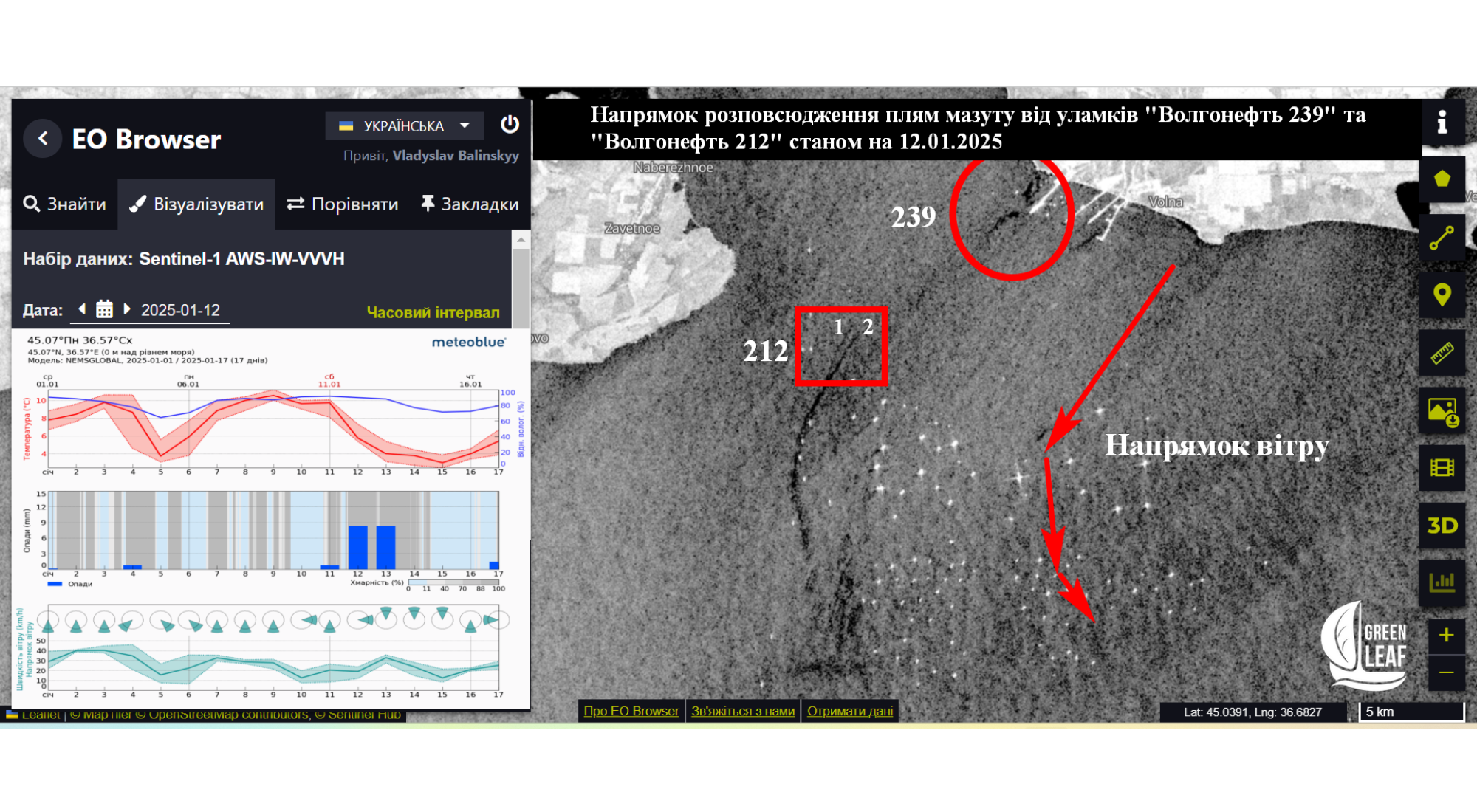
All data collected by Balinskyi are shown on an interactive map of the consequences of the accident.
Fuel oil is spreading through the Black Sea
“We have found ourselves facing one of the greatest environmental threats since the destruction of the Kakhovka Dam. Most likely, this is the largest fuel-oil spill into marine waters in recent decades, and perhaps in the entire history of navigation. The relatively enclosed Black Sea will assimilate this pollution for many years,” believes Yevhen Khlobystov, dean of the Faculty of Natural Sciences at the National University of Kyiv-Mohyla Academy.
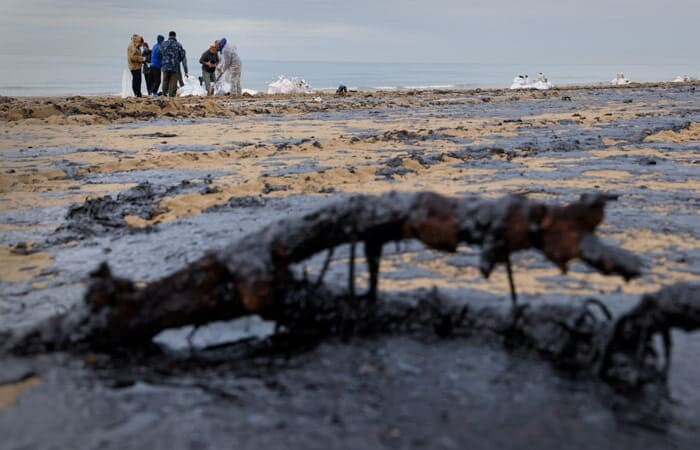
The day after the accident, a thick layer of fuel oil covered the coast of Krasnodar Krai. On beaches in Anapa, sand was saturated with fuel oil to a depth of up to half a metre.
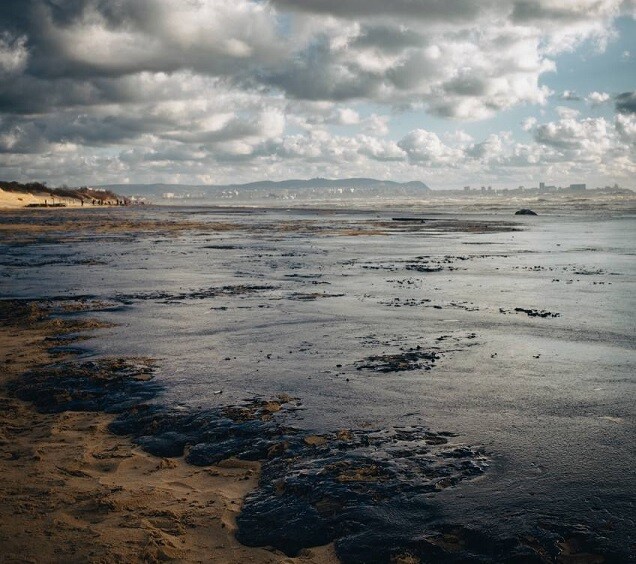
In early January, clumps of fuel oil began to be found along almost the entire coast of annexed Crimea. Ukraine’s Ministry of Environmental Protection and Natural Resources, which together with the Ukrainian Scientific Centre of Ecology of the Sea (UkrSCES) forecasts the spread of fuel oil, stated on 15 January: “Fuel oil that could potentially have reached the north-western shelf of the Black Sea is currently present as clumps because of the low water temperature. These clumps gradually gain weight and sink deeper. In this state, they can remain in the water for several months, creating two possible threats: settling on the bottom of the north-western shelf or later being washed ashore on the Odesa region coast.”
How the fuel oil reached Odesa Oblast
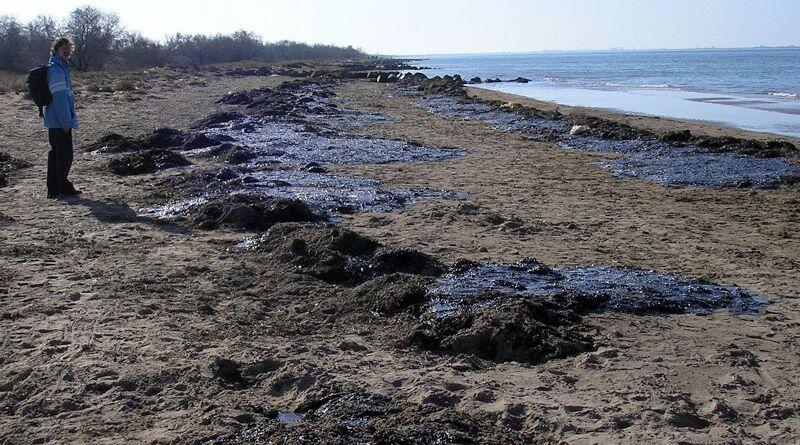
Only ten days later, fuel oil was first detected in Odesa Oblast on the Black Sea coast — on the sandy barrier near the Danube Biosphere Reserve and Tuzlivski Lymany National Nature Park (Katranka recreational area). At first, the fuel oil was collected by staff of Tuzlivski Lymany National Nature Park; later they were joined by municipal workers from the Lyman village council of Odesa Oblast. On 30.01.2025, according to the Odesa Regional Military Administration, pollution was found along the entire coast in the area of the settlements of Kurortne and Mykolaivka in the Serhiivka community.
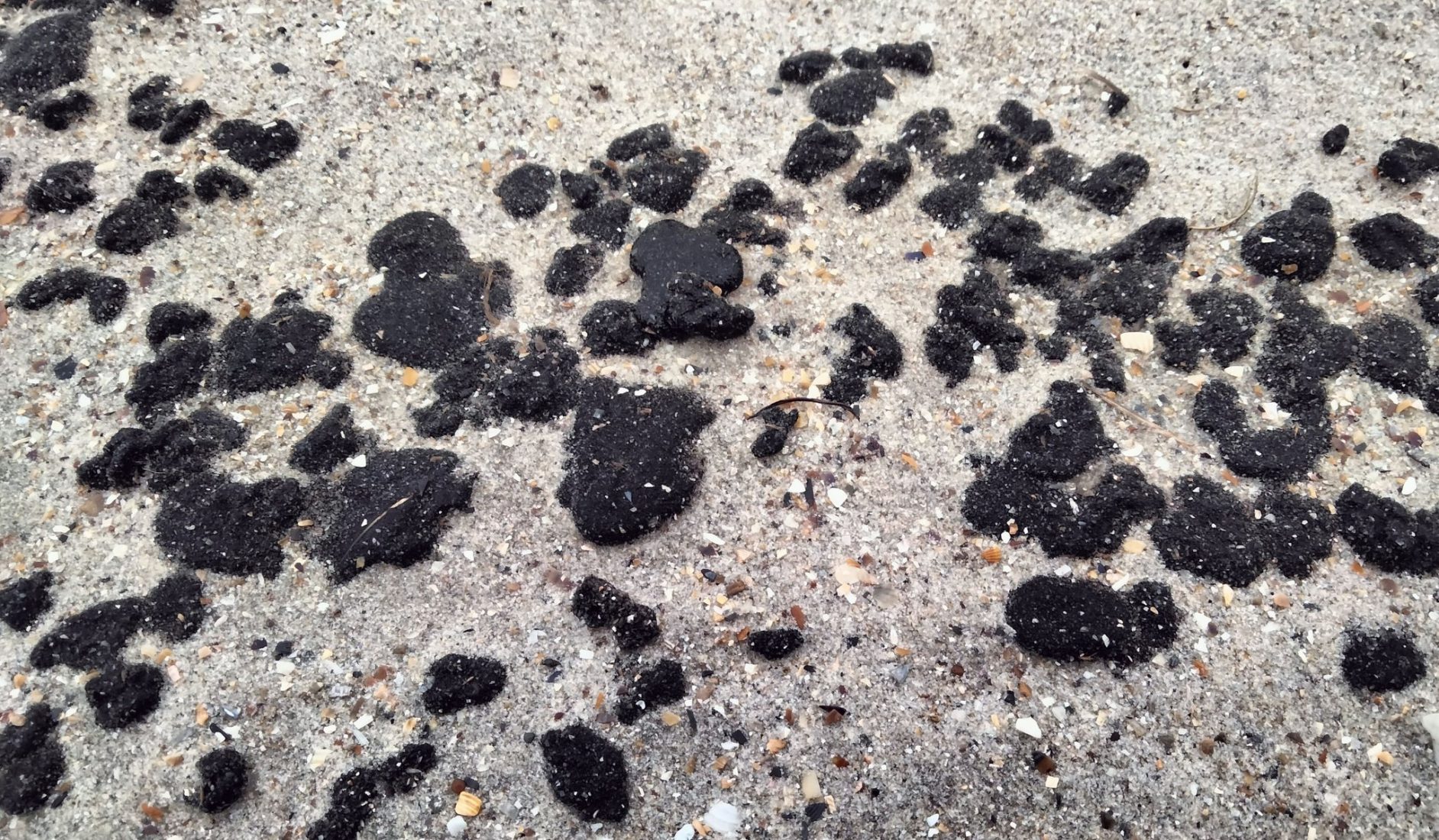
Fuel-oil clumps on the Black Sea coast near Tuzlivski Lymany National Nature Park. Photo by Ivan Rusiev
Odesa Bay is in trouble
“The fuel oil was carried by the main Black Sea current along the north-western Black Sea shelf,” Balinskyi believes. “If we estimate by the direction of the current, the fuel oil travelled about 640 kilometres to Katranka and, most likely, as I said, it was opposite Odesa Bay around mid-January. Most of the fuel oil may have settled opposite the mouth of the Dnipro-Buh estuary, and if so, Odesa Bay is in trouble!” hewrote on Facebook.
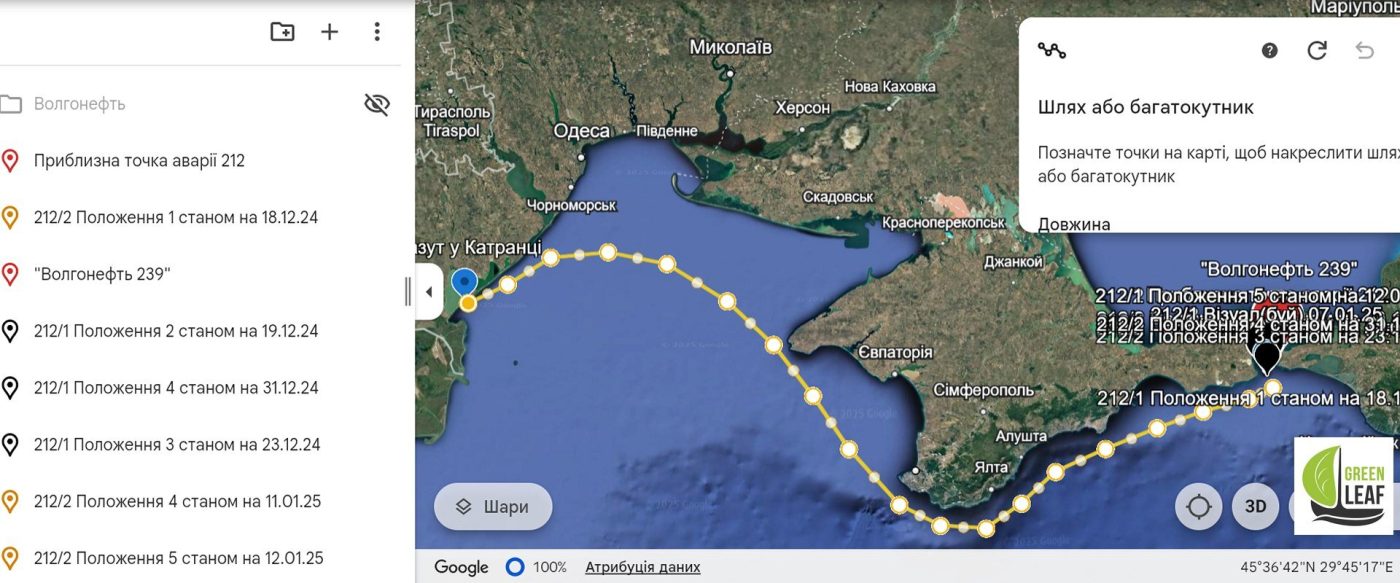
It is difficult to say how much fuel oil reached Odesa Oblast because some of it settled on the seabed in clumps. Most likely, the smallest and most buoyant clumps reached Odesa Oblast. According to Balinskyi, the main mass of fuel oil carried by the Black Sea current may have settled as sediment opposite the Dnipro delta. “The point is that the density of this fuel oil is around one, slightly more — 1.1 — while the density of seawater depends on salinity. The saltier the water, the denser it is, and vice versa.
After the Dnipro flows into the Black Sea, the seawater becomes greatly freshened, and because of this sharp change in density, many fuel-oil clumps may have settled on the bottom. This poses a major threat specifically to Odesa Bay,” the environmental expert says. “Odesa Bay is semi-enclosed and has poor water exchange with the rest of the sea. Therefore, if these fuel-oil clumps are carried here, they will remain for a long time. As water temperatures rise, the fuel oil will begin to melt and release lighter petroleum fractions, which will appear as an iridescent film on the surface of Odesa Bay. We could then face chronic pollution, perhaps for decades.”
The Danube will protect Romania, Bulgaria and Türkiye
During a briefing at the Odesa Regional Military Administration, acting director of UkrSCES Viktor Komorin suggested: if the fuel oil is caught by the main Black Sea current, it will move toward Romania, Bulgaria and Türkiye.
Balinskyi has a different view: “The Danube is a powerful river. As it flows into the Black Sea, it forms jets that seem to twist the Black Sea current and redirect it in a circle all the way toward Türkiye. Therefore, the Danube protects Romania, which is closest to us. But for now this is a theory; we need to continue monitoring the appearance of fuel oil on Black Sea coasts.”
Impact of the fuel-oil spill on the Black Sea ecosystem
Ukraine’s Ministry of Environmental Protection stated that the fuel-oil spill would lead to the death of plankton, poisoning of fish, seabirds and other living organisms, contamination of bottom sediments and coastal zones that serve as habitat for marine flora and fauna, and disruption of food chains, resulting in long-term changes to the region’s biodiversity. The ministry estimated thatdamage to the Black Sea ecosystemfrom the disaster exceeded USD 14 billion.
The tankers sank between Capes Opuk and Takil, where the Opuk Nature Reserve and Cape Takil Landscape and Recreation Park are located. Several species of waterbirds inhabit these areas, including mute swans, European golden plovers, great white egrets, reed warblers, Eurasian teal, cormorants and mallards.
Immediately after the disaster, volunteers in Krasnodar Krai and Crimea began not only collecting petroleum products washed ashore by the waves but also cleaning birds. According to Russian environmental specialists, the number of birds contaminated with fuel oil, for which this poses a deadly threat, reaches into the thousands.
Death of 50,000 birds
Ivan Rusiev, head of the research department of Tuzlivski Lymany National Nature Park, said on Vechir.LIVE that 50,000 birds had already died. Most birds die from fuel-oil poisoning or contaminated plumage. Even washing a bird often does not save it because thermoregulation has been disrupted and it still dies.
“We may lose unique bird species, including those listed in the Red Data Book, such as the black-throated or red-throated diver,” Rusiev suggested in an interview with Crimea.Realities.
Dolphins are also dying from the fuel-oil spill
According to Tetiana Bieliei, head of the Crimean Delfa dolphin rescue centre, at least 84 dolphins have died.
But Rusiev believes the actual number of cetacean victims is much higher. “Dead dolphins are being found even in Georgia. Experts have found more than 100 individuals, but when dolphins die from petroleum products, only 5% are washed ashore. In reality, therefore, several thousand of these animals have died,” Rusiev said on the previously mentioned Vechir.LIVE broadcast.
Doctor of Biological Sciences Rusiev has, since the beginning of Russia’s full-scale invasion of Ukraine, studied the causes of cetacean deaths in the Black Sea and the impact of war-related factors on them.
In the long term, a particular danger to living organisms comes from the accumulation in their tissues of toxic products of petroleum breakdown and impurities contained in fuel oil — sulphur compounds and heavy metals. Pavlo Holdin, a leading researcher at the I. I. Schmalhausen Institute of Zoology of the National Academy of Sciences of Ukraine, told the Association of Reintegration of Crimea about this.
Marine animals consume organic substances, including petroleum products and products of their transformation by bacteria, and these substances — some of which are toxic — enter food chains.
Accordingly, apex predators at the top of food webs suffer the most. These include marine mammals such as dolphins and porpoises, seabirds, predatory fish such as flounders, rays, bluefish, bonito and whiting, and, of course, people who eat various kinds of fish.
The cradle of the Black Sea
“We need to talk not only about the deaths of birds and dolphins but about the impact on the biocenosis as a whole — the community of plants, animals and microorganisms inhabiting a particular area of land or water and characterised by particular relationships both among themselves and with abiotic environmental factors. Marine biocenoses, especially in the Black Sea, are very vulnerable,” believes chemist and biologist Balinskyi.
The Black Sea is a unique body of water. Although it is quite large and deep, life in the Black Sea is concentrated in a fragile, very thin layer — up to 200 metres — in the upper part of the water column.
The shelf zone in the north-western Black Sea is the most valuable
Everything below 200 metres is an anoxic hydrogen-sulphide layer. That is why our shelf zone in the north-western Black Sea is the most valuable — and the most vulnerable.
This part of the Black Sea between Odesa and the Danube delta, which adjoins a large share of the shallow Black Sea limans, is the most valuable for biodiversity and plays an important role in the reproduction of aquatic organisms. It also includes a unique concentration of red algae of the genus Phyllophora near Zmiinyi Island — the botanical reserveZernov’s Phyllophora Field.
It is not called the ‘cradle of the Black Sea’ for nothing. It serves not only as a spawning ground for many fish species, both local and migratory, but also provides them with a rich food base.
Russia’s sabotage involving the destruction of the Kakhovka Dam on 06.06.2023 has already led to consequencesthat directly or indirectly affected the shelf biocenosis’s capacity for self-purification.
Therefore, a monitoring system for the ecosystem of the south-western Black Sea is important not only for Ukraine but also for our neighbours.
In Vladyslav Balinskyi’s view, it is also necessary to address anthropogenic pressure on Odesa Bay, including the discharge of sewage into the sea through the deep-water outfall — a practice carried out by Infoksvodokanal.
The UN will help Ukraine assess damage from the Black Sea fuel-oil spill
This was reported by Ukraine’s Ministry of Environmental Protection and Natural Resources. The matter concerns theUnited Nations Environment Programme (UNEP), which responded to an appeal from Minister Svitlana Hrynchuk concerning theaccident involving two Russian fuel-oil tankers in the Kerch Strait on 15 December 2024. UNEP is ready to provide Ukraine with technical assistance in assessing the damage this disaster caused to the Black Sea ecosystem.
UNEP also stressed that this work should be carried out in close cooperation with the Commission on the Protection of the Black Sea Against Pollution, which has the relevant mandate. In addition, the UNEP Secretariat is ready to cooperate with theInternational Maritime Organization to strengthen international oversight of compliance with environmental standards by seagoing vessels.
It should be recalled that UNEP helped Ukraine assess the consequences of the 2007 vessel accident in the Kerch Strait.
Also, on 31 January, an extraordinary 45th meeting was held of the Commission on the Protection of the Black Sea Against Pollution, with representatives of Romania, Bulgaria, Türkiye, Georgia, Ukraine and the Russian Federation participating. During the meeting, participating countries expressed their positions on the situation, but after four hours of discussion the parties failed to reach consensus on a final resolution. Aware that the Commission would inevitably assess the Russian Federation’s violation of Articles 3 and 4 of the Protocol on Cooperation in Combating Pollution of the Black Sea Marine Environment by Oil and Other Harmful Substances in Emergency Situations, representatives of the aggressor state resorted to their usual tactics of manipulation and distortion of facts, attempting to impose their own interpretation of events, rules and procedures.
Violation of international maritime law
The fuel-oil spill situation was also discussed at a meeting of the International Maritime Organization’s Sub-Committee on Pollution Prevention and Response, held in the United Kingdom from 27 to 31 January 2025. The Ukrainian delegation stated that the incidents constituted a clear violation of international law because the Russian Federation had failed to meet its obligations under UNCLOS and MARPOL by using vessels unfit for maritime operations and by failing to notify Ukraine of the pollution incident.
It was also emphasised that member states should strengthen measures to combat the ‘shadow fleet’ and ensure compliance with IMO Resolution A.1192(33), which calls on member states and all relevant stakeholders to facilitate action to prevent illegal operations in the maritime sector by the ‘shadow fleet’.
Background
United Nations Environment Programme (UNEP) was established in 1972 following the UN Conference on the Human Environment in Stockholm. UNEP is the principal UN body in the field of environmental protection, designed to provide leadership and encourage cooperation in the interests of the environment by stimulating activity, providing information and assistance, and improving quality of life.
The Commission on the Protection of the Black Sea Against Pollution is the governing body of theConvention on the Protection of the Black Sea Against Pollution, whose parties are Bulgaria, Georgia, Romania, Türkiye, Ukraine and Russia, and an international platform for regional cooperation on preserving and restoring Black Sea ecosystems and ensuring balanced use of marine natural resources and landscapes.
The Commission’s main areas of work include protecting the Black Sea marine environment from pollution from land-based sources, preserving the Black Sea’s biological and landscape diversity, and combating pollution of the marine environment by oil and other harmful substances in emergency situations.
At its 44th meeting in October 2024, Ukraineblocked Russia’s chairmanship of the Commission.
International Maritime Organization (IMO) is a specialised UN agency responsible for maritime safety and prevention of pollution of the world’s oceans by ships. The organisation was established in 1948 through adoption of the Convention on the Inter-Governmental Maritime Consultative Organization (Geneva, 06.03.1948). It received its current name after amendments to the Convention were adopted in 1977.
Today, the IMO has 174 member states. Ukraine has been a member of the IMO since 1994.
Tetiana Herasymova