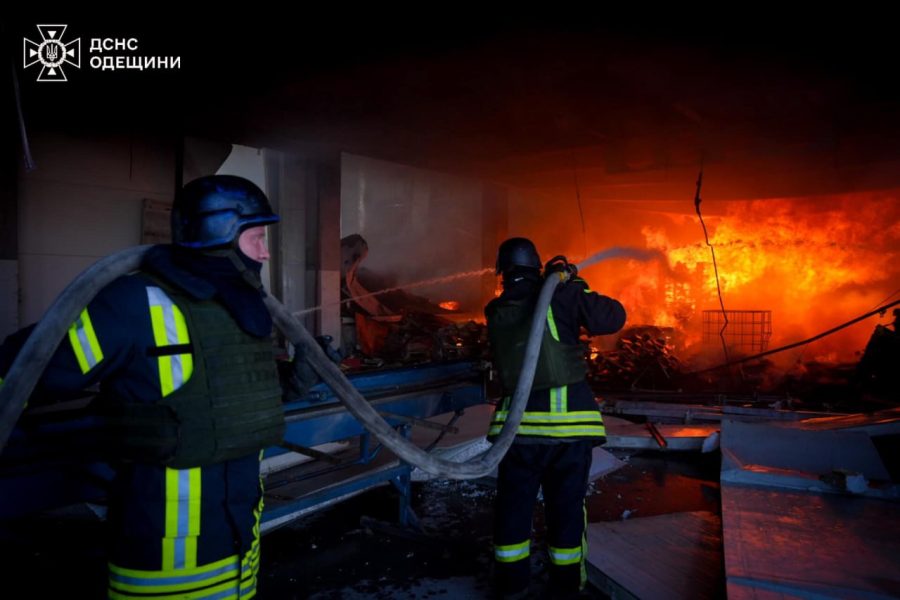

Chronicle of Russia’s War Crimes Against Ukraine’s Environment: Odesa Oblast, May 2024
Over the past 10 years, May has been a month when the Russian chauvinists’ obsession tends to intensify, and they take revenge on Ukrainians for the “Odesa Khatyn,” shelling our cities especially fiercely on the day of their “victory cult.” May 2024 was no exception: at the beginning of the month, Odesa and Odesa Oblast were heavily attacked with drones and missiles.
We collect facts about crimes committed by the Russian Federation against the natural environment of Odesa and Odesa Oblast during the war: environmental pollution caused by explosions and damage to infrastructure, contamination of air, water and soil with toxic substances, destruction of ecosystems in protected areas and internationally important conservation areas, and more. The information will be updated daily, so please send facts known to you to: zeleniy.list1@gmal.com
Read More

Did the Odesa Authorities Finally Hear Odesa Residents?
Green Leaf recently wrote that concerned Odesa residents who gather outside City Hall every Saturday appealed to the city authorities demanding that city-budget funds be directed to combat units of the Defense Forces of Ukraine rather than to non-priority expenditures. The collective letter was submitted to Odesa City Council on May 13 and, during May 13–14, was sent electronically through the deputy portal to every member of Odesa City Council.
And, surprisingly enough, the people of Odesa were heard.
On May 20, Odesa Mayor’s Order No. 400 of May 20, 2024 was issued, convening an extraordinary session for May 22.
An analysis of the draft decisions published on the city’s official website on May 21 shows that the city authorities want to urgently allocate UAH 36 million from the free balance of budget funds to our renowned brigades. Deputies are therefore being asked to support both amendments to the budget and changes to the municipal target program “Safe City Odesa.”
We also recall that the collective appeal referred to a free balance of UAH 945 million that should be directed to financing the urgent needs of combat units of the Defense Forces of Ukraine.
We hope that this UAH 36 million is only the first step by the managers hired by the people of Odesa toward carrying out the will of Odesa residents.
On the Activities of Ukraine’s State Audit Service
Analyzing the work of Ukraine’s State Audit Service (formerly the Control and Revision Office), one cannot escape the feeling that ordinary people live in one world while the State Audit Service lives in another. When those worlds intersect, one simply does not understand the other. We will demonstrate this using two examples of the work of the State Audit Service and its territorial offices. What follows is a Green Leaf report.
Example 1 — state financial audit of the budget of the Odesa City Territorial Community
At the end of 2023, the State Audit Service conducted a “State financial audit of the budget of the Odesa City Territorial Community (the budget of the City of Odesa) for the period from January 1, 2020 to September 30, 2023.” The audit was conducted pursuant to item 3.1 of the State Audit Service Order dated September 19, 2023. At the same time, the leadership of the State Audit Service called on citizens to report possible abuses by city officials in the use of budget funds:
Head of the State Audit Service Alla Basalaieva on the State Audit Service website;
Head of the Southern Office of the State Audit Service Oleksandr Stavniichuk on the Southern Office website.
Applications to the State Audit Service from Green Leaf NGO
Fulfilling its civic duty, Green Leaf submitted to both the State Audit Service and its Southern Office the materials it had concerning the allegedly unlawful registration of the Prymorskyi District Administration of Odesa City Council as a legal entity.
This conclusion is based on the fact that Odesa City Council Decision No. 412-XXIV of October 15, 2002, signed by Ruslan Bodelan, approved the structure of the executive committee of Odesa City Council, including the Prymorskyi District Administration as a territorial subdivision of the executive committee of Odesa City Council.
Following up on Decision No. 412-XXIV (copy at the link, APPENDIX 1), on October 21, 2002 the executive committee of Odesa City Council adopted its own Decision No. 338 establishing district administrations, including the Prymorskyi District Administration of the Executive Committee of Odesa City Council as of January 1, 2003 (copy at the link, APPENDIX 2).
On the same day, October 21, 2002, a public-law legal entity was registered — the Prymorskyi District Administration of Odesa City Council. State registration certificate of the Prymorskyi District Administration of Odesa City Council, series A00 No. 255275 dated October 21, 2002 (copy at the link, APPENDIX 3).
As follows from the materials above, because there was no Odesa City Council decision creating an executive body called the Prymorskyi District Administration of Odesa City Council, it cannot be regarded either as a public-law legal entity within the meaning of the Civil Code of Ukraine or as a budgetary institution within the meaning of the Budget Code of Ukraine.
Duplicating the work of Odesa City Council departments and offices
In the application, we separately drew attention to the fact that of the 57 staff positions in the Prymorskyi District Administration staffing schedule (copy at the link, APPENDIX 4), 24 positions serve the administrative apparatus of the district administration itself. These are the head and deputy heads, chief specialists in civil protection, secrecy regime and personnel work, the secretary of the administrative commission, and departments for accounting, reporting and administrative support, general affairs, organizational work and public relations, and work with citizens’ appeals. Another 26 positions duplicate the work of Odesa City Council departments and offices. Specifically:
— the functions of the district administration’s legal department correspond to the core tasks of the Odesa City Council Legal Department
— the functions of the district administration’s socio-economic department and housing-allocation department correspond to the core tasks of the Odesa City Council Department of Economic Development
— the functions of the department supporting the guardianship and trusteeship body correspond to the core tasks of the Children’s Service
— the functions of the district administration’s housing-services department correspond to the core tasks of the Department of Municipal Services
— the functions of the district administration’s department for control and monitoring of the district’s territory correspond to the core tasks of the City Improvement Department.
Thus, among all structural units and positions of the Prymorskyi District Administration of Odesa City Council, the only genuinely useful unit turned out to be the department maintaining the State Register of Voters, with only seven staff members and functions that are not duplicated, and therefore could be transferred to other executive bodies of Odesa City Council together with the department’s staff.
All of the above was submitted by Green Leaf both to the State Audit Service and to its territorial subdivision, the Southern Office of the State Audit Service.
In its applications, Green Leaf asked:
1. To conduct a state financial audit of the legality of financing from the city budget the legal entity Prymorskyi District Administration of Odesa City Council, for which Odesa City Council never adopted a decision establishing it as an executive body, and which is neither a public-law legal entity within the meaning of the Civil Code of Ukraine nor a budgetary institution within the meaning of the Budget Code of Ukraine.
2. To verify the allegedly unlawful conferral by the Odesa City Council Finance Department, represented by its director S. M. Bedreha, of the legal status of chief administrator of budget funds of the City of Odesa and the legal status of chief administrator of the budget of the Odesa City Territorial Community.
3. To exercise state financial control over the efficiency of using funds from the budget of the Odesa City Territorial Community to maintain the allegedly unlawfully registered legal entity Prymorskyi District Administration of Odesa City Council.
We received a response from the State Audit Service to our application (copy at the link, APPENDIX 5).
As can be seen, in its response the State Audit Service cites various procedures, explains that Odesa City Council Decision No. 412-XXIV of October 15, 2002 approving the staffing structure ceased to be valid in 2006, describes the regulations governing the Prymorskyi District Administration, points out who approved its staffing schedule, and states — without conducting state financial control of the efficiency of expenditures — that the Prymorskyi District Administration meets the requirements established by Article 22 of the Budget Code of Ukraine for chief administrators of budget funds. And much more besides.
But it does not answer the main question: was a public-law legal entity called the Prymorskyi District Administration of Odesa City Council ever legally created at all?
As stated in the XXXXX State Audit Service document (copy at the link, APPENDIX 6), they did not even include this issue in the report.
Was the Odesa City Council Finance Department legally established as a legal entity?
There is more. Green Leaf began a journalistic investigation into the formal establishment of another public-law legal entity — the Odesa City Council Finance Department, which was also inspected by representatives of the State Audit Service.
According to the state registration certificate obtained (copy at the link, APPENDIX 7), the Odesa City Council Finance Office was registered on October 7, 2005, and on May 7, 2008 its certificate was replaced after its name was changed to the Finance Department. But in addition to a state registration certificate there should also be a council decision establishing such a body, adopted pursuant to paragraph 6 of part 1 of Article 26 of the Law of Ukraine “On Local Self-Government in Ukraine.” This requirement was established by Article 24 of the Law of Ukraine “On State Registration of Legal Entities, Individual Entrepreneurs and Public Associations,” in the version in force at the time of registration of the Odesa City Council Finance Office. Yet the state registration authorities do not have such a decision. This is confirmed by the final paragraph of the response from the State Registration Office of the Legal Department of Odesa City Council (copy at the link, APPENDIX 8), which states that despite the requirements of the Law of Ukraine “On State Registration of Legal Entities, Individual Entrepreneurs and Public Associations” in force at the time of the registration actions — which required, among other things, submission for registration of a copy of the founders’ decision or a decision by a body authorized by them to create the legal entity — “it is impossible to provide such a decision due to its absence from the materials of the legal entity’s registration file.”
Summing up the above, only one question arises: how incompetent must State Audit Service employees be if, while auditing public-law legal entities, they fail to notice that those entities were never created in the procedure established by law, even when materials provided by the public indicate the opposite?
Example 2 — terrorizing Tuzly Estuaries National Nature Park under the guise of an audit of financial and economic activity
On March 20, 2024, a news item appeared on the State Audit Service website titled “Auditors were denied access to audit the activities of Tuzly Estuaries National Nature Park in Odesa Oblast.”
If one analyzes only this news item, the impression is that the staff of Tuzly Estuaries National Nature Park are some kind of villains whose alleged criminal activity is known to both MPs and the Security Service of Ukraine, while state auditors are simply prevented from carrying out inspections.
But a more careful analysis showed that this so-called “news” item published on the State Audit Service website does not, to put it mildly, correspond to reality and is manipulative.
It is true that item 1.3.5.1 of the Plan of State Financial Control Measures of the Southern Office of the State Audit Service for the first quarter of 2024 provides for an audit of certain aspects of the financial and economic activity of Tuzly Estuaries National Nature Park. But if one looks at the stated basis for the state financial control measure, it refers only to a letter from the Odesa Regional Directorate of the Security Service of Ukraine dated June 2, 2023 No. 65/5/i/6-2616.
The first question therefore arises: where in the Plan of state financial control measures is the parliamentary appeal mentioned in the “news” item, which according to that publication supposedly gave rise to suspicions about possible inefficient or unlawful use of budget funds allocated to Tuzly Estuaries National Nature Park? It is simply absent from the inspection plan.
Contrived grounds for conducting the audit
The letters obtained by Green Leaf and cited as grounds for the audit do not, in our view, provide legal grounds for auditing Tuzly Estuaries National Nature Park.
The parliamentary request concerning an audit of Tuzly Estuaries National Nature Park, signed by two members of the Verkhovna Rada of Ukraine — two, not one as stated in the “news” item — (copy at the link, APPENDIX 9), Oleksandr Tkachenko and Antonina Slavytska, is based on an appeal from a person who asked MP Tkachenko to provide public information on audits by the State Audit Service of certain aspects of the financial and economic activities of Tuzly Estuaries National Nature Park starting from 2015. Why Oleksandr Tkachenko did not forward the letter to the State Audit Service according to jurisdiction so that the requester could receive public information, as required by the relevant law, is unknown. It is also unclear why the MPs decided that this letter to MP Oleksandr Tkachenko was grounds for demanding an audit of Tuzly Estuaries National Nature Park. Even the State Audit Service apparently understood that the parliamentary request could not be regarded as a legal basis for an audit, which is why it was not included in the order authorizing the inspection. But when preparing the “news” item about the allegedly criminal conduct of Tuzly Estuaries National Nature Park, the State Audit Service apparently decided that a reference to an MP’s appeal would add weight, while providing no specifics.
Role of the Security Service of Ukraine
Now regarding the letter from the Odesa Regional Directorate of the Security Service of Ukraine dated June 2, 2023 No. 65/5/i/6-2616. It exists and was indeed sent to the Southern Office of the State Audit Service, which provided it in response to a public-information request. It can be reviewed at the link (copy at the link, APPENDIX 10). As can be seen, it is an ordinary communication from one state body to another.
But the question arises: did a structural subdivision of the State Audit Service have the right to audit the activities of Tuzly Estuaries National Nature Park on the basis of this letter from the Odesa Regional Directorate of the Security Service of Ukraine?
The answer is contained in the Procedure for Conducting Inspections by the State Audit Service and Its Interregional Territorial Bodies, approved by Cabinet of Ministers Resolution No. 550 of April 20, 2006. The Procedure contains an entire section titled “Specifics of conducting an audit at the request of a law-enforcement body”, consisting of paragraphs 27–34.
The letter from the Odesa Regional Directorate of the Security Service of Ukraine does not meet the requirements established by paragraph 28 of Procedure No. 550 and, pursuant to paragraph 30 of that Procedure, should have been returned.
Nevertheless, the leadership of the Southern Office of the State Audit Service, in violation of Procedure No. 550, began treating the Security Service letter as grounds for conducting an audit.
This raises a second question: what was the lawful basis for the Southern Office of the State Audit Service to include Tuzly Estuaries National Nature Park in its inspection plan at all? Perhaps there was no lawful basis, and the reference to the Security Service letter of June 2, 2023 No. 65/5/i/6-2616 was simply based on the principle that “it will do.” At present there is no answer to this question.
In this situation, the position of the State Audit Service is difficult to understand. Because pursuant to subparagraph 3 of paragraph 5 of the Regulation on the State Audit Service of Ukraine, approved by Cabinet of Ministers Resolution No. 43 of February 3, 2016, the State Audit Service not only failed to exercise oversight over the Southern Office of the State Audit Service but also published on its own website a “news” item that, in our view, does not correspond to reality.
Iryna Vykhrystiuk’s comment on the State Audit Service audit
We also contacted the acting director of Tuzly Estuaries National Nature Park and asked her to comment on the situation.
Iryna Vykhrystiuk stated the following:
From September through December 2023, auditors from the Southern Office of the State Audit Service collected information within the state financial audit of implementation of budget programs by the Ministry of Environmental Protection and Natural Resources of Ukraine for 2020–2022 and the first half of 2023 at Tuzly Estuaries National Nature Park, covering the period from January 1, 2020 to June 30, 2023.
For more than three months, in the Park’s administrative building and remotely, auditors examined programmatic, economic and financial issues concerning the Park. In addition, auditors received explanations on the Park’s core activities, including the State Protection Service. In practice, an inspection blocks the institution’s work because the head of the institution, the lawyer, accounting department, economic and technical department and State Protection Service had to provide endless explanations and copy numerous materials. The auditors’ actions appeared biased and unprofessional because they did not understand how a protected-area institution operates, particularly its State Protection Service. In December 2023, auditors from the Southern Office issued comments in a Certificate on collection of information at Tuzly Estuaries National Nature Park as part of the state financial audit of implementation of budget programs by the Ministry of Environmental Protection and Natural Resources of Ukraine for the period January 1, 2020 to June 30, 2023. The Certificate contained many unreliable statements that were contradicted by regulatory documents and explanations already provided. The Park administration supplied explanations concerning the comments contained in the Southern Office’s Certificate.
On December 20, 2023, Order No. 299 of the Southern Office of the State Audit Service approved the “Plan of State Financial Control Measures of the Southern Office of the State Audit Service (and the Southern Office departments in Mykolaiv and Kherson regions) for the first quarter of 2024, SECTION I ‘Apparatus of the Southern Office of the State Audit Service.’” Pursuant to item 1.3.5.1 of the Plan, an audit of certain aspects of the financial and economic activity of Tuzly Estuaries National Nature Park for the period from January 1, 2020 to December 31, 2023 was scheduled to begin in March. The stated basis for inclusion in the Plan was the letter from the Odesa Regional Directorate of the Security Service of Ukraine dated June 2, 2023 No. 65/5/i/6-2616.
At the same time, the Odesa Regional Directorate of the Security Service of Ukraine sent its letter to the State Audit Service on June 2, 2023, in the second quarter. Therefore, all issues of interest to the Security Service that fell within the competence of the State Audit Service should have been examined during the review conducted at the Park from September through December 2023, in the third and fourth quarters.
On March 13, 2024 at 11:30, Nina USENKO, chief state auditor of the Department for Control in Agriculture, Ecology and Natural Resources of the Southern Office of the State Audit Service, and Olena KARTAKAI, chief state auditor of the same department, arrived at the administrative building of Tuzly Estuaries National Nature Park. They presented the acting Park director with assignment No. 107 dated March 7, 2024, assignment No. 106 dated March 7, 2024, and the Program for auditing certain aspects of the Park’s financial and economic activity (hereinafter, the Audit Program). The documents provided did not include a copy of the letter from the Odesa Regional Directorate of the Security Service of Ukraine dated June 2, 2023 No. 65/5/i/6-2616 on which the inspection was based, despite repeated requests by the head of the institution to provide the letter for review. The Security Service letter, which was the basis for the Park inspection, was the key document; its absence and refusal to provide it despite repeated requests indicated, in the Park’s view, a commissioned inspection. Failure to provide the letter to the inspected entity violates its rights because without the letter we cannot determine whether paragraph 28 of Cabinet of Ministers Resolution No. 550 of April 20, 2006 has been violated, or establish an exhaustive list of issues when it is unclear what the Security Service letter actually contained. It should be noted that MP Solomiia Bobrovska was also unable to obtain this letter from the Security Service in response to her request. At the same time, the Audit Program included issues outside the Security Service’s sphere of control and investigative jurisdiction, as well as issues already examined in the third and fourth quarters of 2023 during the review and information collection within the inspection of the Ministry of Environmental Protection for 2020 through the first half of 2023.
When representatives of the Southern Office of the State Audit Service arrived, Park employees did not create any obstacles for them. First, the representatives were asked to register in the Log of Inspections of the Controlled Entity, but they refused. They were then asked at least to sign the Park visitors’ log, and they refused that as well.
Refusal by an inspector to sign the log
An analysis of current legislation showed that Order No. 18 of the State Committee of Ukraine for Entrepreneurship Development back in 1998 approved the form and Procedure for maintaining the Log of Inspections.
If one reads the Procedure carefully, paragraph 7 indeed establishes that “Before an inspection begins, a representative of the controlling body must without exception make an entry in the log, filling in all required fields, and place their signature.” Paragraph 9 clearly establishes that “refusal by the person conducting the inspection to sign the log is grounds for denying that person access to conduct the inspection.”
Let us try to reconstruct the events surrounding Tuzly Estuaries National Nature Park on the basis of the available materials:
On June 2, 2023, the Odesa Regional Directorate of the Security Service of Ukraine sent a letter to the Southern Office of the State Audit Service asking it to audit Tuzly Estuaries National Nature Park. In violation of Procedure No. 550, the leadership of the Southern Office did not return the letter, but neither did it conduct the requested audit in 2023. Instead, from September through December 2023, Southern Office staff collected information in a manner that, according to the Park’s management, clearly revealed their incompetence, and the head of Tuzly Estuaries National Nature Park informed the Ministry of Environmental Protection and Natural Resources of Ukraine about this.
To increase pressure on Tuzly Estuaries National Nature Park, on October 14, 2023, an individual wrote to a member of the Verkhovna Rada asking MP Oleksandr Tkachenko to provide public information on audits by the State Audit Service of certain aspects of the Park’s financial and economic activity starting from 2015. The individual additionally alleged incompetence on the part of Park director Iryna Vykhrystiuk, without citing any facts and relying only on assumptions.
On the same day, October 14, 2023, MPs Oleksandr Tkachenko and Antonina Slavytska sent a parliamentary appeal to State Audit Service Head Alla Basalaieva seeking information on completed financial and economic control measures, but for some reason also asked for a comprehensive review of the circumstances and facts presented and for the MPs and the applicant to be informed within the period established by Article 15 of the relevant law. Something suggests that neither the MPs nor the applicant ever received such a response.
On December 20, 2023, Order No. 299 of the Southern Office of the State Audit Service appeared, with item 1.3.5.1 providing for a scheduled audit of Tuzly Estuaries National Nature Park. The order cited exclusively the Odesa Regional Directorate of the Security Service letter as the basis for the inspection, even though that letter did not contain all information required for it to serve as a legal basis for such an audit. This apparently did not trouble the Southern Office leadership.
On March 13, 2024, Nina USENKO and Olena KARTAKAI, chief state auditors of the Department for Control in Agriculture, Ecology and Natural Resources of the Southern Office of the State Audit Service, arrived at the administrative building of Tuzly Estuaries National Nature Park.
Despite the applicable procedure requiring inspectors to register in the inspection log, the Southern Office employees refused to do so, which is a lawful ground for denying them access to conduct the inspection. Most likely, the inspectors clearly understood that they lacked lawful grounds to audit Tuzly Estuaries National Nature Park and therefore tried to avoid leaving evidence of their allegedly unlawful actions. But they presented a completely different version of events to their superiors.
Based on that version, at 17:19 on March 20, 2024, a news item appeared on the State Audit Service website presenting the Service’s version of events. At the same time, the State Audit Service conducted no oversight of the activities of its own structural subdivision, the Southern Office. On the contrary, to lend “authority” to the item, the State Audit Service referred not only to the letter from the Odesa Regional Directorate of the Security Service of Ukraine but also to an appeal by members of the Verkhovna Rada — strangely, in the singular.
Summing up the above, only one question arises: how incompetent must employees both of the central office of the State Audit Service and of its Southern Office be to violate current Ukrainian legislation so brazenly and then present it publicly as if others were the ones violating the law?
Conclusion
An analysis of the State Audit Service’s activities shows that, in our assessment, its work does not meet the requirements of its own regulations, particularly regarding implementation of state policy in the field of state financial control.
When convenient, State Audit Service specialists simply “do not see” violations and can audit public-law legal entities that were never lawfully created. When convenient in another direction, the same specialists ignore current legislation and, demonstrating complete incompetence, behave as though statutory requirements do not apply to them. In doing so, they forget that every civil servant has taken the Oath established by the Law of Ukraine “On Civil Service,” which reads as follows:
“Recognizing my high responsibility, I solemnly swear that I will faithfully serve the Ukrainian people, comply with the Constitution and laws of Ukraine, implement them, respect and protect the rights, freedoms and lawful interests of persons and citizens and the honor of the state, carry with dignity the high title of civil servant and conscientiously perform my duties.”
Unfortunately, for employees of the State Audit Service, their own interests appear to carry more weight than the interests of the state they swore to serve.
Appeal by Odesa Residents to the City Authorities
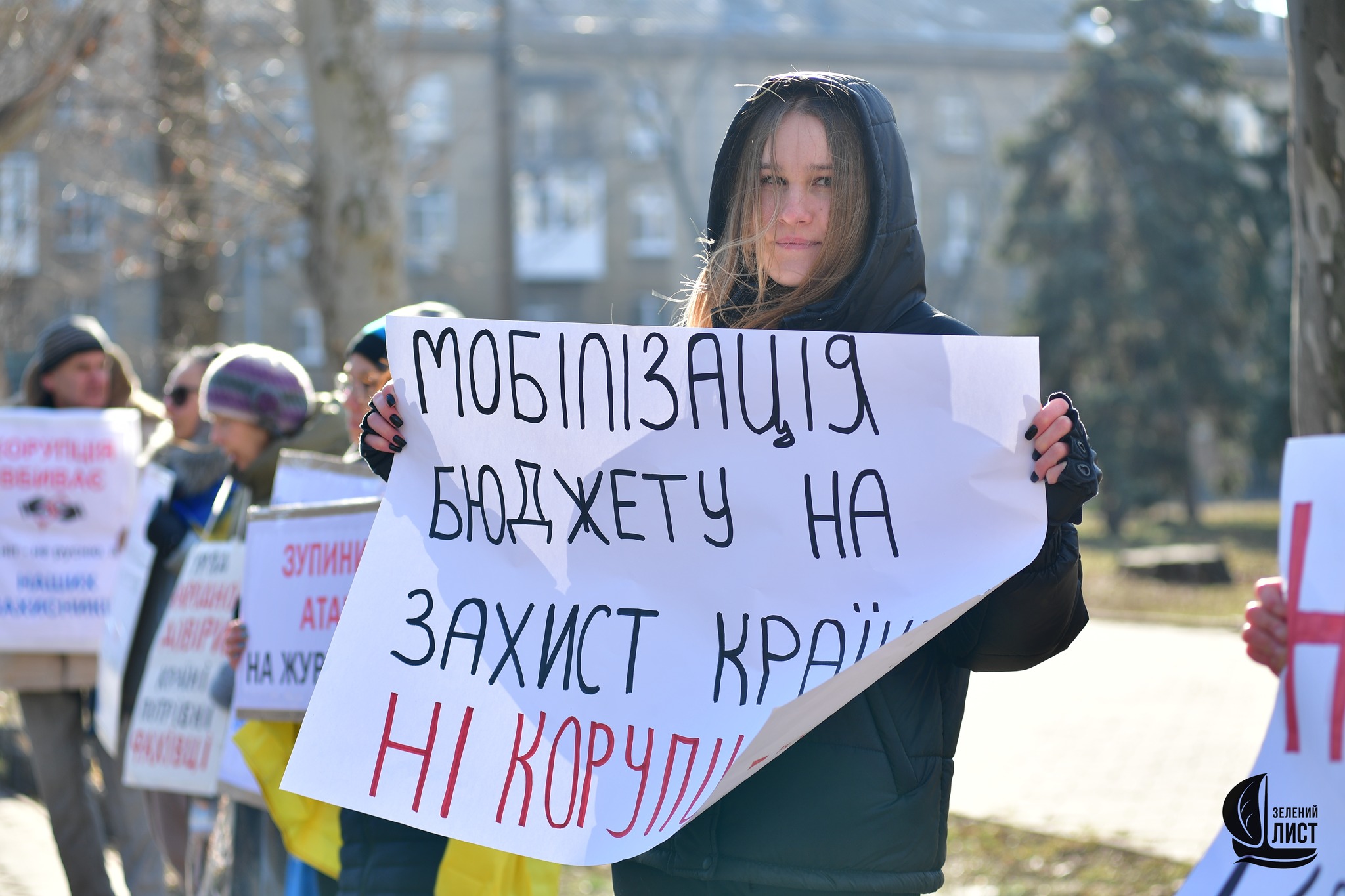
Odesa residents whose demands the city authorities have ignored for nine months directly submitted a collective letter to City Hall on May 11. The initiator of the appeal is Iryna Oleksandrivna Kostenko. On Monday, May 13, the collective letter was submitted to Odesa City Council, and on May 13–14 it was also sent electronically through the deputies’ portal to every member of Odesa City Council. Green Leaf publishes the appeal.
Text of the citizens’ collective appeal
Guided by Article 40 of the Constitution of Ukraine and Articles 1 and 15 of the Law of Ukraine “On Citizens’ Appeals,” we consider it necessary to address you to resolve an urgent issue — financing combat units of the Defense Forces of Ukraine from the city budget.
We are relatives of service members defending Ukraine from the enemy, relatives of fallen heroes, volunteers and concerned Odesa residents. We demand that the city authorities increase expenditures for the Defense Forces of Ukraine, because only thanks to our defenders can Odesa live, work, rest and even celebrate freely rather than under the Russian yoke.
At the City Council session on April 24, 2024, financing for the “Safe City Odesa” budget program was again increased by UAH 146 million, while the total allocated expenditures reached UAH 823 million and another UAH 15 million was allocated for budget loans to business entities. These budget figures show that support for the Defense Forces of Ukraine is not currently a priority for the city authorities. Moreover, not all of these funds are directed to combat units of the Defense Forces, primarily the Armed Forces of Ukraine. At the same time, our defenders are repelling the enemy amid an acute shortage of supplies, especially drones, pickup trucks, electronic-warfare equipment and other items for which their families constantly organize fundraisers. These fundraisers close very slowly, and sometimes never close because those who opened them are no longer alive. Volunteers and military families cannot cover even tens of thousands of hryvnias, while vehicles and other equipment cost from hundreds of thousands to millions. The increases in military pay by UAH 70,000 and UAH 10,000 respectively have also not been secured by law, while our defenders still fuel and repair vehicles at their own expense and are forced to buy everything from personal equipment to body armor and weapons-related equipment.
Yet for some reason the city authorities prioritize financing non-combat bodies such as the Odesa Regional Territorial Recruitment and Social Support Center, which received an additional UAH 1.8 million, bringing its total financing this year to almost UAH 5.9 million, including spending on “payment for the production of insignia and other products.” Such expenditures do nothing to bring victory over Russian aggression closer. It is also difficult to call UAH 2.1 million for the Territorial Office of the Economic Security Bureau in Odesa Oblast or UAH 5.0 million for the Territorial Office of the State Bureau of Investigation priority spending, especially since these institutions are fully financed from the State Budget.
The city authorities have the financial capacity to cover many military needs: purchase tens of thousands of drones, hundreds rather than dozens of pickup trucks and buggies, and finance domestic defense production for which military units are waiting in line and which currently exists only thanks to volunteer funds and donations from concerned civilians.
Analysis of the city budget indicators reveals the following reserves that could be directed to financing the Armed Forces of Ukraine. These are, above all:
1. Unallocated balance of budget funds, which after the April 24, 2024 session amounts to UAH 945,148,563. This amount is calculated from the opening balance of UAH 1,537,806,632, reduced by the UAH 2,000,000 working balance of budget funds and UAH 590,658,070 included in the city budget to cover the current-year deficit. The fact that these UAH 945,148,563 have remained unused for four months indicates that they are not currently needed to cover priority expenditures and can be directed to the needs of the Armed Forces without negative consequences for the city. We demand that this issue be considered and that a draft decision be prepared for the nearest session to direct the specified UAH 945,148,563 exclusively to the needs of combat units of the Defense Forces of Ukraine.
2. Unallocated funds of the deputies’ fund, which after the April 24, 2024 session amount to UAH 103,810,197. Analysis of 2023 shows that most deputies conscientiously fulfill their duty and allocate their share of the deputies’ fund in the first months of the current budget period. However, some deputies do not exercise this right, and the funds remain in the budget without serving the community. We demand that this issue be considered and that a draft decision be prepared for the nearest session to amend Odesa City Council Decision No. 37-VIII of February 3, 2021 so that, if an Odesa City Council deputy does not submit proposals for the use of their share of the deputies’ fund during the first five months of the current year, those funds are automatically directed to the needs of combat units of the Defense Forces of Ukraine. Such amendments would not only increase the accountability of Odesa City Council deputies to their voters but also help identify additional financial resources for urgent needs of combat units of the Defense Forces.
In fact, these two items alone would allow the city authorities to direct about UAH 1 billion to the urgent needs of combat units of the Defense Forces of Ukraine without harming the city’s essential operations. But this is not the limit of the city’s capacity.
Many expenditures are allocated to non-priority needs during the war against Russian aggression — such as landscaping, repairing asphalt where it could still serve for several years, and many other items, including additional bonuses for employees of executive bodies, municipal institutions and enterprises. At the same time, the salary of an ordinary specialist can exceed that of a service member.
Reducing non-priority expenditures could, according to preliminary estimates, free up approximately UAH 1.6–2.2 billion, or 15–20% of the city budget’s expenditure side excluding interbudgetary transfers and the reserve fund. If employees of executive bodies refuse to do this work or provide knowingly incorrect figures, the city’s civil society can assist with this task.
With political will and a state-minded approach, the city authorities could, without harming essential city operations but by abandoning non-priority spending, direct approximately UAH 2.6–3.2 billion in 2024 to the urgent needs of combat units of the Defense Forces of Ukraine.
Based on the above, WE REQUEST:
- Personally review this collective appeal.
- Immediately resolve the issues raised in the appeal.
- Provide a substantive response regarding each of the specified indicators
of the city budget concerning the allocation of funds to finance urgent
needs of combat units of the Defense Forces of Ukraine.
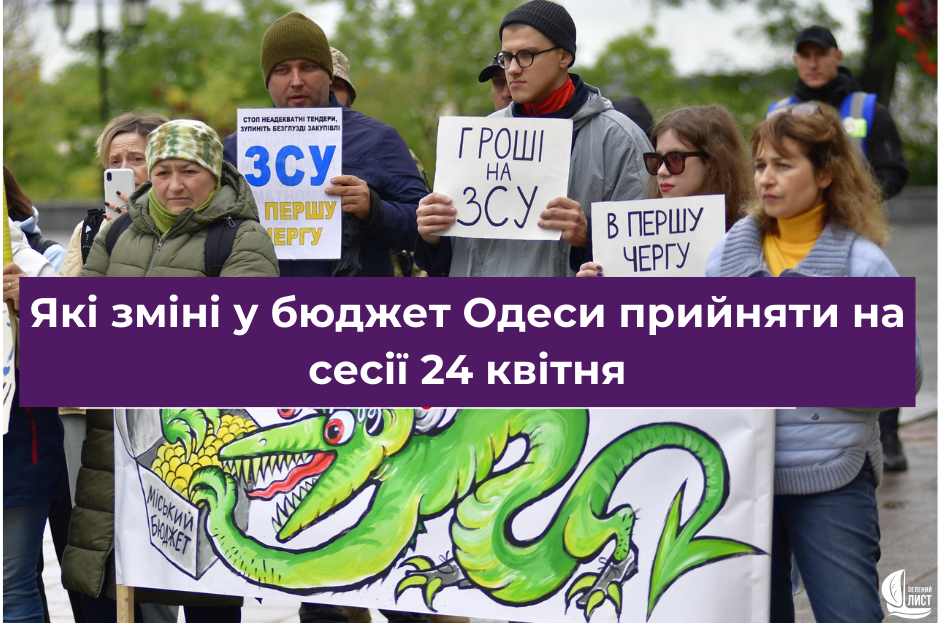
What Changes to Odesa’s Budget Were Adopted at the April 24 Session
Green Leaf has already analyzed the draft amendments to the city budget. The decisions published on the city’s official website on May 1 make it possible to analyze what exactly the city deputies voted for. Green Leaf examined the figures.
Overall budget figures
Revenue side of the budget increased by almost UAH 303 million. This is close to what was stated in the draft decision.
As financing of the budget deficit, another UAH 172.5 million was taken from the hidden unallocated UAH 1.1 billion .
Analysis of the expenditure side showed that reallocations also took place there. Following a “bad tradition,” the city budget reserve fund was reduced by another UAH 311.3 million, and another UAH 52 million of the deputies’ fund was allocated (a little more than UAH 100 million remains unallocated).
The specified UAH 838 million was distributed as UAH 823 million in expenditures, while another UAH 15 million went under the lending item “Provision of budget loans to business entities” through the Department of Economic Development.
We present the distribution of expenditures in a table. The table does not include chief spending units where the change is less than UAH 5 million. These are:
| Name of chief spending unit | Amount, UAH million |
| Department of Education and Science | 80.6 |
| Department of Health | 36.8 |
| Department of Municipal Services | 32.1 |
| Road Management Department | 11.8 |
| Department of Transport, Communications and Traffic Management | 25.9 |
| Capital Construction Department | 478.2 |
| Department of Municipal Security | 146.5 |
The Department of Education and Science and the Department of Health are more or less straightforward.
For the Department of Municipal Services the increase in expenditures was mainly due to increased financing of the City Target Program for Civil Protection of the Population, which had previously been severely underfunded, as Green Leaf reported earlier.
The Road Management Department received additional funds for major repairs of sidewalks.
The Department of Transport, Communications and Traffic Management received additional funds under the budget program “Contributions to the authorized capital of business entities.”
For the Capital Construction Department:
This includes UAH 219.5 million in subvention funds for projects (facilities and measures) aimed at eliminating the consequences of armed aggression, as well as UAH 54 million out of UAH 62 million in co-financing from the city budget. While the subvention funds are allocated under budget program 1517383, the co-financing appears under budget programs 1512010 (hospital building repairs) and 1517310 (water-main construction). It is not entirely clear why and on what grounds UAH 12 million had been allocated earlier.
It also includes UAH 72.4 million in subvention funds for projects under the Ukraine Recovery Emergency Credit Programme.
Funds were also provided for repairs and construction of educational institutions, medical facilities, protection of architectural monuments, other transport-related activities, and more.
The Department of Municipal Security received all UAH 146.5 million to finance the “Safe City Odesa” city target program. All these funds are being transferred to the state budget under program classification code 9800.
Unfortunately, however, not all the funds went to financing combat units of the Armed Forces of Ukraine.
For example, it is not entirely clear why the Territorial Recruitment and Social Support Center needed an additional UAH 1.8 million for office equipment and for such items supposedly “most necessary” for victory over Russian aggression as “payment for the production of insignia and other products.”
Also highly questionable in terms of bringing victory closer is the allocation of UAH 2.1 million to finance the activities of the Territorial Office of the Economic Security Bureau in Odesa Oblast. It gives the impression of a bribe to a law-enforcement body paid for by Odesa residents.
More details on funds allocated in 2024 to the “Safe City Odesa” city target program for transfers to the state budget, including a comparison with the previous session, are available via the link (Safe City Odesa 9800.xlsx).
In summary.
As of the end of April, Odesa had indeed slightly increased financing for combat units of the Armed Forces of Ukraine, but not to the full extent possible. It should not be forgotten that the city budget still contains a kind of “stash” in the form of unallocated balances from previous periods amounting to almost UAH 1 billion.
We should also remember the UAH 400 million city budget reserve fund, which the city authorities have been using for purposes other than its intended function for years.
The overall direction of the budget amendments also indicates that the city authorities are allocating funds either to correct their old “sins,” such as increasing financing for the civil-protection program, or to questionable projects, such as continuing to invest money in a water main for a private entity, which even the State Audit Service commented on.
Overall, looking at the budget indicators, it is hard to escape the feeling that this is an ordinary peacetime city budget. Because despite having more than UAH 1 billion in available financial resources, the city authorities are in no hurry to direct them to the Armed Forces of Ukraine to bring victory over Russian aggression closer.
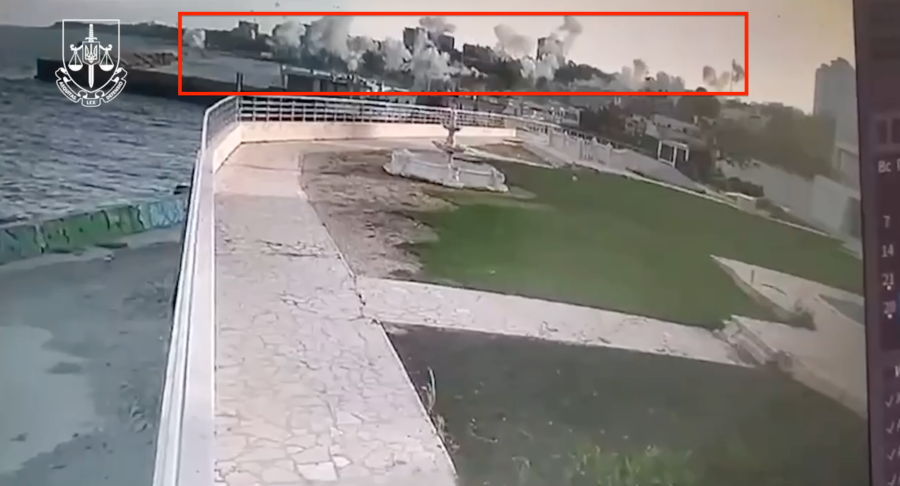
Chronicle of Russia’s War Crimes Against Ukraine’s Environment: Odesa Oblast, April 2024
On April 29, for the first time, Russian forces attacked Odesa with an Iskander-M ballistic missile carrying a cluster warhead. The missile reaches a preset point and explodes in the air. After the warhead bursts, submunitions scatter over the surrounding area. Missile debris and metal fragments were found within a radius of one and a half kilometers from the impact site. Eight people and a dog were killed, and 32 people were injured.
We collect facts about Russia’s crimes against the environment of Odesa and Odesa Oblast during the war: environmental pollution caused by explosions and damage to infrastructure, contamination of air, water and soil with toxic substances, destruction of ecosystems in protected areas and internationally important conservation areas, and more. We will update the information regularly, so please send known facts to: zeleniy.list1@gmal.com
Read More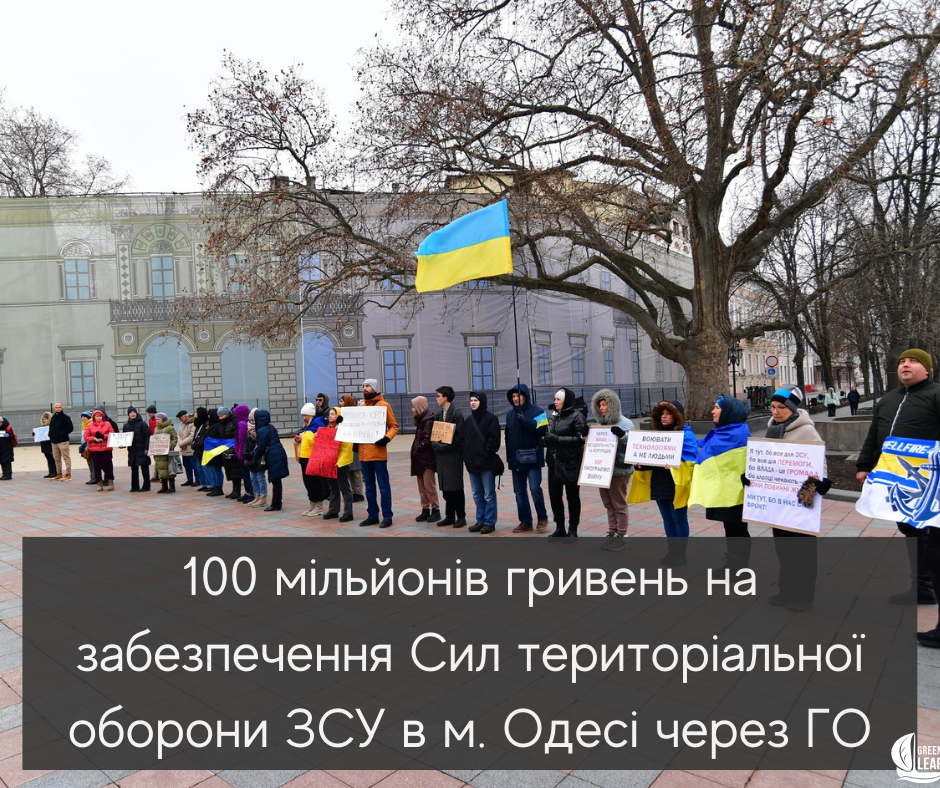
UAH 100 Million for Odesa Territorial Defense Through NGOs
At present, the city program “City Target Program to Promote the Development of Territorial Defense Units and Volunteer Formations of the Odesa City Territorial Community for 2022–2025” provides, among other things, UAH 100 million to public and charitable organizations to address the needs of Odesa’s Territorial Defense Forces. Green Leaf has already reported this earlier.
To clarify all the circumstances, we contacted the Department of Internal Policy of Odesa City Council, which is the chief spending unit for these funds. We were very surprised to learn that two mayoral orders on this issue had already been issued in early March 2024:
No. 114 of 04.03.2024 — On the establishment of the competition commission …
No. 115 of 04.03.2024 — On approval of the Procedure for competitive selection of programs (projects, activities) …
A careful analysis of Order No. 114 did not help us find the composition of the competition commission, although according to the order the list was supposedly attached.
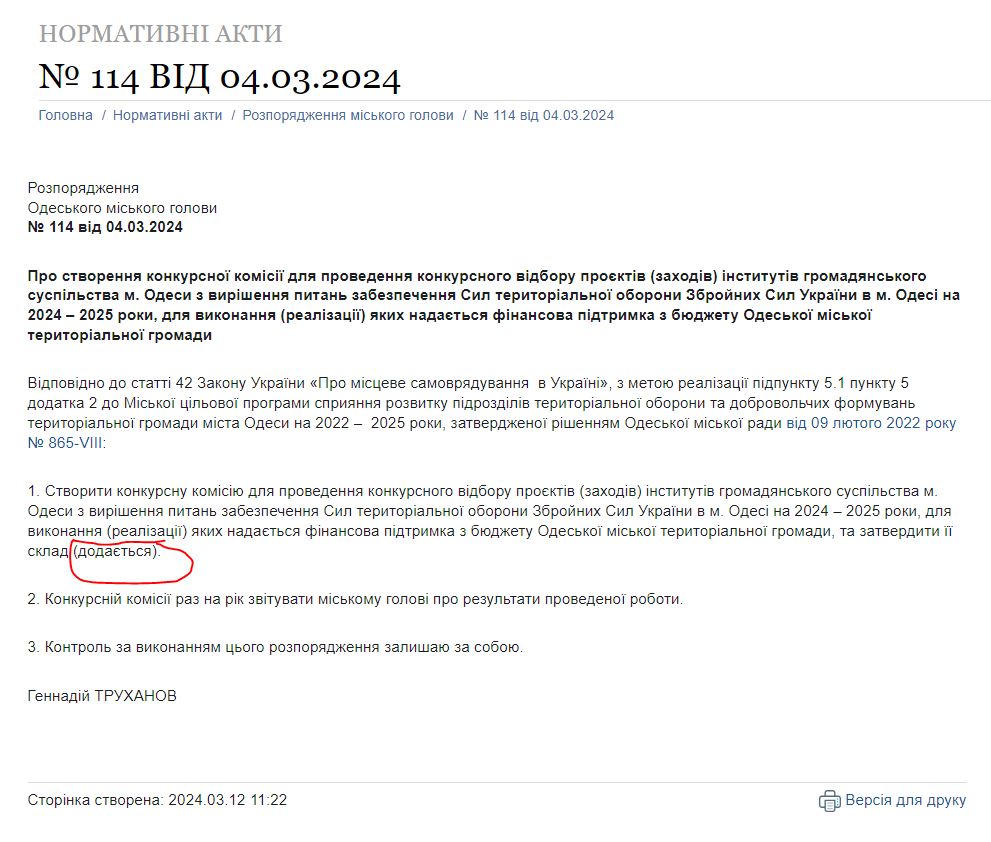
Indeed, on March 23, the Odesa City Council website published a news item titled “For the attention of representatives of Odesa civil society institutions.” The announcement stated that, pursuant to mayoral orders No. 114 and No. 115, the competition commission was launching a competitive selection of programs (projects and activities) by civil society institutions in Odesa aimed at addressing the needs of the city’s Territorial Defense Forces in 2024–2025, with financial support from the budget of the Odesa City Territorial Community. Notably, by April 23 the announcement on the website had been viewed by fewer than 200 people. Posting it on the Facebook page did not add much reach either.
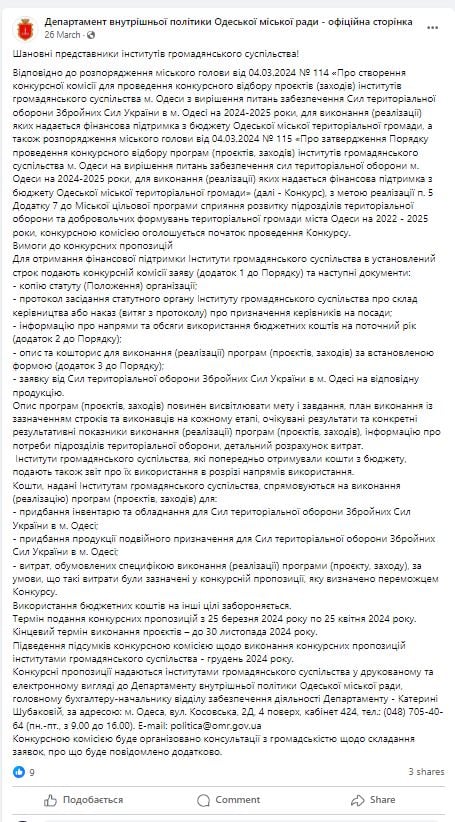
The deadline for submitting competition proposals had already passed on April 25. According to the program passport, the deadline for project implementation is November 30, 2024.
Green Leaf still has questions:
1. Who served on the competition commission?
2. How many NGOs or charitable foundations took part in the competition, how did they learn about it, and who ultimately won?
3. If Odesa’s Territorial Defense is financed directly from the city budget, why create a parallel financing structure for the city’s Territorial Defense?
4. Could this become a repeat, on a larger scale, of the notorious Odesa LED-swing story that cost almost UAH 5 million?