
Balance on the Edge: Crimea’s Water and Land after the Kakhovka Disaster
Introduction
This study is an attempt to take an honest look at how much water actually remained in Crimea in the summer of 2025. It was carried out by the team of the civic organisation Green Leaf together with the National Ecological Centre of Ukraine (NECU).
We did not rely on old reports or official figures. We used open satellite imagery, digital elevation maps and archival water-quality data to build our own independent picture.
The North Crimean Canal, which gave life to the peninsula for half a century, is now a dead artery. After the destruction of the Kakhovka Hydroelectric Power Plant, restoring it in its old form is impossible: there is no source, no volume of water, and no longer the ecosystem it once supplied. We can see steppe reservoirs drying up one by one or turning into salt flats, while some have simply been ploughed up for fields.
Our goal was not to create another set of statistics. We wanted to answer three simple questions:
- where in Crimea is there still living fresh water?
- which reservoirs can be saved and restored?
- what would happen if someone tried tomorrow to send water through the old system again?
Our analysis shows that the balance has shifted: some basins have lost their water completely, while others are only half full. More importantly, the water in many reservoirs is no longer fresh. This is not merely a crisis. It is the point at which it will be decided whether the peninsula can regain water without losing its land.
Crimea’s water infrastructure
Crimea is not only sea and mountains. It is also an entire network of water arteries created by people and nature. More than two dozen large and several dozen smaller reservoirs were once connected through a complex system of canals, tunnels and pumping stations that supplied the peninsula with water.
Two different stories
There are two groups of Crimean reservoirs, and their trajectories diverged after 2014.
The steppe cascade and Mezhhirne are off-channel storage basins that existed only because of the North Crimean Canal. Water came from the Dnipro, and the entire system worked as a single mechanism. When the canal stopped operating, these reservoirs began drying up one after another. Within a few years, many turned into cracked beds, salt flats, or were even ploughed up for fields.
Naturally fed reservoirs — Chornorichenske, Zahorske, Simferopolske, Partyzanske and Feodosiiske — survived. They receive water from local rivers and rainfall, so they remain the basis of drinking-water supply for southern and central Crimea.
The hidden part of the system
Crimea’s water infrastructure is not only the basins shown on a map. It also includes:
- the Baidar hydraulic tunnel, which carries water from the Chornorichenske Reservoir to Sevastopol.
- the underground galleries of the Zahorske basin, which regulate the Belbek River.
- branches of the North Crimean Canal that supplied the steppe hubs.
When these links are broken, a reservoir ceases to function as a reservoir even when it still contains water.
Why this matters today
When we analysed this system, we looked at more than cubic metres of water. We tried to understand what is still alive, what can be saved, and what has already become a different landscape. In this sense, Crimea’s reservoirs are not only about water; they are about function: sustaining life on the land.
When water became a weapon
Russia seized Crimea in 2014 not to develop the region but as a military foothold. The needs of people, drinking water and the peninsula’s natural balance were of no importance to the occupation regime.
After the annexation, Crimea’s resources began to be used exclusively in the interests of the Russian Federation, without regard for ecosystems or long-term consequences. By blocking the North Crimean Canal after the territory was seized, Ukraine was protecting its own water resources and preventing their unlawful use by the occupying forces to support military infrastructure.
Russia responded in a barbaric way: with massive extraction of groundwater, depletion of steppe aquifers, and soil degradation. As a result, within several years steppe Crimea began losing not only water but also land: reservoirs turned into salt flats, and arable land became affected by secondary salinisation.
On 6 June 2023, the occupation military leadership blew up the Kakhovka Hydroelectric Power Plant. The explosion became the largest environmental crime in modern Ukrainian history. In an instant, towns and villages were destroyed, hundreds of square kilometres were flooded, and people and thousands of animals died. But another blow was less visible: the North Crimean Canal finally lost its source of supply.
This was not a technical accident or a ‘side effect of war’. It was a deliberate act of ecocide. It ended the history of Crimea’s old water system and opened a new chapter — the survival of the remaining aquatic ecosystems under completely altered conditions.
How we calculated water volumes in the reservoirs
We wanted to do more than look at maps and count cubic metres. The task was different: to understand where fresh water still survives in Crimea and which reservoirs can be saved.
1️⃣ What we used as a basis
For this purpose we used:
- recent satellite images to see the actual water boundaries in July 2025;
- digital elevation maps showing how full each basin is;
- archival water analyses to distinguish fresh-water reservoirs from saline ones;
- historical hydrological maps to compare the current condition with the situation before 2014.
We relied not on documents produced by the occupation authorities but on data that anyone can verify: open satellite imagery and international digital elevation models.
2️⃣ How we calculated volumes
A satellite shows the surface area of water but not its depth. We therefore combined it with digital elevation maps. This made it possible to estimate how much water each reservoir actually holds, even where the level has fallen by half.
We did not build complex 3D models. We needed a simple but accurate answer: how much water is there now, and how does that compare with the design capacity?
3️⃣ How we assessed water quality
Not all water is the same. Some reservoirs, especially in the steppe, have turned into saline lakes or salt flats. To distinguish fresh-water reserves from unusable ones, we used:
- colour analysis in infrared image bands, which indicates elevated mineralisation;
- comparison with archival chemical analyses carried out before the occupation.
If a reservoir consistently showed signs of salinity and this was supported by historical data, we did not include it in the fresh-water balance.
4️⃣ What else we observed
The analysis showed not only where water remains, but also the risks:
- which basins have become sources of salinisation and could damage soils if water were sent into them tomorrow;
- which dried beds have already been ploughed and lost their protective layer;
- where land around reservoirs has become vulnerable to secondary salinisation.
5️⃣ Why this matters
Since 2014 there have been no systematic hydrometric measurements in Crimea. Satellite data and digital elevation models are therefore now the only way to see the real picture.
This methodology provides two answers:
- how much fresh water actually remains;
- what will happen to land and water systems if someone tries tomorrow to ‘restore the canal’ without preparation.
Crimea’s fresh-water balance
We brought all the data together to obtain an honest picture of how much fresh water actually remained in Crimea in the summer of 2025.
Eastern cascade
Water is still present here. The Frontove and Feodosiiske reservoirs are more than half full and are the main sources for eastern Crimea. But smaller reservoirs show signs of increasing salinity — an early warning sign.
Central cascade
The Simferopolske and Partyzanske reservoirs have retained their role as the main source for the centre of the peninsula. But their volumes have fallen by almost half. Mezhhirne has dried up completely; only the shape of the basin remains. This is a warning that even in the central zone the system is operating at its limit.
Southern segment
Chornorichenske and Zahorske supply Sevastopol and the Southern Coast of Crimea. The situation here is the best: these reservoirs receive water from rivers rather than the canal. Even so, they are only about two-thirds full.
Steppe cascade
This is the area of greatest loss. Most reservoirs are either completely dry or have turned into salt flats and saline lakes. Parts of some beds have already been ploughed. No more than one tenth of the former volume of fresh water remains in the steppe cascade.
Overall picture
Taken together, the figures amount to about one third of the nominal fresh-water capacity. More important, however, is that half of this water is concentrated in only a few naturally fed reservoirs. Steppe Crimea has practically lost its water system.
Why this matters
These data show more than a shortage of water. They show an ecosystem changing. Where there were wetlands and canals, there are now salt flats and dry land. If water is sent through the old system tomorrow without preparation, this saline land will return not life but disaster.
Risks of secondary salinisation
When we looked at the steppe reservoirs, one thing became clear: the greatest threat is not simply the lack of water. The most dangerous consequences would begin if these basins were rapidly refilled.
Why this is dangerous
Many dried reservoirs have turned into salt flats. Over years without water, salts have risen to the surface and formed a concentrated crust. If the first flow of water arrives tomorrow, it will dissolve that crust and carry saline brines further along the canals — directly onto arable fields.
Some reservoirs have already become saline lakes. This is not merely ‘bad water’; it is a systemic change in the reservoir bed. Restoring them would require years of flushing and sums of money comparable to building new reservoirs.
There is another alarming sign: ploughed reservoir basins. Where the bed dried out, people brought in ploughs. This land has lost the protective layer of bottom sediments. If water is released here, it will carry away not only salts but also agricultural chemicals that will enter the irrigation system.
What this means for the entire system
Restarting the North Crimean Canal quickly and without preparation would not bring life back to the steppe. It could turn hundreds of hectares of chernozem into dead white patches of salt. The greatest risk is in the Krasnoperekopsk and Tarkhankut hubs, where arable areas are tied to degraded basins.
Why we need to talk about this now
This is not a forecast for the ‘distant future’. It is a risk for the coming years. If someone decides tomorrow to ‘give water to Crimea’ without environmental preparation, we will get not green fields but a miniature Aral Sea.
Conclusions
1️⃣ How much water remains
Our analysis showed that of more than 600 million m³ of nominal reservoir capacity in Crimea, only about 200 million m³ was fresh water in July 2025. That is one third of the capacity for which the systems were designed.
2️⃣ Where the balance remains
- The southern segment (Chornorichenske and Zahorske) retains up to 65% of actual filling and remains the basis of drinking-water supply.
- The central cascade operates at 40–43% of normal levels but requires protection from silting and increasing salinity.
- The eastern cascade retains only half of its volumes.
- The steppe cascade has effectively been lost: fresh water amounts to no more than 10–11% of design values.
3️⃣ Not only quantity, but quality
Spectral analysis confirmed that a significant share of steppe reservoirs has become brackish. This means that without reclamation, even restored water supplies would not be suitable for irrigation.
4️⃣ Why this method matters
For the first time since 2014, an independent audit of Crimea’s water resources was obtained based not on closed statistics but on open satellite data and digital elevation models. The methodology showed that even without field measurements, water volumes and quality can be estimated with an error margin of only 5–10%.
5️⃣ What should be done next
The figures provide a simple answer: restoration of irrigation is possible only after years of environmental preparation. Without this, the risk of secondary soil salinisation is too high, and the losses could become irreversible.
Supplying Service Members: Responses by MPs and Authorities to the Analytical Note
“The first and most important principle in achieving the objectives of war is to exert, from the outset, the utmost effort with all forces available, until they are completely exhausted.”
— von Clausewitz, On War, 1832
Introduction
An analytical note ‘On the problems of supplying service members with everything they need and ways to address them’
was prepared in response to a deep systemic crisis that, despite the third year of the full-scale war, remains unresolved. The issue is not only shortages of clothing and technical supplies, but the absence of effective mechanisms that would ensure systematic and efficient coverage of the needs of the Armed Forces of Ukraine at the level of state policy.
This document, prepared as a civic initiative with the participation of volunteers, service members and experts, is not merely a critical analysis of the situation but also a concrete roadmap for addressing the problems. Particular attention is paid to the possibility of using local-budget resources, which, despite declared autonomy, are often spent on secondary needs during wartime.
The note contains proposals for changing property-accounting mechanisms, cooperation with volunteers, and the creation of special local defence funds. It presents a comprehensive vision requiring not only political will but also coordinated cooperation among all branches of government.
For this reason, in early December 2024 the document was officially sent to all members of the Verkhovna Rada of Ukraine (except representatives of pro-Russian political forces), as well as to key state institutions: the Office of the President, the Cabinet of Ministers of Ukraine, and the Ministries of Defence and Finance.
This article records the response to that initiative, because actions rather than replies are the indicator of whether the state mechanism is ready to act under critical wartime circumstances.
Responses from members of parliament
General overview:
- about 15 MPs did not receive the letter for technical reasons (full mailboxes);
- some MPs provided written replies;
- some took action without replying (by sending appeals).
Public actions by individual MPs:
- Mariana Bezuhla, Larysa Bilozir — appeal to the Ministry of Defence;
- Olha Vasylevska-Smahliuk — appeals to the Ministry of Defence and Ministry of Finance;
- Oleksii Honcharenko — information taken into consideration;
- Oleksandr Horobets — appeal to the Verkhovna Rada Committee on National Security;
- Viktoriia Kinzburska — will take the proposals into account in her work;
- Olena Kryvoruchkina — appeals to a number of state authorities; responses forwarded to the National Security and Defence Council;
- Ivan Krulko — appeal to the Prime Minister;
- Maslov, Natalukha, Skorokhod, Sovsun, Tarasenko, Fris, Cherniev, Shpak, Yuzhanina, Yurchenko — took the note into account in their work.
Additionally:
- Anton Yatsenko — mentioned in the Ministry of Defence response;
- Oleksii Leonov — response provided by the Odesa City Council.
Response from state authorities
- National Security Committee: appeal to the Cabinet of Ministers;
- Committee on State Administration: also forwarded it to the Cabinet of Ministers;
- Office of the President: redirected it to the Cabinet of Ministers;
- Medical Forces of the Armed Forces of Ukraine: general support for the idea;
- Ministry of Defence and Armed Forces logistics: confirmed that reforms were under way but acknowledged problems with volunteer assistance;
- Association of Ukrainian Cities: focused on the issue of community revenues;
- National Security and Defence Council: redirected it to the Cabinet of Ministers;
- Ministry of Finance: indicated that the initiatives conflicted with current legislation;
- Cabinet of Ministers: forwarded our appeal to the Ministry of Defence. No replies were received to letters from other authorities, including those that directly asked for Green Leaf to be informed.
Summary
Invitation to discussion
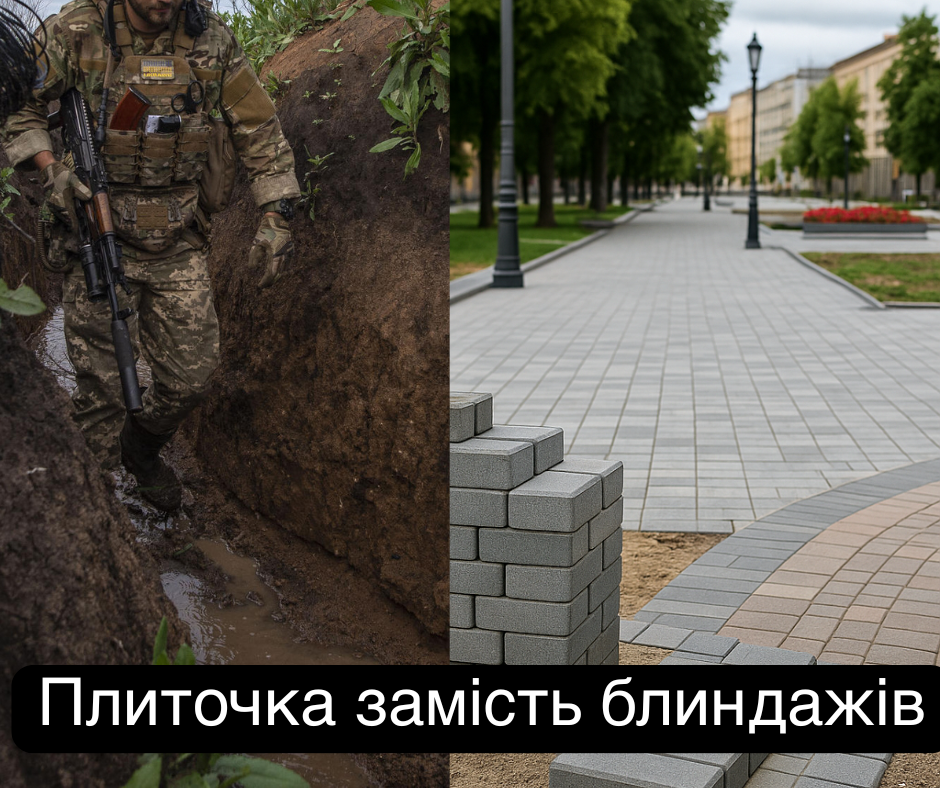
We recognise that supplying the army is not solely the responsibility of the state or parliament. It is a moral challenge for society as a whole. While some give their lives and health on the front line, others should not allow themselves the luxury of standing aside — especially when billions of hryvnias accumulate in community budgets that could be spent on strengthening defence.
We therefore call for a balanced, evidence-based discussion of the proposed mechanisms. This is not about slogans — it is about responsibility. Open dialogue among the public, authorities and the military is the only path to fair and effective use of resources during wartime.
The note was perceived as a serious and professional document and prompted a response from some members of parliament and individual ministries. However, the absence of clear coordination at the level of the Cabinet of Ministers and the Ministry of Finance indicates that a systematic state policy on this issue has still not been formed.
Conclusion: combining the efforts of local budgets and volunteer structures within state policy could not only reduce losses in the Armed Forces of Ukraine but also lower social tension in communities. Instead, we have a situation in which, rather than urgently supplying military units, the state allows communities to spend billions on decorative projects in the rear.
Why Is Odesa City Council Blocking the Petition to Repeal the Pro-Russian Charter?
Introduction
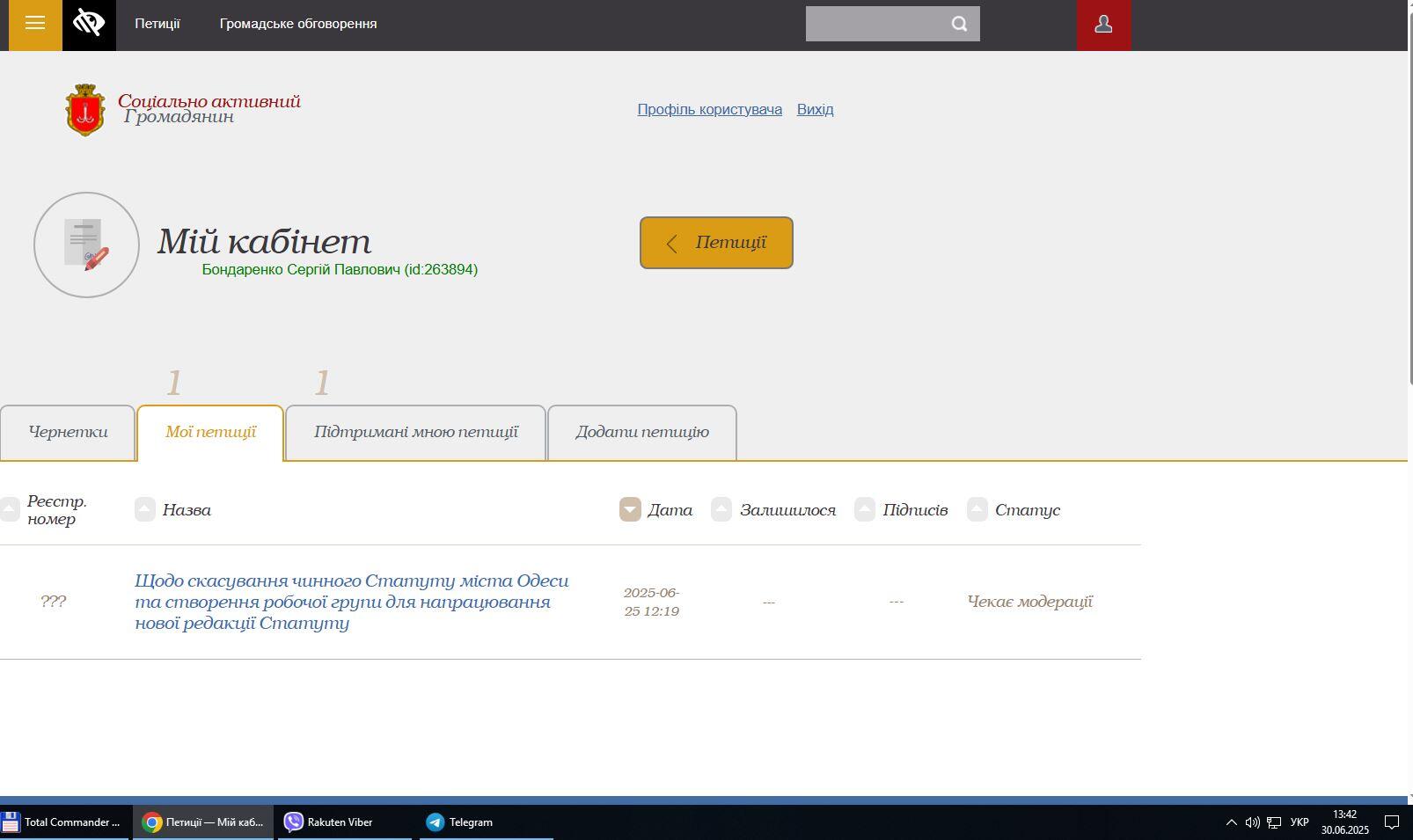
On 25 June 2025, a petition was submitted through the Odesa City Council’s electronic petition service calling for the repeal of Odesa’s current pro-Russian City Charter. It prompted public attention but has still not been published, despite the clear requirements of the procedure.
? https://petition.omr.gov.ua/uk/e-petition/view/2304
What does the law require?
According to the Procedure for Considering Electronic Petitions, approved by Odesa City Council Decision No. 2192-VIII of 26 June 2024, a petition:
- must be published within 2 working days after submission;
- or, if it does not comply with the law, the author must receive an official refusal with reasons provided.
? As of 4 July (the 8th working day), neither of these requirements had been fulfilled.
?️ Screenshot of the petition on the City Council website — status: awaiting moderation
Why are the authorities delaying?
1. The petition meets all legal requirements
It does not violate the Law of Ukraine ‘On Citizens’ Appeals’, contains clear reasoning, identifies the author, and sets out a logical request.
2. There is a strong likelihood of collecting the required signatures
Because of repeated attacks on Odesa and attempts by the Russian Federation to impose a Russian identity on the city, the petition is likely to collect 1,000+ signatures quickly. This would require the council to put it before a session.
3. Political vulnerability of the mayor
If the Charter is repealed, this would directly contradict the position expressed by Hennadii Trukhanov in a 2022 interview: The New York Times:
‘I am concerned about the growth of hatred toward everything Russian.’
What is wrong with Odesa’s current Charter?
❌ Imperial and Soviet myths
- The city’s founding day — 2 September — is tied to an imperial date rather than historical facts.
- ‘Odesa Liberation Day’ — without mention of the change of occupying forces.
❌ Pro-Russian narratives
- The preamble contains phrases about the ‘heroism of Russian servicemen’.
- The Charter establishes Russian as the ‘language of interethnic communication’, which contradicts the Constitution of Ukraine.
? Full text of the petition —
What has already been done?
To determine why the procedure was violated, I sent official appeals to:
- Mayor Hennadii Trukhanov;
- City Council Secretary Pavlo Koval;
- the Standing Commission on Emergencies, Environment and Digital Transformation.
Conclusions
The City Council’s silence is not a mistake but a political tactic.
But the process has already begun, and repeal of the ideologically outdated Charter is only a matter of time.
? Call to the community
Share this information. We demand that the authorities provide an open review and act in accordance with the law.
? Published: July 2025
✍️ Author: Serhii Bondarenko for Green Leaf