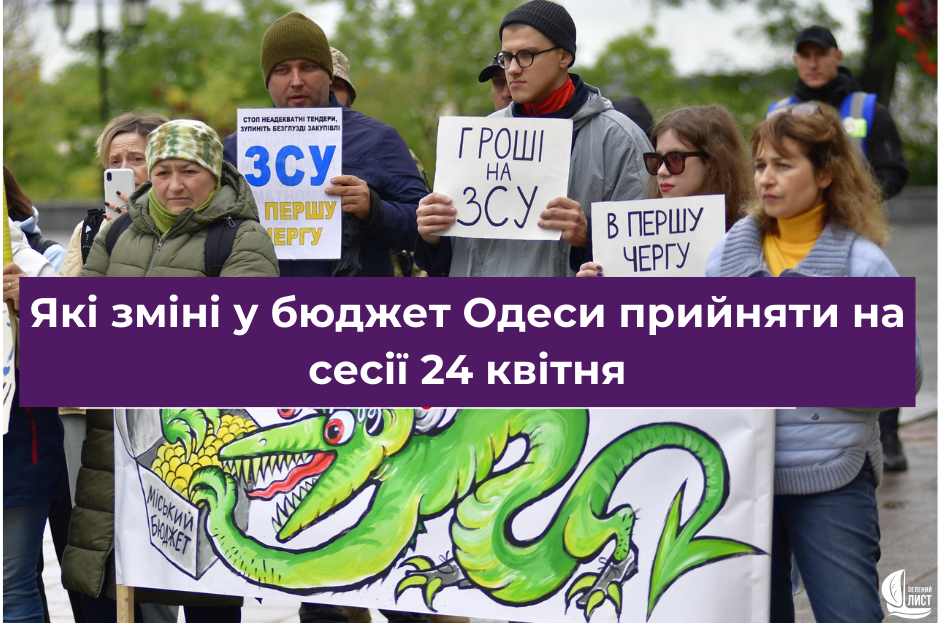

What Changes to Odesa’s Budget Were Adopted at the April 24 Session
Green Leaf has already analyzed the draft amendments to the city budget. The decisions published on the city’s official website on May 1 make it possible to analyze what exactly the city deputies voted for. Green Leaf examined the figures.
Overall budget figures
Revenue side of the budget increased by almost UAH 303 million. This is close to what was stated in the draft decision.
As financing of the budget deficit, another UAH 172.5 million was taken from the hidden unallocated UAH 1.1 billion .
Analysis of the expenditure side showed that reallocations also took place there. Following a “bad tradition,” the city budget reserve fund was reduced by another UAH 311.3 million, and another UAH 52 million of the deputies’ fund was allocated (a little more than UAH 100 million remains unallocated).
The specified UAH 838 million was distributed as UAH 823 million in expenditures, while another UAH 15 million went under the lending item “Provision of budget loans to business entities” through the Department of Economic Development.
We present the distribution of expenditures in a table. The table does not include chief spending units where the change is less than UAH 5 million. These are:
| Name of chief spending unit | Amount, UAH million |
| Department of Education and Science | 80.6 |
| Department of Health | 36.8 |
| Department of Municipal Services | 32.1 |
| Road Management Department | 11.8 |
| Department of Transport, Communications and Traffic Management | 25.9 |
| Capital Construction Department | 478.2 |
| Department of Municipal Security | 146.5 |
The Department of Education and Science and the Department of Health are more or less straightforward.
For the Department of Municipal Services the increase in expenditures was mainly due to increased financing of the City Target Program for Civil Protection of the Population, which had previously been severely underfunded, as Green Leaf reported earlier.
The Road Management Department received additional funds for major repairs of sidewalks.
The Department of Transport, Communications and Traffic Management received additional funds under the budget program “Contributions to the authorized capital of business entities.”
For the Capital Construction Department:
This includes UAH 219.5 million in subvention funds for projects (facilities and measures) aimed at eliminating the consequences of armed aggression, as well as UAH 54 million out of UAH 62 million in co-financing from the city budget. While the subvention funds are allocated under budget program 1517383, the co-financing appears under budget programs 1512010 (hospital building repairs) and 1517310 (water-main construction). It is not entirely clear why and on what grounds UAH 12 million had been allocated earlier.
It also includes UAH 72.4 million in subvention funds for projects under the Ukraine Recovery Emergency Credit Programme.
Funds were also provided for repairs and construction of educational institutions, medical facilities, protection of architectural monuments, other transport-related activities, and more.
The Department of Municipal Security received all UAH 146.5 million to finance the “Safe City Odesa” city target program. All these funds are being transferred to the state budget under program classification code 9800.
Unfortunately, however, not all the funds went to financing combat units of the Armed Forces of Ukraine.
For example, it is not entirely clear why the Territorial Recruitment and Social Support Center needed an additional UAH 1.8 million for office equipment and for such items supposedly “most necessary” for victory over Russian aggression as “payment for the production of insignia and other products.”
Also highly questionable in terms of bringing victory closer is the allocation of UAH 2.1 million to finance the activities of the Territorial Office of the Economic Security Bureau in Odesa Oblast. It gives the impression of a bribe to a law-enforcement body paid for by Odesa residents.
More details on funds allocated in 2024 to the “Safe City Odesa” city target program for transfers to the state budget, including a comparison with the previous session, are available via the link (Safe City Odesa 9800.xlsx).
In summary.
As of the end of April, Odesa had indeed slightly increased financing for combat units of the Armed Forces of Ukraine, but not to the full extent possible. It should not be forgotten that the city budget still contains a kind of “stash” in the form of unallocated balances from previous periods amounting to almost UAH 1 billion.
We should also remember the UAH 400 million city budget reserve fund, which the city authorities have been using for purposes other than its intended function for years.
The overall direction of the budget amendments also indicates that the city authorities are allocating funds either to correct their old “sins,” such as increasing financing for the civil-protection program, or to questionable projects, such as continuing to invest money in a water main for a private entity, which even the State Audit Service commented on.
Overall, looking at the budget indicators, it is hard to escape the feeling that this is an ordinary peacetime city budget. Because despite having more than UAH 1 billion in available financial resources, the city authorities are in no hurry to direct them to the Armed Forces of Ukraine to bring victory over Russian aggression closer.

Chronicle of Russia’s War Crimes Against Ukraine’s Environment: Odesa Oblast, April 2024
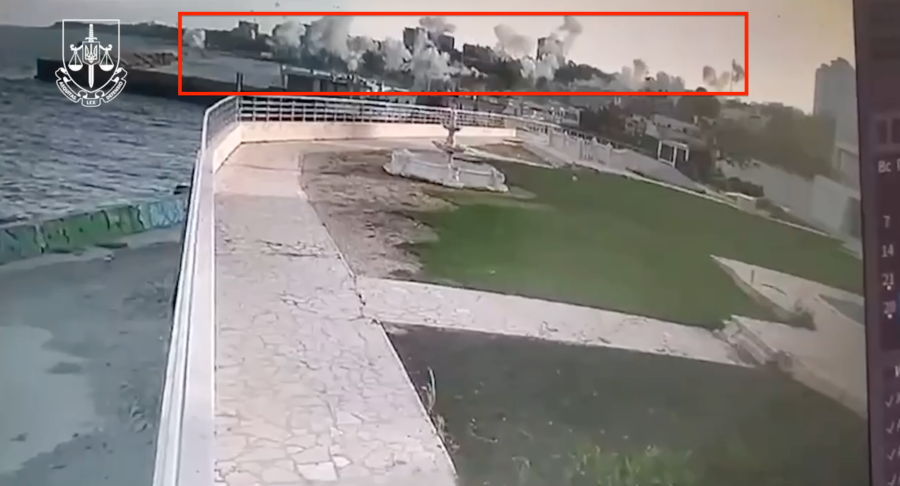
On April 29, for the first time, Russian forces attacked Odesa with an Iskander-M ballistic missile carrying a cluster warhead. The missile reaches a preset point and explodes in the air. After the warhead bursts, submunitions scatter over the surrounding area. Missile debris and metal fragments were found within a radius of one and a half kilometers from the impact site. Eight people and a dog were killed, and 32 people were injured.
We collect facts about Russia’s crimes against the environment of Odesa and Odesa Oblast during the war: environmental pollution caused by explosions and damage to infrastructure, contamination of air, water and soil with toxic substances, destruction of ecosystems in protected areas and internationally important conservation areas, and more. We will update the information regularly, so please send known facts to: zeleniy.list1@gmal.com
Read More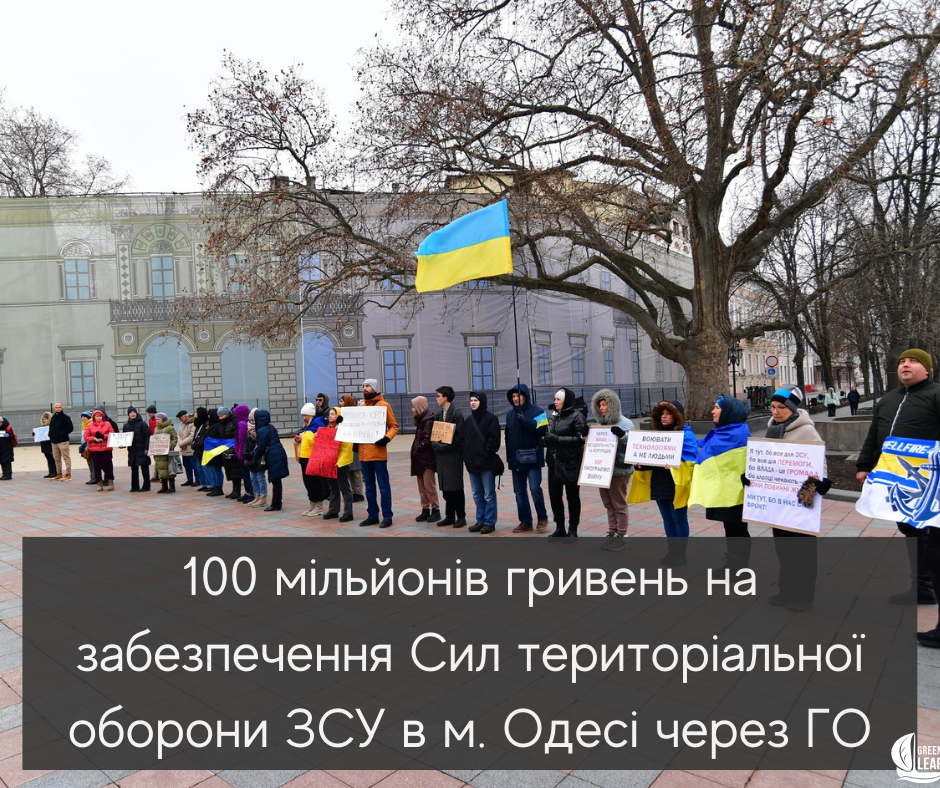
UAH 100 Million for Odesa Territorial Defense Through NGOs
At present, the city program “City Target Program to Promote the Development of Territorial Defense Units and Volunteer Formations of the Odesa City Territorial Community for 2022–2025” provides, among other things, UAH 100 million to public and charitable organizations to address the needs of Odesa’s Territorial Defense Forces. Green Leaf has already reported this earlier.
To clarify all the circumstances, we contacted the Department of Internal Policy of Odesa City Council, which is the chief spending unit for these funds. We were very surprised to learn that two mayoral orders on this issue had already been issued in early March 2024:
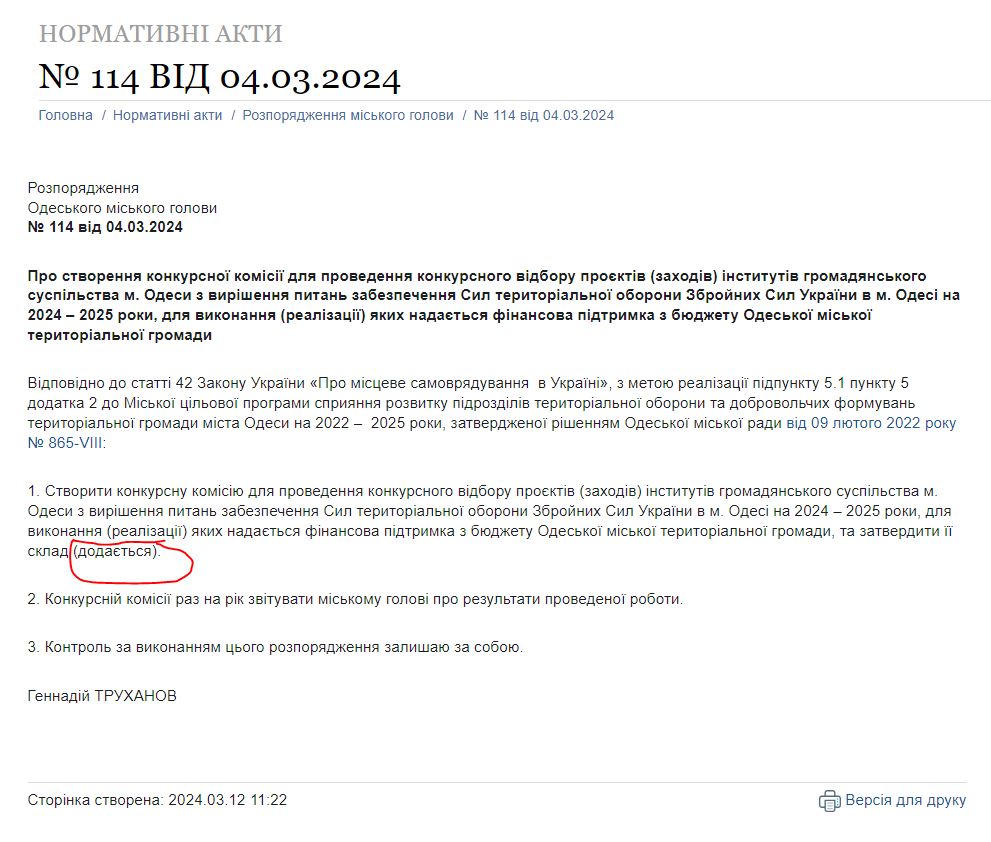
No. 114 of 04.03.2024 — On the establishment of the competition commission …
No. 115 of 04.03.2024 — On approval of the Procedure for competitive selection of programs (projects, activities) …
A careful analysis of Order No. 114 did not help us find the composition of the competition commission, although according to the order the list was supposedly attached.
Indeed, on March 23, the Odesa City Council website published a news item titled “For the attention of representatives of Odesa civil society institutions.” The announcement stated that, pursuant to mayoral orders No. 114 and No. 115, the competition commission was launching a competitive selection of programs (projects and activities) by civil society institutions in Odesa aimed at addressing the needs of the city’s Territorial Defense Forces in 2024–2025, with financial support from the budget of the Odesa City Territorial Community. Notably, by April 23 the announcement on the website had been viewed by fewer than 200 people. Posting it on the Facebook page did not add much reach either.
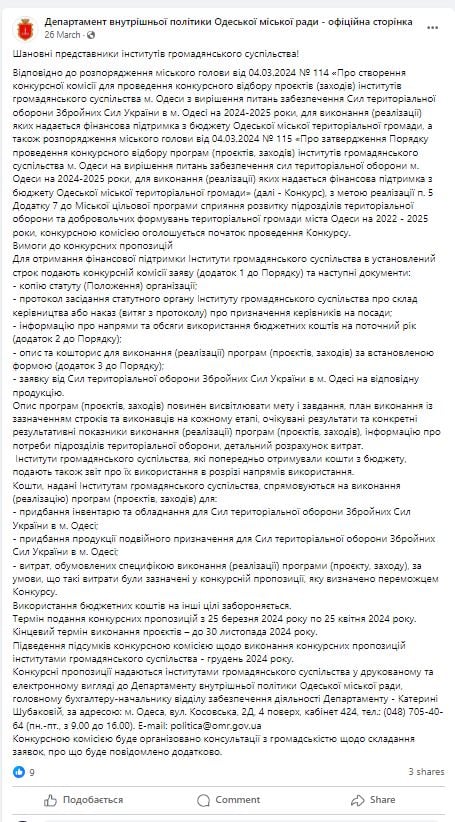
The deadline for submitting competition proposals had already passed on April 25. According to the program passport, the deadline for project implementation is November 30, 2024.
Green Leaf still has questions:
1. Who served on the competition commission?
2. How many NGOs or charitable foundations took part in the competition, how did they learn about it, and who ultimately won?
3. If Odesa’s Territorial Defense is financed directly from the city budget, why create a parallel financing structure for the city’s Territorial Defense?
4. Could this become a repeat, on a larger scale, of the notorious Odesa LED-swing story that cost almost UAH 5 million?

Changes to Odesa’s City Budget for April 24
On the official website of Odesa City Council, in the section “draft decisions of the City Council”, draft decisions have appeared, including a draft on amendments to the city budget that are to be submitted to a session supposedly scheduled for April 24. Green Leaf examined the budget twists and turns.
What changes are proposed for the city budget
Revenue
All changes on the revenue side are subventions from other budgets, both the state budget and the Odesa Oblast budget. The total amount is UAH 301.5 million.
The following should be noted. At the end of 2023, UAH 191.2 million in unused funds was returned from the city budget to the state budget, as Green Leaf wrote earlier, while this year UAH 219.5 million is already being provided from the State Budget for the same purposes (an increase of UAH 28.3 million), as stated in Cabinet of Ministers Resolution No. 247 of March 5, 2024. We also note that the construction of a kindergarten has disappeared from the funding list, although it had previously been planned at 4 Pestelia Lane, Odesa. What prompted these changes is not yet known.
Expenditure
In addition to reflecting the subventions on the expenditure side, we draw attention to the following spending item:
— UAH 10 million is being allocated to the Road Management Department for sidewalk repairs and the installation of ramps at five addresses. Yes, ramps are necessary, but do ramps really cost these amounts? Or is the need to install ramps being used as cover for other work? Especially since most of the amount — UAH 5.2 million — is planned solely for the major repair (restoration) of the hard surface of sidewalks at Borys Derevianko Square, with ramps at the intersections with Itzhak Rabin Street and Akademika Filatova Street. The second-largest amount, UAH 2.9 million, is planned for major repair (restoration) of sidewalk paving with ramps at the corner of Kanatna and Sehedska streets in Odesa.
It is also impossible not to note that, following an unfortunate tradition, the reserve fund is once again being reduced — this time by UAH 14.2 million.
What is currently missing from the draft decision on amendments to the budget
1. At present, the authorities show no desire to distribute the concealed UAH 1.1 billion, as Green Leaf wrote earlier.
2. There is no information whatsoever on the distribution of the deputies’ fund. We recall that UAH 155.8 million is currently recorded as undistributed in the city budget.
3. There is no increase in assistance to combat units of Ukraine’s Defense Forces. As Green Leaf has reported, the city budget currently provides only UAH 85.7 million for combat units.
4. There is no information on putting the financing of the city’s municipal programs in order, as was noted by Green Leaf.
5. There is no information about increased spending on the city’s territorial defense, particularly on increasing the number of mobile firing positions for engaging Shahed drones.
In summary
Either the city authorities have switched to austerity mode, or they are following the old scheme — trying to introduce amendments to the draft immediately before the session itself. In Odesa it has become normal for the public to be unable to review draft decisions; even the deputies themselves do not have time to study them. So the deputies will probably once again have to vote for the budget “blindly,” relying on trust as usual. We also recall that the previous draft budget amendments that reached the session hall contained five changes. One wonders whether the deputies are just as trusting when it comes to their own family budgets.

Odesa Municipal Target Programs: Development Tool or Budget-Raiding Mechanism?
The procedure for developing municipal target and comprehensive programs
in Odesa was approved by Order No. 1115 of the Mayor of Odesa dated November 8, 2016. As stated in the order, a municipal target program is a set of interconnected areas and measures coordinated by timeframe and resources among all involved implementers and aimed at solving the most pressing problems of the city’s development. Put into plain language, a municipal program is a concrete multi-year action plan for all involved parties to achieve a predetermined goal, listing the actions of the relevant city bodies and defining both the areas of action and the financial resources required to carry them out.
Purely formally, every municipal program passes through certain stages:
1. Initiation, justification and preparation of the draft program.
2. Approval of the program.
3. Approval of budget allocations for implementation of the program.
4. Implementation of the program, including amendments to the program.
5. Report on implementation of the program.
Logically, each program should have a financing strategy designed for several years. In practice, financing is determined in the city budget, which is adopted only for the current year. It should also be noted that programs may provide for other sources of funding, but our analysis covers exclusively the funds designated as financing from the city budget.
Current realities (based on materials from the February 21, 2024 session)
At present, 29 municipal programs have been approved in the city. Analysis of these programs, comparing their 2024 financing needs with the funds allocated from the city budget this year, allows them to be divided into four groups:
Group 1. These are programs approved at the most recent session, on February 21, for which budget financing has not yet been allocated. They are not specially marked in the table.
Group 2.These are programs whose financial provision exceeds 96% of the required amount or equals the required amount, allowing us to conclude that there are no financial factors preventing their implementation. This group includes 12 programs. They are marked in green in the table.
Group 3. These are programs whose level of financial provision ranges from 85% to 64%, placing achievement of the planned results in doubt because a number of measures included in the program are unfunded. This group includes seven programs. They are marked in yellow in the table.
Group 4. These are programs whose financial provision ranges from 57% to 6%, making it possible to state that, given the resources allocated to them, their objectives will not be achieved. This group includes eight programs. They are marked in red in the table.
The list of municipal programs can be viewed at this link.
Information on the distribution of expenditures in the budget of the Odesa City Territorial Community for implementation of municipal programs in 2024 can be found in Appendix 7 to Odesa City Council Decision No. 1789-VIII of February 21, 2024, “On Amendments to Odesa City Council Decision No. 1618-VIII of November 29, 2023, ‘On the Budget of the Odesa City Territorial Community for 2024’”. Anyone can review the indicators collected by Green Leaf NGO in the table.
Municipal Target Program for the Development of Education in Odesa
Let us analyze several programs. For example, the Municipal Target Program for the Development of Education in Odesa for 2023–2025, which we assigned to Group 3. For 2024, the program envisages spending UAH 167,184,000, while the budget provides only UAH 113,073,100 to finance it. The principal spending unit is the Department of Education and Science of Odesa City Council.
The program includes the following areas:
| Areas of expenditure | Approximate amount under the program |
| Section 1. Creating conditions to meet the population’s need for high-quality and accessible education for children and stable operation of educational institutions | 28 500 000 |
| including major repairs of buildings and premises | 20 000 000 |
| Section 2 — Creating a safe educational environment | 92 850 000 |
| including arrangement of protective shelters | 30 000 000 |
| including fire-safety measures | 50 000 000 |
| Section 3. Digitalization of the educational process and management of the education sector | 22 706 000 |
| including equipping institutions with multimedia equipment | 6 700 000 |
| including implementation of an electronic-school system | 15 000 000 |
| Section 4. Supporting the development of children’s and students’ intellectual and creative potential | 11 658 000 |
| including recreation and health improvement for children | 5 000 000 |
| including purchase of New Year gifts | 6 000 000 |
| Section 5. Developing creative potential and increasing the prestige of work in the education sector | 11 470 000 |
| including municipal payments | 11 000 000 |
As the table shows, all of these measures are interconnected. Underfunding some areas will negatively affect the effectiveness of all the others. Children need properly equipped educational institutions, completed repairs, recreation and gifts, and teachers receiving decent pay. But the funds allocated from the budget are not enough even to carry out the first two areas of the program, let alone the others. Alternatively, implementation of the other areas would come at the expense of children’s safety while they are in educational institutions.
Municipal Target Program for Civil Protection of the Population
We also propose focusing on the provision of shelters for civilians. This is governed by the Municipal Target Program for Civil Protection of the Population and Territories from Man-Made and Natural Emergencies and for Fire Safety in Odesa for 2022–2026. It provides for spending of more than UAH 178 million in 2024, of which UAH 113.5 million is required for item 1.1 alone — “construction, major repairs and reconstruction of municipally owned civil-protection shelters.” There are also public warning systems, communication channels for warning systems and many other items. Yet only UAH 95.6 million is allocated from the budget for the entire program in 2024, which is not enough even for the protective shelters. The alternative is to implement other areas of the program by reducing shelter financing even further.
Conclusions
At present, most municipal target programs are not fully provided with financial resources. In effect, one can speak of two “parallel worlds”: one says everything is fine because there is a municipal target program addressing the problem and it has been approved by deputies. The other parallel world, represented by the Finance Department, says the city cannot fully finance the solution because the city budget lacks funds. This affects the effectiveness of spending the money that is available: funds are spent, but the objective built into most programs is not achieved.
Putting this area in order requires financing indicators for municipal target programs to correspond to the financial resources actually available to the city. This is possible only if municipal target programs are aligned with the real capacity of the budget, adjusting not only the program’s areas of activity but also its objectives. For example, how can one speak about developing electric transport if the allocated funds are not even enough to pay employees’ wages, let alone finance all other areas of the program, including equipment repairs?

Funding Ukraine’s Defense Forces from the Odesa City Budget
Expenditures on territorial defense
In Odesa, protests against non-priority use of city and regional budgets during wartime have continued for eight months. One question troubling Odesa residents is how much money Odesa City Council allocated in 2024 to meet military needs. Green Leaf will try to clarify this. As previously noted, expenditures on territorial-defense measures and works are reflected in the city budget decision under program classification code 8240. These expenditures appeared in the 2024 city budget from the outset and are shown under the following chief spending units, in hryvnias:
| Chief spending unit | Initial decision for 2024 |
| Executive Committee of Odesa City Council | 10 000 000 |
| Department of Internal Policy of Odesa City Council | 50 000 000 |
| Department of Municipal Services of Odesa City Council | 20 000 000 |
| Capital Construction Department of Odesa City Council | 126 000 000 |
| Department of Municipal Security of Odesa City Council | 347 250 000 |
| Total | 553 250 000 |
More information on how these funds are to be spent is provided by the “Municipal Target Program for Supporting the Development of Territorial Defense Units and Volunteer Formations of the Odesa City Territorial Community for 2022–2025,” whose latest version can be viewed at this link. For convenience, expenditures provided by the program for 2024 have been placed in a separate table available at the link “Program 8240.xlsx”.
Analysis of the program indicators raises several questions
1. There are doubts about the appropriateness of spending UAH 120 million on building repairs this year for buildings provided to the Territorial Defense Forces. According to some assessments, under the guise of repairs for territorial defense, these buildings are simply being prepared for privatization. This is especially questionable given that UAH 121.6 million was allocated for similar purposes in 2023.
2.The “fragmentation” of expenditures among different chief spending units of the city budget is unclear. For example, item 4.2 of the Program will be implemented simultaneously by both the Department of Municipal Security and the Executive Committee of Odesa City Council, even though they are tasked with the same objectives.
3.A major question is raised by item 5.1 of the Program, under which UAH 50 million is allocated to civic and charitable organizations to address issues related to supplying Odesa’s Territorial Defense Forces. In effect, functions are duplicated: procurement for the city’s Territorial Defense Forces is carried out simultaneously by executive bodies of Odesa City Council and by civil-society institutions. This indicates either that the City Council’s executive bodies are unable to provide the Territorial Defense Forces with what they need in a timely manner, or that the leadership of the Territorial Defense Forces is unable to forecast its needs in advance.
Expenditures to support the Armed Forces of Ukraine
Understanding city-budget expenditures for the Armed Forces of Ukraine is more difficult than for the Territorial Defense Forces. First, the Municipal Target Program “Safe City Odesa,” whose latest version can be viewed at this link, includes expenditures for water rescue measures, other public-order and security activities, and specifically subventions from the local budget to the state budget under program classification code 9800. Under that same code there are separate expenditures of UAH 8,500 thousand for implementation of the Municipal Target Program for Civil Protection of the Population and Territories from Man-Made and Natural Emergencies and for Fire Safety in Odesa for 2022–2026, as well as expenditures for implementation of the “Safe City Odesa” program amounting to UAH 131,743.67 thousand. It is this latter amount that interests us.These expenditures were not included in the original 2024 city budget decision and appeared only through amendments to the city budget adopted on February 21, 2024. For convenience, we placed the expenditures provided by the program for 2024 under code 9800 in a separate table, available at the link “Safe City Odesa 9800.xlsx”. We note that the indicators are shown in thousands of hryvnias, as in the program itself.
What can be learned from these indicators
1. It appears that when the draft budget was prepared, the city authorities did not intend to allocate funds to Armed Forces units at all and decided to do so only later.
2. Of the UAH 131.7 million allocated, at least UAH 46 million is not going to combat units, namely:2.1. Items 8.1 and 8.3 of the Program, under which funds go to National Guard units engaged in maintaining public order and citizen safety in Odesa, for a total of UAH 37.0 million. A simple question arises: what, then, are the National Police of Ukraine and Trukhanov’s personal “guard” in the form of the municipal institution “Municipal Guard” doing, given that its authorized staffing level is 450 people and more than UAH 117 million is provided for its maintenance in the 2024 budget?
2.2. Item 9.1 of the Program provides more than UAH 4.0 million to the Odesa Regional Territorial Recruitment and Social Support Center not only for computers and office equipment, but also for the vague item “payment for the production of insignia and other products.” What these insignia and other products are, how urgent such spending is, and how it will bring victory over Russian aggression any closer — the Program does not say.
2.3. Item 19.1 of the Program provides expenditures of UAH 5.0 million for current repairs to the administrative building housing the Territorial Department of the State Bureau of Investigation.
3.Only one military unit with its subordinate units received funding with wording covering “surveillance and fire-adjustment equipment, unmanned aircraft systems (UAVs), weapons, military equipment, electronic-warfare systems and other needs.” As far as we know, combat units urgently need UAVs, buggies or quad bikes, and boats. There is no mention of engineering equipment, boats, medicines and many other items whose provision falls almost entirely on volunteers.
In summary
In 2024, Odesa’s city budget provides no more than UAH 85.7 million to finance combat units of the Armed Forces of Ukraine and UAH 552.6 million for the Territorial Defense Forces. At the same time, UAH 120 million in expenditures planned for repairs of buildings supposedly provided to the Territorial Defense Forces raises doubts about efficiency — is all municipal property in Odesa really in such poor condition? — as does the UAH 50 million allocated to civic and charitable organizations to address supply issues for Odesa’s Territorial Defense Forces. At the same time, there are many questions about insufficient funding for Armed Forces combat units and the absence of certain territorial-defense expenditures. At present, Russian forces can launch 20–30 Shahed-131/136 drones at Odesa in a single night to terrorize the civilian population. Specialists say this should be countered by increasing the density of mobile fire teams around the city. A key component of such mobile fire systems is air-defense searchlight systems. Given the number of casualties from hostile UAV attacks in Odesa, financing additional mobile air-defense groups should have become the number-one priority from the standpoint of civilian safety. It is also much cheaper to shoot these drones down than later allocate city-budget funds to repair and restore infrastructure. Yet the documents reviewed do not show that the city is doing this. Green Leaf previously wrote that the city budget contains UAH 1.1 billion in undistributed — effectively hidden — balances from previous periods.

Chronicle of Russia’s War Crimes Against Ukraine’s Environment: Odesa Oblast, March 2024
Two years after the start of the hot phase of the war, Russian forces shifted to a new tactic — terrorizing civilians in order to create a humanitarian catastrophe. In Odesa and Odesa Oblast, this tactic manifested itself in March 2024, which became one of the most terrible months in the history of Ukraine’s struggle against the Russian invaders. Daily drone and missile terror, large-scale attacks with mass civilian deaths, including small children. A new double-strike tactic was tested: first a target is hit, then firefighters and medics who arrive to rescue the injured and extinguish the fire. The first major strike on an energy facility was against the Dnipro Hydroelectric Power Plant.
We collect facts about Russia’s crimes against the environment of Odesa and Odesa Oblast during the war: environmental pollution caused by explosions and damage to infrastructure, contamination of air, water and soil with toxic substances, destruction of ecosystems in protected areas and internationally important conservation sites, and more. We will update the information daily, so please send any facts known to you to: zeleniy.list1@gmal.com
Read More
Why Did Odesa Authorities Hide UAH 1.1 Billion?
The February 21 session of Odesa City Council left many questions unanswered, especially regarding the distribution of budget balances from previous periods. Green Leaf examined the issue in detail.
Figures for undistributed budget balances
The city ended the 2023 budget year with large balances in City Council accounts, which according to the city office of the State Treasury amounted to UAH 1,537,806,632.66.
It should be noted that these budget-balance figures are reflected exclusively in the State Treasury Service report on execution of Odesa’s budget, or can be obtained by submitting a request to the Treasury, because this information is not shown in the city budget decision for the current year.
Of these funds, UAH 2,000,000 of the general fund constitutes the working balance of budget funds — the amount that cannot be spent.
All other funds, under Article 72 of the Budget Code of Ukraine, both in the general and special budget funds, may be used to cover the budget deficit by amending the local budget decision.
However, by its February 21 session decision, the city authorities used only UAH 418,097,530 to cover the budget deficit. As for the rest of the money, the city authorities, as usual, pretended that it did not exist.
If all figures are compiled in a table separating the general and special funds, the result is as follows:
| Indicators | General fund | Special fund | Total |
| Budget balance at the end of 2023 | 1 435 194 254,56 | 102 612 378,10 | 1 537 806 632,66 |
| Working balance of budget funds in 2024 | 2 000 000,00 | 2 000 000,00 | |
| Budget balance excluding the working balance as of January 1, 2024 (funds that may be directed to expenditure financing) | 1 433 194 254,56 | 102 612 378,10 | 1 535 806 632,66 |
| Budget balances used by the decision of February 21, 2024 | 340 152 330,00 | 77 945 200,00 | 418 097 530,00 |
| Unused budget balance | 1 093 041 924,56 | 24 667 178,10 | 1 117 709 102,66 |
Conclusion
These actions by the city authorities may indicate the following:
1. The unwillingness of Odesa City Council to fully fund the Armed Forces of Ukraine and the city’s territorial defense.
2. From the perspective of the Odesa City Council leadership, an absence of problems in the city that require municipal budget funding.
3. By creating a UAH 1.1 billion “stash,” the Odesa City Council leadership will later be able to use these funds to finance projects exclusively for “connected persons.”

Chronicle of Russia’s War Crimes Against Ukraine’s Environment: Odesa Oblast, February 2024
Two years of Russia’s full-scale invasion: continued missile and drone terror, killings of residents of the region, destruction of housing and civilian infrastructure.
We collect facts about Russia’s crimes against the environment of Odesa and Odesa Oblast during the war: environmental pollution caused by explosions and damage to infrastructure, contamination of air, water and soil with toxic substances, destruction of ecosystems in protected areas and internationally important conservation sites, and more. We will update the information daily, so please send any facts known to you to: zeleniy.list1@gmal.com
Read More