
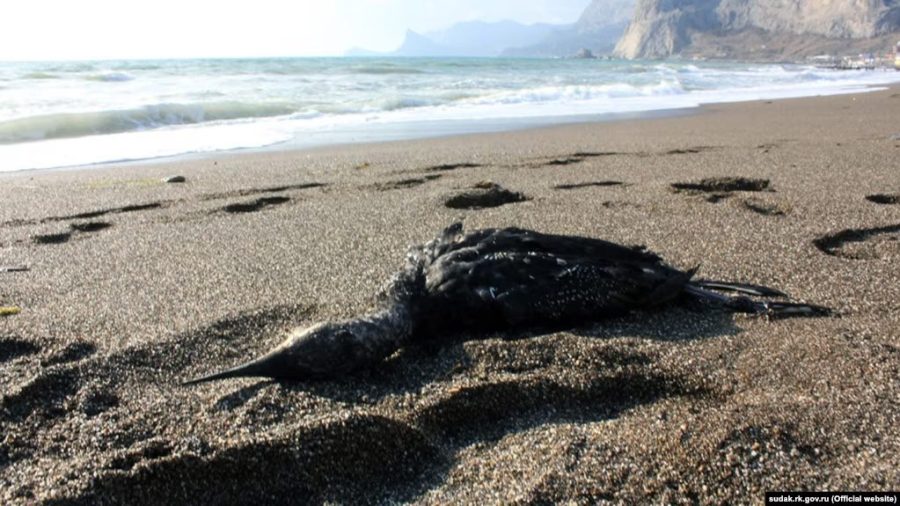
A month ago, a large amount of fuel oil entered the Black Sea as a result of the accidents involving two Volgoneft oil tankers in the Kerch Strait. No one still knows how many thousands of tonnes of petroleum products, or exactly which grade, ended up in the water. It is therefore difficult to predict how they will spread through the sea.
Will fuel oil appear off the coasts of Ukraine’s southern regions, including Odesa Bay? And what should we do to minimise the consequences of the ecocide in the Black Sea caused by the terrorist state? Unfortunately, the Ukrainian authorities have still not only failed to answer these questions, but are denying altogether the possibility that fuel oil could spread to the coast of Odesa Oblast.
Fuel oil is spreading through the Black Sea
After two oil tankers were wrecked in the Kerch Strait on 15 December 2024, Ukraine’s Ministry of Environmental Protection and Natural Resources began monitoring the situation and forecasting the directions in which the fuel oil could spread. The ministry relies on information from the Ukrainian Scientific Centre of Ecology of the Sea (UkrSCES). According to the ministry, scientists model the movement of petroleum products using NOAA’s GNOME model (General NOAA Operational Modeling Environment), which is widely used to forecast the spread of petroleum products in aquatic environments, including to analyse the impact of accidental spills on the ecological condition of marine ecosystems.
Scientists verify the modelling conclusions using Sentinel-1 satellite imagery and media reports.
The first forecast produced with this model showed that on 17 December 2024 petroleum products reached the shoreline, contaminating the coastal strip between the Taman Peninsula and the city of Anapa. The fuel oil formed a persistent film on the water surface that came into contact with coastal ecosystems. After reaching the shore, the fuel oil remained localised along the coastal strip, creating long-term contamination.
According to the modelling results through 22 December 2024, it was determined that the fuel-oil slick would remain within the coastal zone of Krasnodar Krai. This confirms that the contamination had become persistent and required urgent clean-up measures”.
This forecast turned out to be wrong, because from 20 December information began appearing in Crimean public channels about fuel-oil pollution of the Kerch coast. This development had also been predicted by Vladyslav Balinskyi, an expert with the National Ecological Centre of Ukraine and head of Green Leaf NGO. The environmental expert uses several information sources for his forecasts. The first is Sentinel-1 satellite imagery, which clearly shows only surface anomalies. To understand where fuel oil will move, one needs to know wind direction and water temperature. This information is available on windy.com. In this way, the movement of surface pollutants can be forecast. It is also important to take into account the technical characteristics of the fuel oil, including its melting point, which affects its buoyancy.
A few days after the accident, based on weather forecasts from windy.com, the environmental expert predicted that the next area to be contaminated would be the coast of Crimea’s Kerch Peninsula. A week later, this was confirmed by information from Crimean public channels.
On 18 December, the environmental expert wrote on his Facebook page: “It is very bad that the Russian occupiers have taken no action to secure the halves of the sunken Volgoneft-212. A change in wind direction during the night of 18 to 19 December may cause the hull sections to change position and lead to additional contamination of the water area. In that case, fuel-oil slicks will move with the wind vector toward the Sea of Azov and toward the eastern and southern coasts of the Kerch Peninsula”.
After that, fuel oil appeared in settlements all along Crimea’s southern coast, and by mid-January it had reached Yevpatoriia and continued farther.
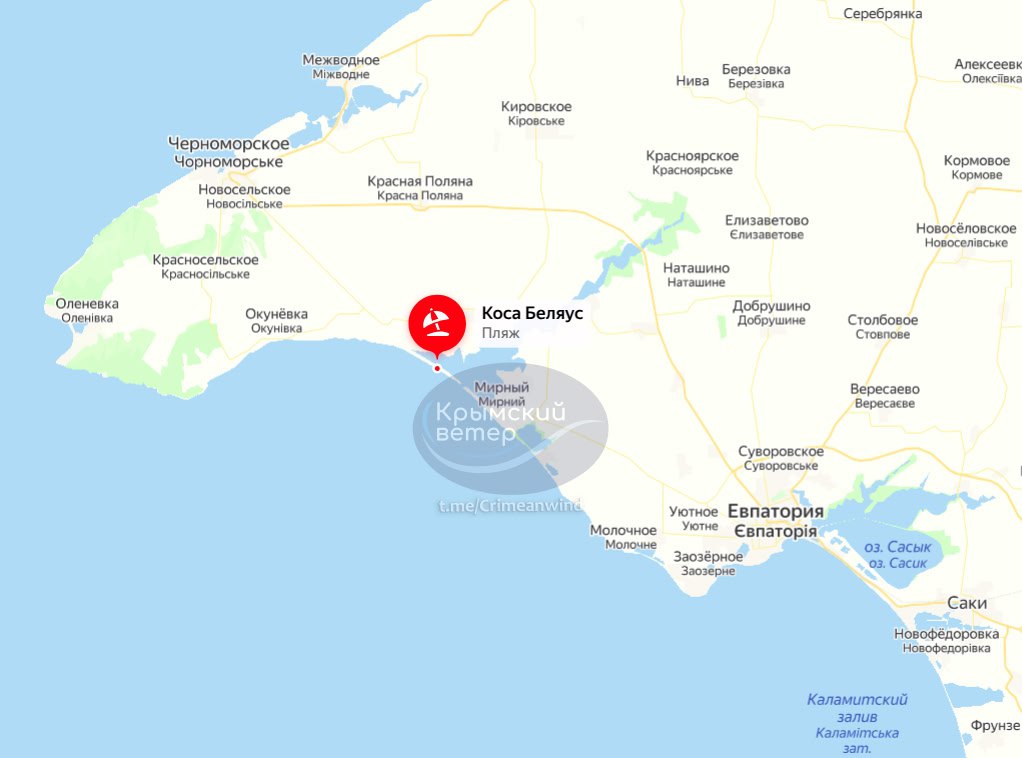
There were also reports of fuel oil appearing on the coast of the Sea of Azov.
On 11 January 2025, the occupation authorities in the temporarily occupied territory of Zaporizhzhia Oblast confirmed a fuel-oil discharge in Berdiansk and also reported a small contamination site on the Peresyp Spit.
Fuel oil may reach Odesa Bay as early as January
The Ministry of Environmental Protection and UkrSCES are confident that the coast of Odesa Oblast is not under threat of fuel-oil pollution. They say there are currently no preconditions for such contamination. This was stated in their forecast of 9 January. The next day, the forecast was already less categorical: “According to current forecasts based on the available information, the coast of Odesa Oblast is not under threat of fuel-oil pollution during the coming week”.
Balinskyi holds the opposite view: “Watching the dynamics of pollution along the Crimean coast, I understand that the fuel oil may reach us as early as January. Crimean Telegram public channels are circulating photographs of fuel-oil clumps on beaches in Yevpatoriia, which is 375 kilometres from the accident site if measured along the coast. That is already well over halfway to Odesa; less than 250 km remain!
It is telling that the satellite images show separate clumps, most often containing plant debris. This indicates that at the current water temperature the fuel-oil clumps have buoyancy close to zero and move through the water column along the vector of the main Black Sea current (counter-clockwise, directly in our direction and onward toward Romania and Bulgaria).
These days, clumps are being washed ashore particularly actively on the western part of the Crimean coast because the water temperature there is higher (the clumps rise) and there is a strong onshore wind from the sea. The very next such southerly wind may begin washing fuel oil onto the coast of Odesa Bay or somewhere closer to Romania”.
This is also discussed by Yevhen Khlobystov, dean of the Faculty of Natural Sciences at the National University of Kyiv-Mohyla Academy.
Ukrainian Navy spokesperson Dmytro Pletenchuk agrees with them and did not rule out that petroleum products released into the Black Sea after the accident involving two Russian tankers in the Kerch Strait could reach the coasts of Odesa and Mykolaiv.
“The current works in such a way that, unfortunately, it is most likely that the fuel oil may reach our Odesa and Mykolaiv coasts. There is such a possibility,” he said during the national telethon.
Why are there such discrepancies between UkrSCES modelling and the forecasts of independent observers?
On his Facebook page, Balinskyi argues: “The fundamental error is that the generally accepted model for the surface spread of fuel-oil slicks or liquid oils is completely unsuitable for fuel oil at low temperatures. Such a case should be treated as combined surface-sediment pollution by a persistent lipophilic pollutant located at the boundary between aggregate-state phases (and therefore with changing buoyancy characteristics)”.
Radar satellite imagery shows well only what remains on the surface. But most of the fuel oil sank during winter and will begin rising from depth only as the water warms. Balinskyi therefore believes that the main problem for years and decades to come will be fuel oil that solidified and sank into the water column and to the bottom. This means that fuel-oil pollution must be treated as sediments, as an atypical deposit that spreads through the water column and therefore may not be visible to satellites.
The environmental expert stresses that the SAR sensor on the Sentinel-1 satellite records the condition of the sea surface (ripples, waves and reflectivity), not pollutants on the surface. It is impossible to detect fuel oil located in the water column using SAR, and models with different input data are needed to describe and forecast its spread through the water column.
Balinskyi insists that the threat of a “fuel-oil bank” forming beyond the zone of freshwater influence of the Dnipro-Buh Estuary, or of fuel-oil sediments spreading farther in the flows of the main Black Sea current, requires urgent study and modelling.
Can pollution forecasting methods be expanded?
Yes, this is possible, and Ukraine has both the capabilities and specialists to do it. Several important comments from experts appeared under Balinskyi’s Facebook post criticising the Ministry of Environmental Protection and the modelling tools used by UkrSCES.
One came from Oleksandr Honcharov, a former department head at UkrSCES and now an environmental-pollution expert with UNDP in Ukraine, who recalled the existence of the Delft3D programme, which can be used for complex hydrological modelling of water-mass transport (the water mass itself, not only a surface film).
Oceanographer and vice-rector for research at Odesa State Environmental University Yurii Tuchkovenko provided details about Delft3D: “Among its products is one that can calculate the spread of up to 30 oil components in three states: on the surface, in the water column, and captured by the bottom with subsequent possible resuspension. Exactly what will be needed in the future. It is based on the DELFT3D-Flow hydrothermodynamic model adapted for the Black Sea”.
What exactly was the fuel oil that entered the sea?
This is important to know for forecasting, but there is still no clarity on this issue either. Russia’s transport ministry claims that the tanker accident near the Kerch Strait on 15 December 2024 was the world’s first accident involving “heavy” M100-grade fuel oil. Such fuel oil solidifies at +25°C and its density is almost the same as water or greater. Unlike other petroleum products, M100 fuel oil does not rise to the surface but sinks to the bottom or floats in the water column.
But Ukrainian observers question this.
“Although the Russians say this is M100-grade fuel oil, the melting point of this fuel-oil fraction is quite low,” Balinskyi suggests. “The water temperature is now below 10 degrees, yet the fuel oil remains liquid on the surface. In other words, it is fairly volatile fuel oil, with a melting point of either 20 degrees or even lower. That is why clumps with a jelly-like consistency form and sink into the water column. They should be treated not as surface pollution but as sediments, that is, bottom deposits. Depending on their size, the clumps may be closer to the bottom or in the water column, and they move with the current”.
Most likely, during the first hours and days after the accident, pollution was dominated by the fuel oil that had been heated in the vessel’s tanks. It was this fuel oil that reached the surface and moved across the water due to the sail effect of the powerful wind prevailing in the region.
The fuel oil then gradually cooled and partly sank to the bottom. At the same time, fuel oil continued leaking from the vessels’ tanks, creating new slicks on the water surface.
Impact of fuel-oil pollution on the Black Sea ecosystem
The fuel-oil spill will have catastrophic consequences for a large part of the marine ecosystem and for all living organisms because of the toxic effects of petroleum products. It poisons molluscs, plankton, fish and dolphins and contaminates birds.
Immediately after the disaster, volunteers in Krasnodar Krai and Crimea began not only collecting petroleum products washed ashore by waves but also cleaning birds. According to environmentalists, the number of birds contaminated with fuel oil, for which this poses a mortal danger, reaches into the thousands. Dolphins are dying because of the spill. Ivan Rusiev, head of the research department at Tuzlivski Lymany National Nature Park, believes that in reality thousands of dolphins have already died as a result of this accident.
Birds partially covered in fuel oil have already reached our coast as well. On 9 January, such birds were found in Tuzlivski Lymany National Nature Park. One bird did not survive and was sent to Odesa for examination by specialists at UkrSCES. But the scientific institution refused to accept the bird’s body. UkrSCES director Viktor Komorin explained that, to ensure staff safety and conduct analyses effectively with reliable results, it was necessary to have:
1) A veterinary doctor’s conclusion on the results of the post-mortem examination (necropsy), determination of the need for additional laboratory tests, and their specification.
2) A description of tissue samples professionally collected by a veterinary doctor for additional laboratory tests.
3) Preliminary testing of the samples for infectious safety, including particularly dangerous infections, avian influenza and so on, together with a conclusion that the samples are epidemiologically safe.
4) Proper storage and transport conditions for samples intended for analysis.
Why are birds dying?
Practically all bird species characteristic of the temperate and subtropical latitudes of Eurasia can be encountered in the Black Sea. Waterbirds and birds of prey live and nest around the water body, and a large number of migratory birds reach the Black Sea during seasonal migration.
Most birds near the coast feed on marine resources. Many are diving birds that catch fish, molluscs and invertebrates. Some representatives of the avifauna find food on the water surface or on the shore.
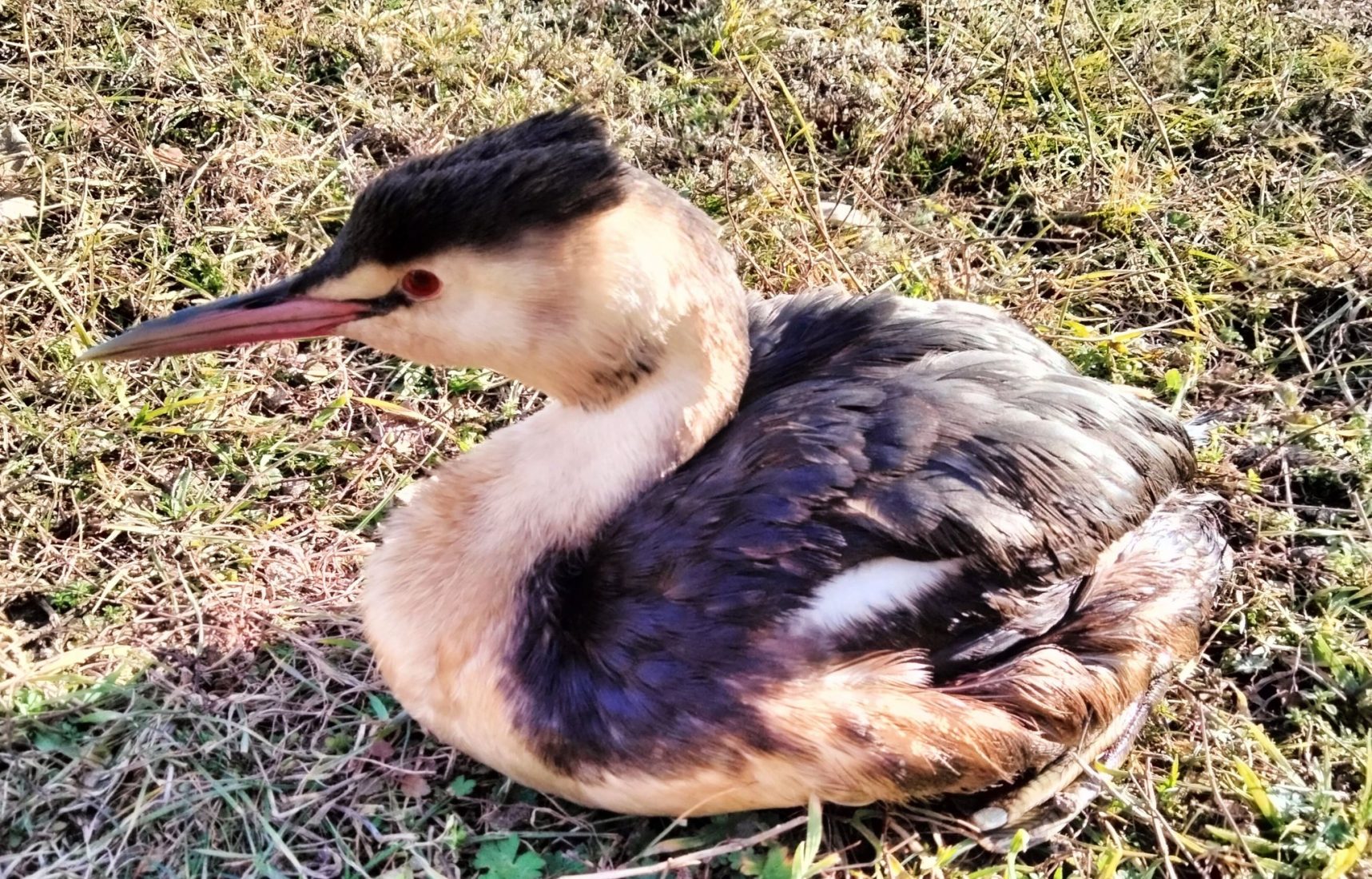
Grebes of various species (waterbirds) have suffered the most. They remain along the shoreline because they feed on fish.
As Balinskyi, a biologist by training, explains, a bird’s plumage consists of several layers that allow it to retain thermal-insulation and waterproofing properties in winter. Birds in the water have dry down beneath a layer of dense outer feathers. Those dense outer feathers also have an oily layer thanks to a special gland that secretes oil. Fuel oil sticks to the outer feathers, then penetrates deeper and accumulates in the lower layers of feathers and down. In this way it completely destroys the birds’ protective properties — both thermal insulation and waterproofing. The birds very quickly begin to drown or are forced to come ashore. They cannot feed and simply freeze. A bird’s body temperature is much higher than a human’s, above 40 degrees Celsius. To maintain that temperature birds need a lot of food, but they can no longer hunt.
Birds also suffer chemical burns to their mucous membranes. In addition, like mammals and dolphins, they feed on marine fish. Even if they were not at the site where the fuel-oil slicks spread, they may eat fish that have accumulated these toxic petroleum products.
What should Ukraine do?
Fuel oil is the petroleum product with the most severe consequences. It will affect the condition of the Black Sea for many years to come.
Fuel-oil accumulations may change their buoyancy depending on temperature. They may fragment into smaller pieces, migrate along the shoreline and rise to the surface, continuing to poison everything around them.
It is now important to prepare properly for the first fuel-oil slicks to appear off Odesa. This requires using all available methods to forecast the consequences of the accident and seeking answers to the questions: in which areas and how much fuel oil has settled on the seabed; under what conditions it will begin to rise and where it will be carried; and how the amount of damage to marine resources can be substantiated.
If this is not done now, it will be difficult to prove Ukraine’s claim before an international court for compensation, because Russian scientists will argue that the fuel oil could not have reached the Odesa coast. They will rely, among other things, on UkrSCES modelling assessments and statements by Ukraine’s Ministry of Environmental Protection.
Meanwhile, according to Ukraine’s Minister of Environmental Protection and Natural Resources Svitlana Hrynchuk, Ukraine has already appealed to the relevant secretariats of UN conventions, UNEP, UNESCO, the European Union and the International Maritime Organization (IMO). Feedback was received from the Secretariat of the Commission on the Protection of the Black Sea Against Pollution concerning the need to hold an extraordinary meeting to consider this case. The case will also be considered on 27 January this year at a meeting of the IMO Sub-Committee on Pollution Prevention and Response.
Tetiana Herasymova