
At the end of November 2023, the Odesa Regional Military Administration adopted the Regional Comprehensive Environmental Protection Program for Odesa Region for 2024–2028. Almost UAH 4 billion is planned to be spent on environmental protection in Odesa Region in total, with UAH 1.7 billion to be spent during this year alone. Environmental protection specialists carried out a detailed analysis of the document and concluded that, in its current form, the program would not only fail to provide benefits but could also harm the environment. Why?
The specialists set out their views in this short video.
Environmental Protection Program for Odesa Region
The program lobbies the interests of a narrow circle of people connected with the regional authorities
This is the view of Iryna Vykhrystiuk, acting director of Tuzly Estuaries National Nature Park. She describes the nearly UAH 4 billion program as a purely lobbying document tailored to specific deputies and representatives of the Odesa Regional State Administration.
The program includes many measures that will not merely fail to produce an environmental benefit but are actually harmful to the environment. The planned expenditure amounts are unbalanced and inflated.
Vykhrystiuk noted that the procedure for adopting the program was violated and that, more generally, it does not meet today’s requirements. The measures envisaged by the program do not fit the context of wartime conditions in Ukraine. The need to prevent and eliminate the consequences of industrial pollution and environmental pollution caused by the armed aggression of the Russian Federation is mentioned in only one line. There are no projects at all for restoring damaged natural ecosystems. On the contrary, many of the planned measures would deepen the crisis even further.
A return to industrial poaching
Vykhrystiuk gave an example concerning Tuzly Estuaries National Nature Park. The program provides for scientific justification, preparation of a detailed design, construction and commissioning of connecting hydraulic structures between the Black Sea and the Tuzly estuaries. She considers these measures absolutely unacceptable for the Tuzly estuary ecosystems and contrary to the very essence of protecting and preserving these ecosystems in their natural state. “Construction of such hydraulic structures will turn these natural ecosystems into a kind of fish collective farm,” the park head says. “The regional administration has long dreamed of creating a municipal enterprise that would then manage these facilities and carry out commercial fishing.”
Yet UAH 4 million from the regional budget is planned to be spent in 2024 just on the scientific justification and design of a structure harmful to the environment!
Let us recall that such a hydraulic structure already existed in the National Park — an artificial and unlawful fish-catching and passage channel between the Black Sea and the estuary. It was installed by the Granit-2 cooperative. Through this channel, Granit-2’s successor, the Institute of Marine Aquaculture LLC, carried out barbaric and illegal fishing. In 2021, thanks to court decisions and joint actions by the park administration and the National Police of Ukraine, this illegal scheme was broken up.

Environmental Protection Program for Odesa Region
The environmentalist is concerned that a similar “mullet trap” may now be built under the patronage of the regional authorities.
A corruption feeding trough instead of removing the Sasyk dam
Iryna Vykhrystiuk also mentioned studies of Lake Sasyk contained in the strategic environmental assessment report. “The Sasyk problem has been studied for more than 25 years,” Vykhrystiuk says. “Many decisions have been adopted. And once again representatives of the regional Department of Ecology return to the idea that more research is needed and more money must be spent on it. I want to say: stop stealing, stop lying. Sasyk — its natural processes, life and functioning — must be restored by creating a channel.”
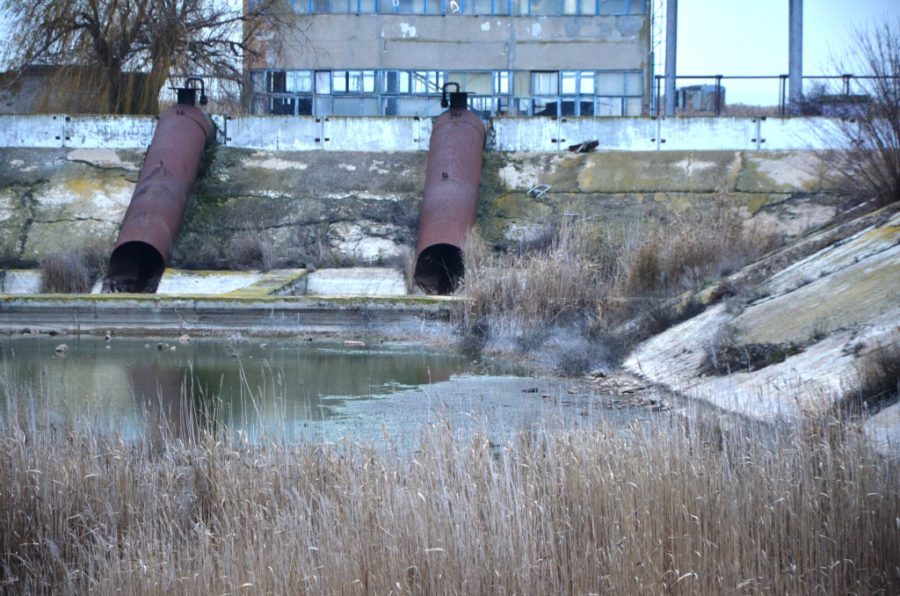
More than 40 years ago, we should add, an experiment was carried out here that turned into a disaster: the Sasyk estuary was separated from the sea by a dam. The main goal at the time was to desalinate Sasyk with Danube water in order to develop agriculture.
Environmental Protection Program for Odesa Region
However, the project failed spectacularly: when fresh water was introduced, it turned out that so much salt had accumulated in the estuary mud that desalination would take decades. Irrigation with water from Sasyk continued for several years. During that time, about 30,000 hectares of chernozem soil were destroyed. After the fields became salinized, irrigation was stopped. At the same time, the dam that cut the Sasyk estuary off from the sea and turned it into a lake has still not been removed.
As a result, not only the Sasyk estuary ecosystem suffered; all coastal settlements were affected. Today this is an area of ecological disaster. The problem, which arose back in the Soviet period, remains unresolved. Restoring water exchange between Sasyk and the Black Sea would help restore the ecosystem and improve conditions in all coastal settlements.
The program is aimed at laundering money from the regional budget during the war
Doctor of Biological Sciences and deputy director of Tuzly Estuaries National Nature Park Ivan Rusev analyzed other areas of the program — improving the condition of the Kuialnyk Estuary and the Kuialnyk River, as well as other rivers in Odesa Region.
The environmentalist recalled that on January 1, 2022, a presidential decree created Kuialnyk National Nature Park and granted it the special status of a state resort. Yet the park administration has still not been established, so resources on its territory are being plundered on a massive scale. For example, more than a thousand oak trees and trees of other species were recently destroyed; an investigation is now under way.
However, the program plans to develop a land-management project and allocates more than a quarter of a million hryvnias for it. Who exactly will develop it? Who will receive this money? The presidential decree states that the park administration, once established, is tasked with commissioning such a land-management project and preparing a project for organization of the territory.
The program also provides for development of environmentally safe technologies and measures for salt extraction. The implementing organization is an entity called the “Dzhankoi-Syvash Research and Experimental Plant of the Institute of Chemistry.” This organization is registered in occupied territory. To whom will the substantial sum of UAH 36 million be transferred?

Environmental Protection Program for Odesa Region
One area of the program is scientific research into supplying the Kuialnyk Estuary with fresh water from the Khadzhibei Estuary. A water body with the unique status of a state resort and national nature park cannot be filled with polluted water from Khadzhibei. No modern technology can bring that water to the quality required by the Kuialnyk Estuary. Yet first UAH 400,000 is allocated for this, followed by another UAH 3 million to develop a detailed water-supply design using such water. Who needs this, and why is it being done?
An enormous sum — UAH 857 million — is planned for development of a project to clear the channel of the Velykyi Kuialnyk River in Odesa Region (the first through third construction phases of the project). But why do this if there is no targeted state program to renaturalize the Kuialnyk River itself — its channel, floodplain and living ecosystem? “The money will simply be laundered and nothing will be done,” Rusev believes.
Let us recall that more than 10 years ago the regional authorities had already adopted the program “Conservation and Restoration of Water Resources in the Kuialnyk Estuary Basin for 2012–2016.” Its purpose was the ecological rehabilitation of the Velykyi Kuialnyk River and restoration of the sustainable functioning of the Kuialnyk Estuary basin’s aquatic ecosystem. Among other measures, it provided for clearing the channel of the Velykyi Kuialnyk River. UAH 82,431.17 thousand was planned for implementation, including UAH 61,318 thousand from the state budget and UAH 20,633.17 thousand from the regional budget. Responsibility for implementation was assigned to the Department of Ecology and Natural Resources of the Odesa Regional State Administration. The money was spent, but the program was not implemented, and in June 2021 the Odesa Regional Prosecutor’s Office opened a pre-trial investigation into alleged abuse of office by certain executive-branch officials responsible for implementing the regional program.
Ivan Rusev called on the Odesa Regional Military Administration to withdraw the program: “I state, as a citizen of Ukraine, as a specialist, as a scientist and as a Doctor of Biological Sciences, that this program is absurd. Together with my colleagues, we maintain that it was created to launder money, and we call on the head of the administration to withdraw it.”
The program does not take into account the current state of the environment in Odesa Region
Olena Popova, associate professor at the Department of Botany, Plant Physiology and Landscape Gardening of Odesa National University and senior researcher at Tuzly Estuaries National Nature Park, noted that the program fails to take into account one of the most important areas that must be developed as part of European Union integration: increasing the area of protected natural territories.
In the scientist’s view, the program also allocates exorbitant sums to some measures, while other measures are not needed at all, meaning that spending money on them is a pointless waste of taxpayers’ funds. The program does not take into account other strategic documents, including those previously adopted by the Odesa Regional Council. It is an extremely poor-quality financial document containing a huge number of errors, inaccuracies and repetitions. “We cannot agree with this regional comprehensive program because it effectively contradicts environmental protection in Odesa Region,” Olena Popova believes.