
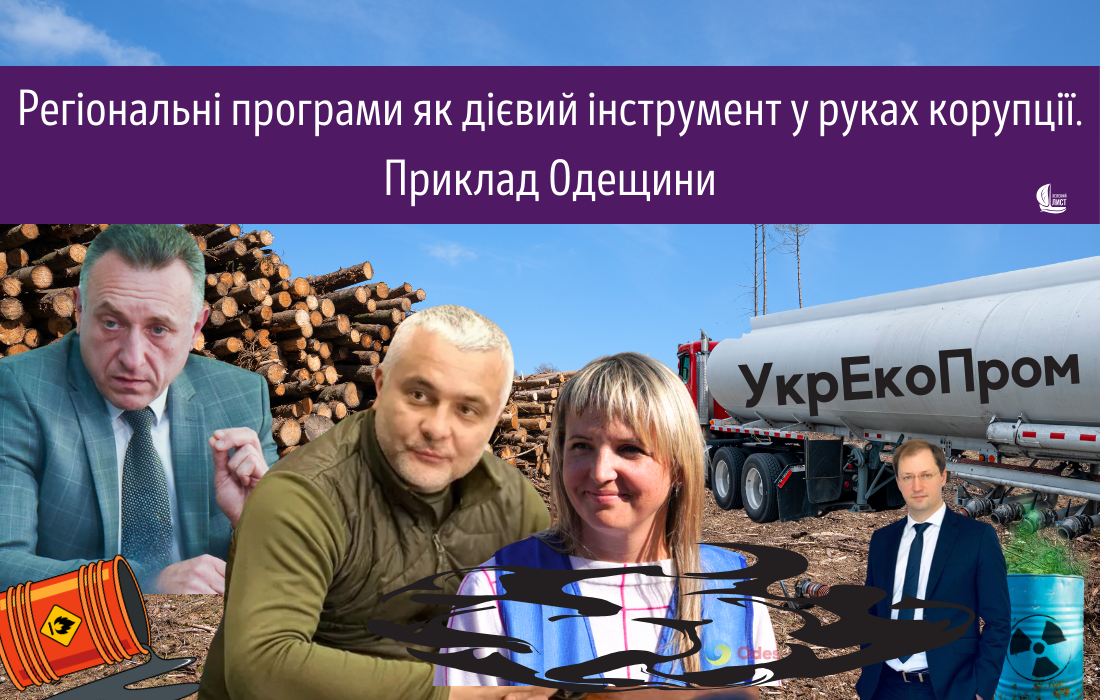
Local target programs are an integral part of the budget process for local self-government bodies. They are a tool for defining specific tasks and measures for effective financial management across all areas of community life. But Odesa Oblast shows how an important regional program can become an uncontrolled instrument for enriching local “elites.” This concerns the Regional Comprehensive Environmental Protection Program of Odesa Oblast for 2024–2028.
The possible environmental consequences of implementing this program are not limited to inefficient use of funds. The risks arising from unprofessional or corruption-prone actions in such a situation may be irreversible and lead to a significant deterioration in environmental indicators.
Regional target programs without methodological guidance from the state
There is no single answer in the current regulatory framework regarding the structure of documents and the implementation of Regional Target Programs (hereinafter RTPs). It should be noted that the only Methodological Recommendations on the procedure for developing RTPs, monitoring and reporting on their implementation were repealed in 2019. Since then, regulation of RTPs has fallen entirely on local authorities. For example, the Lviv Regional Military Administration approved its own Procedure for developing regional (budget) target programs, monitoring and reporting on their implementation during martial law. Similar decisions are being adopted in other regions. In the Odesa Regional State Administration, this procedure was developed back in 2017 and, as you can imagine, is unlikely to reflect the realities of wartime.
A corruption case from Odesa Oblast
The Regional Comprehensive Environmental Protection Program of Odesa Oblast for 2024–2028 has already been approved by Oleh Kiper Regional Comprehensive Environmental Protection Program of Odesa Oblast for 2024–2028. The Department of Ecology and Natural Resources of the Odesa Regional State Administration is the executor, developer and participant of the Program.
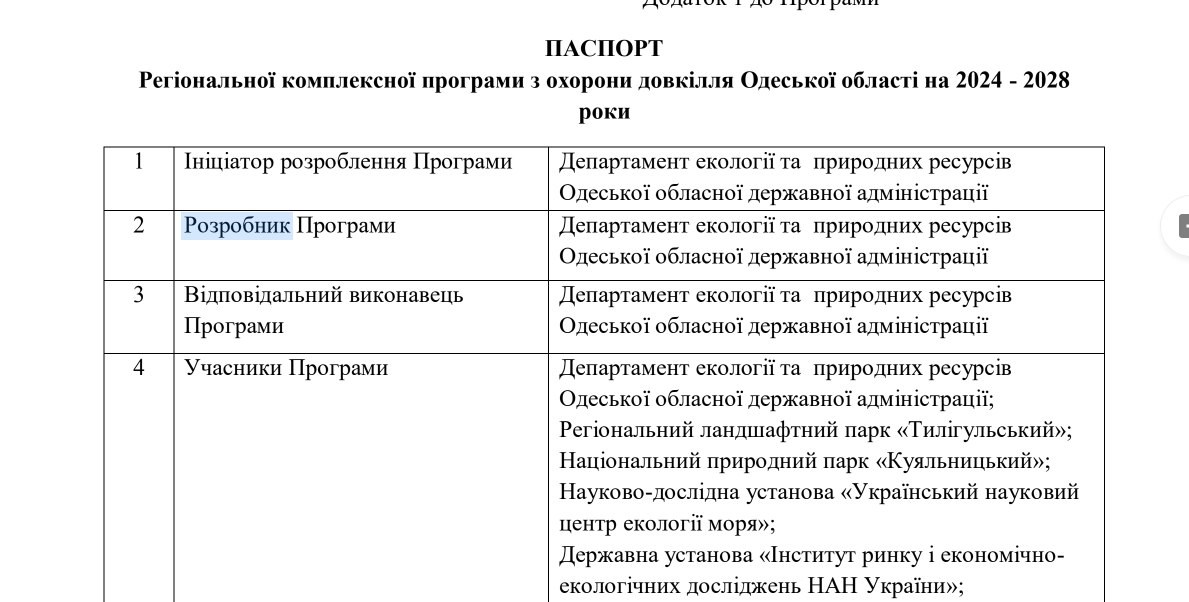
As part of developing the Regional Comprehensive Environmental Protection Program of Odesa Oblast for 2024–2028, pursuant to Article 8 of the Law of Ukraine “On Strategic Environmental Assessment,” on November 20, 2023 a notice was published on the official website of the customer — the Department of Ecology and Natural Resources of the Odesa Regional State Administration — regarding the scope of the SEA. One of the mandatory stages of SEA is public discussion and consultations in the manner provided by Articles 12 and 13 of the Law of Ukraine “On Strategic Environmental Assessment.” But whether such a discussion actually took place is unknown to us. In the notice on the scope of the SEA, the public was invited to submit comments and proposals to the Department of Ecology and Natural Resources of the Odesa Regional State Administration at: 65032, Odesa, 83 Kanatna Street, or to the email address:
ecolog@od.gov.ua. The deadline for comments and proposals was from November 20 through November 29, 2023 inclusive. However, on the official page of the Odesa Regional Military Administration where reports on public consultations are published, we did not find a report on the SEA scope for the development of this regional program.
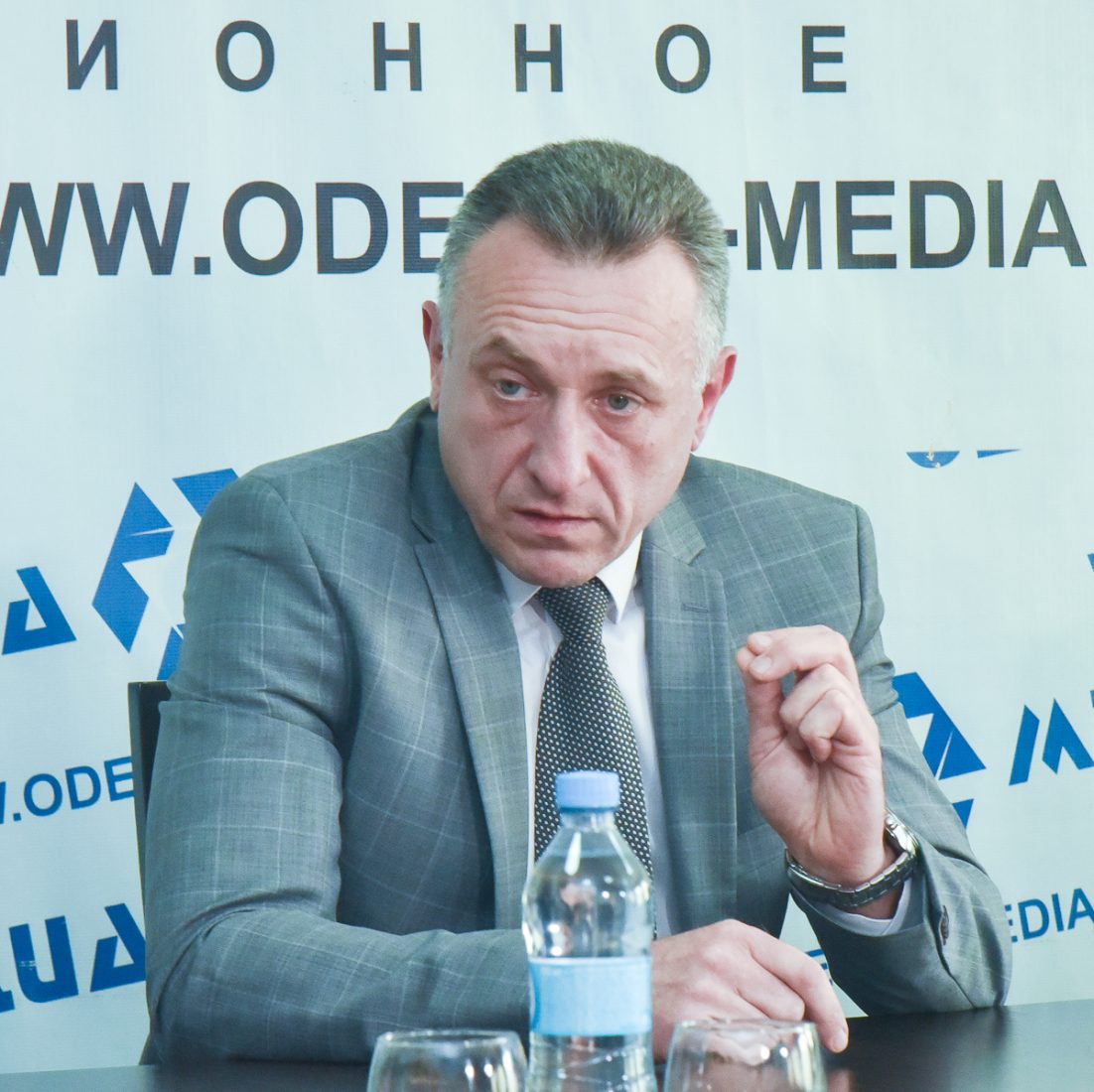
Overall, this program is the “brainchild” of Pavlo Bulanovych, known online as Pasha-500. Before joining the ecology department of the Odesa Regional State Administration, Pavlo headed the environmental inspectorate of Odesa Oblast, and earlier still he had been lustrated from the State Inspectorate for Safety in Maritime and River Transport. Bulanovych, an experienced scheme operator and corrupt official, assembled the environmental RTP piece by piece, but his greed eventually caught up with him. Together with the regional forestry leadership, he organized a scheme to cut down oak trees in the newly created Kuyalnytskyi National Nature Park and was dismissed from the ecology department even before the program was approved.
The “quality” of the program text itself also deserves separate mention. Although professionalism is one of the principles of public service and includes the continuous improvement of a civil servant’s professional competence, the document is very poorly drafted and contains dozens of mathematical errors — duplicated rows, reordered items and so on — that made their way into the program budget. The implementation stages are: Stage I — 2024–2026; Stage II — 2027–2028. The total amount of financial resources is UAH 3,942,528,382. Almost UAH 4 billion!!! In 2024 alone, planned expenditures amount to about UAH 1.7 billion. But perhaps the environment really needs this money? Let us look at the substantive part — there is indeed a great deal of interest here.
Anti-environmental schemes disguised as environmental measures
Reconstruction of the Tyligul Canal
Once again, money is being requested — namely UAH 37 million for reconstructing the canal between the Tyligul Estuary and the Black Sea (item 4.2.17). Implementation of this project has already cost taxpayers UAH 140 million and ended in a criminal case.
Everything is clear here. Construction of a canal for catching migrating fish — industrial-scale poaching — with taxpayers’ money was lobbied by Oleh Kutateladze, a current member of the Odesa Regional Council from the Servant of the People political party. This was probably not difficult for Oleh Dzhumberovych, because he is a member of the Odesa Regional Council’s standing commission on ecology, natural-resource use, land relations, administrative-territorial structure, prevention and response to emergencies and defense matters, as well as simply an influential businessman and co-owner of TIS Container Terminal, TIS Coal, TIS Ore and a number of other companies.
Hydraulic structures “Tuzly Estuaries — Black Sea”
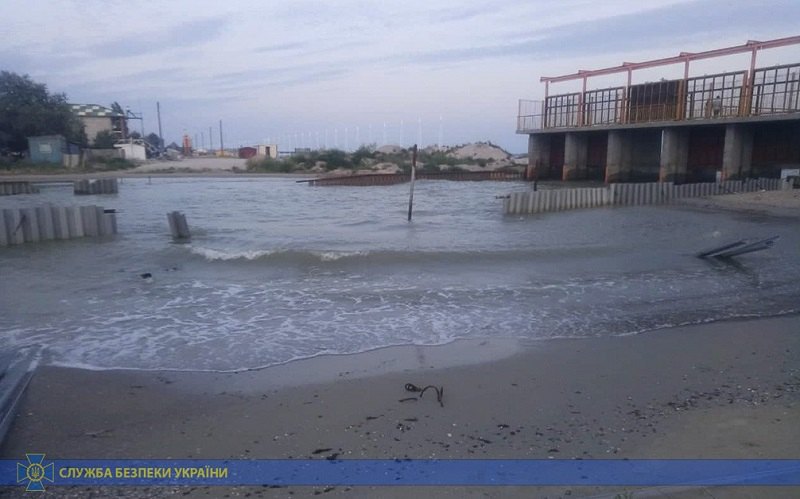
Items 4.2.18/19/20: UAH 3.5 million from the state and regional budgets for scientific substantiation, preparation of a working design and “Construction and commissioning of connecting hydraulic structures ‘Tuzly Estuaries — Black Sea.’ Do the program developers really not know that these so-called hydraulic structures, which were unlawfully built within Tuzly Estuaries National Nature Park, are used for industrial-scale poaching?
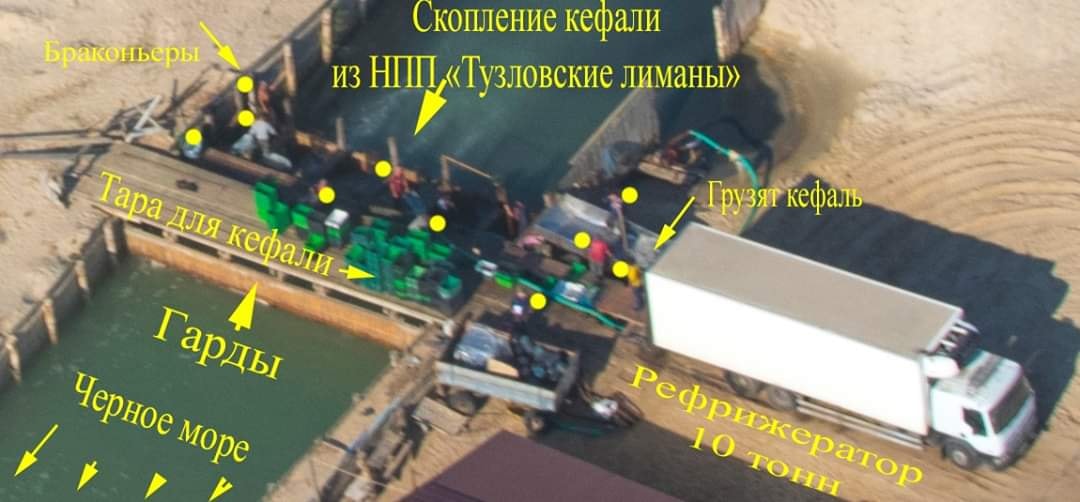
Perhaps this is precisely why, contrary to the law, the project was never agreed with the National Park administration? This project for industrial poachers connected to those in power is being lobbied by another Odesa Regional Council deputy from the Opposition Platform — For Life, Tryfon Antov. Incidentally, he is also a member of the Odesa Regional Council’s “environmental” commission and appears on the Myrotvorets website. Green Leaf has written repeatedly about his activities. Perhaps it is time for the Security Service of Ukraine and the military prosecutor’s office to get involved?
Reconstruction of the Khadzhibey Canal to Sewage Pumping Station No. 25 in Odesa
Item 3.2.3: reconstruction of the discharge canal from the Khadzhibey Estuary to sewage pumping station No. 25 in Odesa, on the irrigation fields, for UAH 238 million. Clearly intended for expansion of the “Dry Port”, owned by the private company Euroterminal LLC, as part of a linkage with the notorious corruption project “Deep-Water Outfall.”
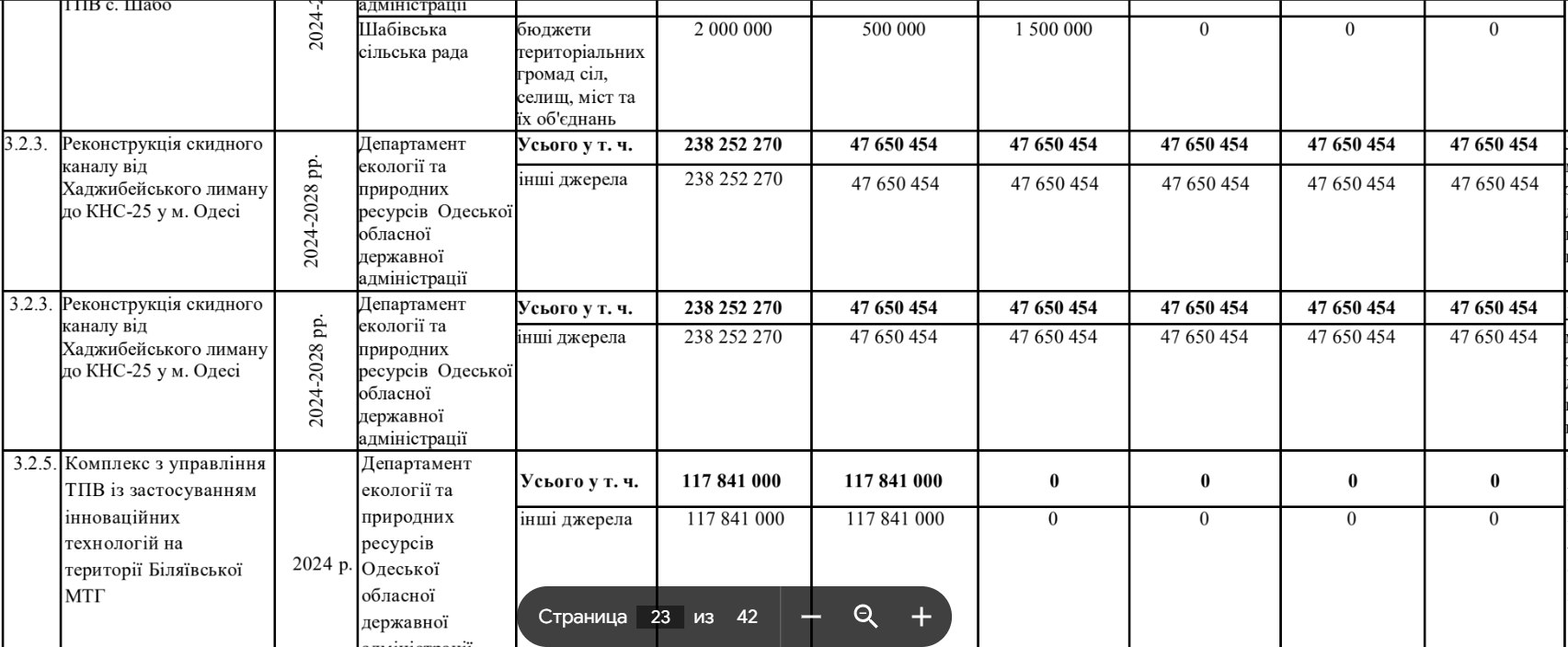
Notably, item 3.2.3 is duplicated (238 × 2 = UAH 476 million). Naturally, the duplicated amount has already been signed and approved by order of Oleh Kiper — why bother with small sums!
Clearing the channel of the Velykyi Kuyalnyk River
Items 4.2.8–4.2.9: design development and execution of works “Clearing the channel of the Velykyi Kuyalnyk River in Odesa Oblast” at a cost of UAH 858 million. How do you like that wording? This is not about restoring meanders or revitalization. Put plainly, it means channelizing the Velykyi Kuyalnyk for almost UAH 1 billion, which would lead to the river’s final destruction!
Repair of the Khadzhibey Estuary dam
Item 4.1.6: UAH 30 million for yet another repair of the Khadzhibey Estuary dam. Once again, the company “Rostdorstroy” — such a favorite of officials!
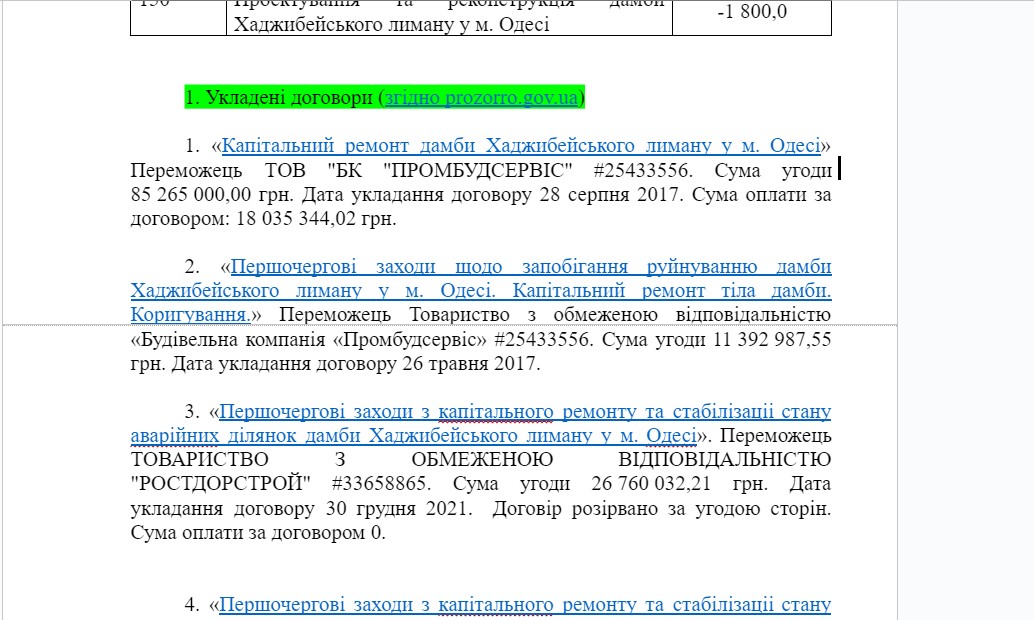
How much longer can this dam be repaired? All previous amounts since 2006 are listed here. And that is only from the regional budget; local funds were spent as well!
Maintenance of the mobile laboratory
Item 2.1.5: “maintenance of a mobile laboratory (conformity assessment, verification and calibration of measuring instruments, metrological support and technical training of personnel)” — this is simply UAH 3.32 million being written off.
Thermometers and fluorescent lamps for friends of the Odesa Regional State Administration ecology department
Items 3.1.1–3.1.2 for almost UAH 684 thousand. Ensuring environmentally safe transport, treatment/disposal of waste and hazardous chemicals (metallic mercury and its waste, and mercury thermometers). Interestingly, this item concerns only thermometers and fluorescent lamps to be collected at the Department of Ecology and Natural Resources of the Odesa Regional State Administration, the research institution Ukrainian Scientific Centre of Ecology of the Sea and the Institute of Market and Economic-Ecological Research of the National Academy of Sciences of Ukraine. One wonders how many mercury-containing thermometers and lamps there are in an average regional ecology department during wartime. And of course, the issue is not even these hundreds of thousands. It is simply that when a “research institution” or the “National Academy of Sciences of Ukraine” suddenly appears in the list of Program executors, everything looks much more respectable.
Clearing the lower channel of the Baraboi River
Item 4.2.15. Almost UAH 4.2 million. “Clearing the lower part of the Baraboi River channel, 8.8 km long, in order to improve the environmental and water-management situation, with reconstruction of existing hydraulic structures. Reconstruction.” Now that certainly sounds impressive. You can immediately tell that the “specialists” have been working. But anyone who knows this area even a little will immediately suspect something is wrong.
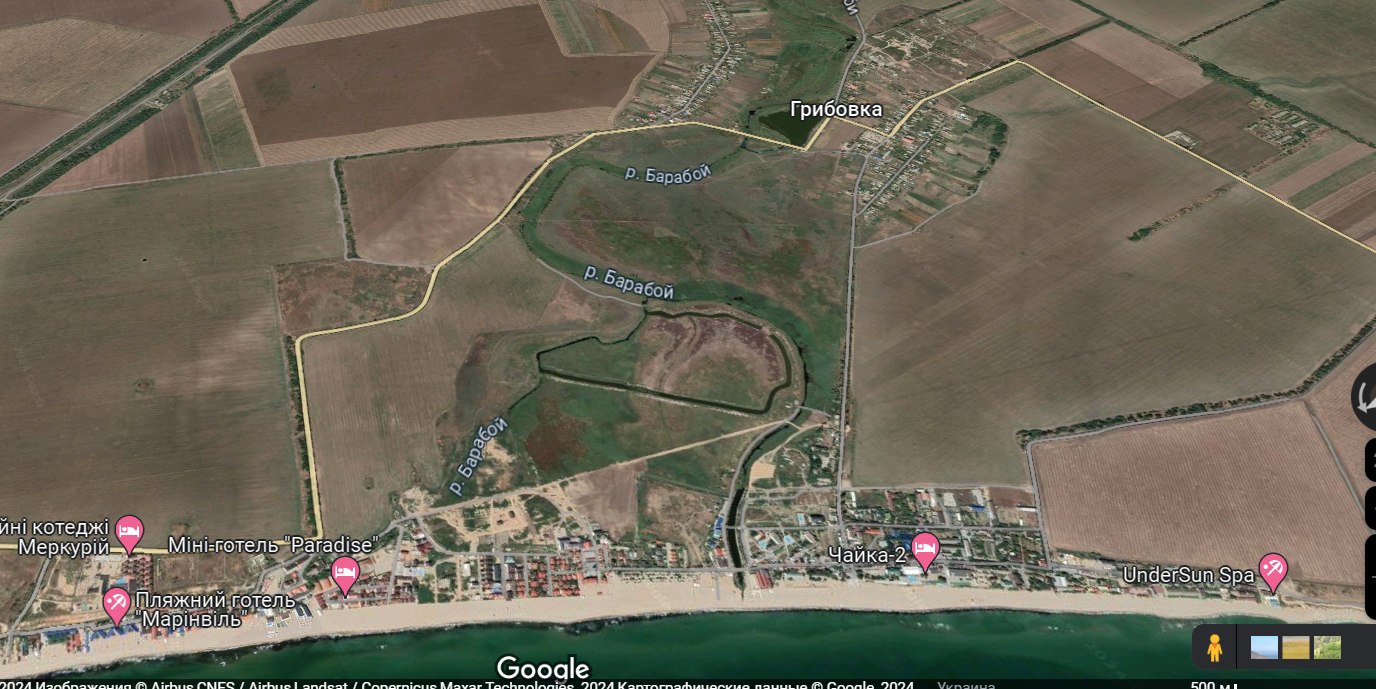
The Baraboi River runs through the densely built Odesa agglomeration and is channelized along virtually its entire length, except for its natural mouth. It is not entirely clear what exactly can be “cleared” and “improved” in that case. The answer becomes obvious once you know the ultimate beneficiaries of this scheme. And one should not be naive enough to think that NVO PIVDENDIPROVODHOSP LLC (EDRPOU 43611362) merely wants to absorb UAH 4.2 million during the war. The stakes are much higher. The Baraboi flows into the sea at the upscale resort village of Hrybivka, and the owner of this enterprise has hotel complexes nearby. Naturally, he would like to “clear” and “improve” the floodplain channel a little and at the same time expand the area available for development by draining land that is subject to flooding. Unfortunately, we have many such “environmentalists.”
Oleksandr Vasylovych Panasiuk is an interesting figure in his own right.
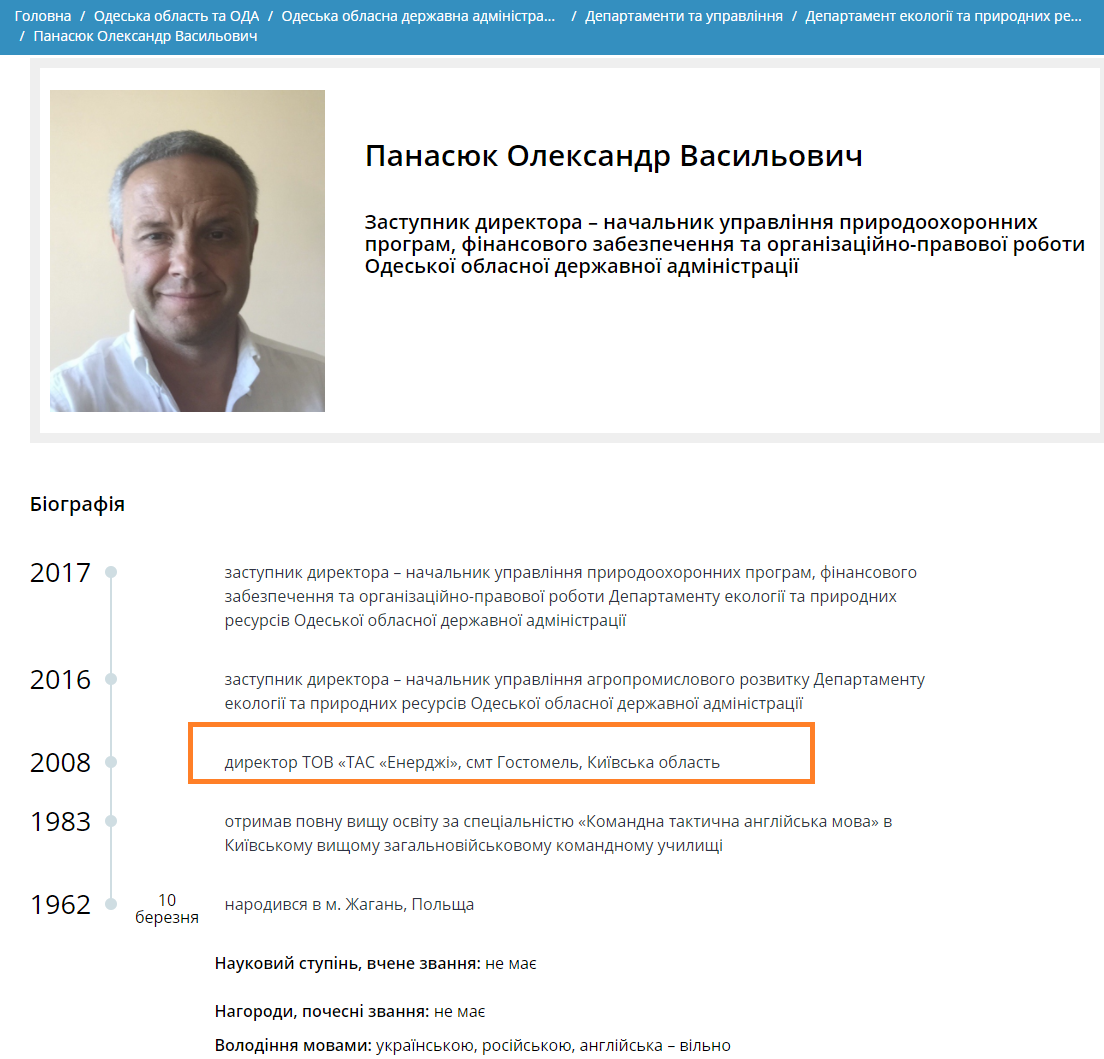
As a major businessman (he owns twenty-four companies and manages ten), he worked until 2017 as deputy director of the ecology department of the Odesa Regional State Administration and, quite predictably, became “confused” in his asset declaration, which is what ultimately brought him down.
Conclusions
There are, of course, genuinely necessary measures for Odesa Oblast in the program. However, given the complete absence of an environmental strategy — as we wrote in the previous article — the poor drafting and dozens of mathematical errors in the budget, funding will be allocated only with the involvement of influential lobbyists, that is, to schemes, some of which we have described in this article.
Overall, the environmental program of the Odesa Regional Military Administration was adopted against a backdrop of complete opacity on the part of the regional authorities and an intense struggle by so-called local elites for natural resources — this is what real ecocide looks like. Unfortunately, it can be stated that in Ukraine most environmental target programs today are initiated by these very “elites” in order to siphon off taxpayers’ money and/or provide cover for private projects — development, construction, infrastructure and raw-material projects. Of course, genuinely useful projects can occasionally be found, but they usually remain unfunded; the rest is merely an imitation of vigorous activity.