
After the start of Russia’s full-scale invasion of Ukraine, members of the Green Leaf NGO team began focusing on what Odesa and Odesa Oblast needed most: security and strengthening the region’s defense capability. This included assistance to the Armed Forces of Ukraine and Odesa’s Territorial Defense brigade, strengthening social protection for residents and internally displaced people from “hot spots,” coordinating volunteer centers, documenting Russia’s environmental crimes, monitoring city-budget spending on security needs, conducting anti-corruption investigations into the actions of Odesa city authorities, and promoting derussification and decolonization in the Odesa region.
The organization continued work on ongoing projects and implemented new ones.
1. The “Kuyalnyk — A Place for Life” project, supported by the Netherlands Helsinki Committee.
Project implementation period: 10.11.2021 – 10.05.2022, extended because of hostilities until 01.08.2022.
After February 24, 2022, the issue of building a road in the Kuyalnyk floodplain was removed from the agenda because of the war, so the related advocacy campaign under the project was no longer relevant. The estuary itself and settlements of the Krasnosilska territorial community came under shelling from the first days of the war. Project activities therefore split into two periods — before February 24, 2022 and after it.
On the eve of the invasion, February 23, 2022, we held a briefing at which we presented the findings of a sociological survey of residents of Korsuntsi village regarding the road that the Odesa Oblast Road Service planned to build near Kuyalnyk. The presentation of the study was published on the website.
Our year-and-a-half campaign pressing the President of Ukraine ended successfully, and on January 1, 2022 the Presidential Decree “On the Establishment of Kuyalnytskyi National Nature Park” was finally signed.
We had to revise the subject of a seminar planned for March 2022 with residents of the Krasnosilska territorial community on holding public hearings about construction of a road in the Kuyalnyk Estuary floodplain. Because of the war, the seminar was postponed until August 2022 and the topic was changed to the more relevant “Environmental Protection under Martial Law.” Participants and listeners discussed the impact of Russia’s armed aggression on the environment in Ukraine and Odesa Oblast. The seminar was held online using the free technical capabilities of Facebook and Google Teams.
As part of the project, the film “Kuyalnyk Is More Than an Estuary” was produced
The film tells the story of this unique place in our region — a place that needs protection to survive, because the condition of the water body and surrounding area is currently extremely poor. The film was supposed to be presented before Russia’s full-scale invasion, but this was delayed for objective reasons. The premiere took place in early February 2023.
In November 2023, this project received the Civil Society Campaigning Award as one of the best projects implemented with support from the Netherlands Helsinki Committee.
2. The project “Improving Institutional Support and Legal Protection of Ukraine’s Protected Areas Using Tuzly Estuaries National Nature Park as a Case Study.” Supported by the Matra Programme of the Kingdom of the Netherlands in Ukraine.
Project implementation period: 01.07.2021 – 01.07.2023.
The project aimed to break the vicious anti-environmental corruption cycle in the use of natural resources, involving representatives of government at various levels, natural-resource users, poachers, local residents and others, and to change their consumer-oriented attitude toward natural areas and resources. Under the project, lawyers from Green Leaf defended the rights of Tuzly Estuaries National Nature Park in 14 court cases.
One of the strategic lawsuits concerned expansion of the boundaries of the village of Prymorske at the expense of lands of Tuzly Estuaries National Nature Park. In September 2022, the Fifth Administrative Court of Appeal began considering appeals filed by the Odesa Regional Prosecutor’s Office and Tuzly Estuaries National Nature Park against the decision of the Odesa District Administrative Court, which had refused to satisfy their claims concerning expansion of the boundaries of Prymorske.
Since the Russian army invaded Ukraine on February 24, 2022, Tuzly Estuaries National Nature Park has been subjected to regular shelling by the occupiers. The park’s wildlife and vegetation suffer from Russia’s war crimes. We therefore changed the focus of publications about events in the park. Publications are now devoted to the challenges of the park and its staff surviving under constant threat of Russian bombardment, and to the effects of hostilities on wildlife, vegetation and the environment.

Many publications have addressed the ecocide carried out by the Russian army in Ukraine, including the mass deaths of dolphins in the Black Sea.

We also changed the focus of the monthly reviews on the Green Leaf website. Instead of digests about environmental protection in the region, we publish reviews of crimes committed by Russian forces against nature in Odesa Oblast.
3. The project “Engaging Green Leaf Website Readers in Preserving Ecological Balance.” Supported by the International Renaissance Foundation.
Project implementation period: 20.10.2021 – 20.10.2022
After the Russian Federation’s armed invasion of Ukraine on February 24, 2022, the project team quickly adapted its work, updated and expanded publication topics in line with martial-law conditions and the need to strengthen security in the Odesa region. We broadened both subjects and geography, adding nuclear safety, the Russian army’s use of prohibited weapons and civilian protection, and analysis of the consequences of war crimes against Ukraine’s environment.
Many articles, news items and reports focused on Russia’s war crimes in Ukraine, particularly in Odesa and Odesa Oblast. Journalists wrote about the consequences of shelling and bombing of Odesa, the ecocide affecting dolphins in the Black Sea, Russia’s nuclear terrorism and the use of prohibited weapons. With the help of specialists, we advised readers of the website and the Facebook page “Green Leaf, NGO” on how to protect themselves from the consequences of prohibited weapons.
Whenever possible, Green Leaf members traveled to sites of major bombardments to document the consequences of crimes, assist investigative actions and publish reports and photo reports.
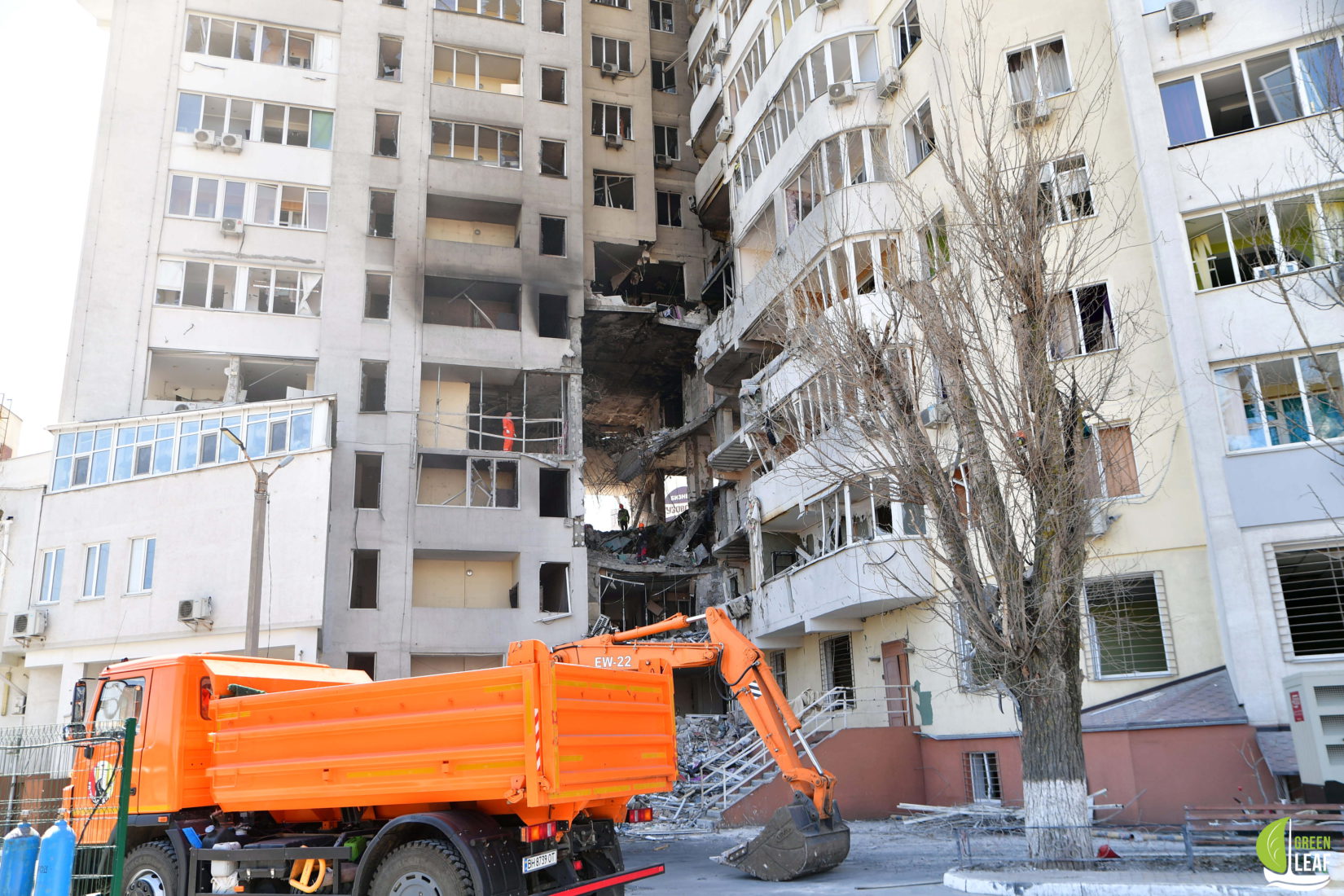
After February 24, 2022, we also wrote on topics we considered important. First and foremost were publications under the “War Chronicles” section. Odesa became a city where many people from occupied areas or active combat zones found refuge — about 35,000 internally displaced persons, hereinafter IDPs, in Odesa and about 75,000 in Odesa Oblast. IDPs are important witnesses to Russian crimes, so Green Leaf journalists spoke with them, recorded their stories while preserving anonymity, and published them on the website.

From the standpoint of the Odesa region’s security, we consider the decolonization and derussification of Odesa an important topic: amending the Charter of the City of Odesa, which contains narratives of the “Russian world,” and removing monuments that serve as markers of the Russian Empire. Thanks to an analysis of the Charter of the City of Odesa, conducted by Green Leaf journalists, and appeals to representatives of city and state authorities demanding changes to this important city document, Odesa City Council resumed the work of the working group on amending the Charter, which had been created in 2015 but had not worked a single day before then.

Green Leaf members were the first in Odesa to write about the need to dismantle the monument to Catherine II in the city center.

Part of our anti-corruption investigations focused on efficient use of public resources to strengthen the security of the city and region.
Since March 2022, the project team has been actively involved in strengthening the region’s security and defense capability: helping the Armed Forces and Odesa’s Territorial Defense brigade and strengthening social protection for regional residents and IDPs. All of this also became the subject of publications. We established cooperation with Hospitable Home, the largest humanitarian center in southern Ukraine. At Green Leaf’s initiative, a mobile office of the Odesa Regional Center for Free Secondary Legal Aid was opened for displaced people.
4. The project “From Identifying Problems to Solving Them.” Supported by the European Endowment for Democracy
Project implementation period — 25.02.2022 – 31.08.2022
With the start of Russia’s war against Ukraine, Odesa and Odesa Oblast found themselves in territory that, according to the German newspaper Bild, Russia intended to seize in the first stage of the invasion. Capturing southern Ukraine was needed to secure water supplies to Crimea and to cut Ukraine off from the sea and therefore from deliveries of goods and cargo. Russia planned to use landing ships transferred from the Baltic Sea to the region in spring to transport tanks and troops from Crimea to the outskirts of Odesa.

Russian plans also envisaged an amphibious operation east of Odesa, between Fontanka and Kobleve. Russian troops planned to advance northeast of the city, then turn left and move toward Transnistria. Had these intentions been realized, Odesa would have been surrounded by Russian forces. Combined with the seizure of territories in Kherson and Zaporizhzhia regions, the plan could have placed all of southern Ukraine under Russian control and created a corridor from Russia to NATO’s border with Romania.
Odesa has also been a special focus of Russian propaganda since the mass unrest of May 2, 2014. Putin repeatedly threatened Odesa residents that Russian troops would come to Odesa and “deal with” those who defended their city against the “Russian world” on May 2, 2014.
Events from February 24 to March 7 showed:
1. The Russian military’s blitzkrieg to seize Kyiv and other major Ukrainian cities failed.
2. Faced with enormous military losses, the aggressor shifted to a strategy of terror — bombing residential buildings, schools and kindergartens and killing civilians.
3. Attempts to take control of Odesa continued according to the original plan, but were pushed back in time.
The main reason for the failed blitzkrieg was fierce resistance by the Ukrainian army, Territorial Defense forces and the entire Ukrainian people, along with a powerful volunteer movement.
Odesa’s main volunteer groups were formed back in 2014, when Russia’s war against Ukraine began. At that time they supplied the Ukrainian army with essentials and received displaced people from Crimea and the occupied parts of Donetsk and Luhansk regions. In recent years, the volunteer movement had shifted toward supplying medical institutions and helping the population during the coronavirus pandemic.
After the Russian invasion on February 24, 2022, volunteers returned to their familiar work: supplying the Armed Forces and Territorial Defense, helping civilians and receiving refugees from Ukraine’s “hot spots.” Led by volunteers, Odesa residents built defensive fortifications on central city streets and along the Black Sea coast, including collecting sand on beaches and carrying it into the city in bags for fortification work.
Compared with 2014, new problems emerged in maintaining normal life for residents of the city and region. Weak points became apparent in the protection of residential neighborhoods and city infrastructure from shelling.
In Odesa, a more or less functional audible air-raid warning system was established only several days after the war began. Air-raid alarms in so-called shelters had to be switched on manually, and the signal could not be heard across the entire city.
Not all bomb shelters were ready for use. Some were locked altogether. City authorities directed people to schools and medical institutions as shelters, even though experience from other cities subjected to artillery and air strikes shows that such social facilities can themselves be targeted.
City residents faced numerous problems accessing social services. Emergency-service phone lines worked with major disruptions. Humanitarian cargoes repeatedly encountered customs-clearance problems at the Ukrainian border.
There were also problems supplying Territorial Defense brigades. At the start of the aggression, the leadership of the Odesa Regional State Administration and Odesa City Council did too little to strengthen the region’s defense capability. The 122nd Territorial Defense Brigade was assigned unsuitable premises without toilets, lighting, sleeping places or a bomb shelter, and there was no food for personnel, although UAH 10 million had been allocated from the Odesa regional budget to support the brigade. City residents also contributed funds to Territorial Defense.
After President Volodymyr Zelenskyy dismissed Serhii Hrynevetskyi as head of the Odesa Regional Administration on March 2, 2022 and appointed Armed Forces officer Maksym Marchenko in his place, an additional UAH 32 million was allocated from the regional budget for Territorial Defense.
Odesa City Council was also slow to establish Territorial Defense units. But after a high-profile investigation by Green Leaf journalists on March 6, 2022, Odesa City Council allocated UAH 100 million from the city budget for Territorial Defense needs.
Thus, Green Leaf members who before the war worked on environmental security for residents of Odesa and Odesa Oblast made strengthening security and social protection in the region their priority after Russia’s invasion of Ukraine.
We were assisted in this by the European Endowment for Democracy, which supported this project from the first day of the full-scale invasion. The goal of the project was to strengthen the security and social protection of residents of Odesa and Odesa Oblast.
To achieve the project’s goal, we worked simultaneously in several areas.
Area 1. Studying access to social services for Odesa residents and displaced people from other Ukrainian cities who found refuge in Odesa, and government transparency
For this we used methods of internal and external monitoring.
Internal monitoring involved sociological research among different social groups, studying the real situation using the classic journalistic technique of “tested on ourselves,” analyzing the content and number of residents’ calls to Odesa’s 15-35 hotline, and content analysis of media publications. Internal monitoring identified several serious problems: complete opacity of the city authorities, lack of information about social assistance, and long queues at social-service centers.
Fifty in-depth interviews with people who found temporary refuge in Odesa, conducted in May–June 2022, revealed employment problems and an inability to resolve legal issues.
To change the situation, we did the following:
1. Based on the monitoring results, we developed recommendations, sent them to Odesa City Council and published an article with recommendations.
2. With the assistance of Mykola Viknianskyi, an Odesa businessman, philanthropist and one of the founders of the Hospitable Home Humanitarian Center, we opened the “City of People” media center to inform displaced people and Odesa residents.
3. At the initiative of Green Leaf, we opened a mobile office of the Odesa Regional Center for Free Secondary Legal Aid for displaced people.
By the end of May, we recorded a fundamental improvement: problems faced by displaced people began to be resolved in an organized and prompt manner. A quantitative survey of 371 displaced people produced no negative feedback about city authorities, only positive assessments. Problems with providing social and administrative services to Odesa residents who found themselves in difficult circumstances after the war began were also being resolved, and a system for employing Odesa residents and displaced people was established.
External monitoring consisted of collecting and analyzing information about decisions by the Odesa Regional Council and Odesa City Council on allocating budget funds for strengthening the defense capability of the city and region and ensuring the functioning of communities.
Area 2. Supporting the volunteer movement in Odesa and Odesa Oblast From the first days of the Russian invasion, organization members either volunteered themselves or assisted volunteers. We established cooperation with the largest humanitarian center in southern Ukraine, “Hospitable Home.”
To provide practical assistance to volunteers, we developed methodological recommendations on receiving, providing and distributing humanitarian aid.
As part of the project, team members also began monitoring the budget of Odesa and other territorial communities in Odesa Oblast. Subsequently, budget monitoring became one of the organization’s main areas of work.
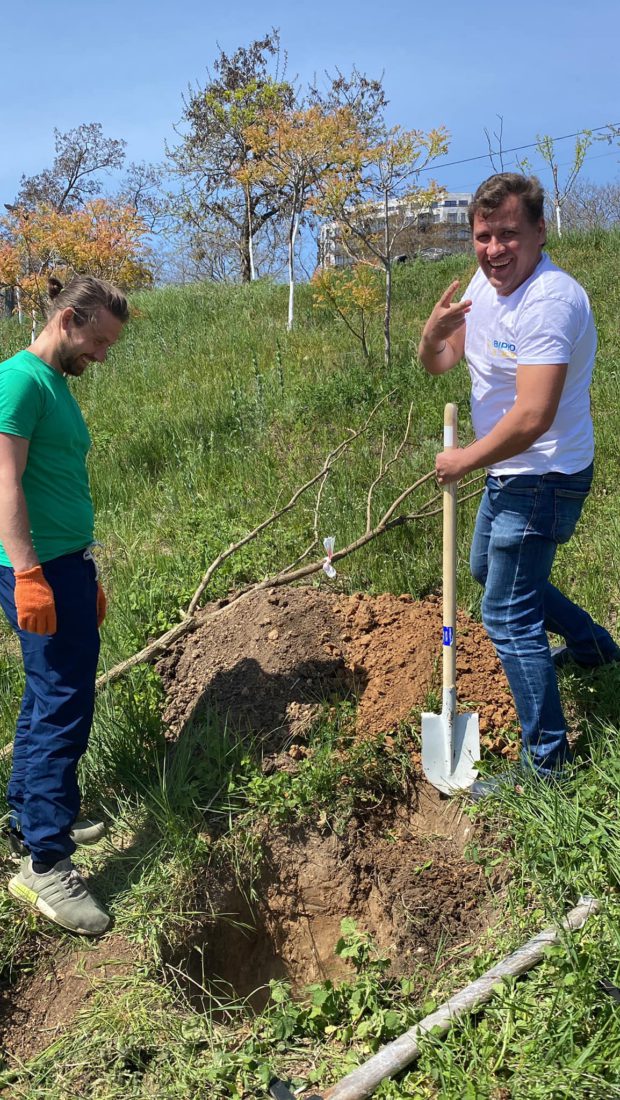
Despite regular shelling of Odesa, city residents together with Green Leaf members planted trees on the Black Sea coast and improved green areas.