
Updated on May 4, 2026
Vladyslav Balinskyi, Researcher at the Tuzly Estuaries National Nature Park, Head of the Odesa branch of the National Ecological Center of Ukraine (NECU)
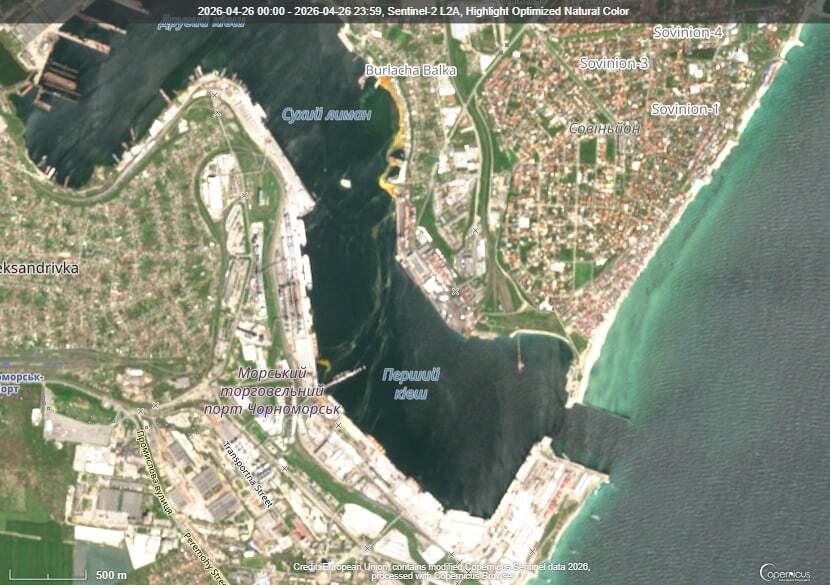
During the night of April 25–26, 2026, between 02:09 and 03:42, Russian Shahed-136/«Geran-2» drones attacked the port infrastructure of the city of Chornomorsk. The strike damaged three sunflower oil tanks (3,000 tonnes each) at the RISSOIL-Terminal LLC, Chornomorsk Sea Port, 28 Transportna Street. According to the worst-case scenario principle (OPRC Convention, 1990), approximately 6,000–6,500 tonnes of edible oil entered the open sea. The Odesa Regional Prosecutor’s Office opened criminal proceeding No. 22026160000000254 under Article 438 of the Criminal Code of Ukraine.
This article is an attempt to document what happened next, based on Sentinel-1 SAR imagery, Sentinel-2 optical data, and field observations.
? What you need to understand before reading
- Sunflower oil is not toxic in the classical chemical sense. Its impact is physical and biogeochemical: the surface slick blocks gas exchange, sticks bird feathers, emulsifies into the water column, and during biodegradation can cause local oxygen depletion (hypoxia). Part of the product undergoes oxidation and partial polymerization, eventually sinking to the seabed and entering trophic chains.
- Surface area of contamination ≠ mass of oil. A decrease in the visible slick does not mean the oil has disappeared – it may move into the water column or partially settle on the bottom.
- April 30 was the peak of surface coverage. The subsequent impact shifts into the water column and bottom sediments.
- International law equates vegetable oils to petroleum products (EPA 40 CFR Part 112, MARPOL Annex II, Bucharest Convention) – not because of toxicity, but because of identical mechanisms of harm to the environment.
? The symmetry that does not exist: Tuapse vs Chornomorsk
On April 26, 2026, satellites recorded two different events in the Black Sea.
- Tuapse, Russian coast: dark oil streaks from the oil refinery – separate winding threads. The surface contamination area during peak days (April 26 – May 3) was about 80 km².
![Sentinel-2 L2A, Highlight Optimized Natural Color, Туапсе, 26 квітня 2026. Туапсинський НПЗ (ООО РН) і нафтові тяжі у відкритому морі. Окремі слики. Масштаб: 1 км. Copernicus Sentinel data 2026.]](https://zeleniy-list.od.ua/wp-content/uploads/2026/05/tuapse-voda.jpg)
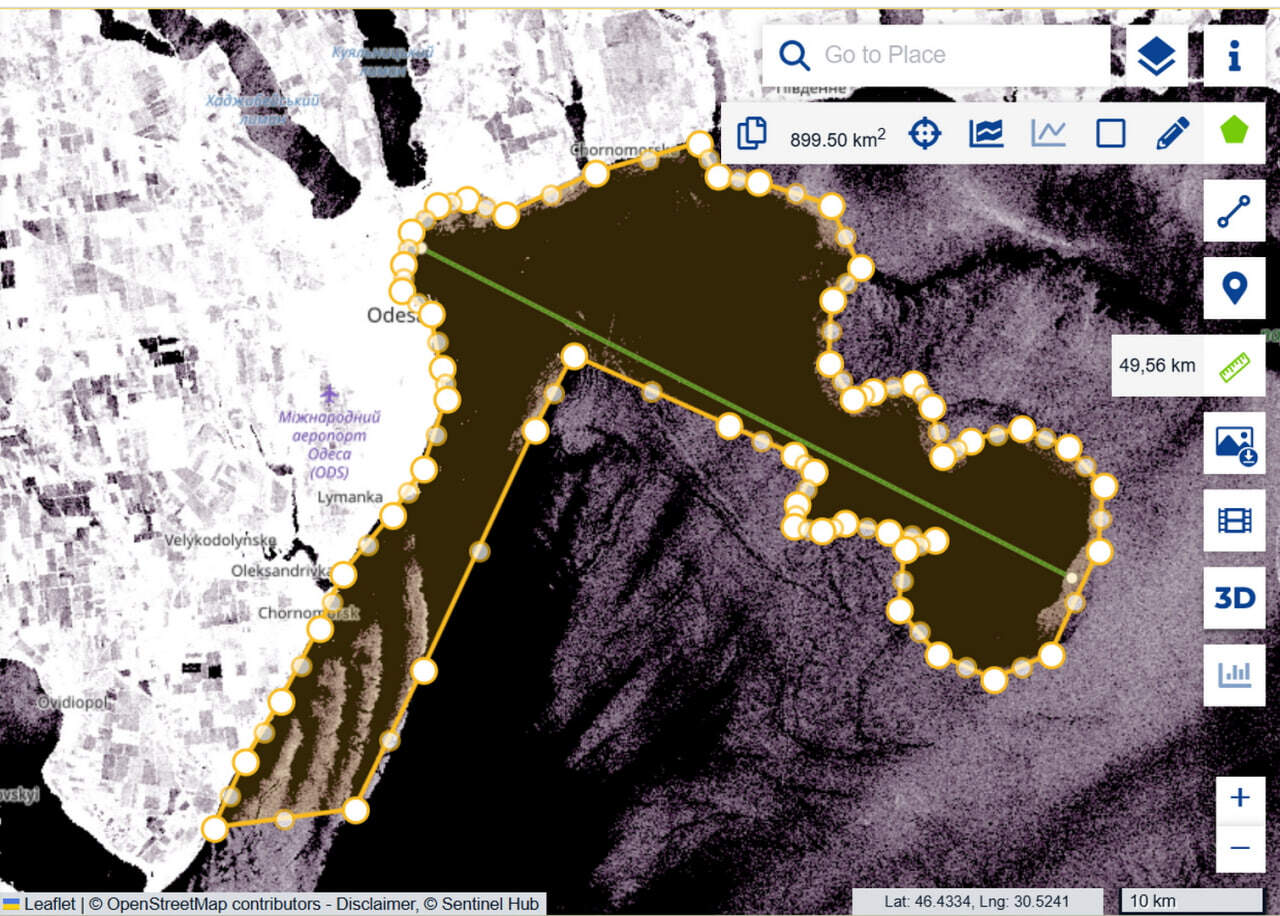
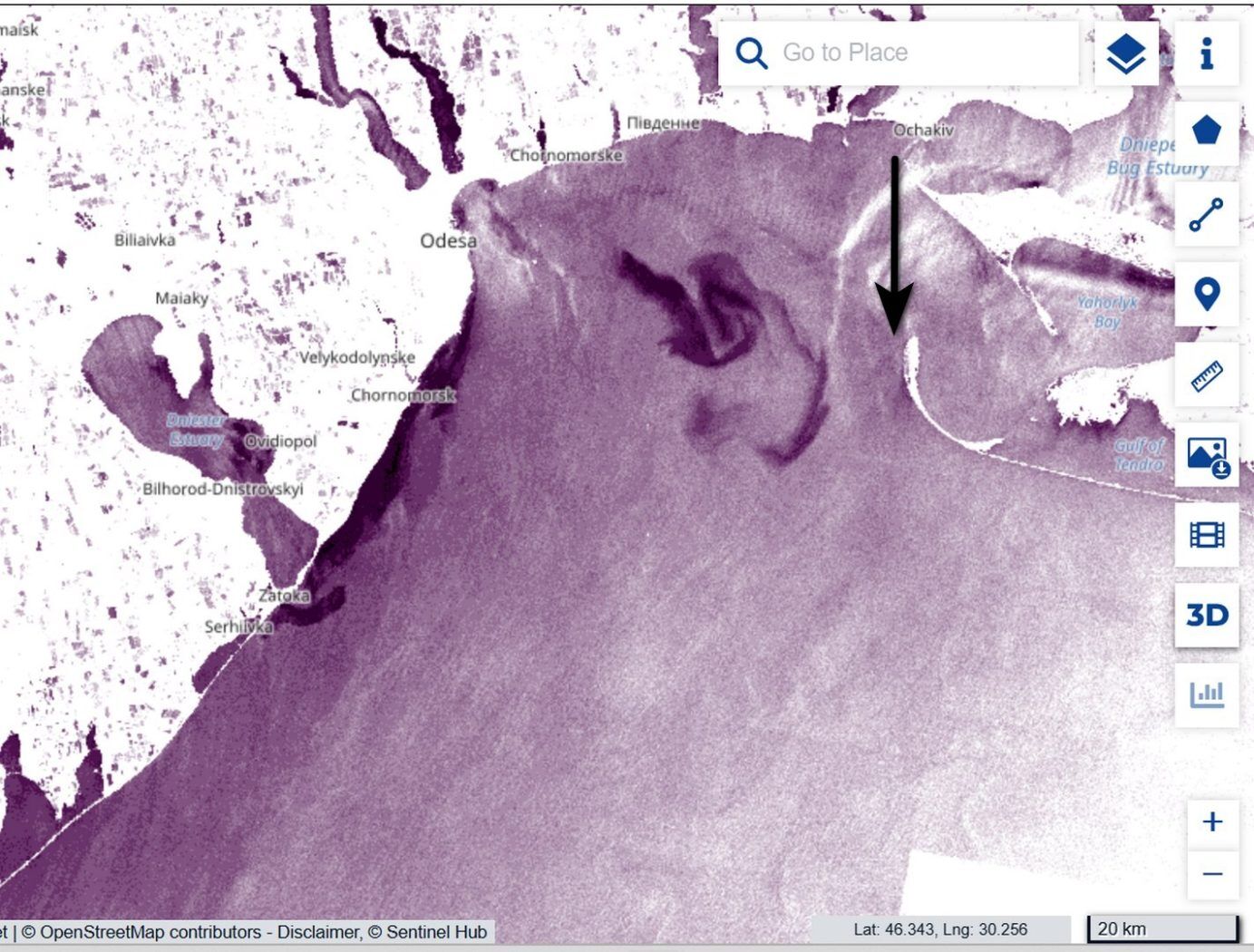
- Chornomorsk, Ukraine: a continuous sunflower oil slick that at its peak on April 30 reached 899.5 km² – more than 11 times larger.
Direct comparison of contamination areas of different substances has limitations (different physico-chemical behavior). However, the orders of magnitude allow us to assess the spatial scale: in the Ukrainian case it is an order of magnitude larger.
? Chronology: April 26 – May 4 (SAR facts)
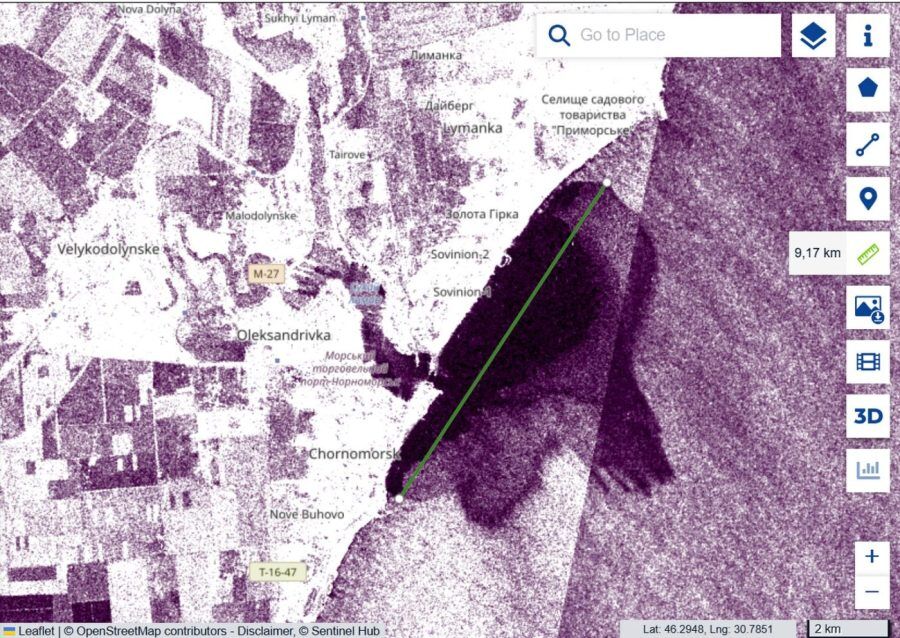
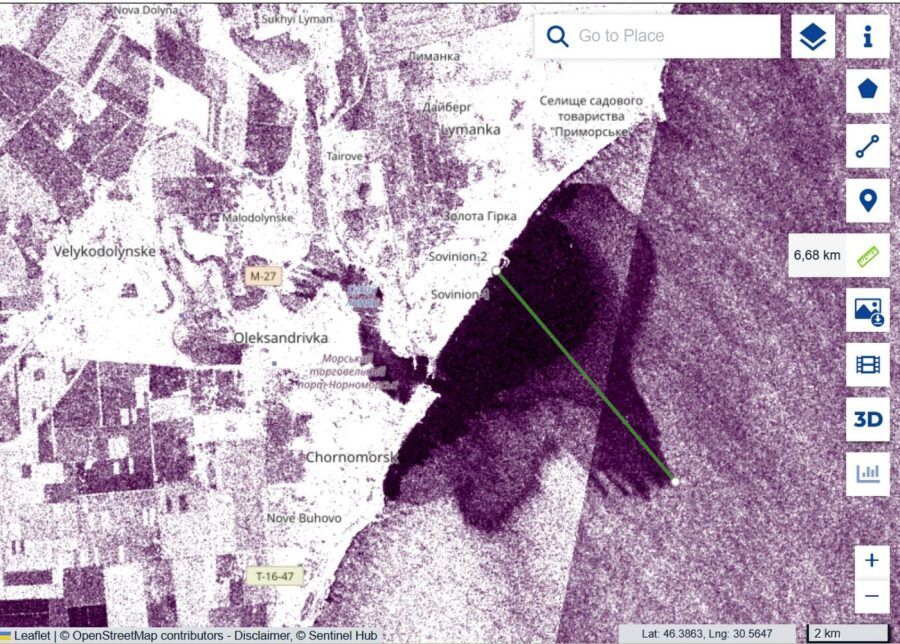
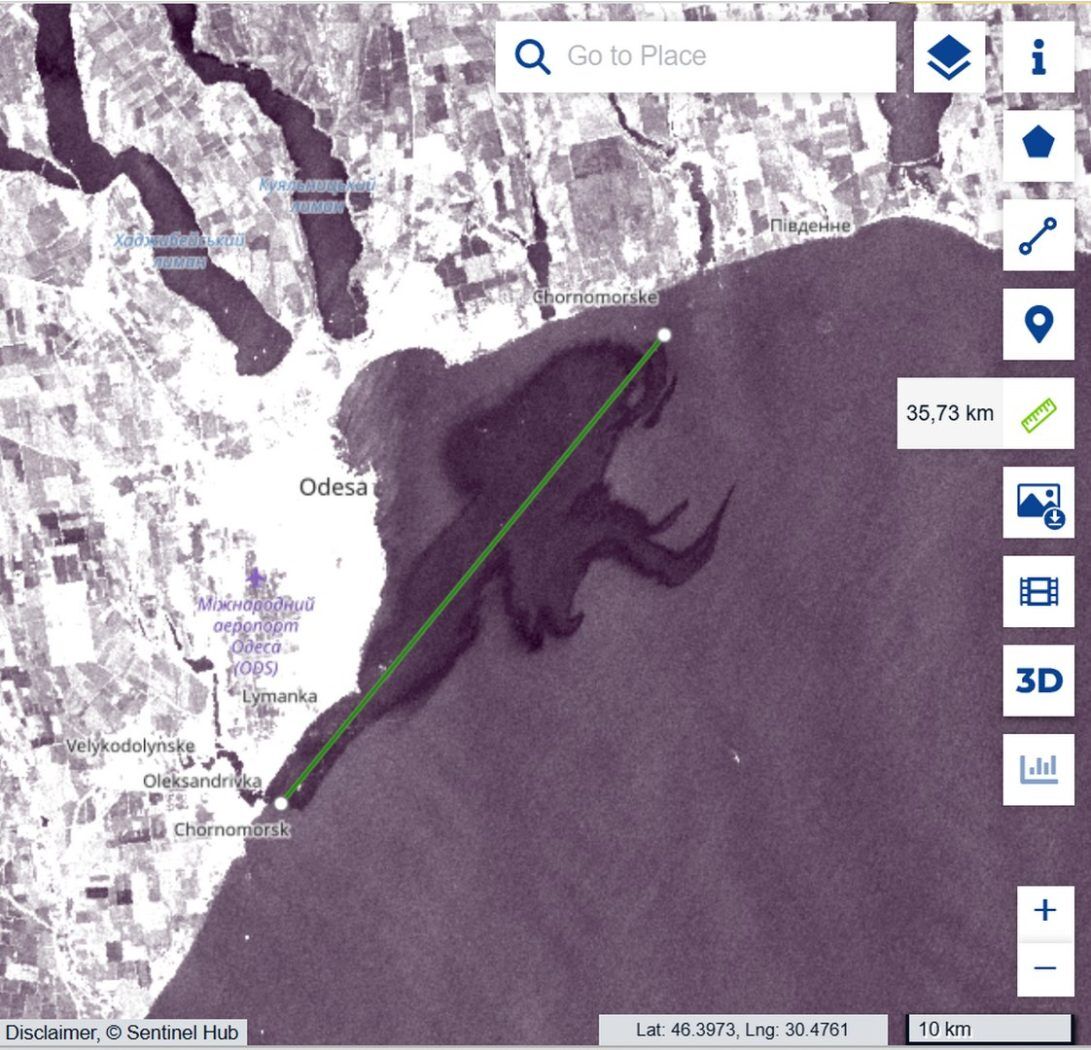
Methodology: Sentinel-2; Sentinel-1, C-band, VV+VH polarization, linear gamma0. Oil dampens backscatter – it appears as a dark anomaly on the images.
| Date | Instrument | Parameter | Note |
|---|---|---|---|
| 26.04 | Sentinel-2 L2A | port area, Sukhyi Estuary | day of the attack, ~6,000–6,500 t to sea – Fig.2 |
| 27.04 | Sentinel-1 SAR | anomaly 9.17 km | along the coast – Fig. 3a |
| 27.04 | Sentinel-1 SAR | anomaly 6.68 km | exit to sea – Fig. 3b |
| 28.04 | Sentinel-1 SAR | anomaly 35.73 km; ~250–300 km² | past Odesa – Fig. 4 |
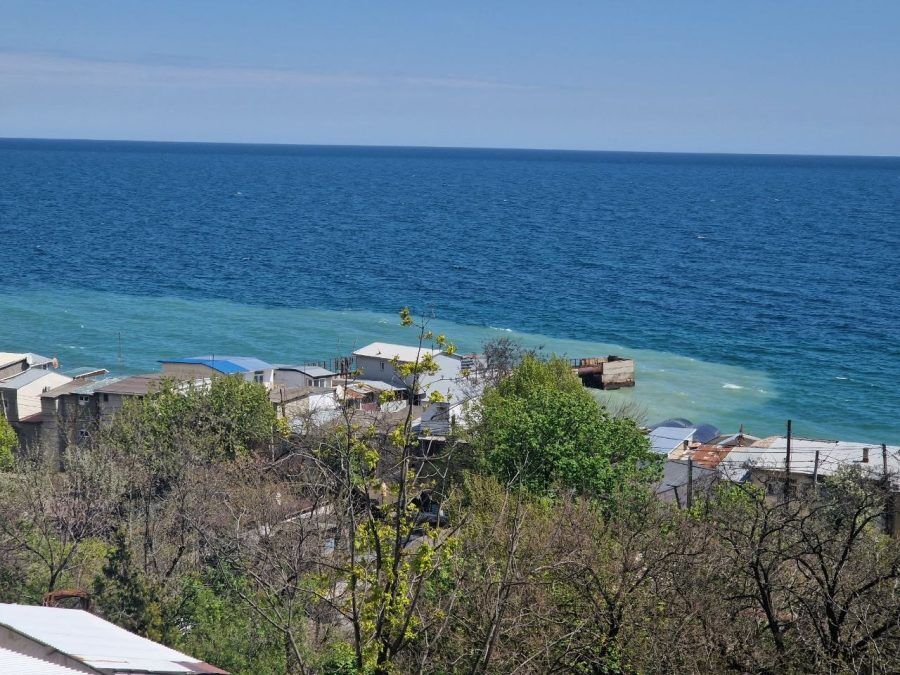
| 28.04 | Confirmation photo | confirmation of oil transition into water column | Odesa, 411th station – Fig. 5 |
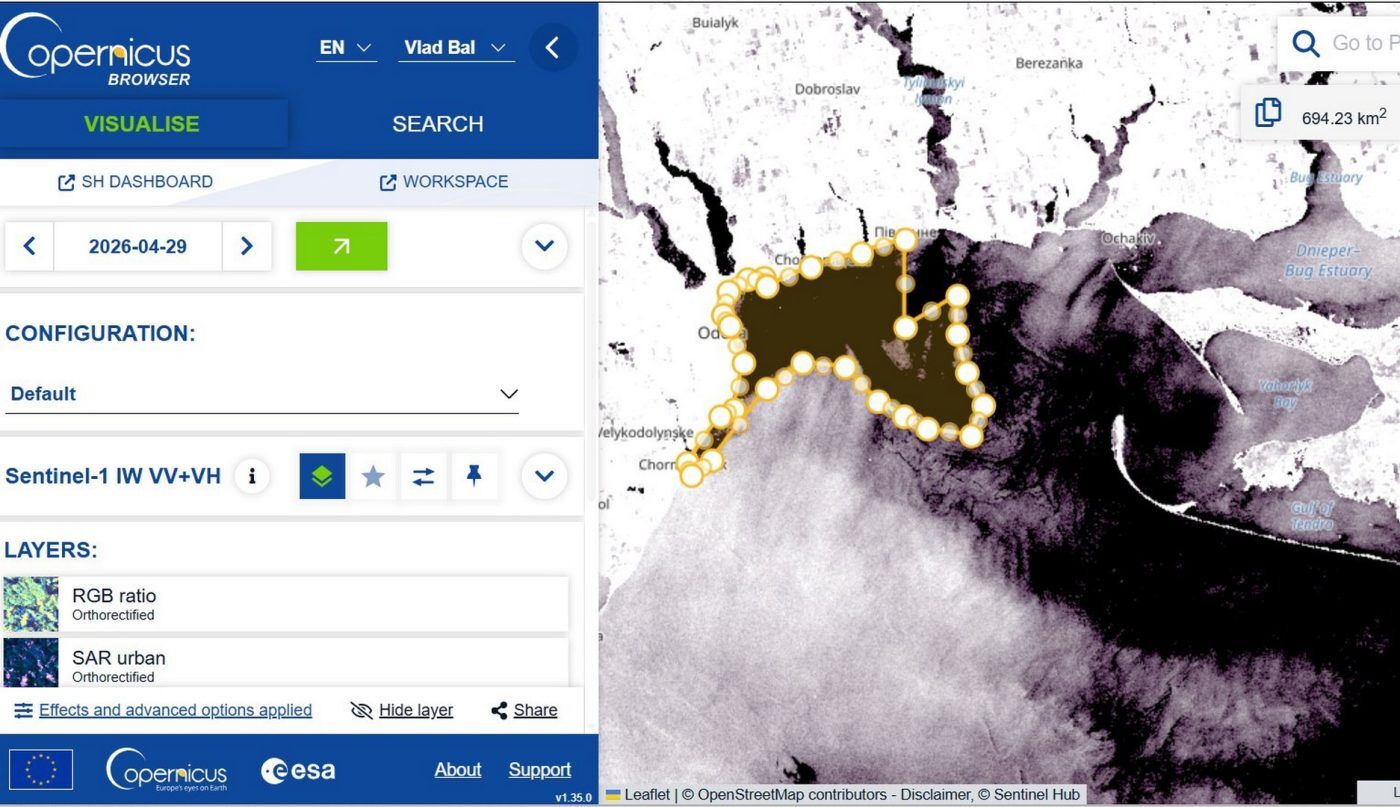
| 29.04 | Sentinel-1 SAR | 694.23 km² | vortex forms – Fig. 6 |
| 30.04 | Sentinel-1 SAR | 899.50 km² | peak surface area – Fig. 7 |
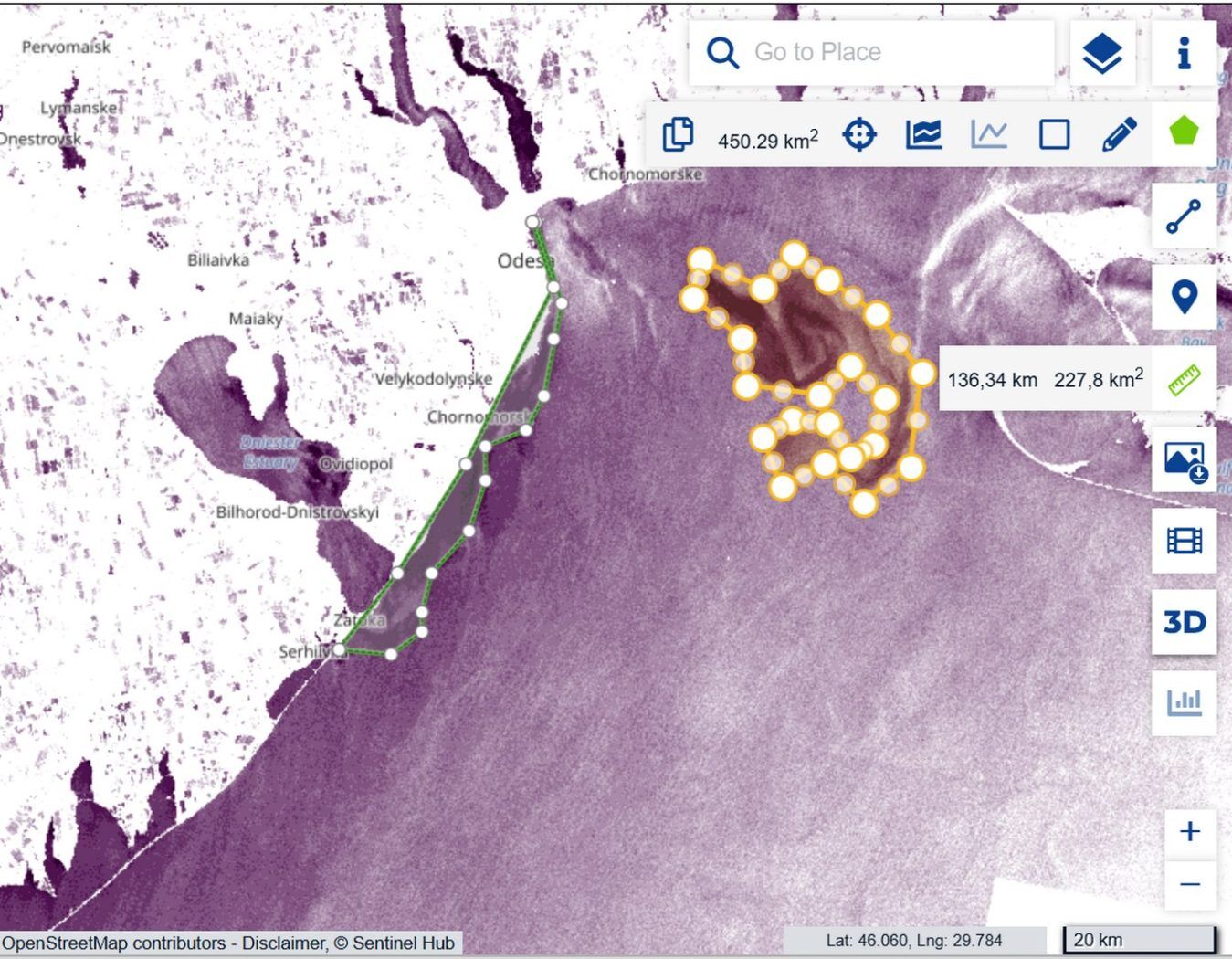
| 03.05 | Sentinel-1 SAR | 450.29 + 227.8 = 678 km² | split into two components – Fig. 9a, 9b |
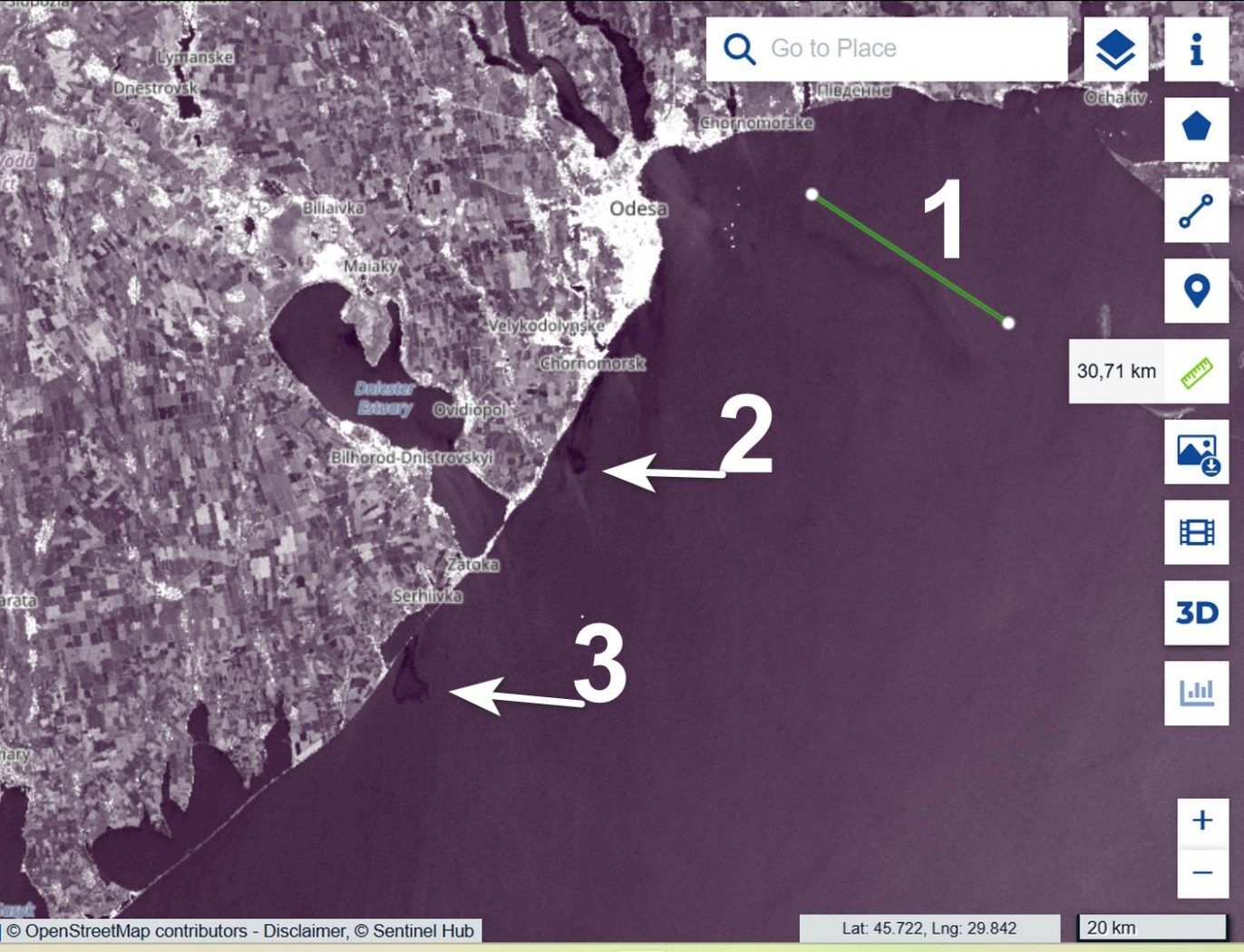
| 04.05 | Sentinel-1 SAR | n/a (area not determined) | split into three components – Fig. 10 |
?️ Meteorological conditions on April 30, 2026 – key moment of drift
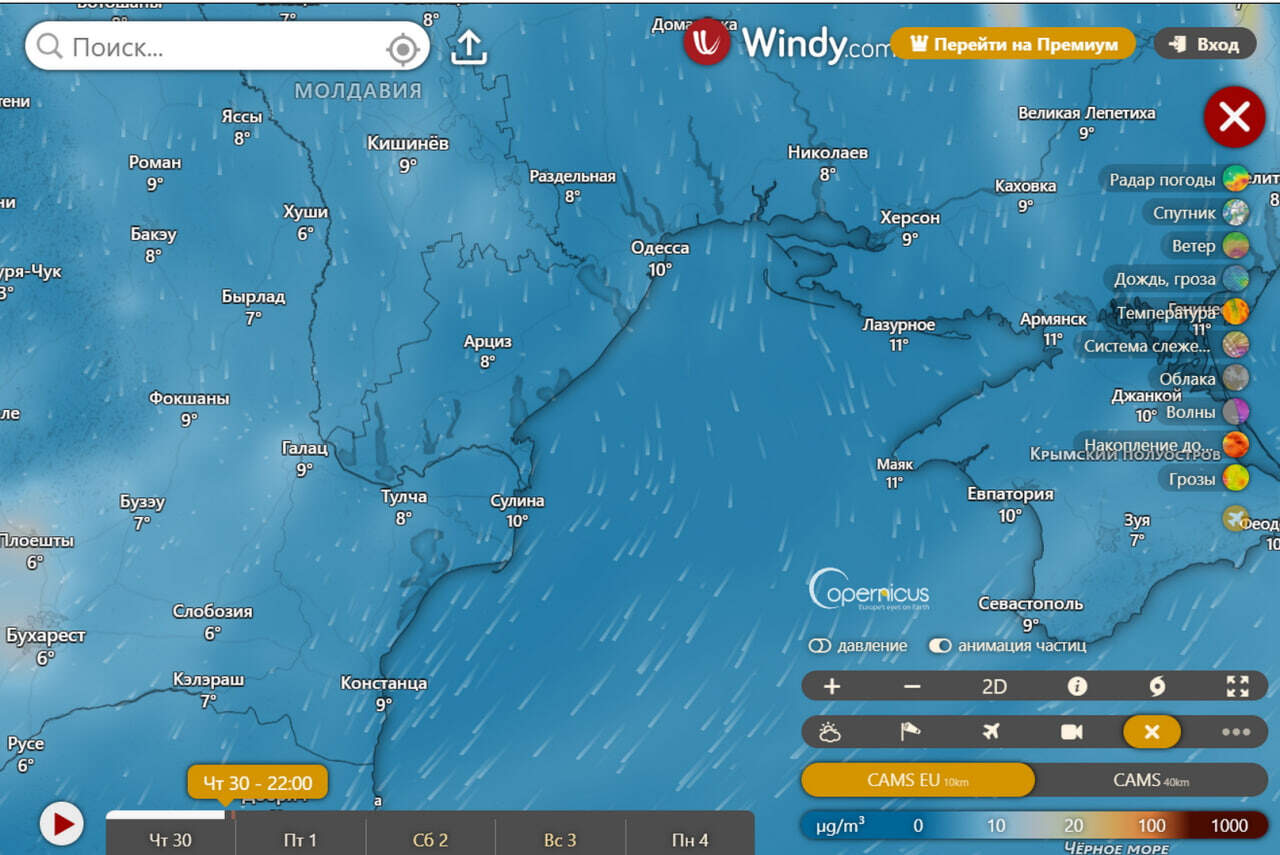
This image explains why the slick, which was carried out to the open sea by offshore winds on April 26–28, began to return to the coast on April 30 and turn toward the Tuzly Estuaries NPP.
? May 3: two components – threat to Tendra Spit
On the SAR image of May 3, the slick split for the first time into two structurally different components with different drift trajectories.
Cyclonic component in the open sea – 450.29 km² (yellow polygon). Captured by vortex circulation, moving toward Tendra Spit and Yahorlyk Bay. This is the peak of the nesting season there.
Coastal strip – 227.8 km², perimeter 136.34 km (green polygon). Stretched along the coast from Odesa to Serhiivka.
⚙️ Why did the visible area decrease between April 30 and May 3?
The observed decrease in total surface slick area (from 899.5 to ~678 km²) does not mean the oil disappeared. It reflects redistribution of contamination between the surface, water column, and bottom sediments due to three simultaneous processes:
- Emulsification – waves break oil into droplets that distribute in the surface layer (depths of several meters). Such dispersion gives much lower radar contrast or becomes invisible.
- Oxidation – UV light and oxygen alter the chemical structure of unsaturated fatty acids; the surface slick becomes more viscous and its radar contrast decreases.
- Beginning of sedimentation – partially oxidized and polymerized fractions together with adsorbed organic matter (phytoplankton, detritus) form aggregates that slowly sink to the bottom. This process takes weeks, but starts now.
Conclusion: the oil has not disappeared – it has changed its form of presence. The impact shifts from surface-concentrated to volume-distributed, making monitoring more difficult and expanding the range of vulnerable species.
? May 4: cyclonic component disappeared under water – coastal strip split again
Images from May 4 record a fundamental change in contamination dynamics.
The cyclonic component (450.29 km²) disappeared from the surface. Most likely, this is due to a change in the physical state of the contamination: emulsification, fragmentation of the surface slick, and reduction of radar contrast. Part of the oil may have moved into the water column or into a finely dispersed state not detected by SAR as a continuous anomaly. Such redistribution may increase risks to benthic ecosystems.
The coastal strip split into two: the first part stretched from Velykyi Fontan cape to Hrybivka; the second passed Serhiivka and lies opposite Kurortne village. The distance from the second part to the border of the Tuzly Estuaries NPP is about 30 km. In the coming days, suspended threads and emulsified oil clumps in the water column may begin to reach the park.
? Precedent of December 2025: what we already know
On December 20, 2025, after a strike on the Pivdennyi port, a sunflower oil spill occurred with an area of up to 730 km². Documented consequences:
- Death of about 5,000 birds (grebes, cormorants, swans). Oil sticks feathers, destroys thermal insulation – birds drown or freeze. Important: according to our observations, the share of return to nature after washing is extremely low (a few percent) – vegetable oil paradoxically damages feather structure more deeply than fuel oil.
- Contamination of the Tuzly Estuaries NPP perecyp (bar) after the storm on February 6, 2026, on an area of about 10,000 m². Thousands of crabs of four species died.
- Mass stranding of seahorses (Hippocampus guttulatus) on January 27, 2026 – up to 35 individuals per m². The mechanism (polymerization, sedimentation, clogging of gills by resuspended aggregates) is a working hypothesis that requires separate laboratory verification.
- Time lag – the first wave of contamination reached the NPP perecyp about 7 weeks after the initial event.
Based on this precedent, for the April spill, contamination is likely to reach the Tuzly Estuaries NPP in June 2026 (5–8 weeks).
? Forecast (observation guidelines)
- May 2026 (now) – peak spring bird migration. The coastal strip is already on the shore. First contaminated individuals are likely in the coming days.
- June–August 2026 – oxidation, partial polymerization, settlement of part of the aggregates to the bottom, chronic contamination of mussel beds.
- Autumn–winter 2026/2027 – autumn storms may resuspend settled aggregates. Similar to January 2026, a potential threat of a new wave of seahorse and other demersal species deaths.
? Three spills in two years: a systemic pattern
- October 2024 – Sukhyi Estuary, 125 t of oil, damage UAH 10.9 billion.
- December 2025 – Pivdennyi port, area up to 730 km².
- April 2026 – Chornomorsk port, peak 899.5 km², transition into the water column.
These are not random incidents. They are a documented sequence of strikes on civilian food infrastructure with a foreseeable environmental outcome.
? What to do now
- Record coordinates of slicks, oily deposits on the shore, contaminated birds. GPS, photo, time.
- Photograph optical water turbidity (turquoise / milky-green hues – signs of emulsified oil).
- Do not handle birds without a protocol – better pass coordinates to experienced volunteers.
- Send data to NECU, Tuzly Estuaries NPP, monitoring groups.
- Avoid eating seafood and fish from the contaminated zone in the coming months.
Every image, every coordinate is evidence for the Bucharest Convention, the UNEP mandate, and the international recognition of ecocide.
? Summary
The recorded event demonstrates not only the scale of a single contamination, but also a reproducible pattern of impact: from surface spill to long-term ecosystem contamination through the water column and bottom sediments. The sequence of events in 2024–2026 indicates the systemic nature of such incidents and the predictability of their environmental consequences. In this sense, we are not talking about a single incident, but about the formation of a long-term environmental footprint of war in the Black Sea.
The author thanks the team of the Tuzly Estuaries National Nature Park and personally Dr. Ivan T. Rusiev for joint field observations. Data: Sentinel-1, Sentinel-2, Ukrainian Hydrometeorological Center, Windy.com.
Vladyslav Balinskyi, May 4, 2026
Green Leaf NGO, Tuzly Estuaries NPP, NECU

The monitoring and analytical work presented in this publication was supported by the Deutsche Bundesstiftung Umwelt (DBU, German Federal Environmental Foundation) within its program supporting Ukrainian researchers and environmental practitioners. The findings, interpretations, and conclusions expressed herein are those of the author and do not necessarily represent the official position of DBU.