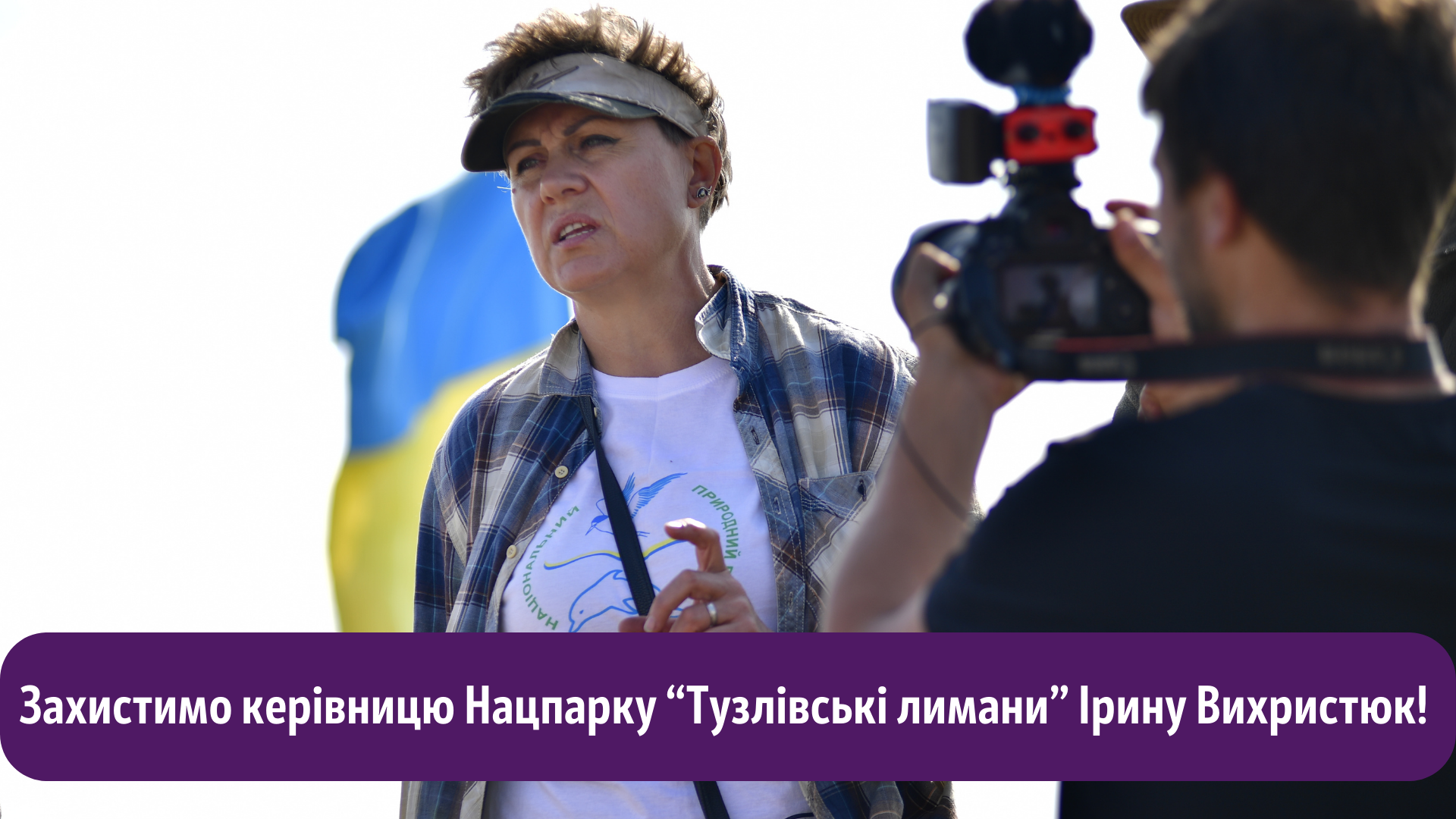

Defend Iryna Vykhrystiuk, Head of Tuzly Estuaries National Nature Park!
For seven years, ecologist Iryna Vykhrystiuk, acting director of Tuzly Estuaries National Nature Park, has been waging a real battle to preserve one of the jewels of the north-western Black Sea coast — the Tuzly estuaries in Bilhorod-Dnistrovskyi District of Odesa Region. Throughout all seven years, attempts have been made to remove Vykhrystiuk from office because she prevents the theft of valuable state resources that belong to all the people of Ukraine.
Read More

“Stop Stealing, Stop Lying!” Environmentalists Demand That Odesa Regional Administration Withdraw Its Environmental Protection Program
At the end of November 2023, the Odesa Regional Military Administration adopted the Regional Comprehensive Environmental Protection Program for Odesa Region for 2024–2028. Almost UAH 4 billion is planned to be spent on environmental protection in Odesa Region in total, with UAH 1.7 billion to be spent during this year alone. Environmental protection specialists carried out a detailed analysis of the document and concluded that, in its current form, the program would not only fail to provide benefits but could also harm the environment. Why?
Read More
Life Defeats Death: What Is Happening in Protected Areas of Southern Ukraine
According to a statement by the Ministry of Environmental Protection and Natural Resources, more than 20% of Ukraine’s protected natural areas – 812 nature reserve fund sites (NRF) with a total area of 0.9 million hectares have been affected by the war. A total of 514 NRF sites covering 0.80 million hectares remain under occupation. This list and the scale of losses may continue to grow because fighting continues in parts of Ukraine, while other areas remain occupied or await demining.
Read More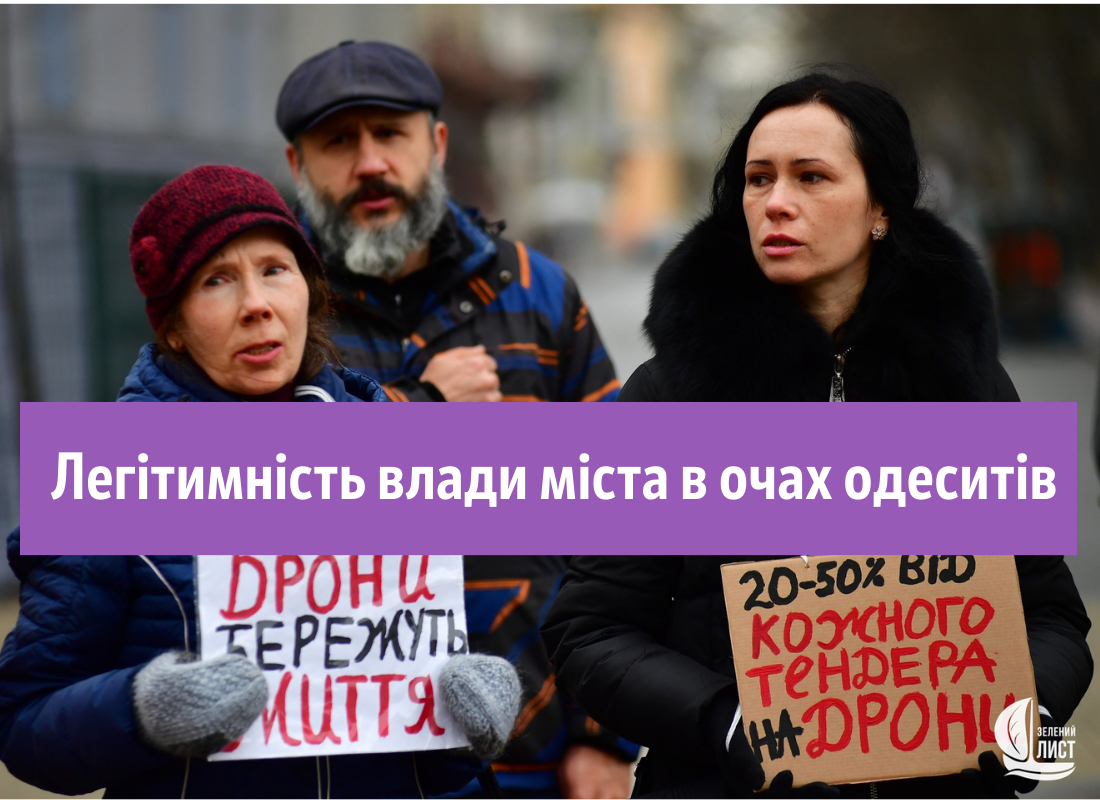
Legitimacy of City Authorities in the Eyes of Odesa Residents
Green Leaf has already reported that Odesa residents appealed to the city authorities asking that unallocated city budget funds be directed to the needs of combat units of the Defense Forces of Ukraine. To recap, the appeal was sent to the Mayor of Odesa, every member of the Executive Committee of the Odesa City Council, and, via the councillors’ portal, personally to every city councillor.
The city authorities remain silent or send formal replies
According to information provided by Iryna Kostenko, representatives of the city authorities are in no hurry to perform the duties entrusted to them. As of June 19:
1. No response has been received from the Mayor of Odesa.
2. Among representatives of the Executive Committee, only the Department of Municipal Security has provided a response.
This “response” does not provide any substantive answer to the issues raised in the collective appeal and is, in effect, a form letter.
3. Of the 56 councillors listed on the councillors’ portal, only three have replied. They are:
– Iryna Lioneliyivna Holovatiuk-Yuzefpolska, “TRUST IN DEEDS”;
– Zhanna Vasylivna Mandrychenko, “EUROPEAN SOLIDARITY”;
– Olha Oleksiivna Kvasnitska, “SERVANT OF THE PEOPLE”.
It should be noted that under the Law of Ukraine “On the Status of Deputies of Local Councils”, “A deputy of a local council, as a representative of the interests of the territorial community and the voters of their electoral district, is obliged to express and defend the interests of the relevant territorial community and its part — the voters of their electoral district, to carry out their instructions within the powers granted by law, and to take an active part in local self-government.”
In practice, however, we see that most members of the Odesa City Council of the VIII convocation do not regard themselves as representatives of their voters’ interests.
In conclusion.
Odesa residents gave the city authorities a test. Once again, the city authorities failed it. In fact, today we can speak of a major crisis of trust between residents and the authorities, and even most city councillors are making no effort at their level to overcome this crisis.
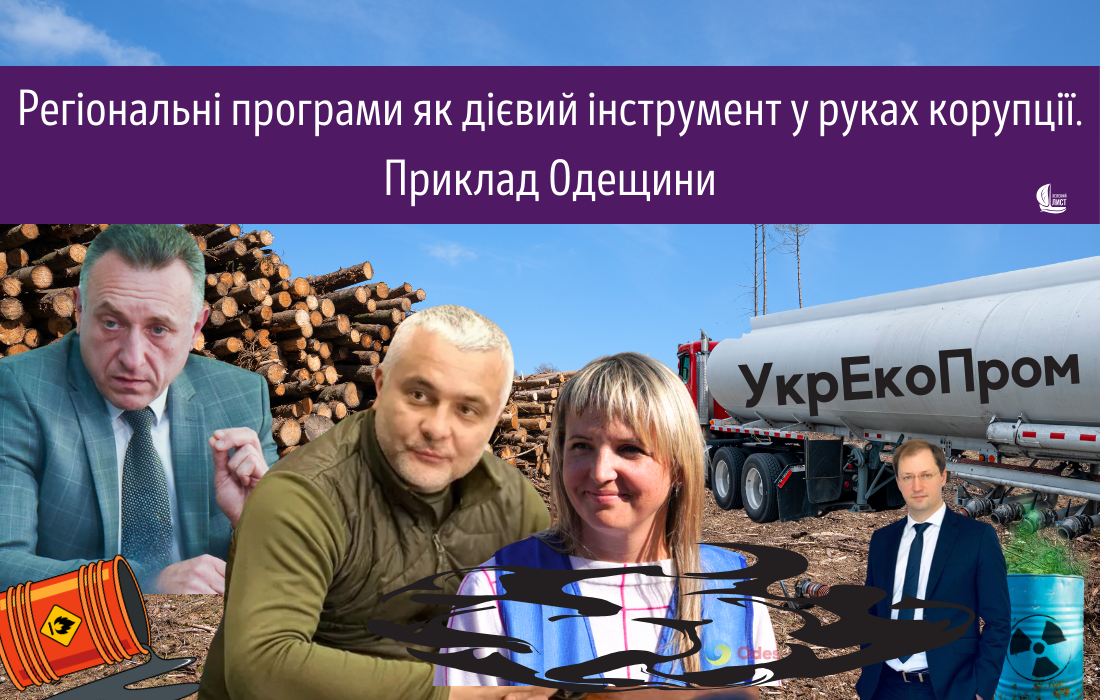

Regional Program as an Instrument of Corruption: The Case of Odesa Oblast
Local target programs are an integral part of the budget process for local self-government bodies. They are a tool for defining specific tasks and measures for effective financial management across all areas of community life. But Odesa Oblast shows how an important regional program can become an uncontrolled instrument for enriching local “elites.” This concerns the Regional Comprehensive Environmental Protection Program of Odesa Oblast for 2024–2028.
Read More
Green Leaf NGO Activity Report for 2022
After the start of Russia’s full-scale invasion of Ukraine, members of the Green Leaf NGO team began focusing on what Odesa and Odesa Oblast needed most: security and strengthening the region’s defense capability. This included assistance to the Armed Forces of Ukraine and Odesa’s Territorial Defense brigade, strengthening social protection for residents and internally displaced people from “hot spots,” coordinating volunteer centers, documenting Russia’s environmental crimes, monitoring city-budget spending on security needs, conducting anti-corruption investigations into the actions of Odesa city authorities, and promoting derussification and decolonization in the Odesa region.
Read More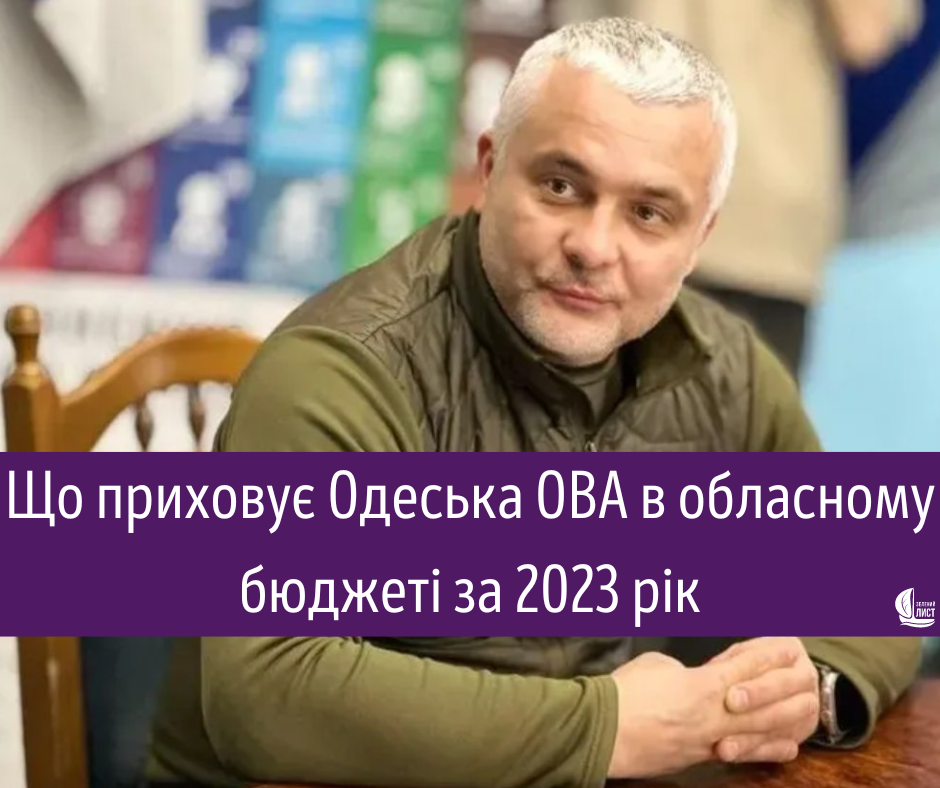
What the Odesa Regional Military Administration Hides in the 2023 Regional Budget
At present, the Odesa Regional Military Administration is trying to conceal as much as possible both important public documents and the overall indicators of the Odesa Oblast regional budget. This is done in the simplest way: public information is simply not published, in violation of the law. It sometimes seems that the administration’s PR staff post endless photos of Kiper in different poses specifically to distract public attention from the complete opacity of the regional authorities. Fortunately, information on execution of the regional budget can also be obtained from the annual reports of the State Treasury Service of Ukraine. This is public information; the Regional Military Administration simply “forgot” about it. Separately, I note that analysis of the revenue and expenditure parts of the previous budget year is by itself important mainly for scale. However, together with analysis of target programs adopted at the same time — such as the “Regional Comprehensive Environmental Protection Program of Odesa Oblast for 2024–2028” worth almost UAH 4 billion — it can at least serve as an indicator of the Odesa Regional Military Administration’s effectiveness during the war. We will return soon to analysis of this “environmental” program; for now, let us look more closely at the 2023 regional budget indicators.
General overview of the 2023 budget
If the 2023 regional budget is expressed in a few figures showing actual revenues, expenditures and balances, the picture is as follows:
Opening balance — UAH 1,714.3 million (UAH 1.7 billion)
Revenue — UAH 7,239.5 million (UAH 7.2 billion)
Budget expenditures — UAH 6,367.6 million, including:
— direct budget expenditures — UAH 6,075.8 million
— loans issued from the budget, shown under lending — UAH 34.6 million
— borrowings repaid, shown under financing — UAH 257.3 million
Other calculations* — UAH 85.8 million
(Taking into account interbudgetary transfers passed between local budgets)
Closing balance — UAH 2,500.5 million (UAH 2.5 billion).
Opening balance
These figures show how much money was held in regional-budget and budget-institution accounts at the beginning of the year.
Balances in budget-institution accounts — UAH 92.7 million.
Balances in budget accounts — UAH 1,621.6 million, of which UAH 270.7 million represented balances of subventions from the state budget.
Budget revenue
These figures show how much money was received into budget and budget-institution accounts during the year.
Tax revenues amounted to UAH 3,718.0 million, including:
— personal income tax and related levy — UAH 3,234.0 million
— corporate profit tax — UAH 434.8 million.
Non-tax revenues amounted to UAH 424.3 million, including:
— administrative fees and payments and income from non-commercial economic activity — UAH 101.0 million
— own-source revenues of budget institutions — UAH 299.6 million.
Revenue from capital transactions, mainly proceeds from disposal of property, amounted to UAH 1.8 million.
Another UAH 2.6 million was received into the regional budget as revenue under assistance programs of foreign governments, international organizations and donor institutions.
UAH 0.8 million was received into regional-budget earmarked funds.
Interbudgetary transfers totaled UAH 3,092.0 million, including:
— grants from the state budget — UAH 211.3 million
— subventions from the state budget — UAH 2,159.9 million
— subventions from local budgets — UAH 720.8 million, of which UAH 606.6 million were other subventions. It was under this code that other local budgets transferred money to the regional budget “for the Armed Forces.” In the absence of any explanations, we will assume that all funds under this subvention were precisely the funds provided by territorial communities to the regional budget “for the Armed Forces.”
Budget expenditures
According to Article 10 of the Budget Code of Ukraine, budget expenditures are grouped on the basis of the standard program classification of local-budget expenditures, approved by the Ministry of Finance.
Under this classification, all regional-budget expenditures are grouped as follows:
0100 Public administration
This code records expenditures on maintaining the Odesa Regional Council and its subdivisions.
These expenditures amounted to UAH 89.3 million.
Note that this code does not include financial support for municipal enterprises, even where the Regional Council itself provides the funding. Such support for municipal enterprises is recorded under code 7693.
1000 Education
This includes expenditures on general secondary education in special schools, sanatorium schools, lyceums and educational-rehabilitation centers; vocational education, professional pre-higher and higher education; purchase of school buses and so on. Total expenditure in this area was UAH 1,610.0 million (UAH 1.6 billion).
2000 Health care
This includes payment for utilities and energy used by municipal health-care institutions, funding of regional development and support programs for municipal health-care facilities, regional public-health programs, and other institutions and activities within the health-care system, including infant homes, blood-service institutions, medical-social expert commissions and specialized medical-supply bases.
Total expenditure in this area was UAH 484.9 million.
3000 Social protection and social security
This includes financing social-protection and social-security programs, providing social and rehabilitation services to older people, persons with disabilities and children with disabilities in social-service institutions, support for internally displaced persons and more.
Total expenditure in this area was UAH 537.8 million.
4000 Culture and arts
This includes financial support for theaters, philharmonic organizations, artistic and musical groups, ensembles, concert and circus organizations; support for libraries, museums and exhibitions, palaces and houses of culture, clubs, leisure centers and other club institutions; and financing other institutions and activities in culture and the arts.
Total expenditure in this area was UAH 280.4 million.
5000 Physical culture and sport
This includes sports activities in the region, physical-culture, sports and rehabilitation work for persons with disabilities, development of youth and reserve sport, support and development of sports infrastructure, and other measures for developing physical culture and sport.
Total expenditure in this area was UAH 110.0 million.
6000 Housing and municipal services
This includes expenditures related to issuing and servicing preferential long-term loans to citizens for construction/reconstruction/purchase of housing and reducing mortgage costs to provide affordable housing to citizens who need improved housing conditions.
Total expenditure in this area was UAH 1.3 million.
7000 Economic activity
This includes programs and measures related to economic activity. Mainly:
— implementation of agricultural programs totaling UAH 0.1 million.
— construction and regional development, including construction and repair of social and cultural facilities, restoration and protection of architectural monuments and implementation of investment projects totaling UAH 197.9 million.
— maintenance and development of roads and road infrastructure totaling UAH 849.0 million, including:
UAH 258.6 million from the regional budget
UAH 549.9 million from a state-budget subvention
UAH 40.5 million from other local budgets
— other programs and measures related to economic activity totaling UAH 113.0 million, of which UAH 107.9 million was financing for municipal enterprises.
Total expenditure in this area was UAH 1,166.0 million (UAH 1.17 billion).
8000 Other activity
This includes expenditures not assigned to other sections. These were:
— other public-order and safety measures totaling UAH 0.3 million
— territorial-defense measures and works totaling UAH 32.0 million. Note that UAH 233.8 million had been planned. In fact, these measures were funded at only 13.7% of the planned amount.
— prevention and elimination of environmental pollution, which took the form of waste disposal totaling UAH 31.4 million. Pay attention to these expenditures. All the money was paid to the company Ukrekoprom, whose activities became the subject of dozens of criminal proceedings available in the court archive. One proceeding, for example, concerns how the company allegedly dumped sewage within Odesa instead of disposing of it properly.
— servicing local debt totaling UAH 55.6 million. This was interest paid on loans in 2023.
Total expenditure in this area was UAH 119.3 million.
9000 Interbudgetary transfers
This section records funds transferred from the regional budget as grants and subventions both to local budgets and to the state budget.
Total expenditure in this area was UAH 1,676.9 million.
We also note that under code 9800, “Subvention from a local budget to the state budget for implementation of regional socio-economic development programs,” through which funds are also transferred for the Armed Forces and for which the Odesa Regional Military Administration collected money from Odesa Oblast communities, expenditures totaled UAH 635.4 million. This almost matches the figure for “Other subventions from local budgets” on the revenue side of the regional budget.
Closing balance
These figures show how much money remained in the accounts of the regional budget and budget institutions at the end of the year.
Balances in budget-institution accounts — UAH 114.7 million.
Balances in budget accounts — UAH 2,385.8 million, of which UAH 446.6 million represented balances of subventions from the state budget, namely:
| Name of state-budget subvention to local budgets | Amount, UAH million |
| Education subvention | 223.0 |
| — for design, restoration, construction, modernization, equipping and repair of public-purpose construction facilities, social facilities, cultural heritage, housing and municipal infrastructure and other facilities affecting everyday life | 69.6 |
| — for state support to persons with special educational needs | 9.7 |
| — for financing construction, reconstruction, repair and maintenance of local public roads and municipally owned streets and roads in settlements | 144.3 |
We also note that during 2023 the increase in balances held in regional-budget accounts, excluding balances of subventions from the state budget, exceeded UAH 580 million.
Conclusion
An analysis of the overall orientation of the Odesa regional budget shows that the Regional Military Administration finances social and cultural institutions, road construction and calmly repays previously contracted loans…
But despite having substantial free financial resources measured in billions of hryvnias, there is no significant assistance to combat units of the Defense Forces of Ukraine funded specifically from the regional budget.The assistance provided under code 9800 consists almost entirely of funds transferred to the regional budget by communities of Odesa Oblast.
Could this be precisely why the Odesa Regional Military Administration is trying to conceal its activities from public view?
For reference, we inform Green Leaf readers that anyone can download the State Treasury Service of Ukraine report on execution of the Odesa Oblast regional budget and independently analyze the budget indicators. The report is available at the link (Report on execution of the Odesa Oblast regional budget for 2023).