
Environmental monitoring · Odesa Bay · July 2026
The loss of Golden Leo is not an isolated maritime casualty. It adds another layer of pressure to waters already affected by the destruction of the Kakhovka Dam, heavy-fuel-oil pollution and wartime attacks. Fuel, bilge water, a cargo of corn and an unstable hull may act at the same time—at the surface, near the seabed and within marine sediments.
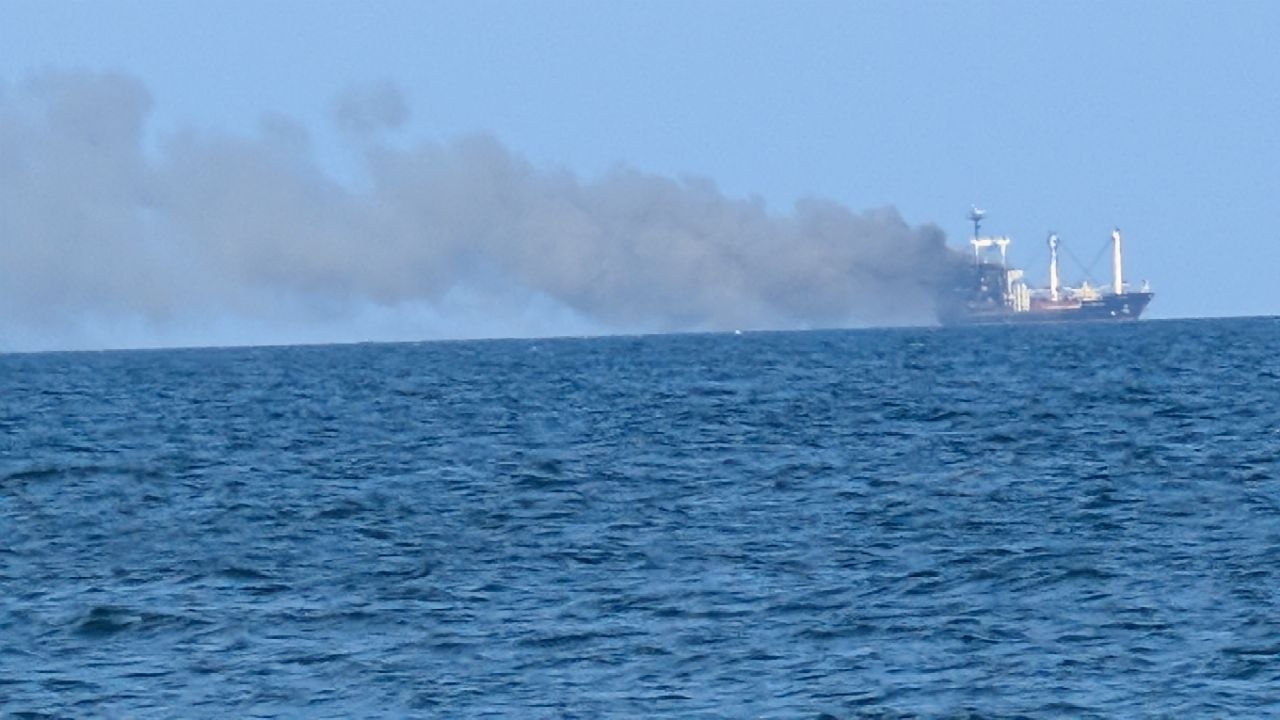
War is changing the Black Sea not only through explosions, but through processes whose effects may persist for years. The destruction of the Kakhovka Dam, heavy-fuel-oil pollution following the casualty involving Russian tankers in the Kerch Strait, sunken vessels and attacks on civilian shipping are creating an interconnected system of risk.
Golden Leo adds another potential source of pressure roughly five nautical miles off Odesa, in shallow coastal waters strongly influenced by wind-driven circulation.
For Odesa Bay, the sinking of Golden Leo is not only a human tragedy but a new source of long-term environmental risk. A large wreck containing fuel, technical fluids and a cargo of corn may affect surface waters, bottom waters, seabed sediments and the safety of navigation.
What happened
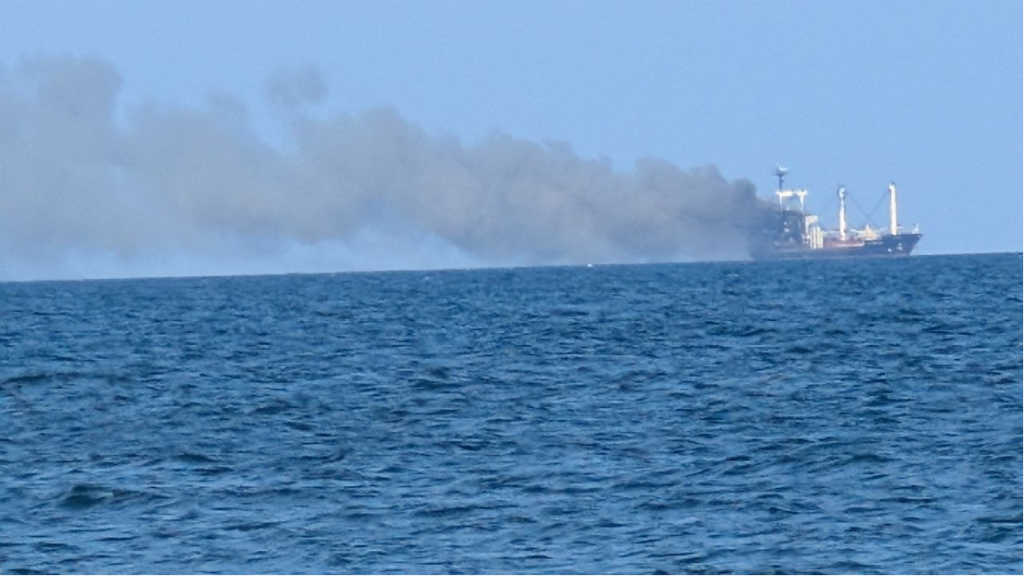
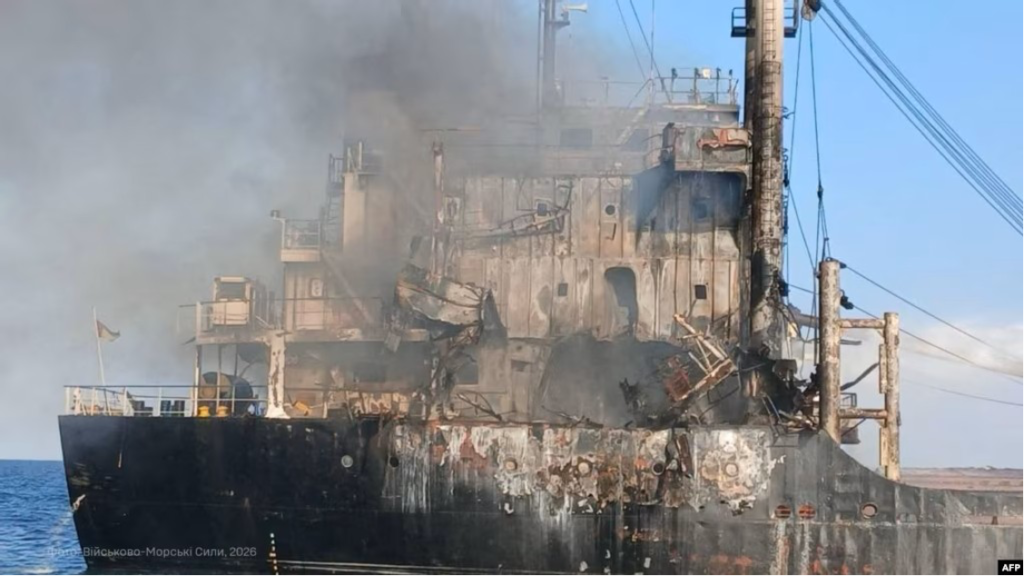
On 19 July, the Guinea-Bissau-flagged merchant vessel Golden Leo, carrying Ukrainian corn, came under a Russian missile attack while leaving the port of Chornomorsk through Ukraine’s maritime corridor. Ten people were killed—nine crew members and a Ukrainian maritime pilot. After several days of damage-control efforts, the vessel was no longer seaworthy and sank on 26 July, approximately five nautical miles off the Odesa coast.
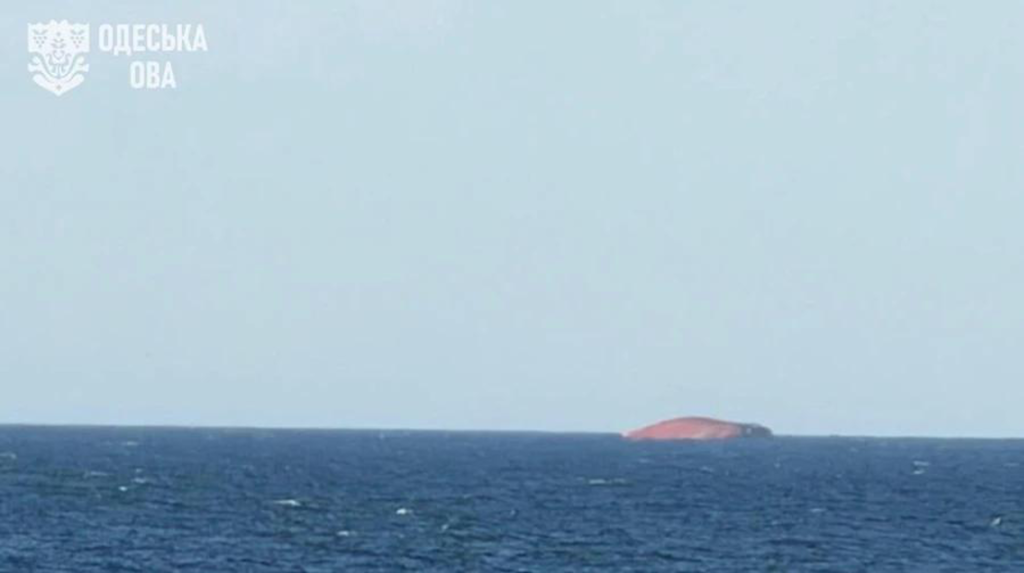
Among the many Odesa residents who witnessed the disaster was Vladyslav Balinskyy, a researcher at Tuzly Lagoons National Nature Park and head of the Odesa branch of the National Ecological Centre of Ukraine.
“The ship was struck in three successive missile attacks. After the first hit, the Russians waited roughly seven or eight minutes—the very period when pilot boats, emergency responders and other support craft would normally approach a damaged vessel. A second strike followed, and then a third,” Balinskyy says.
Attacks on civilian shipping have become systematic
Since spring 2026, Russia has sharply intensified attacks on civilian shipping in the Black Sea. According to Ukraine’s Deputy Prime Minister for Restoration, Oleksii Kuleba, more than 70 attacks on merchant vessels had been recorded since the beginning of the year.
According to the Odesa Regional Prosecutor’s Office, 28 civilian vessels were hit in the ports of Greater Odesa in just one month, from the second half of June to the second half of July. Twenty-six were foreign-flagged and two were Ukrainian. The attacks killed 21 people and injured another 34.
Among the first documented incidents of 2026 was a strike on 18 May against a Marshall Islands-flagged merchant vessel owned by a Chinese shipowner. On 29 May, the Vanuatu-flagged bulk carrier ANT was hit while leaving a port in Odesa region for Türkiye. A fire broke out on board and two crew members were injured.
On 22 June, Russia carried out another attack on civilian vessels in the Black Sea. At least three merchant ships flying the flags of Panama, Vanuatu and China were struck. A cook from Egypt was killed on one vessel, while eight other seafarers had to abandon ship in a life raft.
The pace of attacks rose sharply in July. Within a single week, vessels flying the flags of Saint Kitts and Nevis, Togo, Tanzania, Liberia, the Marshall Islands, Antigua and Barbuda, Palau and other states were reported hit. Some vessels were attacked more than once.
The 19 July strike on Golden Leo became the culmination of that escalation.
Several days earlier, on 13 July, the International Maritime Organization formally condemned a series of attacks on civilian merchant vessels in the Black Sea and the Sea of Azov and called for attacks on international shipping to stop.
On 23 July, Ukraine’s Ministry of Agrarian Policy reported that the sharp rise in Russian attacks had prompted shipowners to temporarily suspend calls at Ukrainian Black Sea ports.
On 27 July, the UN Security Council held an emergency meeting on the safety of civilian shipping in the Black Sea. According to the UN, more than 40 crew members were killed or injured in attacks on civilian vessels during July alone.
The rising threat has already disrupted maritime logistics. Lloyd’s List Intelligence described operating conditions as the worst since the Black Sea Grain Initiative ended in 2023. Insurance premiums and freight rates increased, while some international operators, including Maersk, temporarily suspended selected Ukrainian services because of the security situation.
Two very different approaches to warfare at sea
Balinskyy argues that the Golden Leo case exposes a fundamental distinction between military operations designed to disrupt an opponent’s logistics and attacks directed at civilian shipping.
Ukraine’s Unmanned Systems Forces conducted Operation Molochka from 6 to 28 July with the aim of cutting fuel-supply routes serving Russia’s southern military grouping.
Russia used occupied Crimea as a transport and logistics hub. Across the Sea of Azov, small tankers and cargo vessels of the Volgoneft, Volgobalt and related designs regularly moved substantial quantities of fuel and lubricants. The existence of that transport system in itself posed a potential threat to the ecosystems of the wider Black Sea–Azov basin.
A detailed satellite-based assessment is available in the Green Leaf investigation “201 Vessels Hit—but Not 201 Fires: Satellite Analysis of Operation Molochka”.
Reflecting on the environmental consequences of Operation Molochka, Balinskyy says:
In his view, the attack on Golden Leo followed a fundamentally different logic.
Balinskyy’s assessment is that the objective was not simply to disable the vessel, but to maximise loss of life, destroy a civilian ship and create long-term risks for maritime transport and the marine environment.
“The warhead of a cruise missile is incomparably more powerful than that of an attack drone and may contain around 300 kilograms of explosive. The attack killed ten people, critically damaged the vessel and ultimately caused it to sink. Beyond the human tragedy, it created potential environmental risks that now require long-term monitoring and scientific assessment,” Balinskyy says.
After the vessel went down, the Odesa Regional Military Administration convened an emergency meeting of its commission on technological and environmental safety.
The commission introduced continuous monitoring of the Black Sea area to assess potential effects on the environment and on navigation safety.
Authorities are paying particular attention to possible leaks of fuel and lubricants into the sea.
But is surface surveillance alone enough to evaluate all the environmental consequences of a large merchant ship lying on the seabed?
Potential sources of pollution
In this context, the sinking of Golden Leo presents serious environmental risks for the north-western Black Sea and Odesa Bay. The effects are likely to remain local, but local does not mean insignificant. Odesa Bay is shallow and partly enclosed, and its water circulation depends heavily on wind direction and strength. Under certain weather and sea conditions, pollutants from the wreck site could be carried towards the coast.
The main potential sources of contamination are fuel, lubricants, hydraulic fluids, other technical substances and bilge water. Large bulk carriers have complex networks of fuel tanks, pipelines and machinery spaces that may retain considerable quantities of petroleum products after a casualty. Preliminary estimates suggest that a vessel of this class might have carried anything from several dozen tonnes to roughly 100–150 tonnes of heavy marine fuel. The actual amount can be established only from the ship’s documentation.
Bilge water poses a separate hazard. It is a mixture of water, fuel, lubricants and other technical fluids that accumulates in machinery spaces. If released, it can become another source of toxic contamination.
Surface waters
Fuel, lubricants and technical fluids may form films or slicks whose movement will depend largely on wind, waves and surface currents.
Bottom waters
Decomposition of the organic cargo may consume dissolved oxygen, alter local water chemistry and create oxygen-depleted conditions near the seabed.
Seabed sediments
Petroleum products and decomposition residues may accumulate in sediments and later be released during storms or if the wreck shifts.
The wreck itself
Instability, corrosion and storm loading may open new leakage pathways even when no visible contamination is present at the surface.
How a cargo of corn can affect the marine ecosystem
The ship’s cargo also requires attention. Corn is a natural material, but a large mass of organic matter concentrated in one place can still alter the marine environment. Some grain has reportedly been found on the shore of Odesa Bay, while most of the cargo is thought to remain inside the holds.
When large quantities of grain remain submerged, they can swell, ferment and gradually decompose. These processes consume dissolved oxygen, potentially creating local oxygen-depleted zones and changing conditions near the seabed. Anaerobic decomposition may also generate gases and organic compounds that affect benthic ecosystems.
At least two different impact pathways may therefore operate at the same time: surface contamination from possible fuel and lubricant leaks, and near-bottom changes caused by the decomposition of organic cargo. Their development will depend on weather, currents and local circulation.
Why an underwater survey is essential
Balinskyy says the immediate priority should be a detailed underwater survey of the wreck. Investigators need to determine how the hull is resting on the seabed, whether it is stable, whether autumn and winter storms could shift or break it apart, and what condition the fuel tanks, pipelines, access hatches and damaged sections are in.
Only then will it be possible to decide whether the hull needs to be sealed, whether fuel and bilge water should be pumped out, whether the wreck requires additional stabilisation, or whether other engineering measures are necessary. The site also needs clear navigational marking and long-term structural monitoring.
The feasibility of removing the corn requires a separate technical assessment. That decision depends on the vessel’s position, the condition of the holds, the extent of structural damage and whether the cargo can be reached safely.
- How the hull is positioned and whether it is stable at a depth of about 20 metres;
- The condition of fuel tanks, pipelines, access hatches and breaches;
- Whether the wreck can be sealed and fuel or bilge water pumped out;
- The condition of the holds, the distribution of the corn and whether the cargo can be reached safely;
- Whether the hull needs stabilisation, navigational marking and long-term structural monitoring.
War is creating a new human-driven regime in the Black Sea and the Sea of Azov
Golden Leo is only one example of the environmental consequences of Russia’s full-scale war at sea.
Since the full-scale invasion began, the Black Sea and the Sea of Azov have become active theatres of war. Missile strikes on port infrastructure, attacks on civilian shipping, mined sea routes, sunken vessels, fuel leaks, destroyed hydraulic structures and the constant presence of military hardware are creating new forms of pressure on marine ecosystems.
Among the largest environmental shocks of recent years are the destruction of the Kakhovka Dam, which sent enormous volumes of organic matter, pollutants and sediments from the Dnipro basin into the Black Sea; the casualty involving Russian tankers in the Kerch Strait, which caused extensive heavy-fuel-oil pollution; and repeated attacks on civilian vessels using Ukraine’s maritime corridor.
Balinskyy argues that these events cannot be assessed in isolation.
“Existing damage is now being compounded by newly sunken vessels and by fragments of missiles and drones entering the marine environment. All of these objects may release petroleum products, metals, polymers and other pollutants. We are not dealing with separate incidents, but with accumulating pressures that must be studied as one system.”
In his assessment, the full-scale war has created an entirely new human-driven operating regime in the Black Sea. Before 2022, the main pressures were river runoff, shipping, agriculture, industrial pollution, eutrophication and climate change. They have now been joined by sunken vessels, missile and drone debris, munitions, damaged hydraulic infrastructure, fuel leaks and the large-scale movement of contaminated sediments.
Each pressure may appear local when considered alone. But currents, waves, storms and sediment transport connect them into a single system in which the effects of different events accumulate, interact and may emerge months or even years later.
“That is why responding to individual pollution incidents is no longer enough. We need to understand how the Black Sea ecosystem is changing as a whole and how different sources of pressure interact,” Balinskyy says.
The same cumulative pattern is visible in field research along the coast of Tuzly Lagoons National Nature Park, where scientists are documenting heavy fuel oil, fragments of Russian aerial systems and the deaths of marine mammals at the same time.
From isolated incidents to systematic monitoring
Golden Leo again shows that dealing with the immediate aftermath of an accident is not enough. Environmental damage must also be documented systematically—for scientific assessment, future damage calculations, international investigations and the restoration of marine ecosystems.
To support that work, the non-governmental organisation Green Leaf, together with scientists from Tuzly Lagoons National Nature Park, developed the Black Sea Environmental Evidence Platform. It brings together Sentinel satellite data, field observations, laboratory analysis and photographic records. Each entry preserves coordinates, observation dates, sources, verification methods and scientific caveats.
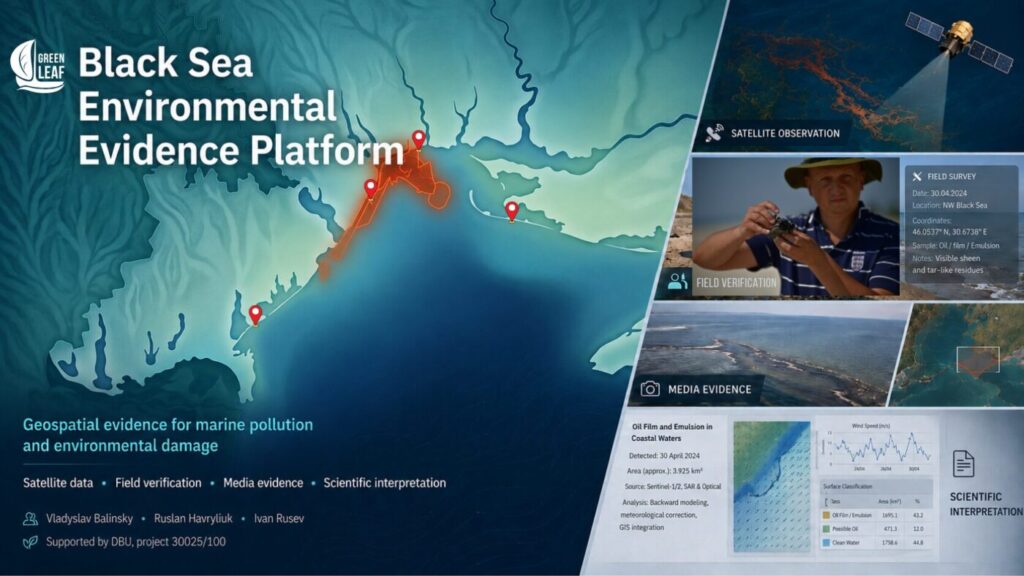
The Platform does not determine legal responsibility. Its purpose is to preserve verifiable evidence that may support environmental assessments, damage evaluation and international legal proceedings.
The system has already been tested while documenting the Volgoneft tanker casualty and vegetable-oil spills in the ports of Pivdennyi and Chornomorsk. It can also be used to record the consequences of the sinking of Golden Leo, attacks on civilian vessels, marine pollution and other wartime incidents.
Balinskyy believes that Black Sea monitoring should become a continuous observation system combining satellite surveillance, field research, analysis of water and sediments, and structural monitoring of wrecks and other technological hazards.
Unlike water samples, which capture conditions only at the moment they are collected, sediments accumulate petroleum products, heavy metals, microplastics, organic pollutants and other substances over long periods. Storms, dredging and other natural or human-driven processes can release those contaminants back into the water, turning the seabed into a secondary source of pollution.
Monitoring around Golden Leo should therefore extend far beyond looking for visible oil slicks. It should include bottom-water and sediment sampling, measurements of petroleum hydrocarbons, organic matter and dissolved oxygen, and repeated observations around the wreck over an extended period.
Only this kind of integrated approach can assess more than the consequences of a single casualty. It can also help explain how war is gradually changing marine ecosystem function and creating new long-term risks across the Black Sea and the Sea of Azov.
Sources and related reading
- National Ecological Centre of Ukraine — the original Ukrainian publication by Tetyana Herasymova on which this adapted edition is based.
- National Ecological Centre of Ukraine — background on the long-term effects of the destruction of the Kakhovka Dam on the Black Sea.
- National Ecological Centre of Ukraine — background on heavy-fuel-oil pollution following the casualty involving Russian tankers in the Kerch Strait.
- USM — reporting on the attack against Golden Leo and the circumstances of the incident.
- Reuters — reporting on the vessel’s loss on 26 July 2026.
- Ministry for Communities and Territories Development of Ukraine — the reported number of attacks on merchant vessels since the beginning of 2026.
- Radio Free Europe/Radio Liberty, Ukrainian Service — figures from the Odesa Regional Prosecutor’s Office on vessels hit, fatalities and injuries.
- International Maritime Organization — statement on attacks against civilian shipping in the Black Sea and the Sea of Azov.
- Latifundist — reporting on the temporary suspension of vessel calls at Ukrainian ports.
- USM — reporting on the emergency UN Security Council meeting on attacks against shipping.
Related articles from Green Leaf
Editorial note. This is an English editorial adaptation of the Ukrainian article published by the National Ecological Centre of Ukraine. The title, introductory framing, structure, visual presentation and links to the Green Leaf series were adapted for an English-language audience; the author’s reporting and the expert assessments were preserved.
Golden Leo after a Russian missile strike in the Black Sea on 19 July 2026. Photo: Vladyslav Balinskyy.
Golden Leo sinking off the Odesa coast on 26 July 2026. Photo: Odesa Regional Military Administration.
The Black Sea Environmental Evidence Platform brings together satellite data, field verification, media evidence and scientific interpretation.