
Vladyslav Balinskyi, biologist and journalist, Zeleny Lyst (Green Leaf)
27 April 2026
On 8 June 2024, I was standing on Sobachyi beach listening to frogs.
The Kakhovka dam had been blown up two days earlier. From that moment I tracked the movement of the surface plume — and on the 8th it reached Odesa. Past me floated rooftops, entire islands of trees and reeds with birds sitting on their nests, refrigerators, construction debris, animal carcasses. The Dnipro had come to the Black Sea and the sea turned fresh. Frogs were calling on the beach. For Odesa, it was surreal.
About ten days later, when the water had somewhat settled, I took my camera and dived. I have been studying Odesa Bay since 1996 and know this seabed well. The mussel banks were covered with a solid layer of organic sediment. Mass die-off of colonies. I thought then that this was already a systemic process — mussels filter the water throughout the entire bay, and I did not know the scale of this death. I documented all of it on video. It was my first documentation of the consequences of the Kakhovka dam destruction for the biocenoses of Odesa Bay.
I recall this now because on 27 April 2026, looking at satellite images, I was thinking about the same thing — about boundaries that are still unknown.
On 26 April, Russian drones struck the port of Chornomorsk and destroyed a tank containing sunflower oil. One point deserves emphasis: sunflower oil is a food product, an agricultural commodity, and has no connection whatsoever to military infrastructure. A strike on storage facilities holding a civilian food product, with foreseeable catastrophic environmental consequences, is precisely what is called ecocide. According to the State Environmental Inspection of the South-Western District, approximately 6,000 tonnes of oil entered the port basin, then Sukhyi Lyman, then the sea. This is already the third major oil spill in the Odesa region in under two years.
The following morning my phone filled with questions. Telegram was full of alarm and short on facts. I opened Sentinel Hub.
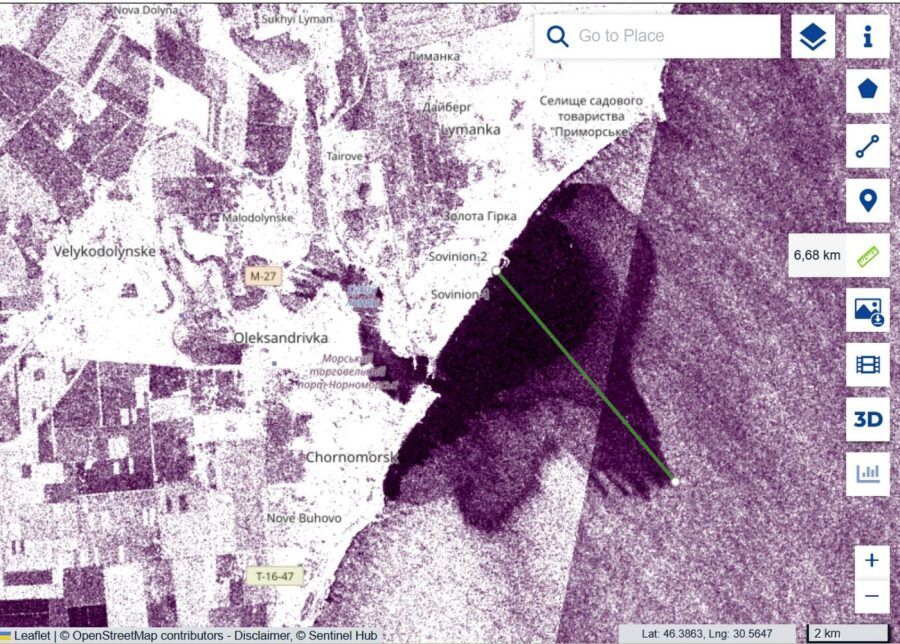
To assess the area of contamination I used Copernicus satellite imagery in SAR mode (C-band, VV polarisation). An oil film on the sea surface suppresses backscattering of the radar signal and appears on imagery as a dark anomaly against normal wave texture. Official services recorded a slick directly in the port basin measuring 400 by 200 metres — at the time of the first inspection, booms were still containing the spill. On imagery the following morning, after an offshore wind had driven the oil into open water, I estimate the total area of contamination of the sea surface at approximately 40 square kilometres — and this does not include the area of Sukhyi Lyman. The slick continues to move.
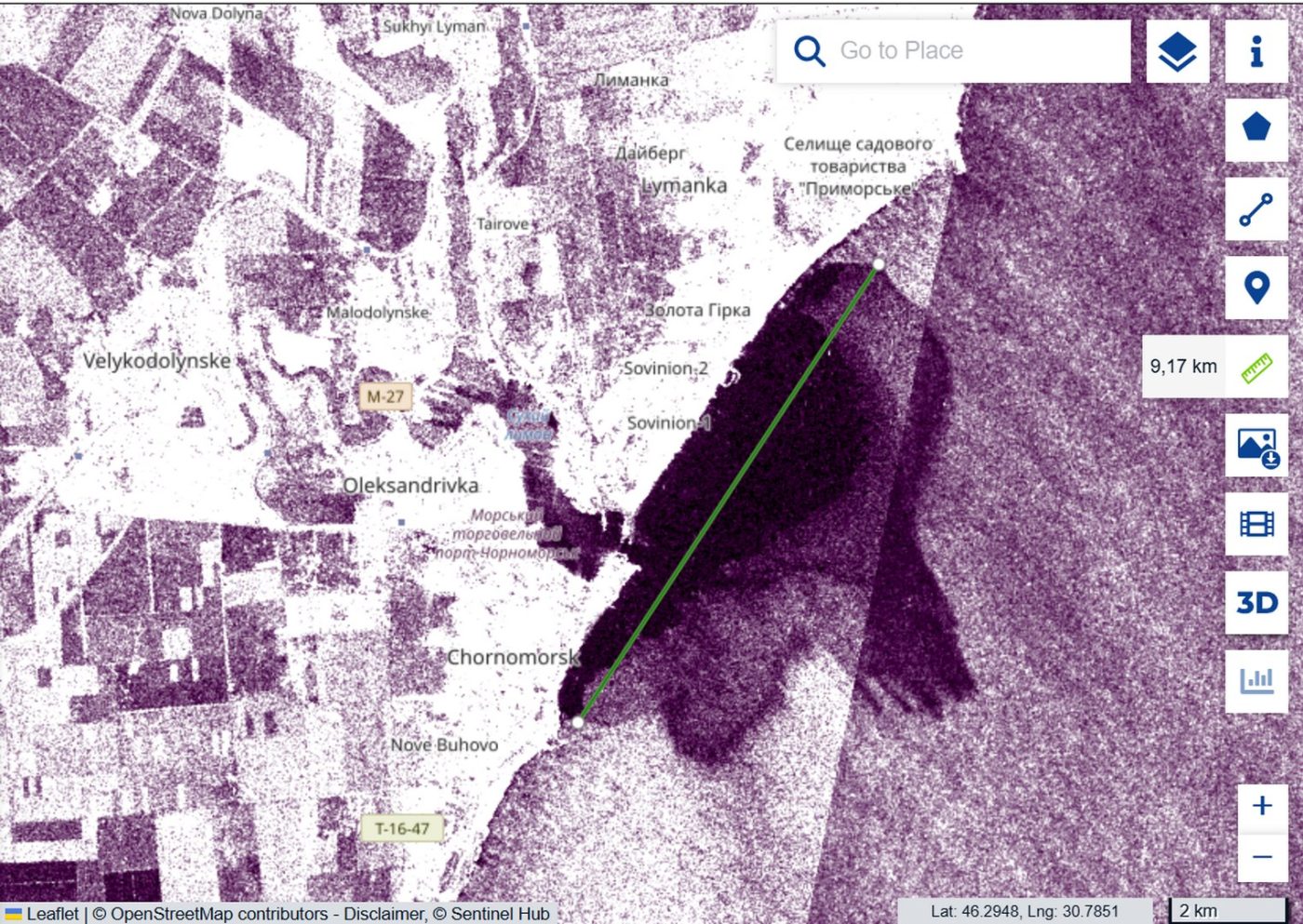
Fig. 1. SAR image, Sentinel Hub Copernicus (C-band, VV polarisation), Chornomorsk port area and adjacent sea. 27 April 2026, first time frame. Measured anomaly length — 9.17 km. The dark area corresponds to radar signal suppression by the oil film. Source: Sentinel Hub EO Browser, author’s own measurements.
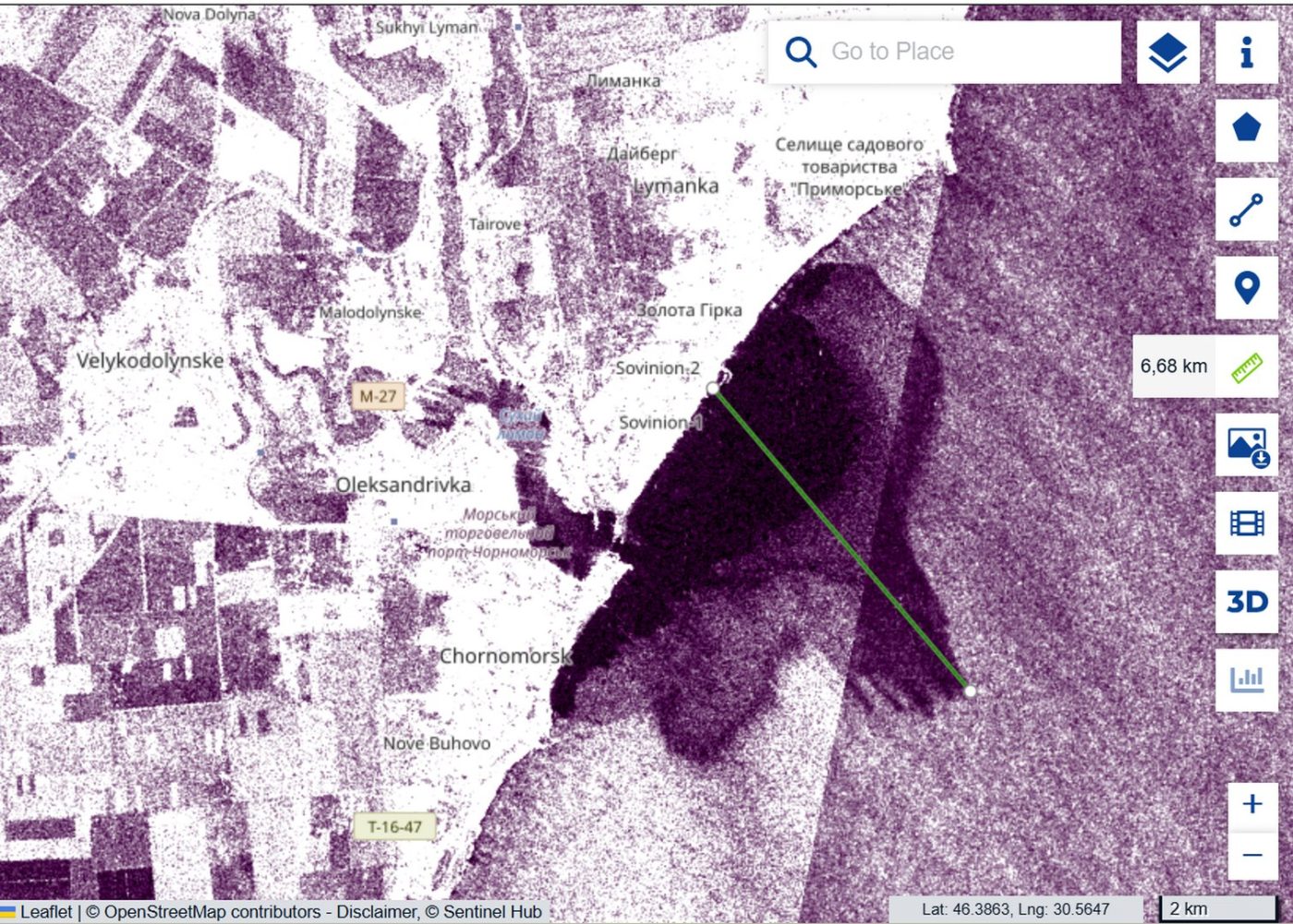
Fig. 2. SAR image, Sentinel Hub Copernicus (C-band, VV polarisation), Chornomorsk port area and adjacent sea. 27 April 2026, second time frame. Measured anomaly length — 6.68 km. The change in slick configuration reflects wind-driven transport dynamics. Source: Sentinel Hub EO Browser, author’s own measurements.
The direction of movement is determined by wind. According to data from the Ukrainian Hydrometeorological Centre and Sinoptik, on 25–26 April a strong offshore westerly and north-westerly wind prevailed over the bay, 12–18 m/s with gusts to 22 m/s. It pushed the oil away from shore into open water, where no boom system can collect it. By the night of the 27th the wind had begun to shift to south-easterly — Meteoblue forecasts gusts to 23 mph. For Odesa Bay this is an onshore direction; it drives surface masses back toward the coast and further toward Tuzlivski Lymany.
I have seen what happens after such a shift.
To understand what comes next, it is necessary to know what came before.
October 2024: the first major spill — 125 tonnes of oil into Sukhyi Lyman following a drone strike by the Russian Federation on port infrastructure. The State Environmental Inspection documented damages of 10.9 billion hryvnias. Birds died.
December 2025: Russian Shahed drones struck port Pivdennyi and destroyed an oil-processing terminal. Again sunflower oil — again a civilian food product, again a foreseeable environmental strike. Thousands of tonnes entered the Black Sea — the precise volume remains unknown, as meaningful marine monitoring is impossible under wartime conditions. Satellite data showed contamination reaching up to 730 square kilometres. Scientists stated that no spill of vegetable oil on this scale had ever been documented in the scientific literature.
What followed I observed personally along the Odesa coastline. In parallel, Dr Ivan Rusyev, Head of the Scientific Department of Tuzlivski Lymany National Nature Park, documented the situation from his end every day and published field data on his Facebook page — the picture was assembled from two ends of the same shoreline. According to Ivan Rusyev’s estimate, approximately 5,000 birds died between December and February. After the storm of 6 February, remnants of polymerised oil covered the park’s sandbar over an area of approximately 10,000 square metres. Thousands of crabs of four species were washed ashore.
On 27 January, along the coastline from Lanzheron to the 16th station of Velykyi Fontan — dead seahorses in a continuous carpet, up to 35 individuals per square metre. Hippocampus guttulatus, a species listed in the Red Book of Ukraine, whose population in the bay had only begun to recover from 2017. The official explanation was storm. But if the current had been strong enough to tear a living seahorse from its substrate, it would also have torn away mussel clusters and seagrass. None of that was present among the wrack. The storm carried ashore those who had already died earlier.
As a biologist I will explain the mechanism, because it is not obvious.
Vegetable oil does not poison the water — it is not toxic in the classical sense. But within a few weeks, under the influence of sunlight, oxygen and salt, it polymerises and sinks to the seabed. It accumulates in depressions between rocky ridges — precisely where seahorses overwinter and where mussel banks grow. Mussels absorb this mass through filtration. Seahorses in a state of winter torpor are, in my hypothesis, suffocated when storm-resuspended mass blocks their delicate gill apparatus. This is a working hypothesis based on field observations — it requires laboratory confirmation, but I have nothing better to explain what I observed in January.
For birds the mechanism is different. Oil mats the feathers and destroys their insulating and water-repellent properties — the bird sinks and freezes in any water temperature. After months of practical work alongside ornithologists I reached a conclusion that sounds counterintuitive: vegetable oil appears to be more dangerous for birds than fuel oil. Fuel oil can be washed off. Vegetable oil, by all indications, damages feather structure more deeply and more permanently — at least that is what the evidence shows in practice.
After the December disaster I published a rescue algorithm on Facebook: how to collect birds, how to wash them with dish soap, how to keep them for two weeks. People acted. But here a methodological point matters: the zoo transferred birds to volunteers and counted them as saved. Genuine rescue, however, means returning a bird to the wild — not transferring it between people. According to our observations, no more than 5% of birds counted as “saved” actually returned to the wild. Vegetable oil damages feather structure in ways that no washing can fully repair. If you want to help now — document the locations of slicks and pass the coordinates on. That is material that works over the long term.
Based on what I observed after the December disaster, I can outline the most likely risks — not a forecast, but reference points for observation.
The coming weeks: the most acute threat concerns birds. Late April and May represent the peak of spring migration and the start of nesting. The onshore south-easterly wind is already carrying contaminated water toward shore, and the first oiled individuals will most likely appear within days.
Two to four months: the physical process of oil polymerisation and sedimentation to the seabed is well established. The extent to which this will affect the benthic biocenoses of Odesa Bay depends on the actual volume that entered the sea and on hydrodynamic conditions that are difficult to forecast at this stage.
Autumn–winter 2026/2027: the most dangerous horizon. Following the December 2025 disaster, we recorded mass mortality of seahorses in January. Whether a direct causal link exists between these events through lipid sediment deposition is my working hypothesis, requiring verification. If it holds, autumn storms resuspending bottom sediments could become a critical factor for benthic organisms during their winter torpor.
Tuzlivski Lymany NNP: after the December disaster, the first wave of contamination reached the park after seven weeks. Prevailing currents in the spring-summer season carry surface masses southward and south-westward. There are grounds to expect a repeat of this scenario, though timing and scale will depend on wind patterns over the coming weeks.
October 2024. December 2025. April 2026. Mussels after Kakhovka. Seahorses in January.
Three strikes on civilian food infrastructure. Three spills of a food product into the sea. A foreseeable environmental outcome each time. These are not collateral damages — this is a documented pattern.
I have been studying this bay since 1996 and hold a video archive of its condition across different years. Comparing what it was with what is happening now — that is my work.
Every photograph, every GPS coordinate of a slick, every SAR image is material for documentation under the Bucharest Convention on the Protection of the Black Sea, the UNEP mandate on environmental consequences of armed conflict, and Ukraine’s efforts toward the recognition of ecocide as an international crime. Collect it.
Vladyslav Balinskyi, biologist and journalist, Zeleny Lyst
Odesa, 27 April 2026
SAR imagery: Sentinel Hub Copernicus, C-band VV, Chornomorsk sea area, 27 April 2026. Author’s own materials.